
By HistoraEDU
A student sees corn in a recipe and concludes, “People have eaten this exact dish for thousands of years.” Another places maize on a map of Mexico and assumes every later corn-growing community received an unchanged package of plants, methods and meals. Both students have noticed something relevant. Neither has yet separated the history of a crop from the history of a particular use.
Give one food three different questions
Build a maize evidence sheet with three boxes: early cultivation and domestication; movement and exchange; a documented recipe in a named publication. Under every box, leave room for a place, a date or period, a source and a limit. These are three investigations, not a continuous route that students can fill with imagined arrows.
Ask the class to sort three claims before reading: “People cultivated this plant here”; “People traded this crop”; “This publication describes this dish.” A source supporting one claim does not automatically support the other two. The goal is a short, defensible food biography—not a list of supposedly universal Indigenous foods.
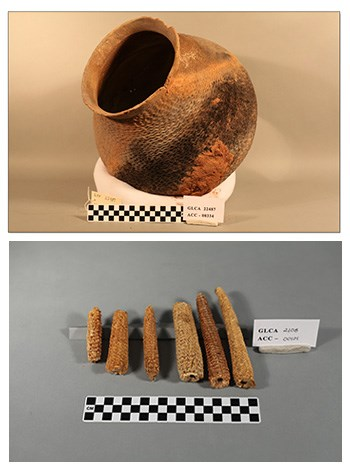
Glen Canyon collection photographs show a vessel and corn cobs. Their appearance alone cannot establish maize’s origin date or that these objects were used together. Credit: NPS. No claim to original U.S. Government works. Image source
First distinguish an origin claim from a photograph
For the first box, use the maize-history account from the Ross-Ibarra research laboratory at the University of California, Davis. It identifies southwestern Mexico as the region where people began domesticating maize from teosinte roughly 9,000 years ago. It also describes farmers moving and trading maize and later adapting it to different environments. Teach domestication as a process involving people and plants, not a single dated invention of a modern recipe.
Model the entry: “Early domestication: southwestern Mexico; approximately 9,000 years ago; laboratory account drawing on archaeological and genetic evidence.” The limit is equally important: this does not identify the first cook, the first soup or the precise route followed by every later variety.
The Glen Canyon collection photograph is useful precisely because it cannot do that job. Students can see preserved cobs and a vessel. The image alone does not date maize’s domestication or establish that the vessel held those cobs. Ask what object records and archaeological context would be needed before making either claim.
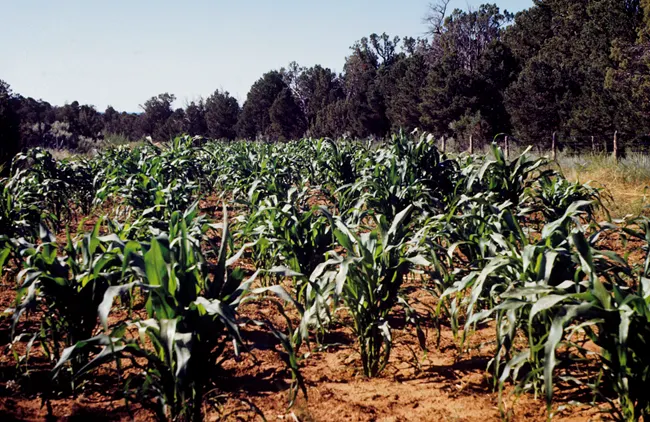
Modern experimental cornfield at Mesa Verde, planted with Hopi corn varieties using traditional techniques. This is not a photograph of early domestication. Credit: NPS. No claim to original U.S. Government works. Image source
Then investigate an actual exchange context
For the second box, turn to the National Park Service’s “Subsistence: Tribal Nutrition & Health,” written by members of the Mandan Hidatsa Arikara Nation for educators. Its Knife River account explains that women produced crops for consumption and trade; visitors exchanged other goods for the crops. It also describes drying corn and storing food. This is a named regional case, not evidence that all Indigenous communities grew or exchanged the same foods.
A supported entry reads: “Knife River village context: agricultural production supplied food and exchange; the community-authored teaching account connects growing, preservation and trade.” Do not draw a direct Mexico-to-Knife-River-to-Oneida route. These sources establish different parts of maize history, not every link between the places on your sheet.
Now revisit the Mesa Verde photograph. Its source identifies a modern experimental field using Hopi corn varieties and traditional techniques. Ask students which label matters: ancient field, modern research plot or photograph of the original domestication site? Only the second fits. A named variety and a cultivation method are evidence of particular agricultural knowledge, not proof that all maize has remained unchanged.
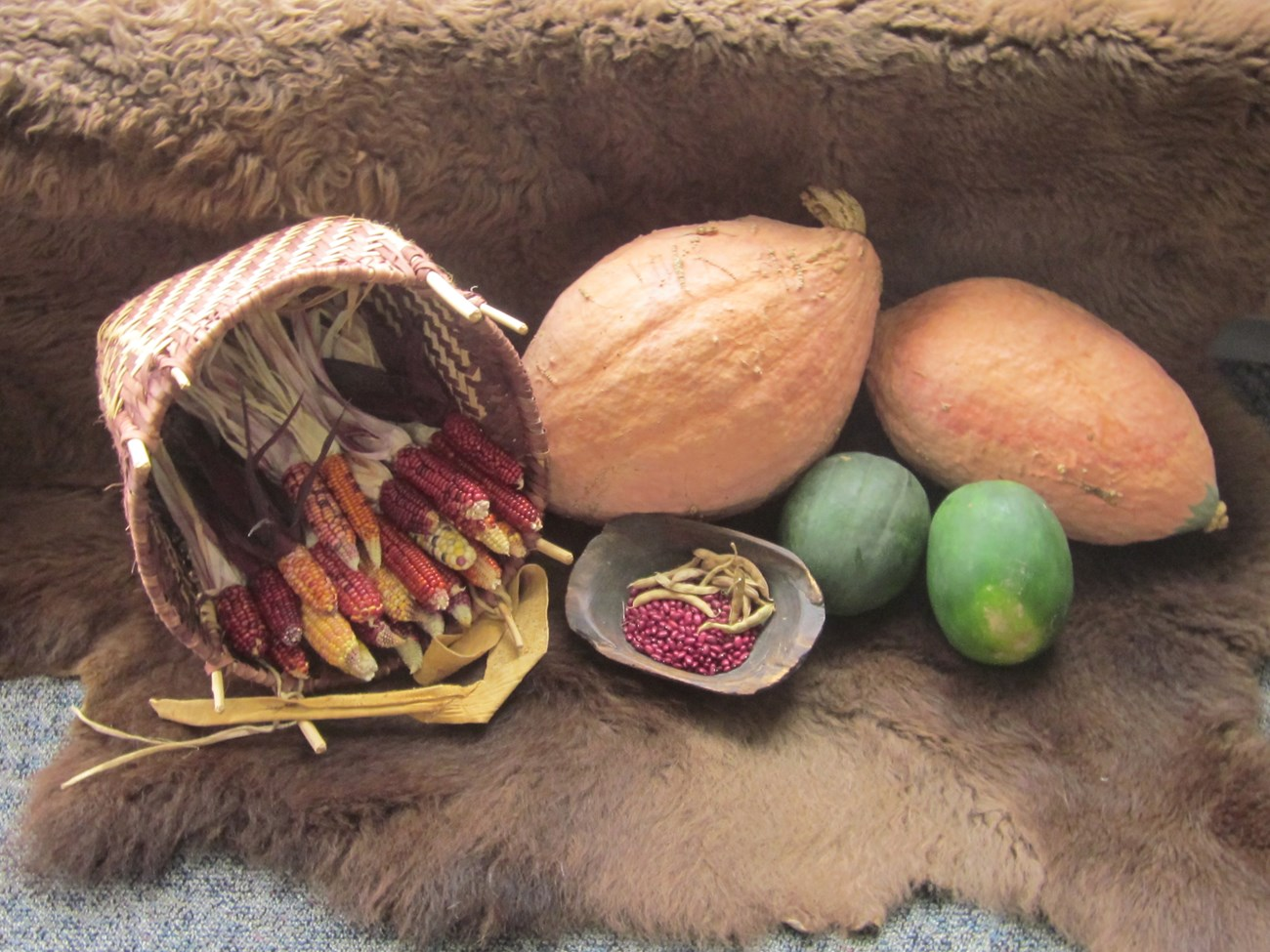
Corn, squash, beans and melons harvested from the Knife River park garden in 2018. This photograph does not depict the Oneida recipe discussed below. Credit: KNRI Staff / NPS, 2018. No claim to original U.S. Government works. Image source
Read a present publication without erasing a living tradition
The third box uses page 14 of the Oneida Nation’s September 2025 DRUMS publication. It presents an Oneida corn-soup recipe with corn, kidney beans and pork, and describes processing and combining them. Have students record the publisher, issue date, page and dish. Link to the original; there is no need to copy the full recipe or cook it in class.
The warranted claim is “This Oneida Nation publication shares this version in 2025.” That date is not the dish’s invention date. Nor does the recipe prove that every ingredient, utensil or instruction appeared in an identical meal 9,000 years ago. A living food tradition can have a long history while particular versions, ingredients and publication contexts change. Students should not describe change as making a community’s food less authentic.
Use the Knife River harvest photograph as a final trap for careless captions. It records a 2018 park-garden harvest, not the Oneida soup or a prehistoric feast. Ask students to explain why placing it beside the recipe without that distinction would create a misleading connection.
Assess the verbs students can defend
For the exit task, students write three sentences beginning “cultivated,” “exchanged” and “published,” each with its own source label. Then they underline a question still unanswered. A strong response distinguishes early maize cultivation, the Knife River exchange context and a specific Oneida publication without claiming an unbroken recipe genealogy.
For support, supply the three source labels and let pairs choose the correct verb. For extension, ask what new evidence would be needed to trace one named maize variety or one recipe across generations. Do not assign plant identification, food-safety experiments or imitation ceremonies; the historical reasoning can be completed through reading.
Choose a reading for the particular question
The three resources below are separate editable Google Docs with reading passages and comprehension work. The evidence sheet is an additional teaching routine, not a claimed product component. Select the relevant passage and pair it with the named sources above rather than assigning every generalization as established fact.
Three Sisters Agriculture Reading Passage | Native American History
Use selected crop-identification passages to distinguish maize, beans and squash before investigating maize’s provenance. Do not use the reading’s “nutritionally complete diet” wording as dietary guidance or its broad regional statements as proof of one uniform planting method.
Native American Farming Reading Comprehension Worksheet
Use the maize-origin passage for a teacher-led comparison with the UC Davis account. Its Three Sisters vocabulary definition is incomplete; do not assign that entry. Keep the lesson about maize, not a claim that all American agriculture had one origin.
Indigenous Foodways Reading Comprehension | Native American History
Use a selected passage to distinguish cultivation from other food practices, then document the Knife River case separately. Do not assign its universal yield or complete-diet claims, or use its gathering discussion as a plant-identification guide.
View this HistoraEDU resource on TPT
Sources and credits
UC Davis Ross-Ibarra Lab: maize history
Mandan Hidatsa Arikara Nation contributors / NPS: subsistence, production and trade
Oneida Nation: September 2025 DRUMS, corn-soup recipe, p. 14
Product covers: HistoraEDU, reproduced from the exact linked TPT listings at the owner’s request. Photographs and archival reproductions are credited beside each image. No claim to original U.S. Government works. Source institutions and depicted people do not endorse HistoraEDU or its products.
