
By HistoraEDU • Teaching evidence and Indigenous historical erasure
A debate can make an unsupported claim look like a legitimate alternative simply because students have been assigned to defend it. That is the problem with asking a class whether Native Americans built North America’s earthworks. Teach the history of the racist mound-builder myth as a subject for investigation, not a position to advocate. Students can examine how a claim erased Indigenous achievement, test the evidence it relied on and write a better public explanation without rehearsing the prejudice as their own argument.
Name the false claim briefly and establish the question
Ohio History Connection describes the nineteenth-century mound-builder myth as an account that attributed eastern North American earthworks to a supposedly vanished civilization unrelated to Indigenous peoples. Versions of the story cast Native Americans as destroyers of those builders. The institution explains how this story could support dispossession by portraying Indigenous people as recent intruders rather than the makers of the places around them.
Keep that summary short. Do not assign teams to defend a lost non-Indigenous race, display sensational fabrications as mysteries or ask Native students to answer for their identities. Replace “Which side is right?” with “How did this claim work, what evidence contradicts it, and whose achievement did it erase?” The object of analysis is the false explanation and its consequences.

Modern view of Mound City Group in Ohio. NPS / Tom Engberg, public domain. These are protected earthworks in a contemporary photograph, not an image of an ancient ceremony. No endorsement implied.
Give students evidence before the misconception takes over
Begin with the National Park Service’s Mound City account, which identifies Native Americans as its builders and dates construction across the first four centuries CE. Ask students to locate the site name, attribution and period in the institutional account. The photograph helps locate the landscape, but the image alone cannot supply its builders’ identities or construction dates.
Use three short evidence notes rather than a contest of opinions. One note records a specific claim from the site account. Another identifies what the modern photograph actually shows. A third lists a question still requiring investigation, such as a particular feature’s construction history. An unanswered question about one detail does not restore the discredited lost-race explanation.
Separate useful documentation from the authority of its maker
Show E. G. Squier’s 1847 map reproduced by NPS. Students can identify recorded shapes and relationships among waterways and earthworks. The map is a nineteenth-century record of earlier sites, not a document made by their builders. Its measured-looking geometry does not automatically establish every historical interpretation attached to it.
The NPS account explains that early archaeological investigations in Ohio took place after forced removal had excluded Indigenous nations from their homelands. Ask whose participation and knowledge were absent from those investigations. Do not let a published map become a shortcut for treating the recorder as the sole authority on the people who made the earthworks. Nor should students infer that every geometric detail is false because the wider research context was unequal. Evaluate the particular evidence and claim separately.
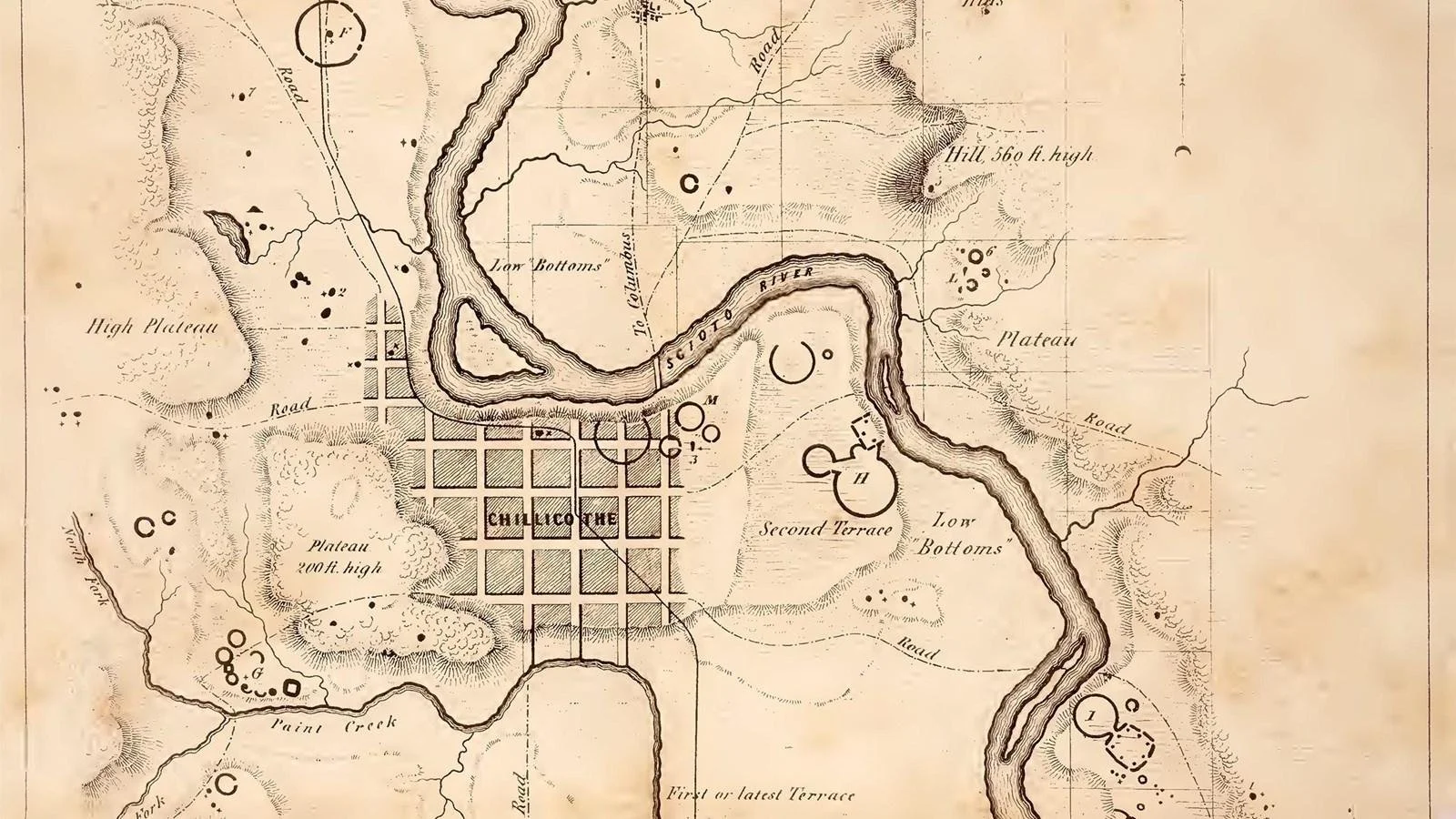
E. G. Squier’s 1847 lithographic map, reproduced by NPS. Public domain by age. A historical record of earthwork locations, not an Indigenous-authored map or proof of a lost non-Indigenous civilization.
Include a continuing relationship to a named place
A lesson that ends with an outside scholar correcting another outside scholar can leave Indigenous people absent again. Add a contemporary institutional account of a specific relationship to land. In a 2022 joint announcement published by Macon-Bibb County, Muscogee (Creek) Nation Principal Chief David Hill described the Ocmulgee River lands as the Nation’s enduring ancestral homeland. Identify the speaker, date and named place; do not turn that statement into a claim about every earthwork across the continent.
At Ocmulgee, the NPS identifies the Earth Lodge as a reconstructed Mississippian council chamber with an original clay floor inside. Its modern exterior is not untouched ancient architecture. This distinction lets students recognize both Indigenous construction and later interpretation without treating the reconstruction as evidence of an invented population. Keep public site imagery separate from photographs of human remains or restricted ceremonial material.
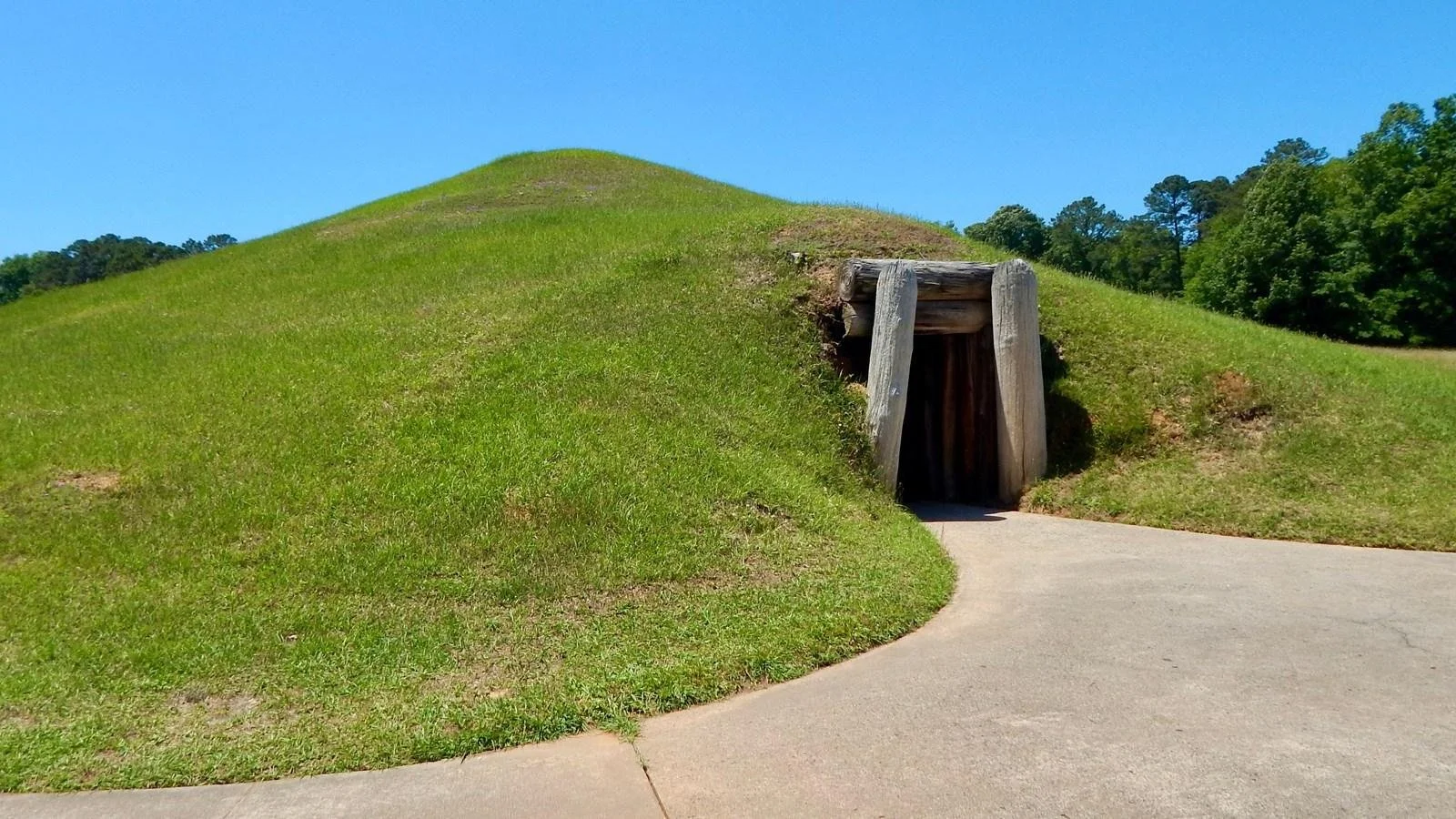
Modern exterior of the reconstructed Earth Lodge at Ocmulgee. Walls and ceiling were reconstructed in the late 1930s; the earlier clay floor is inside and is not visible in this photograph. NPS/Martinson, public domain; no endorsement implied.
Replace the debate with an editorial correction
Give students a teacher-created label marked as deliberately inaccurate: “These mysterious earthworks must have been built by a vanished people unrelated to Native Americans.” Ask them to write a replacement of roughly 80 to 120 words. It should name a site, make an evidence-supported attribution, identify the old claim as a myth and explain one consequence of erasing Indigenous builders. Do not reproduce slurs to make the exercise feel authentic.
Require two source references and one limit. For example, a student can explain that the NPS identifies Mound City’s builders as Native Americans while noting that the modern photograph does not identify every individual or decision involved. A limit strengthens an explanation when it is specific; it does not mean all explanations deserve equal weight.
Assess whether the replacement changes the explanation, not merely its tone. “The builders were advanced” still leaves the makers anonymous. “All Native peoples built the same mounds” replaces one error with another. Students should name the relevant site and distinguish an archaeological label from one uniform nation or a single timeless culture.
Choose a narrow reading and retain accurate labels
These HistoraEDU listings describe editable reading-and-question resources. They can provide background for the editorial correction task, but the task and primary-source comparison above are additional teacher-designed work. Select a passage that fits the site under discussion and use the specific qualifications below rather than presenting a whole resource as independently certified.
Mound Builders Reading Comprehension | Native American History
View this HistoraEDU resource on TPT
The listing explicitly includes the historical denial of Indigenous achievements, making a selected passage a possible starting point for the myth investigation. Qualify its opening chronology: a 1000 BCE start does not cover Poverty Point, which NPS places at 1700–1100 BCE. Use site-specific dates rather than repeating one start date for all mound building.
Adena Culture Reading Comprehension | Mound Builders Worksheet
View this HistoraEDU resource on TPT
The listing describes an Adena-focused reading. Use a selected passage to distinguish a named archaeological tradition from a generic lost population. Keep the activity on historical explanation and publicly appropriate evidence; do not require a simulated excavation, handling of remains or reconstruction of sacred practices.
Hopewell Culture Reading Comprehension | Mound Builders Worksheet
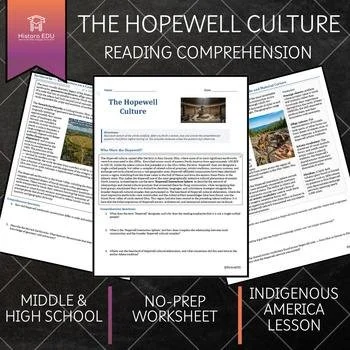
View this HistoraEDU resource on TPT
The listing describes Hopewell earthworks and cultural connections. Pair a selected passage with the NPS account, which explains that Hopewell is not the name of a known tribal nation. Correct the reading’s Great Circle measurement before use: the official site gives nearly 1,200 feet in diameter, not nearly a mile.
Mississippian Culture Reading Comprehension | Mound Builders History
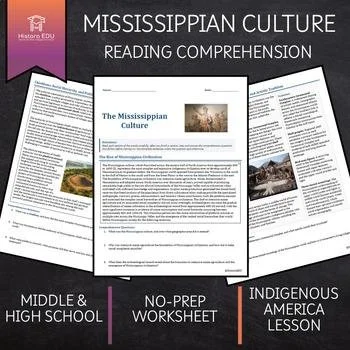
View this HistoraEDU resource on TPT
The listing describes Mississippian political organization and material culture. Use one located example rather than describing all Mississippian communities as a single state. The Ocmulgee site record supports the particular reconstruction distinction discussed here.
Cahokia Reading Comprehension | Mississippian Culture Worksheet
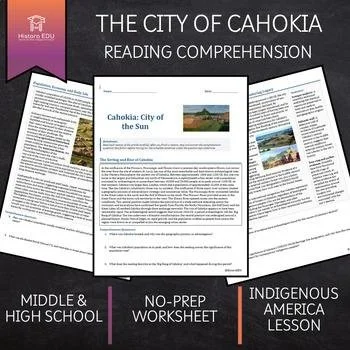
View this HistoraEDU resource on TPT
The listing describes Cahokia’s urban development. A selected passage can provide a specific case rather than a claim about all earthworks. Use the correct present-day name, Cahokia Mounds State Historic Site; do not repeat the reading’s label “Cahokia Culture National Historical Park.” Verify any selected quantitative claim against the official site account before assigning it.
Sources and image credits
Ohio History Connection analysis of the moundbuilder myth
Mound City site and Indigenous builders
Hopewell earthworks map and research context
Muscogee ancestral homeland statement in the 2022 joint announcement
Ocmulgee Earth Lodge construction and reconstruction
Poverty Point period in the NPS World Heritage account
Great Circle official site measurement
Illinois official Cahokia site
Image record ocmulgee-earth-lodge
Product thumbnail reproduced from the exact HistoraEDU listing at the owner’s request. Historical photographs are separate evidence, not product endorsements. The NPS photographs are used as credited editorial site illustrations. The 1847 map is a genuine historical record in the public domain by age, not a newly generated facsimile. No restricted ceremonial material or human remains are pictured. No archival institution or Indigenous nation is represented as endorsing these products. No claim to original U.S. Government works.
