
By HistoraEDU • Distinguishing political identities in Southeastern history
When students read that Native Americans received U.S. citizenship in 1924, some conclude that tribal nations must have ended then. Others use U.S. citizenship, tribal citizenship and cultural identity as interchangeable labels. A short document comparison can interrupt both mistakes. Put a dated federal act beside a named nation’s own constitutional account and ask which political relationship each source addresses. The goal is a precise historical explanation, not a classroom decision about anyone’s present eligibility or identity.
Read the actual scope of the 1924 act
Begin with the Indian Citizenship Act of June 2, 1924. Its operative sentence addresses Native people born within U.S. territorial limits who were not already U.S. citizens. Have students identify that qualifying language before summarizing the law. “Every Native person first became a citizen in 1924” is not an accurate paraphrase: the act itself distinguishes those who were not yet citizens.
Then locate the proviso preserving rights to tribal or other property. Ask students to distinguish what the sentence says from a claim it does not make. It grants U.S. citizenship to the specified population; it does not announce that every tribal government has disappeared. The property proviso is not, by itself, a complete account of tribal sovereignty, so students need a second source rather than an oversized conclusion from one sentence.
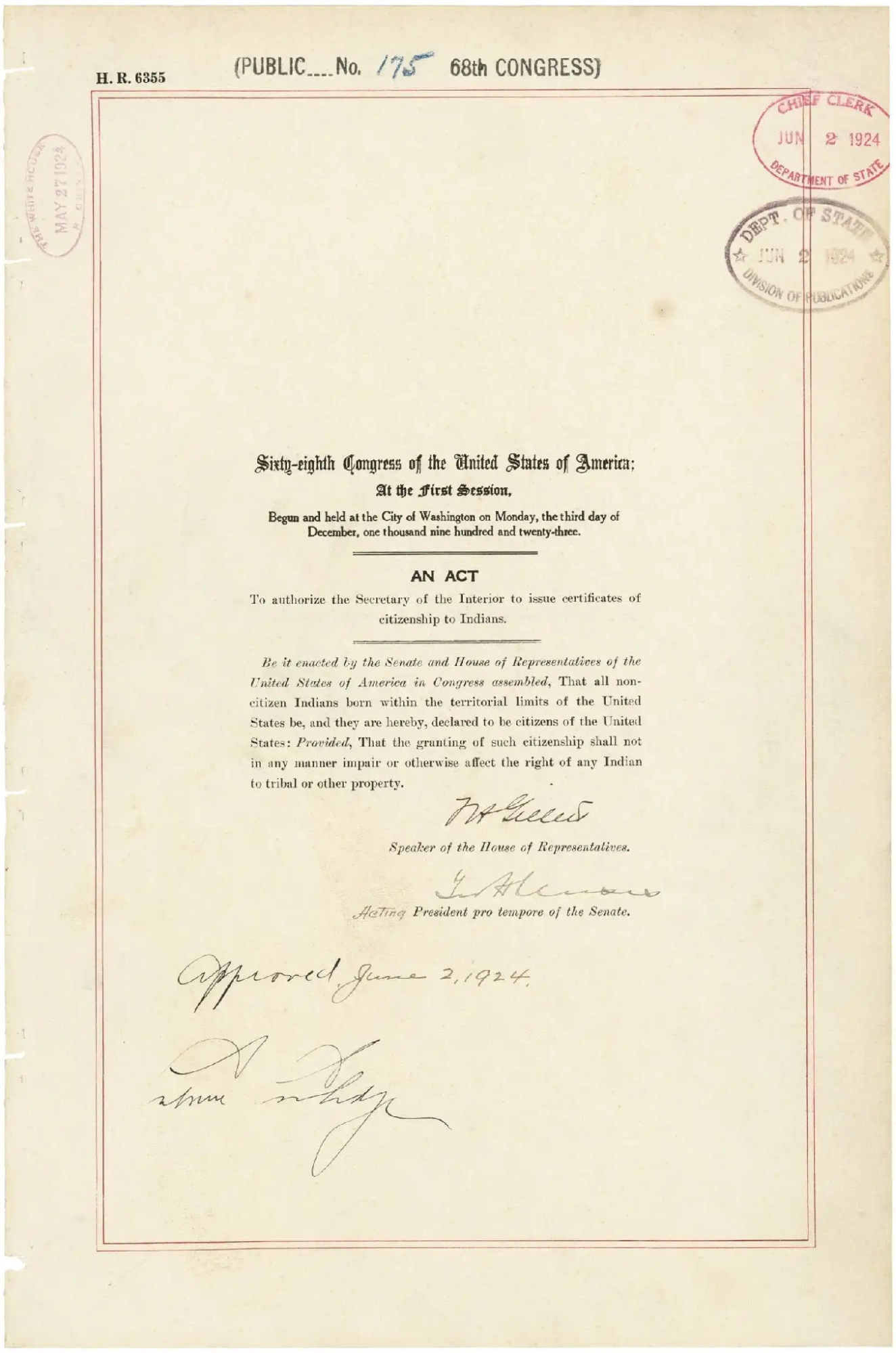
Indian Citizenship Act, June 2, 1924, National Archives identifier 299828. Authentic enrolled-act scan, not a newly made historical replica. Public domain. Use the linked National Archives PDF for close reading.
Put a nation specific document beside the federal one
Use the Cherokee Nation’s Constitution of 1999, effective in 2003, as a deliberately later source. Article I affirms the Nation’s sovereignty and relationship with the United States. Article V identifies separate legislative, executive and judicial branches. Those provisions address a governing nation, not merely a cultural club. Keep the two documents’ dates visible; a later constitution is evidence of later institutions, not a transcript of what every person thought in 1924.
Give students three prompts for each document: Who issued it? Which political relationship or institution does it address? What can this passage not decide? Model a restrained answer: the federal act addresses U.S. citizenship, while the Cherokee constitutional provisions describe the Cherokee Nation’s government and federal relationship. Neither short selection authorizes students to adjudicate an individual’s citizenship application.
The Cherokee Nation’s own history museum currently describes Cherokee people as citizens of both the Cherokee Nation and the United States. This is a useful institutional example of why the categories are not mutually exclusive. Do not make that one account speak for every Cherokee government or every Indigenous nation.

Cherokee National Capitol, photographed in 2008 by Caleb Long. CC BY-SA 2.5, unchanged. The historic building now houses the Cherokee National History Museum; this dated photograph is not evidence of the present location of every government office.
Compare institutions without flattening distinct histories
For a second institutional example, use the Muscogee (Creek) Nation Supreme Court’s published constitutional text. Its preamble describes self and local government in continued relations with the United States; Article VI establishes a National Council. Students can identify a named institution and the document that authorizes it. They should not infer that Muscogee and Cherokee citizenship rules, political histories or constitutional provisions are identical.
A dated official photograph can make the institutional language less abstract. The USDA record below identifies George Tiger as Principal Chief of the Muscogee (Creek) Nation in April 2015. Ask students what the source establishes about its date and office, and what it cannot establish about a person’s authority today. Keep the portrait in this editorial discussion; it is not a product endorsement.

George Tiger, identified by USDA as Principal Chief of the Muscogee (Creek) Nation in Okmulgee, Oklahoma, April 7, 2015. USDA photograph by Lance Cheung, public domain. The title belongs to that dated record, not a claim about current officeholding. Editorial illustration only; no endorsement.
Keep the Seminole political names specific
The Seminole Tribe of Florida’s own account distinguishes the political entity organized in 1957 from the much longer history of Seminole people. It also distinguishes the Seminole Tribe of Florida, Seminole Nation of Oklahoma, Muscogee (Creek) Nation and Miccosukee Tribe of Indians of Florida as separate political entities despite related histories. Have students name the particular government their source describes instead of writing “the Seminoles” whenever they mean an institution.
This is not a ranking exercise in which a later constitutional date makes a people less historical or less legitimate. Ask students to separate the date of a particular political document or organization from the history of the communities involved. Do not ask students to disclose family enrollment records, judge classmates’ identities or imitate tribal citizenship proceedings.
Assess the distinction with a corrected explanation
Offer this mistaken statement: “After 1924, Native Americans were U.S. citizens, so their nations no longer governed.” Ask students to revise it in three or four sentences using the federal act and one named nation-specific source. Require the document dates and a sentence identifying a limit of the comparison.
A useful response explains the act’s citizenship provision, identifies a later governmental institution and rejects the assumption that the two political relationships cannot coexist. It should not claim that citizenship removed discrimination or settled every jurisdictional dispute. Assess the source-to-claim connection, not the number of legal terms students can repeat. These are historical civics questions, not current legal or enrollment advice.
Use background readings for context rather than eligibility decisions
The following HistoraEDU listings describe editable reading-and-question resources. Choose a bounded passage for regional or community context, then add the primary documents above. The document comparison in this article is a separate teacher-designed routine; it is not being represented as a complete activity already inside the products.
Southeast Native Americans Reading Comprehension Worksheet
View this HistoraEDU resource on TPT
The listing describes regional geography, governance and historical change. Use a selected section to locate the Southeast, not to imply that all nations share one citizenship system. The federal and nation-specific documents above provide the evidence for this article’s political-status comparison.
Cherokee People Reading Comprehension | Native American History
View this HistoraEDU resource on TPT
The listing describes Cherokee institutions and history. Use a selected passage to prepare context, then identify the particular Cherokee government in the constitutional source. Do not treat a broad Cherokee reading as a current enrollment guide.
Creek People Reading Comprehension | Native American History
View this HistoraEDU resource on TPT
The listing describes Muscogee history and political organization. A selected governance passage can prepare vocabulary for the National Council example. Use the Nation’s constitutional source for the specific institutional claim rather than assuming every historical passage describes present arrangements.
Seminole People Reading Comprehension | Native American History
View this HistoraEDU resource on TPT
The listing describes Seminole history and distinct Florida and Oklahoma communities. Keep those political names separate. Before using its Third Seminole War passage, clarify with the Tribe’s leader account that Holatta Micco, known as Billy Bowlegs, eventually left Florida in the removal, while Abiaka led those remaining into the wetlands. Do not reproduce the reading’s mistaken identification of Billy Bowlegs as leader of the remaining group. The reading is not a guide to current citizenship eligibility.
Sources and image credits
National Archives text of the Indian Citizenship Act
Cherokee Nation Constitution of 1999
Cherokee National History Museum institutional account
Muscogee Creek Nation Supreme Court constitutional text
Seminole Tribe of Florida cultural and political distinctions
Seminole Tribe of Florida historic leaders
Cherokee Capitol photograph license CC BY SA 2 5
Image record george-tiger-2015
Product thumbnail reproduced from the exact HistoraEDU listing at the owner’s request. Historical photographs are separate evidence, not product endorsements. The Cherokee Capitol photograph remains CC BY-SA 2.5 with attribution, license link and unchanged image. The dated USDA portrait is limited to the editorial body, not an advertisement, product cover or testimonial. No pictured person, nation, photographer or archival institution is presented as endorsing HistoraEDU. No claim to original U.S. Government works.

