
By HistoraEDU • Teaching Haudenosaunee and United States government comparisons
A student finds councils in two political systems and concludes that one copied the other. Another student notices differences and concludes that there could have been no influence at all. Both conclusions go beyond that evidence. Teach a more useful distinction: describing a resemblance is not the same task as explaining a historical connection. A short comparison of a contemporary Haudenosaunee account, a 1751 Franklin letter and a 1988 congressional resolution gives students different kinds of evidence to evaluate without erasing Indigenous political thought.
Start with a specific feature and a specific source
Use the Haudenosaunee Confederacy’s own public description of government, rather than a generic chart of “Native government.” Its account explains a Grand Council and the role of clan mothers in selecting chiefs. For the United States comparison, choose one dated constitutional provision: Article I’s original arrangements for the House and Senate, for example. Do not silently substitute the present system for the 1787 text.
Have students write two headings on paper: “What this source supports” and “What it does not establish.” A general resemblance such as representation in a council belongs in the first column only if the sources actually support it. The claim that a particular U.S. institution was borrowed belongs to a different question. It needs evidence of people, communication, timing and use, not just a matching word.
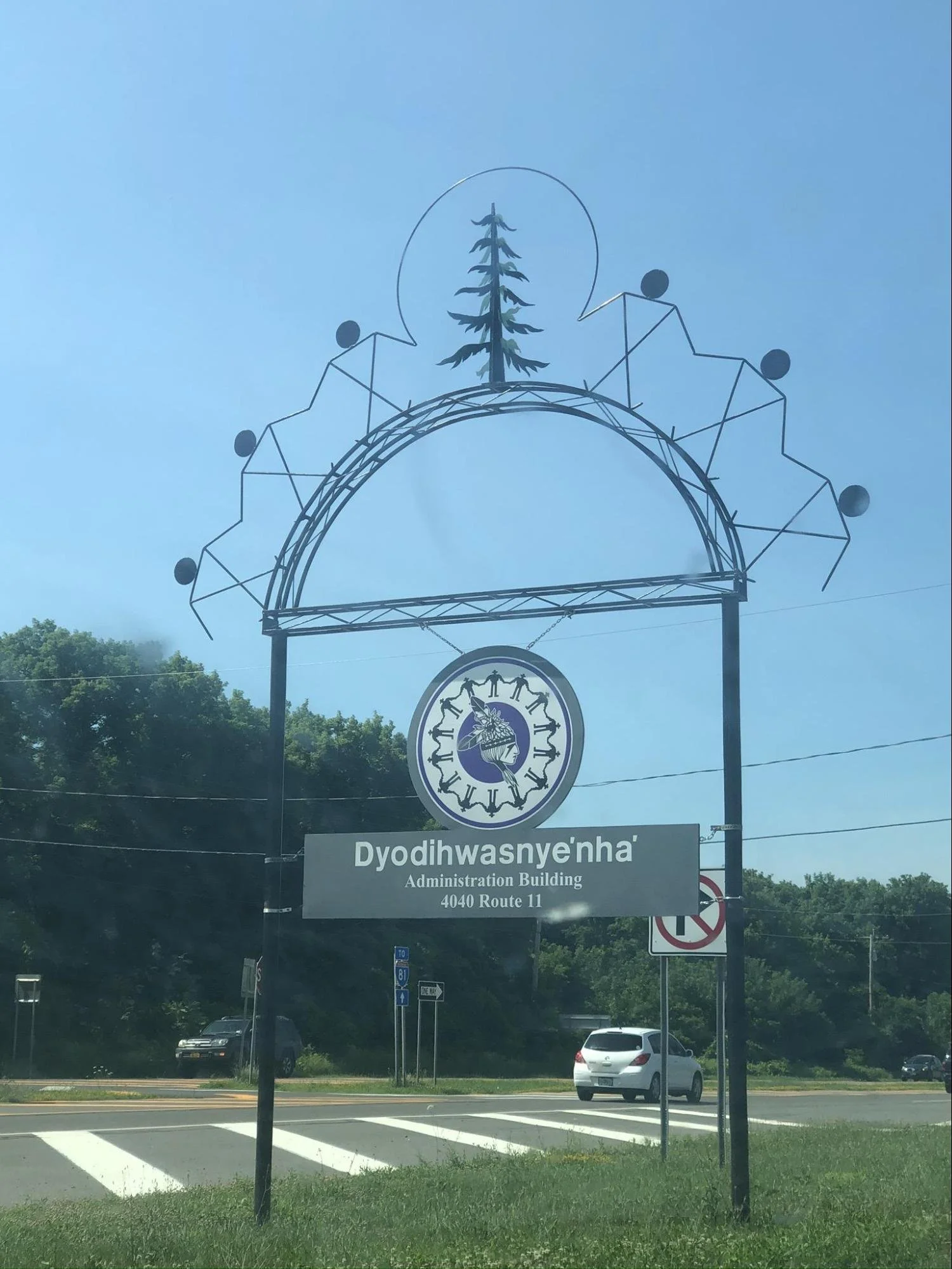
Public roadside sign for the Onondaga Nation administration building, July 18, 2020; not an eighteenth-century council scene. Photograph: Louisianajones1978, Wikimedia Commons, CC BY-SA 4.0; unchanged. The sign identifies a contemporary place and is not evidence that one constitution copied another.
Work one dated statement rather than a sweeping origin story
Give students a carefully selected passage from Benjamin Franklin’s March 20, 1751 letter to James Parker. Franklin invokes the Six Nations’ union while arguing that British colonies could unite. This is more than a resemblance noticed by a modern reader: it is a documented use of an Indigenous political example in a colonial argument.
Model the two columns. Supported: Franklin referred to the Six Nations’ union when advocating colonial union in 1751. Not established by this letter alone: that every later constitutional feature came from that example, or that a specific 1787 clause was copied directly. The limited conclusion recognizes evidence of influence on an argument without making the source prove an entire constitution’s origin.
Prepare students for the letter’s racist and colonial language before assigning it. Explain the harmful wording without requiring students to repeat it aloud. If you provide a paraphrase, label it as a paraphrase; do not quietly rewrite the original and present it as a quotation. Franklin’s awareness of Indigenous political organization did not make the letter an unbiased account of Haudenosaunee life.
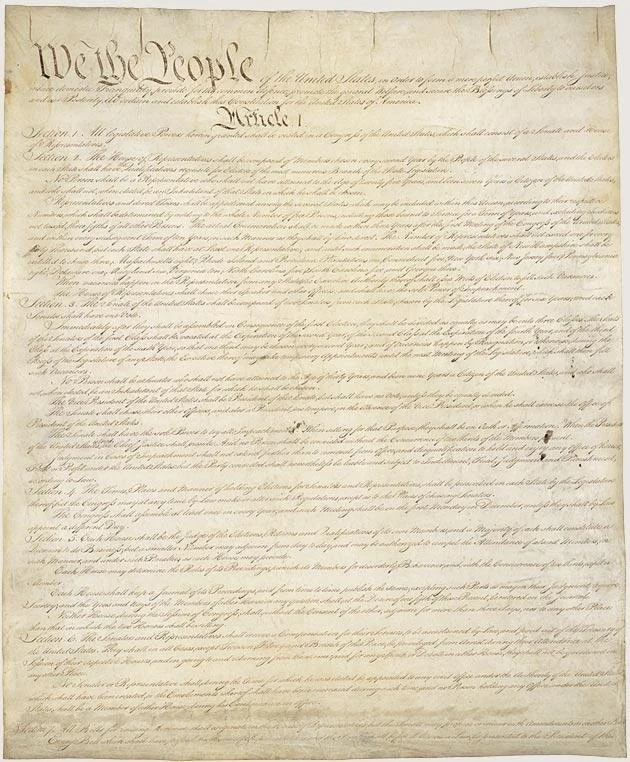
First page of the United States Constitution, 1787, digitized by the National Archives. Public-domain original government document. Use the linked transcript for close reading; the image is not itself evidence of how each provision was developed.
Compare a constitutional rule without forcing an equivalence
The original Article I provides for House members chosen by the people of the states and senators chosen by state legislatures. The Confederacy’s account of clan mothers selecting chiefs describes a different selection process. Students can identify both representation and a consequential difference; neither observation, by itself, settles the larger history of influence.
Ask students to replace “They both had representatives, so they were the same” with a precise comparison. A possible response is: “Both sources describe people acting in a governing body, but they describe different ways of selecting those people. To explain a historical influence, I would need a dated source connecting an idea to a decision.” Keep the task about evidence, not a mock ceremony or role-play of sacred offices.
Treat later recognition as a different kind of document
In H.Con.Res.331, agreed to on October 21, 1988, Congress acknowledged contributions of the Iroquois Confederacy and other Indian nations to the formation and development of the United States. Its preamble explicitly describes influence on the union of the colonies and democratic principles in the Constitution. The Onondaga Nation also publishes this resolution as a record of that acknowledgment.
This is important evidence of what Congress recognized in 1988. It is not a transcript of a 1787 drafting conversation. Put the document’s date and purpose in the second column before using it to support a particular origin claim. Students need not choose between treating the acknowledgment as meaningless and treating it as proof of every proposed one-to-one borrowing.
The scanned page includes the end of an unrelated resolution above H.Con.Res.331. Have students locate the correct heading, date and resolution number before reading. Continue to page 4933 for the operative acknowledgment; do not mistake the end of page 4932 for the complete document.
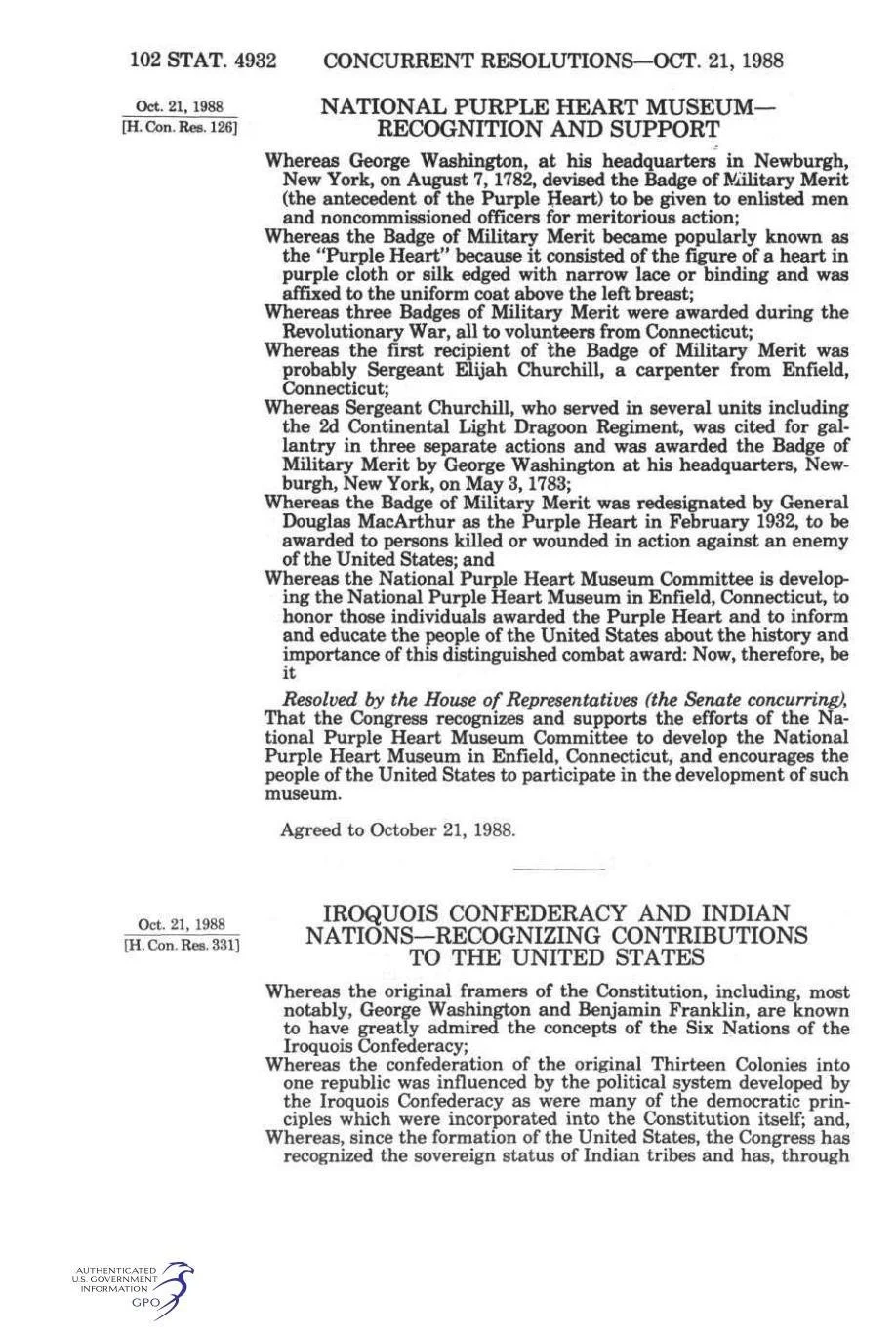
U.S. Statutes at Large, volume 102, page 4932: H.Con.Res.331 begins in the lower part and continues on page 4933. Agreed to October 21, 1988. Genuine government-document scan from GovInfo, not a newly created historical facsimile. Public domain.
Assess a bounded conclusion
Give students a final three-sentence task: identify one comparison, state one documented historical connection, and explain one limit. Require a source and date in the connection sentence. This makes it possible to distinguish careful uncertainty from a vague “we can never know.”
A strong response might say that Franklin’s 1751 letter uses the Six Nations’ union as an example for colonial union, while the 1988 resolution records later congressional acknowledgment. Neither source, alone, traces every clause of the 1787 Constitution. A student who wants to make a more specific claim should name the additional correspondence, debate or other contemporaneous record needed to investigate it.
Keep Haudenosaunee governance visible as a subject in its own right, not merely a possible ingredient in United States history. The Onondaga Nation’s current government account describes continuing institutions. Its value does not depend on finding a U.S. equivalent for every feature.
Choose background readings without turning them into proof
These HistoraEDU listings describe editable reading-and-question resources. Use a selected passage to prepare vocabulary or distinguish the political systems being compared. The primary-source comparison above is an additional teacher-designed routine; the products are not being advertised as a complete documentary investigation of constitutional influence.
Eastern Woodlands Native Americans Reading Comprehension Worksheet
View this HistoraEDU resource on TPT
Regional background on Eastern Woodlands societies, according to the listing. Keep the regional frame distinct from a claim about one government. The reviewed source has an incomplete matrilineal definition ending after “passed through”; provide a complete teacher note distinguishing maternal-line clan descent from the specific role of Clan Mothers in selecting representatives before assigning that vocabulary, and check the selected passage against a nation-specific account.
Algonquian Peoples Reading Comprehension | Eastern Woodlands History
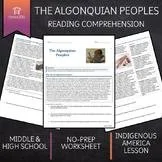
View this HistoraEDU resource on TPT
The listing describes a reading on the diversity of Algonquian-speaking peoples. Use it to establish that a language family is not one political institution. Do not recruit a broad language-family description as evidence that the U.S. Constitution borrowed a specific Haudenosaunee practice.
Haudenosaunee Confederacy Reading Comprehension Worksheet

View this HistoraEDU resource on TPT
The listing describes a reading on the Confederacy’s government and colonial relationships. Use a selected governance passage alongside the Confederacy’s own account. The reviewed version confuses the Treaty of Paris date: distinguish its 1783 signing from U.S. ratification in 1784 before assigning the relevant text or questions. The influence investigation here requires the separate primary sources linked above.
Native American Government Reading Comprehension Worksheet
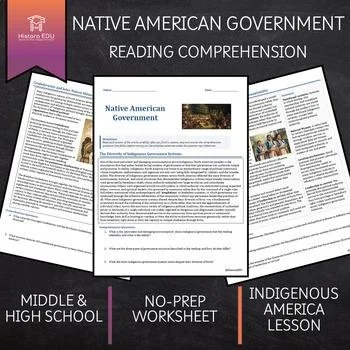
View this HistoraEDU resource on TPT
The listing describes comparisons among Indigenous governance systems. Use a bounded example rather than treating all confederacies as interchangeable. Its reviewed Lakota example needs the distinction between the seven Lakota bands and the wider Oceti Sakowin alliance; correct or omit that example. The resource is not evidence, by itself, of a documented borrowing into the U.S. Constitution.
Sources and image credits
Haudenosaunee Confederacy government account
Benjamin Franklin to James Parker March 20 1751
United States Constitution transcript Article I
Onondaga Nation government account
Onondaga Nation publication of the 1988 acknowledgment
Onondaga photograph license CC BY SA 4
Image record onondaga-building
Image record constitution-1787
Product thumbnail reproduced from the exact HistoraEDU listing at the owner’s request. Historical photographs are separate evidence, not product endorsements. The Onondaga sign photograph remains CC BY-SA 4.0 and is reproduced unchanged with attribution and a license link. It is an editorial place illustration, not a product logo, cover or endorsement. No claim to original U.S. Government works.

