
By HistoraEDU
You have found a striking bowl photograph for tomorrow’s lesson. The saved filename says “Native pottery,” the repost has no credit, and the image would fit neatly beside the reading. The tempting shortcut is to add a museum name and move on. But an attractive photograph is not yet an identified artwork, and an artwork’s age does not settle the reuse status of every photograph of it.
Turn that preparation problem into a short source-tracing lesson. Students will build a card for one exact image, keeping the artist, object and photograph distinct. The aim is a defensible caption and use decision—not a decorative page full of anonymous “tribal” designs.
Treat a repost as a lead rather than the final source
For a controlled classroom exercise, show the first bowl below before revealing its caption. Explain that you have temporarily hidden the identification for the exercise; do not invent a real repost or pretend that its history has been traced. Students can describe visible features, but should leave maker, community and date blank until they open a record.
If students bring an actual repost, save that starting URL and follow its credits or links. A search-result thumbnail can help locate a collection page, but it cannot replace one. Stop if the trail leads only to repeated copies with no identifiable source. Choosing a different, documented image is a successful research decision.
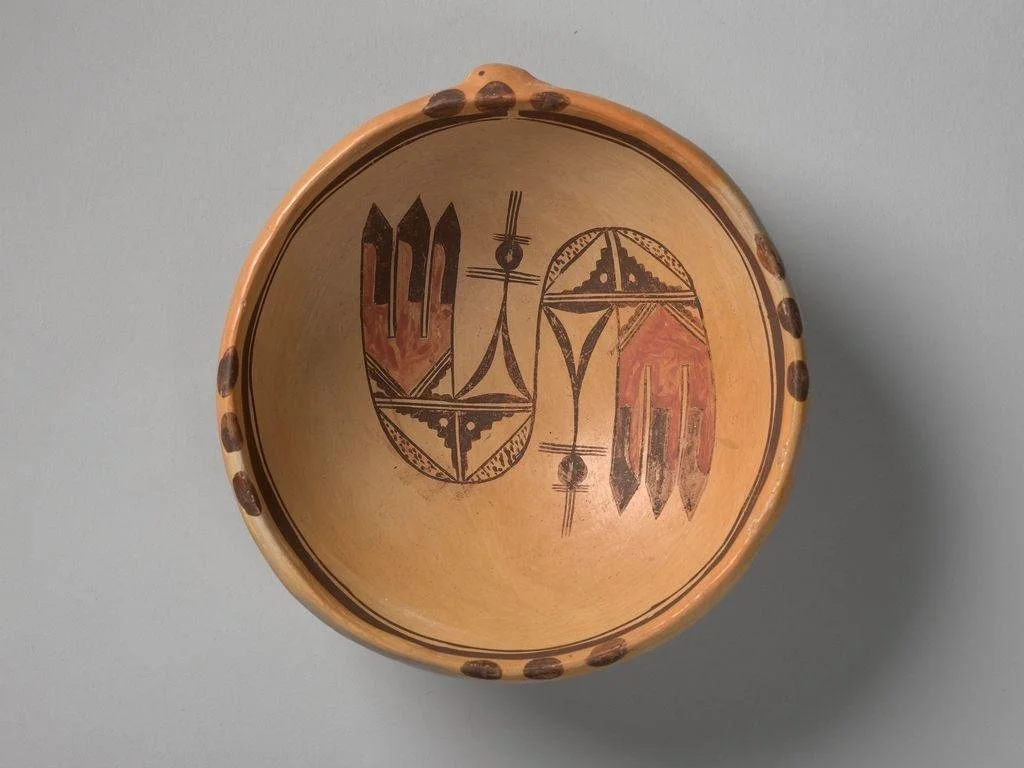
Num-pa-yu (Nampeyo of Hano), Hopi-Tewa, Bowl, ca. 1900. Ceramic with slip-paint; 7 × 19.7 cm. Gift of Jim Maddox, Class of 1965, and Lucy Maddox (2024-196). Image courtesy of the Princeton University Art Museum. Public-domain image. Image source
Build the card from this exact object record
Open Princeton University Art Museum’s record for Bowl, object 2024-196. It names the maker as Num-pa-yu, also identified as Nampeyo of Hano, and identifies her as Hopi-Tewa. It dates the bowl approximately 1900 and records ceramic with slip-paint. Preserve the approximate date; replacing it with “made in 1900” would add certainty the record does not give.
Ask students to enter separate fields: object title and number; artist as credited; community identification as recorded; date and its qualifier; materials; collection credit; photograph credit; exact image source; and stated reuse basis. Put the collection-page link beside the saved image so the relationship survives a renamed file or copied slide.
For this example, the object credit is the gift of Jim Maddox, Class of 1965, and Lucy Maddox. That is not a photographer’s name. The record does not identify an individual photographer; write that rather than guessing. Princeton’s image-use guidance supplies the institutional image credit. An unresolved photographer field should remain explicit even when the exact image has a clear reuse statement.
Check the image permission separately
This record’s download panel offers the pictured image as a public-domain work image. Princeton’s policy allows its designated public-domain images to be used without seeking approval and asks for the museum image credit. Use the download associated with this record, not an unrelated commercial photograph of a similar bowl.
The conclusion belongs to this asset: “This exact museum image has a stated public-domain reuse basis.” It does not become “All museum images are free” or “All Indigenous designs may be copied.” Reproducing a documented object photograph for analysis is not permission to invent meanings for its designs, remove an artist’s identity or market a copied motif as your own.
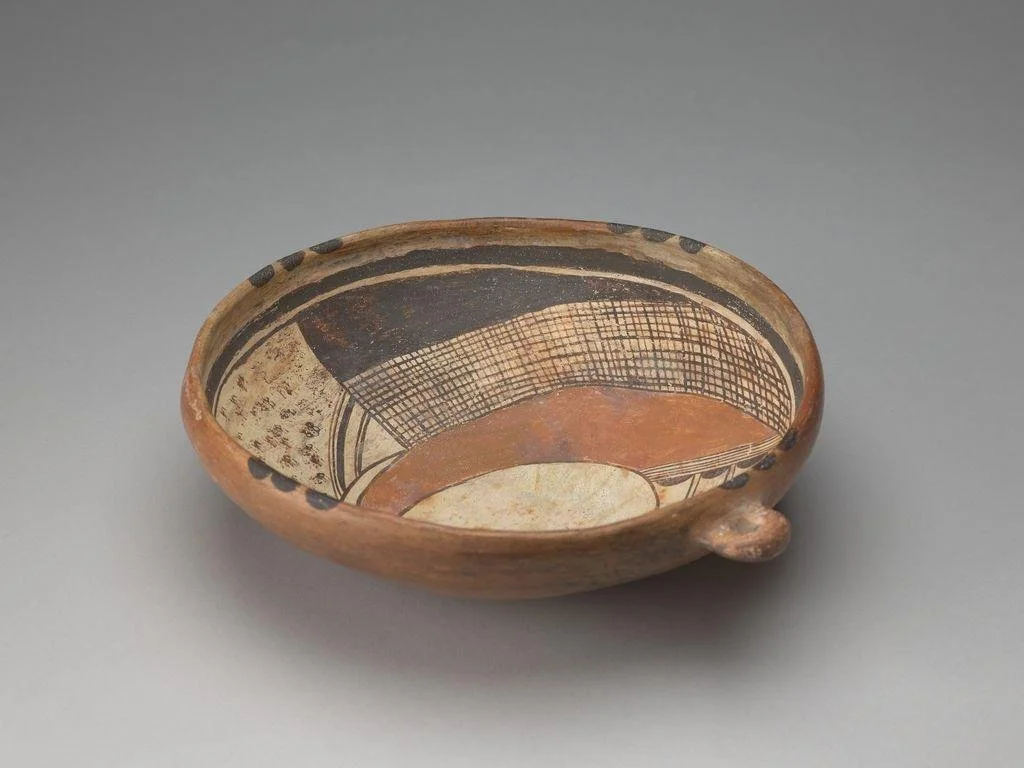
Attributed to Num-pa-yu (Nampeyo of Hano), Hopi-Tewa, Bowl, ca. 1900. White-slipped ceramic with red and black slip-paint; 6.5 × 25.4 × 23 cm. Gift of Jim Maddox, Class of 1965, and Lucy Maddox (2023-165). Image courtesy of the Princeton University Art Museum. Public-domain image. Image source
Keep the attribution qualifier when another bowl looks familiar
Now open Princeton’s Bowl 2023-165. This is a different object with its own photograph and dimensions. Its maker field says “Attributed to” Num-pa-yu. Those words matter: students must not transfer the first bowl’s unqualified maker line to this one because the names, dates or visual forms seem related.
Have pairs compare the two record numbers before discussing similarities. One student reads the caption while the other checks the matching image and record. Their correction might be as small as restoring an attribution qualifier, but it changes what the caption claims. A matching artist search result is not a matching object record.
Do not confuse the artist with the photographer
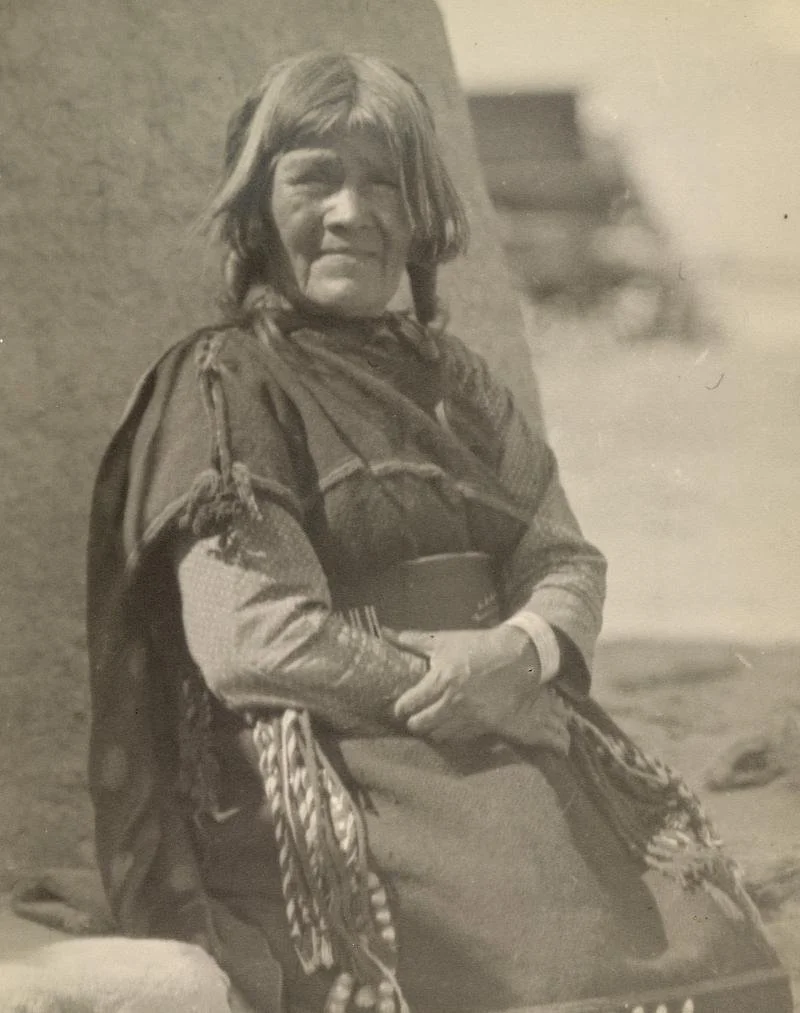
Nampeyo, photographed by Arnold Genthe, c. 1926. National Portrait Gallery, Smithsonian Institution, NPG.98.51. CC0 image. The sitter is the potter; the credited photographer is a different person. Image source
The Smithsonian National Portrait Gallery offers another useful distinction. Its photograph Nampeyo, dated about 1926, names Arnold Genthe as the artist of the photograph and Nampeyo as the sitter. The photograph’s date is not the date of either bowl. Nor does the portrait prove that a particular object shown elsewhere belonged to the person pictured.
Its record marks the media CC0 and names the National Portrait Gallery, Smithsonian Institution, for credit. Students should record that image-specific statement, not infer permission from the Smithsonian logo alone. Keep “photographer” and “pictured artist” in different boxes on the card. The portrait gives an identified person a place in the lesson without turning her into an anonymous illustration of a culture.
Assess the traceable card
Ask students to submit one image card and a three-sentence explanation: which record identifies the object or person; what supports using the exact image; and what remains unknown. Do not award extra points for filling every blank. “Individual photographer not named in this record” is better than an invented credit.
For a supported version, provide the two Princeton links and let students match record numbers, images and attribution wording. For an extension, have students test whether a caption still identifies the correct object after its filename changes. They can design the card’s layout using their own visual choices; they do not need to imitate Hopi-Tewa pottery designs.
A reading to accompany the attribution work
Use a background reading before the image-card task, then return to the exact collection records when students make claims about these works.

Indigenous Art and Cultural Identity Reading Comprehension Worksheet
This editable Google Docs reading includes comprehension and vocabulary work about Indigenous art and cultural identity. Use selected passages to frame why artist and community attribution matter, then add the exact-image card activity above. The reading is not an image-license guide, and these museum photographs are supplemental examples rather than promised components of the product. Preview the reading and answer key for your class.
View this HistoraEDU resource on TPT
Sources and credits
Princeton Bowl 2024-196 — exact object and public-domain image download
Princeton Bowl 2023-165 — attributed maker and separate image record
Princeton image use and access — scope and required image credit
Smithsonian Nampeyo portrait NPG.98.51 — Arnold Genthe and CC0 media
Product covers: HistoraEDU, reproduced from the exact linked TPT listings at the owner’s request. Photographs and archival reproductions are credited beside each image. No claim to original U.S. Government works. Source institutions and depicted people do not endorse HistoraEDU or its products.
