
By HistoraEDU
Put a museum model, a building photograph and a garment photograph on the same slide, and they may occupy three identical rectangles. Students can easily mistake that display choice for information about the objects. A model begins to look like a small house people inhabited; a dress looks child-sized because its photograph is small. The missing step is not a better guess. It is a measurement record.
Keep three kinds of size separate
Write three labels: size on the screen; recorded object dimensions; represented building or body. Ask which one students can measure with a ruler held against a printed picture. Only the first. Without a documented scale and a suitable view, measuring a photograph does not recover the other two.
Use the three examples below to practice reading dimensions, converting units and rejecting an unsupported scale claim. They come from different communities, periods and purposes. They are not a matching set of house, owner and clothing, and students should never assemble them into an imagined household.
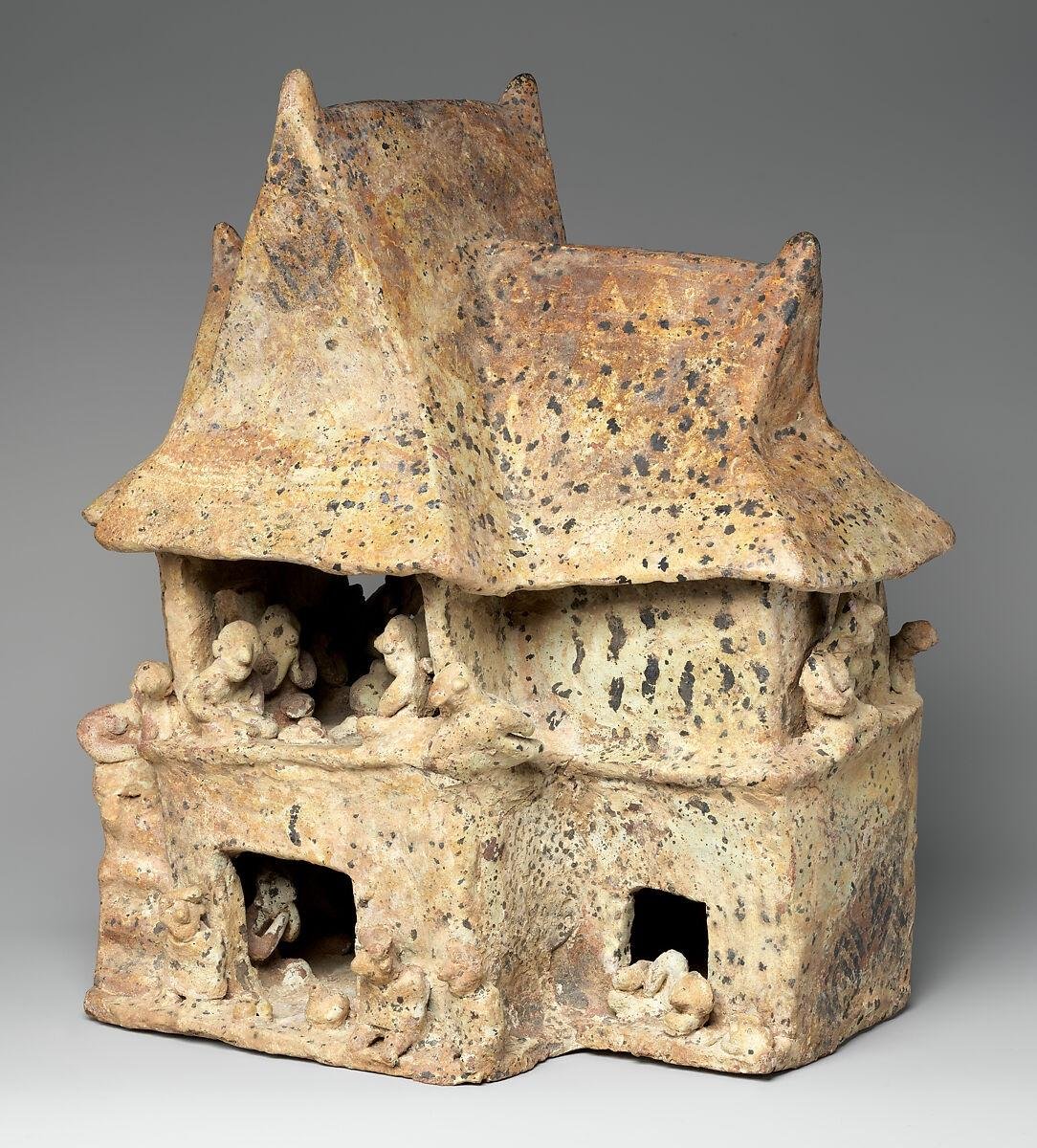
House model by Nayarit artist(s), 200 BCE–300 CE; 30.5 cm high, 25.4 cm wide, 17.1 cm deep. The Met, 2015.306; gift of Joanne P. Pearson, in memory of Andrall E. Pearson, 2015. Image: The Met, Public Domain / CC0. Image source
Begin with the measured model—not an imagined prototype
The Metropolitan Museum of Art identifies this ceramic House model as the work of Nayarit artist(s), from Mexico, dated 200 BCE–300 CE. Its recorded dimensions are 30.5 cm high, 25.4 cm wide and 17.1 cm deep. Have students copy the axis labels as well as the numbers. “About thirty centimeters” alone loses information they need for a comparison.
The museum interprets such models in relation to community gatherings and funerary contexts. That makes it especially important not to reduce this object to a toy or a classroom building plan. Observe its represented architecture without copying its designs or staging its figures’ activities.
Model one defensible statement: “The ceramic object is 25.4 cm wide.” Contrast it with “The original dwelling was 25.4 meters wide.” The second statement requires evidence the object record does not supply: a particular original building and a documented relationship between that building and the model. The presence of small figures does not supply a reliable ruler.
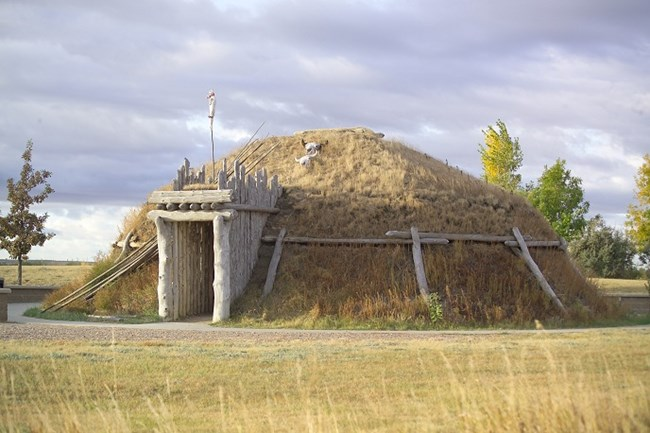
Reconstructed earthlodge on the grounds of Knife River Indian Villages; the park identifies this structure as 40 feet across. It is not the prototype of the Nayarit model. Credit: NPS Staff. No claim to original U.S. Government works. Image source
Make a numerical comparison that is honest about its limits
Next use the National Park Service’s earthlodge page. It identifies the reconstructed structure pictured at Knife River Indian Villages as 40 feet across. Keep “reconstructed” and the named place on the measurement card. This is a full-size structure in a different context, not the Nayarit model’s original house.
Convert the two recorded horizontal spans to one unit: 40 feet × 12 inches per foot = 480 inches. The model’s recorded width is 10 inches, equivalent to 25.4 cm. Then calculate 480 ÷ 10 = 48. Using the stated measurements, the lodge’s span is about 48 times the model’s width.
Now stop before writing “scale 1:48” on the model. You have compared the width of a ceramic object with the span of a separate reconstructed building. You have not established a model-to-prototype scale. Different shapes, purposes, dates and communities remain different even after the units match. Nor does a ratio between these two spans establish an area, volume or population ratio.
Give pairs two answer cards. Card A says, “The compared spans have a ratio of about 48 to 1.” Card B says, “The Nayarit artist made a 1:48 model of this Hidatsa-style earthlodge.” Students explain why the arithmetic can support A but cannot rescue B. This catches a reasoning error that a correct calculation alone would miss.
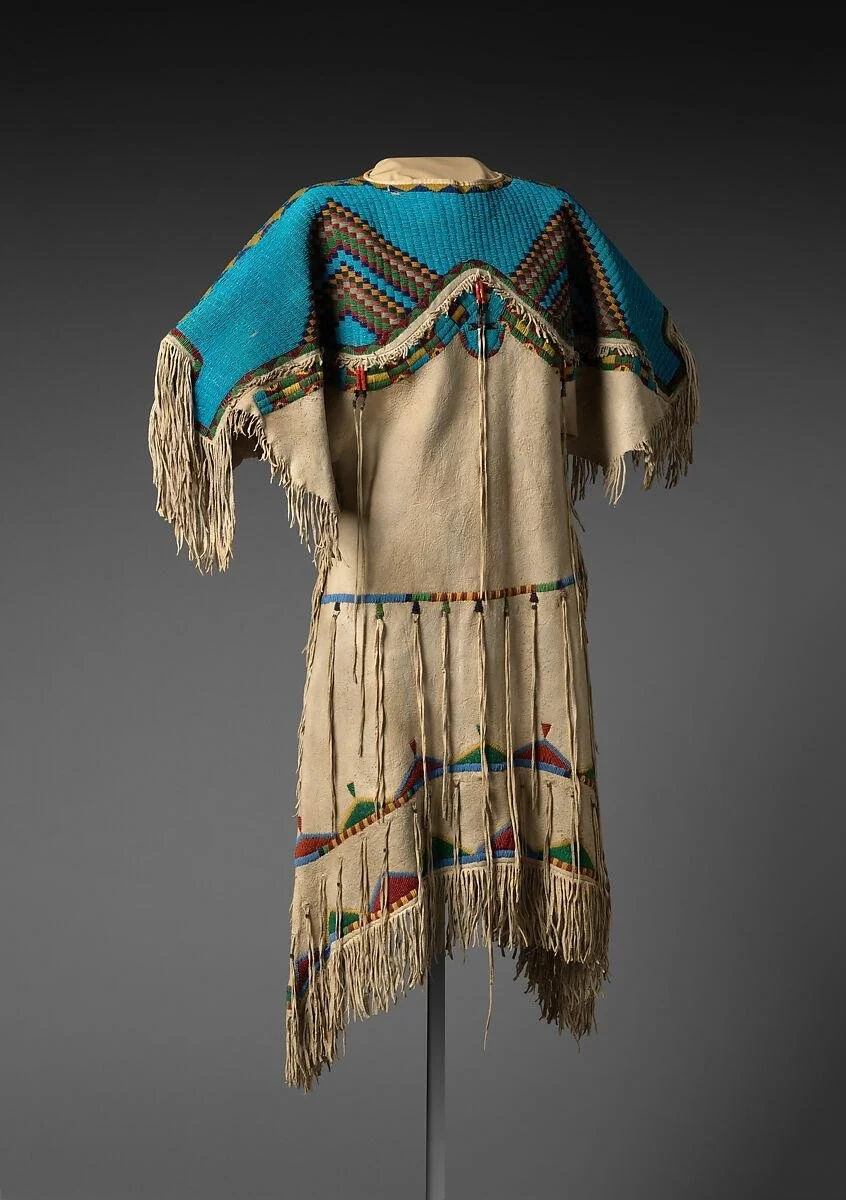
Dress, Lakota / Teton Sioux, ca. 1870; recorded dimensions 35 × 48 inches. The Met, 2019.456.27; Charles and Valerie Diker Collection of Native American Art, gift of Charles and Valerie Diker, 2019. Image: The Met, Public Domain / CC0. Image source
Let garment dimensions raise questions—not identify a wearer
The Met records this Lakota / Teton Sioux dress, dated around 1870, as 35 × 48 inches, or 88.9 × 121.9 cm. Preserve the record’s ordering without inventing axis labels it does not give. Ask students to compare those numbers with the small photograph on the page. The displayed image clearly is not the garment’s physical size.
Students can mark the two recorded lengths on plain paper strips laid on a desk or floor. Label them “recorded garment dimensions,” not a pattern to wear. They should not copy beadwork, make regalia or ask classmates to model a cultural identity. The task is to understand measurement, not to recreate the object.
Ask what remains unknown from the dimensions alone. They do not establish the wearer’s name, height, age, family, role or occasion of use. The museum’s cultural attribution is evidence from its record; it is not something students should guess from body size or a motif. Also distinguish an object's dimensions from the way fabric hangs on a modern display support.
Assess the boundary beside the calculation
Use a four-part exit ticket: identify one object precisely; record its dimensions and units; complete the 480 ÷ 10 comparison; explain why that result is not the model’s verified scale. Add one sentence about what the garment photograph cannot establish. Reward the student who identifies missing evidence, not the one who supplies the most confident imagined story.
For support, provide the unit conversion and let students check which dimension is being compared. For extension, ask what additional record would justify a true scale-model claim. Keep a space labeled “not supplied” rather than substituting a typical house size. This turns visual uncertainty into a manageable evidence question.
Use the readings as background, not as measurement records
The Homes and Clothing resources are editable Google Docs with reading passages, comprehension questions and vocabulary. The museum records, numerical comparison and measurement strips are additional lesson materials described here; they are not advertised as included product components.

Indigenous Homes and Environments Reading Comprehension Worksheet
Select introductory architecture and environment passages as background, then use the exact museum and park records for dimensions. Do not assign the Arctic section’s Sod house vocabulary entry: its prairie/Great Plains definition does not explain the Inuit housing context. The Nayarit model is an additional comparison, not a promised product example.

Indigenous Clothing Reading Comprehension | Culture and Environment
Use selected materials-and-making passages before the garment record. Keep its regional overview separate from this particular Lakota dress. Dimensions do not identify a wearer, and public display does not authorize copying ceremonial or community-owned designs.
View this HistoraEDU resource on TPT
Sources and credits
The Met: Nayarit House model, 2015.306, dimensions and interpretation
NPS: reconstructed Knife River earthlodge and its 40-foot span
The Met: Lakota / Teton Sioux dress, 2019.456.27
The Met: Open Access image terms
Product covers: HistoraEDU, reproduced from the exact linked TPT listings at the owner’s request. Photographs and archival reproductions are credited beside each image. No claim to original U.S. Government works. Source institutions and depicted people do not endorse HistoraEDU or its products.
