
By HistoraEDU
You planned to teach the Cold War. A student points at a lunar photograph and says the empty sky proves the landing was filmed in a studio. Suddenly the room wants a debate. You can take the question seriously without treating an unsupported allegation as an equally established historical account. Narrow the claim, identify what evidence could test it, and return students to the difference between an observation and a conclusion.
Choose one claim, not a competition of suspicions
Write a teacher-created example: “There are no visible stars in this photograph, so Apollo 11 did not land on the Moon.” Divide it into two parts. The first is an observation about one image. The second is a claim about an entire mission. Ask what reasoning connects them and what information is missing.
Set a respectful boundary: nobody needs to defend a family member, an influencer or a personal identity. Students are evaluating a sentence and a source. Do not ask half the class to invent arguments for a hoax. That can reward confident invention rather than careful historical work.
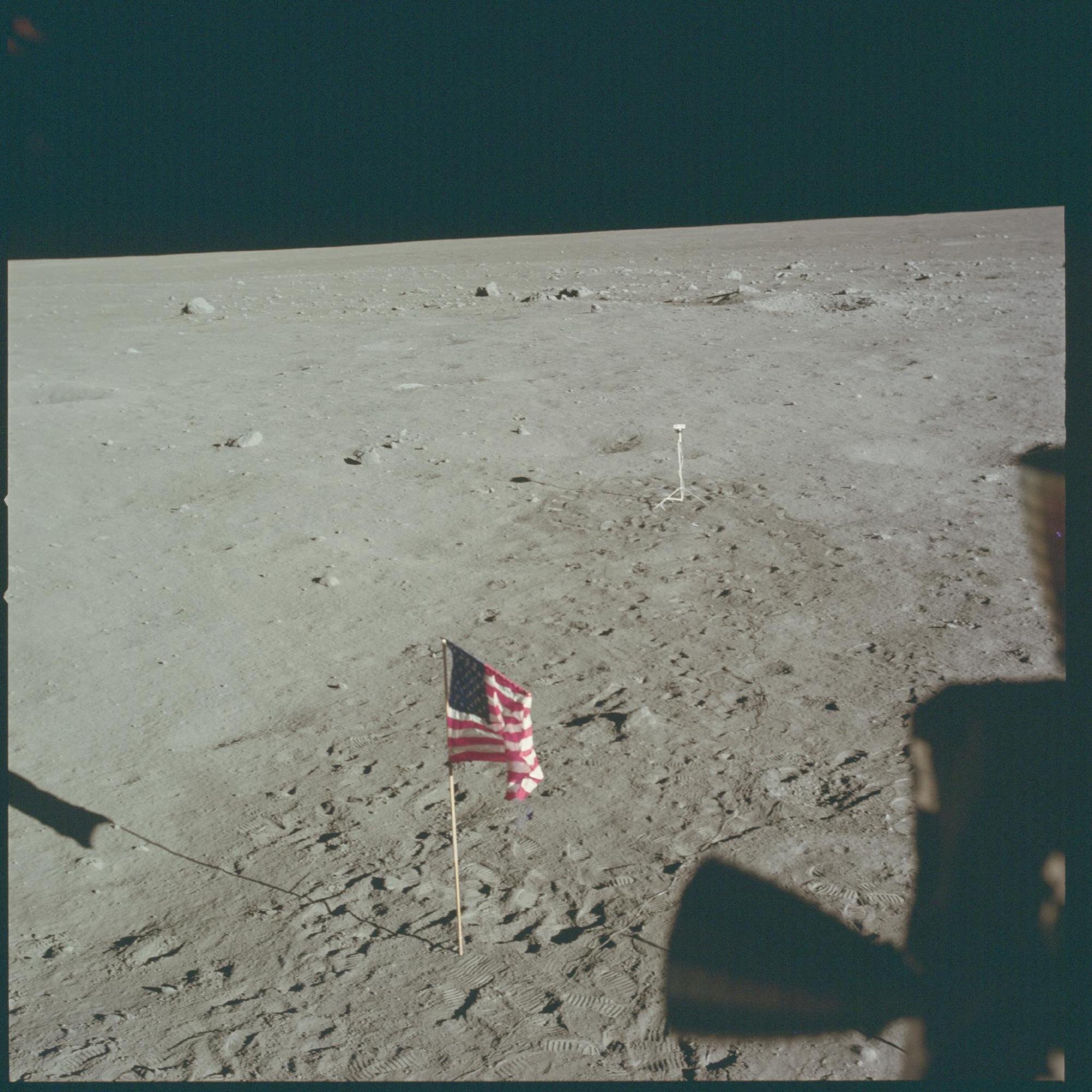
Apollo 11 frame AS11-37-5480, photographed from the lunar-module window after the moonwalk in July 1969. NASA; scan via Project Apollo Archive. Public domain. Full downloaded image shown without an added sky or crop; no NASA endorsement implied.
Identify the image before explaining it
Use a specific frame rather than a cropped social-media screenshot. The image here is AS11-37-5480. NASA’s Apollo 11 Image Library identifies it as a post-moonwalk view from the lunar module, with the flag and television camera visible. Record the frame number, mission and source alongside the observation.
Then ask, “Would every object visible to a person necessarily appear in a photograph?” NASA’s explanation of missing stars describes the exposure problem: a short exposure suitable for bright subjects may not record much fainter stars. A dark sky in a photograph is therefore not, by itself, evidence of a studio.
Do not invent the exact shutter setting for this frame. The exposure explanation identifies why the proposed inference is insufficient; it is not a complete reconstruction of every camera adjustment. If a student wants to investigate further, the next task is to find the relevant camera or mission documentation, not to multiply untested visual claims.
Build a source-needed map
Draw three rows: image record, tracking record and material record. Give each row three questions: What could this help establish? What could it not establish alone? Who created or preserved it? Students are designing a manageable investigation, not proving a complex mission from a single picture.
For the image row, use the identified frame and its neighboring entries in the NASA library. Frame identifiers and sequence matter; ten reposts of the same scan are not ten independent observations. The image can support a careful description of the scene, while its archive provides provenance.
For tracking, use the Jodrell Bank Centre for Astrophysics record linked below. It presents a chart of signals received from the Eagle lander and explains how changing relative motion affected the received frequency. Students should read the institution’s explanation rather than pretend they can independently decode an unfamiliar scientific graph in five minutes.
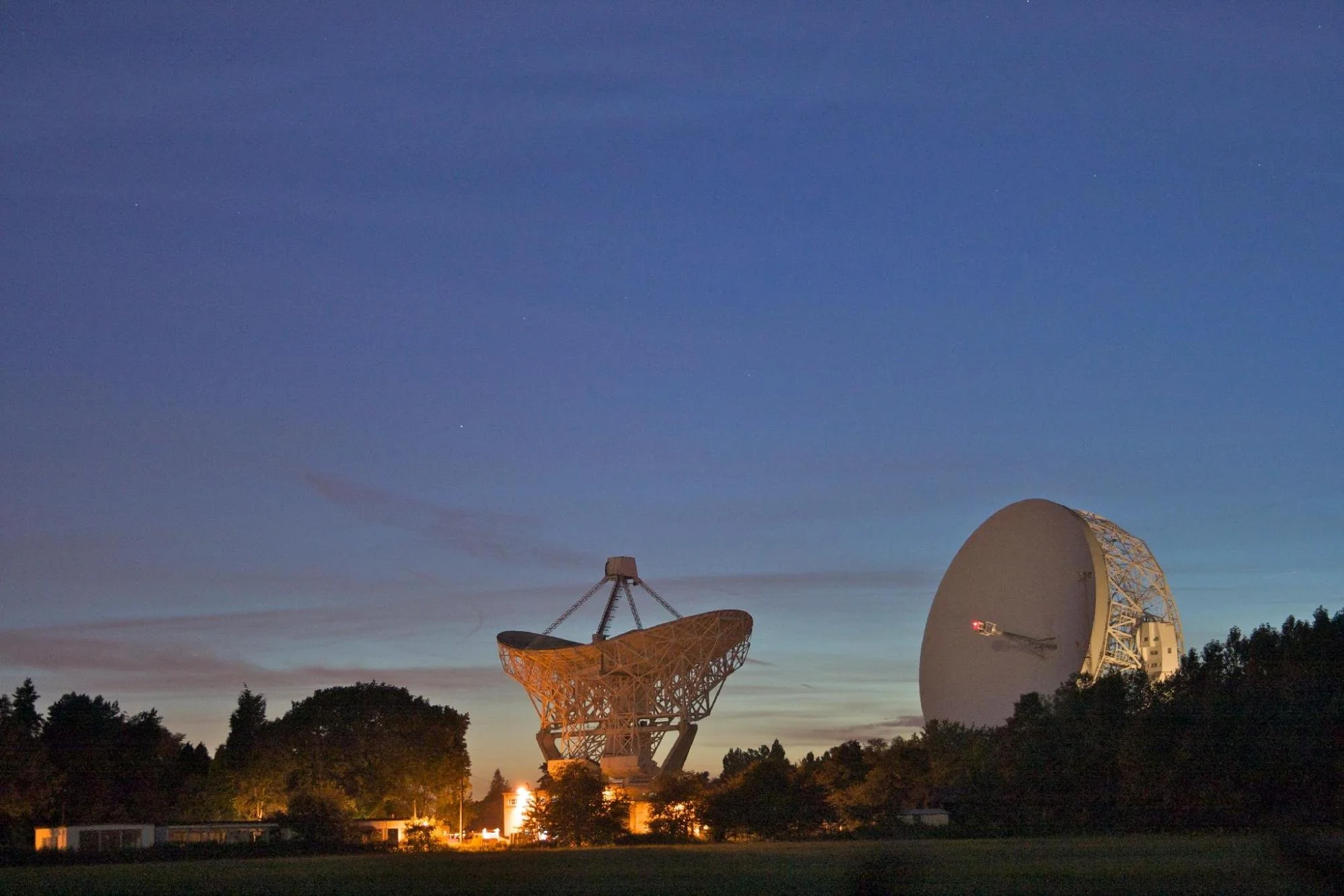
Mark II and Lovell telescopes at Jodrell Bank, July 30, 2007—not a photograph of the 1969 landing reception. Mike Peel; Jodrell Bank Centre for Astrophysics, University of Manchester. CC BY-SA 4.0; unaltered. No endorsement implied.
Use independent evidence without overselling it
The observatory record is useful because it concerns signals received at an institution outside NASA, rather than another copy of NASA’s surface photograph. Have students state exactly which aspect it addresses: tracking a signal associated with the lander. It is not another camera view of the astronauts walking.
Keep the modern observatory photograph in its proper role. It helps students visualize a place that collected evidence, but it was made in 2007. It cannot document what its instruments recorded in 1969. A truthful date makes the image useful instead of misleading.
For the material row, show NASA’s photograph of sample 10020. Ask students what a laboratory photograph can establish on its own, and what would require a sample catalog, collection history and scientific analysis. Seeing a rock-shaped object is not the same as independently testing its composition or provenance.
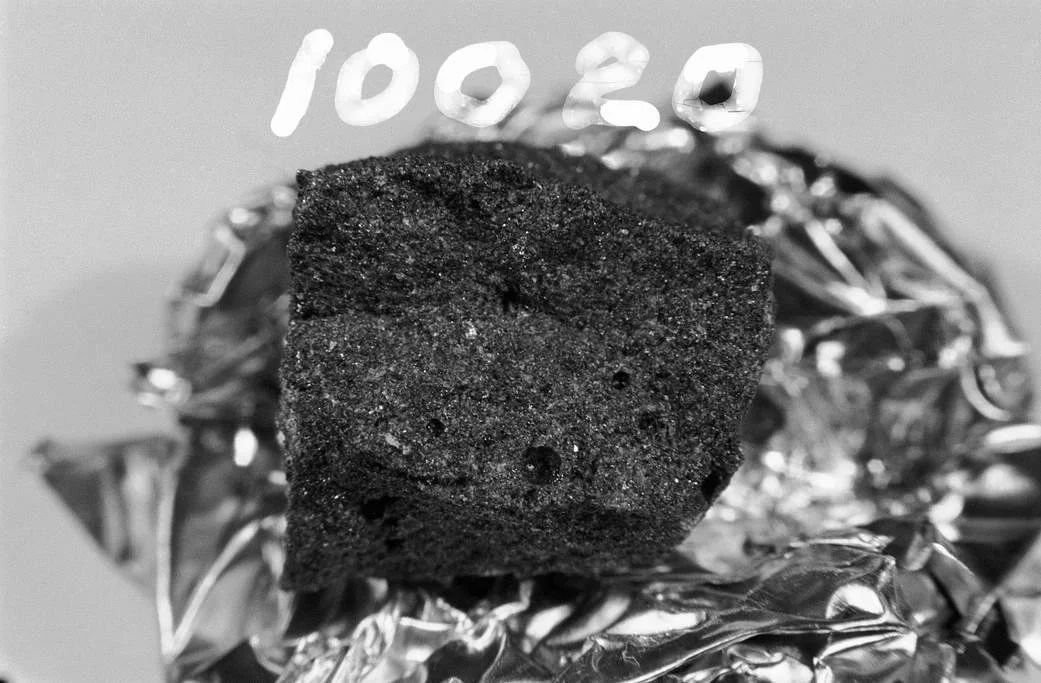
Lunar sample 10020, NASA photograph S69-46481. This laboratory image is not a photograph of the sample being collected. NASA; public domain. No endorsement implied.
Make the conclusion the size of the evidence
Ask pairs to complete two sentences: “The missing-stars claim does not establish a hoax because…” and “To investigate the mission beyond this photograph, we would consult…” Look for an exposure explanation followed by distinct source types, not a list of repeated websites.
A useful response says that a camera can fail to record faint stars while exposing a bright surface, then identifies the image archive, the observatory’s tracking record and documented sample research as different lines of inquiry. The point is not that every source is flawless. It is that a sweeping allegation needs to account for evidence beyond one ambiguous detail.
If time is short, stop after students have corrected the inference and made their source map. Collect any remaining questions for a later, bounded research task. You can acknowledge uncertainty about a technical detail without implying that the historical landing itself is equally uncertain.
Return to the Space Race lesson
Once the evidence question is contained, reconnect to the lesson’s purpose: why the lunar landing mattered within Cold War competition. HistoraEDU’s Space Race reading and photo-analysis resource can supply that shared historical context. This article’s source-needed map is a supplementary routine, not a promise that the product contains a conspiracy-debunking unit or the Jodrell Bank records.
Use the resource when students need structured reading and questions; use the additional sources here when a specific authenticity claim interrupts that work. The practical goal is a classroom habit: slow down a large claim, identify the source, and choose evidence capable of answering the actual question.
Space Race Reading & Photo Analysis | Cold War | Grades 7–8

View this HistoraEDU resource on TPT
Grades 7–8 Space Race reading and photo analysis for Cold War context. Pair with the separate records in this article for the targeted evidence activity; the extra investigation is not represented as a product feature.
Sources and image credits
NASA Apollo 11 Image Library, including AS11-37-5480
NASA: why bright-subject exposures may omit stars
Jodrell Bank: Eagle lander signal recording and explanation
NASA identification of lunar sample 10020
Telescope photo license CC BY-SA 4.0
Product thumbnail reproduced from the exact HistoraEDU listing at the owner’s request. Historical photographs are separate evidence, not product endorsements.


