
By HistoraEDU
When an essay says “McCarthy’s HUAC,” the problem is bigger than a mistaken acronym. A student has made one famous name stand for several institutions, each with different powers. Before asking whether an investigation was justified, give students a way to identify who actually acted. A short comparison of records can replace a foggy villain-and-victim narrative with a more precise explanation of responsibility.
Start with four blanks, not a name quiz
Put this frame on the board: actor → authority → action → consequence. Explain that “authority” means the office or institutional power involved, not a judgment that the action was fair. A senator, a House committee, a President and a private employer are not interchangeable actors. Students should be able to leave a consequence unresolved when their source does not establish it.
Give pairs three short, clearly labeled source cards: House correspondence from 1947, the title and historical membership pages of a 1953 Senate hearing record, and a documented employment case from the Library of Congress. Keep the dates visible. This is a comparison across related events, not a claim that the three records describe one proceeding.
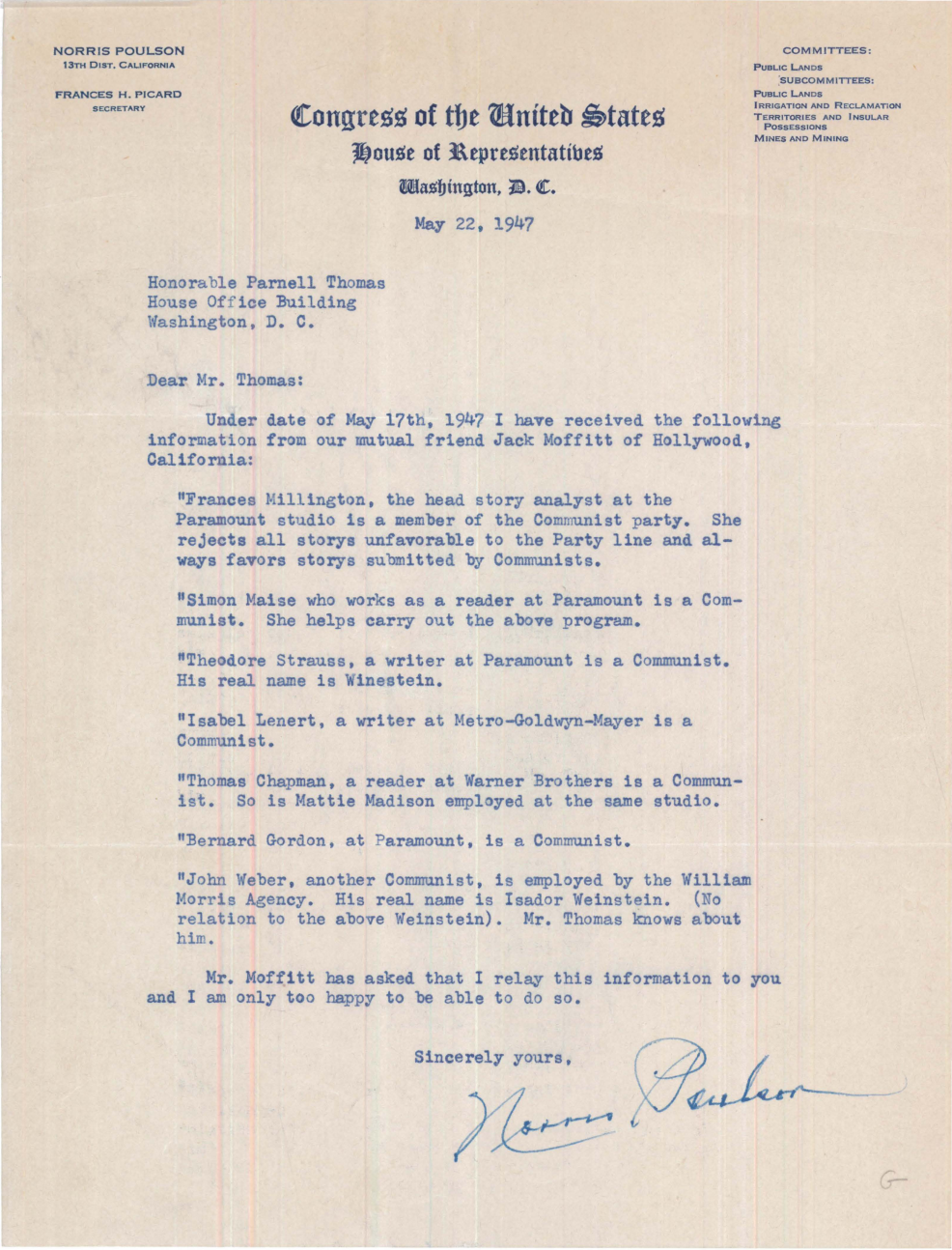
Norris Poulson to J. Parnell Thomas, May 22, 1947. Official House correspondence transmitting allegations, not proof of them. National Archives, via U.S. House History, Art & Archives. Public-domain federal record. Image source
Model the House record
In the House’s “Communism in Hollywood” record, Representative Norris Poulson wrote to Representative J. Parnell Thomas on May 22, 1947, relaying allegations attributed to Jack Moffitt. Thomas chaired the House Committee on Un-American Activities. Ask students to find the letterhead, sender and recipient before reading the allegations.
A careful entry reads: “Poulson, a House member, transmitted allegations to Thomas, HUAC’s chair.” The letter establishes that information was passed along; by itself it does not prove the allegations or establish that a named person lost a job. Ask: “What additional record would we need to claim a specific consequence?” This prevents an accusation from quietly becoming a finding.
Give the Senate its own row
Next open Volume 1 of the Senate’s published executive-session transcripts. Its title identifies the Permanent Subcommittee on Investigations of the Committee on Government Operations. The historical membership page names McCarthy as chair. Students can now write “Senate subcommittee,” not “HUAC,” and identify questioning in a hearing as the institutional action.
Separate the year of the hearings from the publication date: this volume concerns 1953 sessions and was printed in 2003. Also distinguish those sessions from the Army–McCarthy hearings in 1954. In that later investigation, McCarthy temporarily stepped down and Karl Mundt presided. A familiar label should never erase who chaired a particular proceeding.
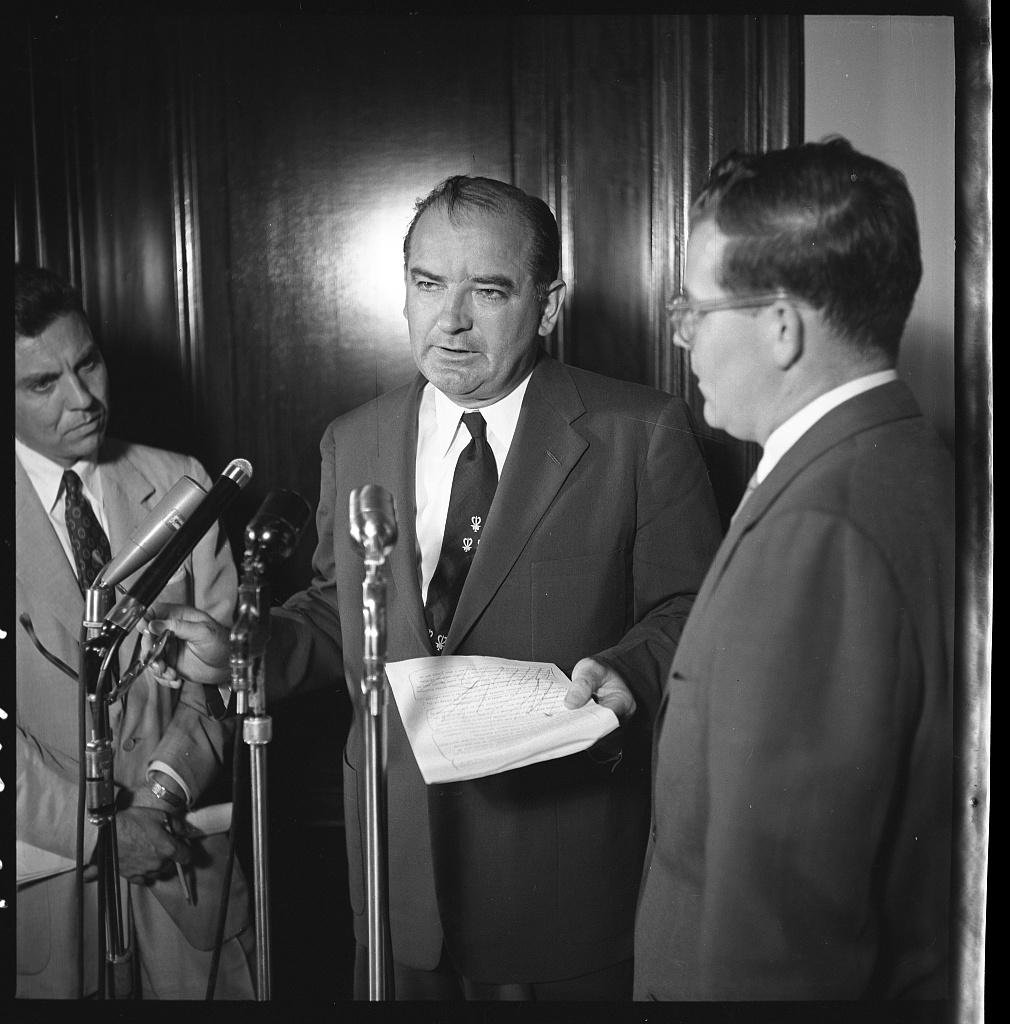
Joseph McCarthy at microphones with two men. Catalog context is tentative: discussion of the Watkins censure committee, [June 1954]. Thomas J. O’Halloran, Library of Congress, LC-DIG-ds-07186; staff-photo rights dedicated to the public. This is not identified as an Army–McCarthy hearing photograph. Image source
A private employment decision belongs in another row
The Library of Congress documents actor Sam Jaffe’s blacklisting and preserves his May 22, 1953 letter to Columbia Pictures executive Nate Spingold. Its exhibit explains that Jaffe’s HUAC subpoena was discharged, yet he remained unable to work in radio, television or films for seven years. Use this documented case summary without inventing dialogue or treating the letter as a court judgment.
Students should identify the employment gatekeepers as private industry actors, not rename them “McCarthy.” Their row should separate the committee episode from the employment consequence. Ask: “Does a committee investigation itself hire or fire an actor? What evidence connects an employer’s action to the wider blacklist?” The point is to locate responsibility, not to suggest that public pressure and private decisions were unrelated.
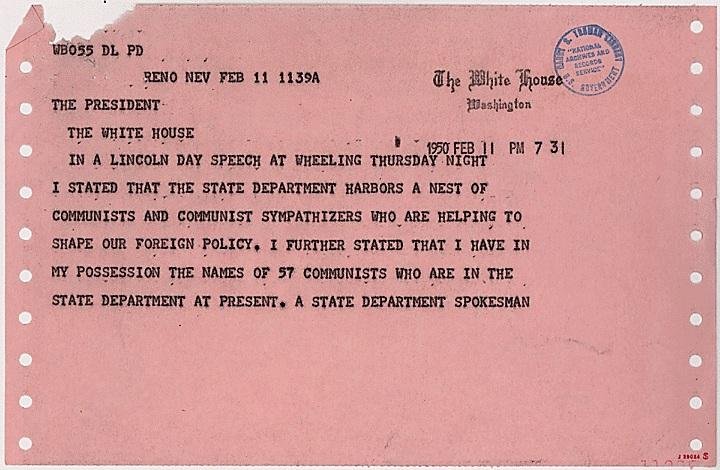
First page of McCarthy’s telegram to Truman, February 11, 1950. Harry S. Truman Library, National Archives, identifier 201514. Public-domain federal record. Identify sender and recipient; the telegram is not an executive order. Image source
Check whether the distinction transfers
Use the February 11, 1950 telegram from McCarthy to President Truman as a fourth, brief check. A message addressed to the President is not an executive order, and an assertion in a telegram is not proof. Have students label sender, recipient and document type, then explain what the page can establish. Do not ask students to accuse classmates or simulate a loyalty investigation.
For support, supply institution names on cards and read the source headings aloud. For extension, ask students to repair “McCarthy fired Hollywood actors through HUAC” using two accurate sentences and one unresolved evidence question. The exit ticket is successful when it names distinct actors and actions—not merely when it substitutes the word “Congress” for every institution.
Use background readings without flattening the actors
The comparison above is an added primary-source routine, not a promise that these records are included in either resource. Choose a reading for the background students need, then keep the actor–authority frame beside it.
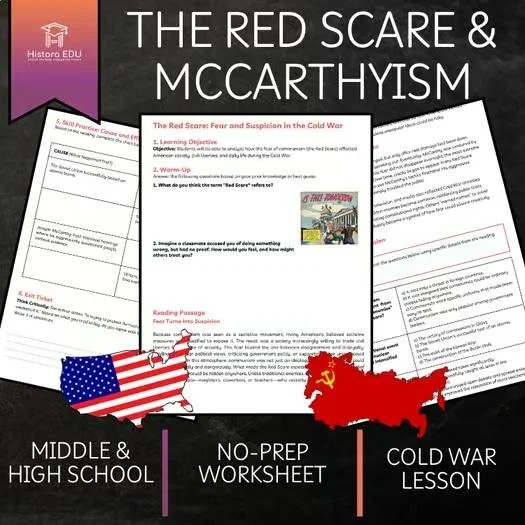
Red Scare & McCarthyism Reading Comprehension | Cold War Civil Liberties lesson
The Red Scare & McCarthyism reading is an editable Google Docs lesson with a warm-up, comprehension and analysis questions, vocabulary, a cause-and-effect chart, exit ticket and answer key. Use it before the institutional comparison.
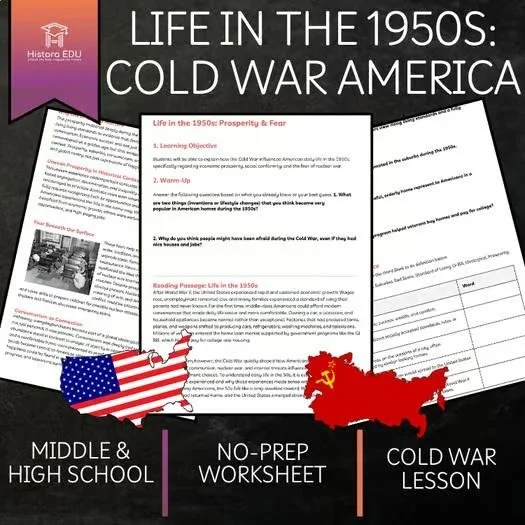
Life in the 1950s Cold War Lesson | Red Scare, Suburbia & Consumerism | 8th
Life in the 1950s supplies wider domestic context, including conformity and Cold War anxieties. Its listing describes an editable, printable Google Doc with reading questions and a cause-and-effect activity. Use selected context rather than restarting a whole decade survey.
View this HistoraEDU resource on TPT
Sources and credits
House correspondence and contextual record
Senate executive-session record, Volume 1
Senate distinction between the two investigations
Sam Jaffe documents and employment history
McCarthy telegram and provenance
Product covers: HistoraEDU, reproduced from the exact linked TPT listings at the owner’s request. Photographs and archival reproductions are credited beside each image. Source institutions do not endorse HistoraEDU or its products.
