
By HistoraEDU
A student can recognize “the Fourth Amendment” and still read unreasonable searches as “all searches.” Another may understand petition as signing any list, without noticing whom the request addresses. If the words are unstable, a scenario activity tests decoding and background knowledge at the same time. Give students a short language lesson before asking them to decide which right fits.
Make the original visible and the reading manageable
Display the National Archives reproduction beside its transcript. Explain the numbering before students begin: the 1789 sheet proposed twelve amendments; ten became the Bill of Rights in 1791. Its “Article the third” is the proposal that became the First Amendment. Students should not mistake the manuscript’s numbering for today’s amendment numbers.
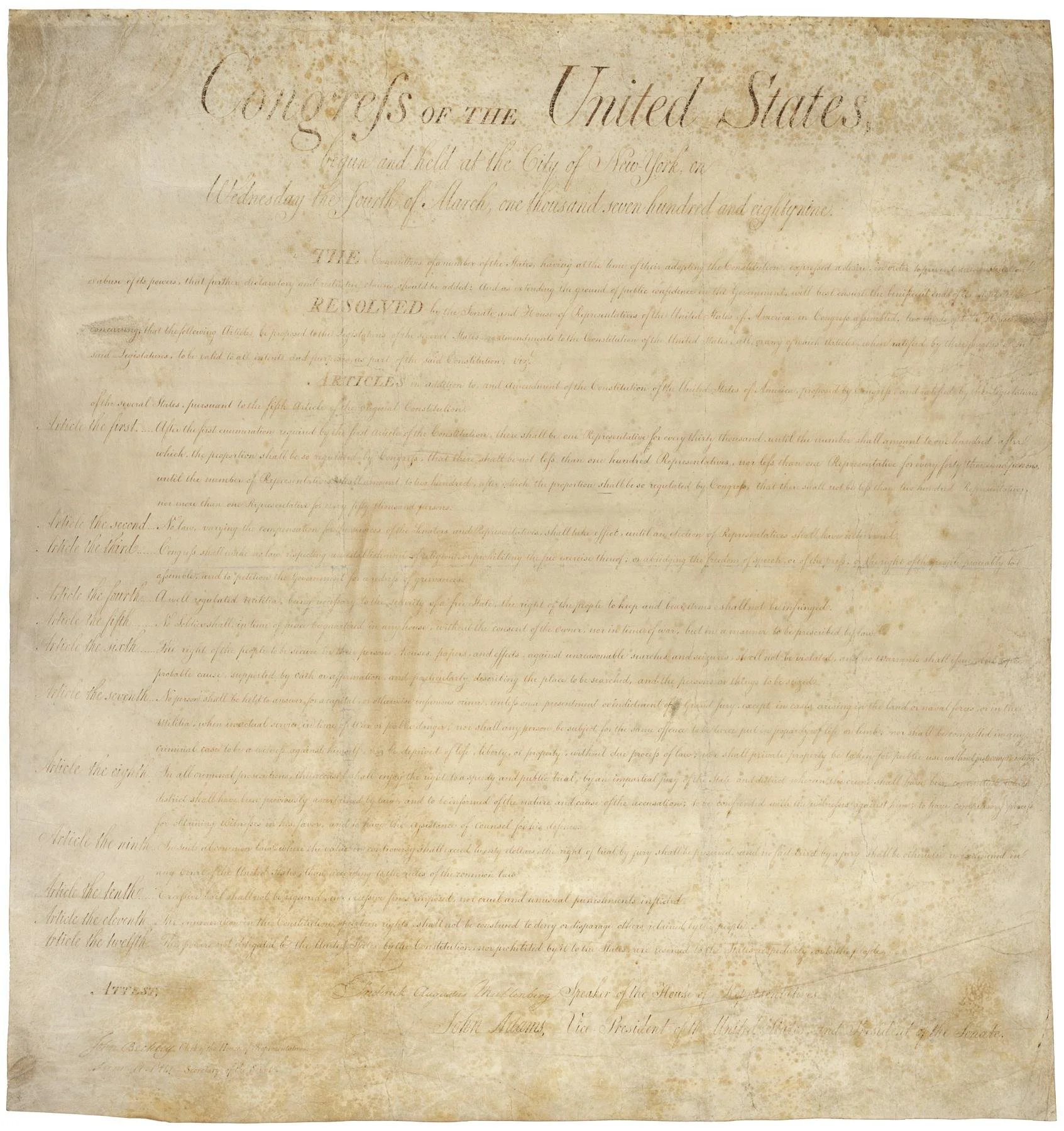
The 1789 joint resolution proposing twelve amendments. Ten became the Bill of Rights in 1791. National Archives, Record Group 11. Public domain. Use a transcript for close reading rather than relying on this reduced manuscript image. Image source
Do not make deciphering eighteenth-century handwriting the entry requirement. Provide two brief, typed excerpts from the authoritative transcript, preserving the wording. Read each aloud once without interruption, then again in phrases. Tell students that their job is to preserve meaning while making the sentence easier to understand—not to replace difficult words with whatever sounds familiar.
Build a three-part meaning map
For each excerpt, mark an action, the interest or right being protected, and language that narrows or qualifies the statement. Use labels as well as colors so the annotation does not depend on color vision. Add an audience question: “Who is being asked, limited or protected?” A dictionary definition alone will not always answer that.
Begin with “petition the Government for a redress of grievances.” In context, petition means to ask the government to address a complaint or wrong. Have students underline the action, box its recipient and explain the purpose. An accurate classroom paraphrase is “ask the government to address a complaint.” “The government must give everyone the result they want” adds a promise that these words do not make.
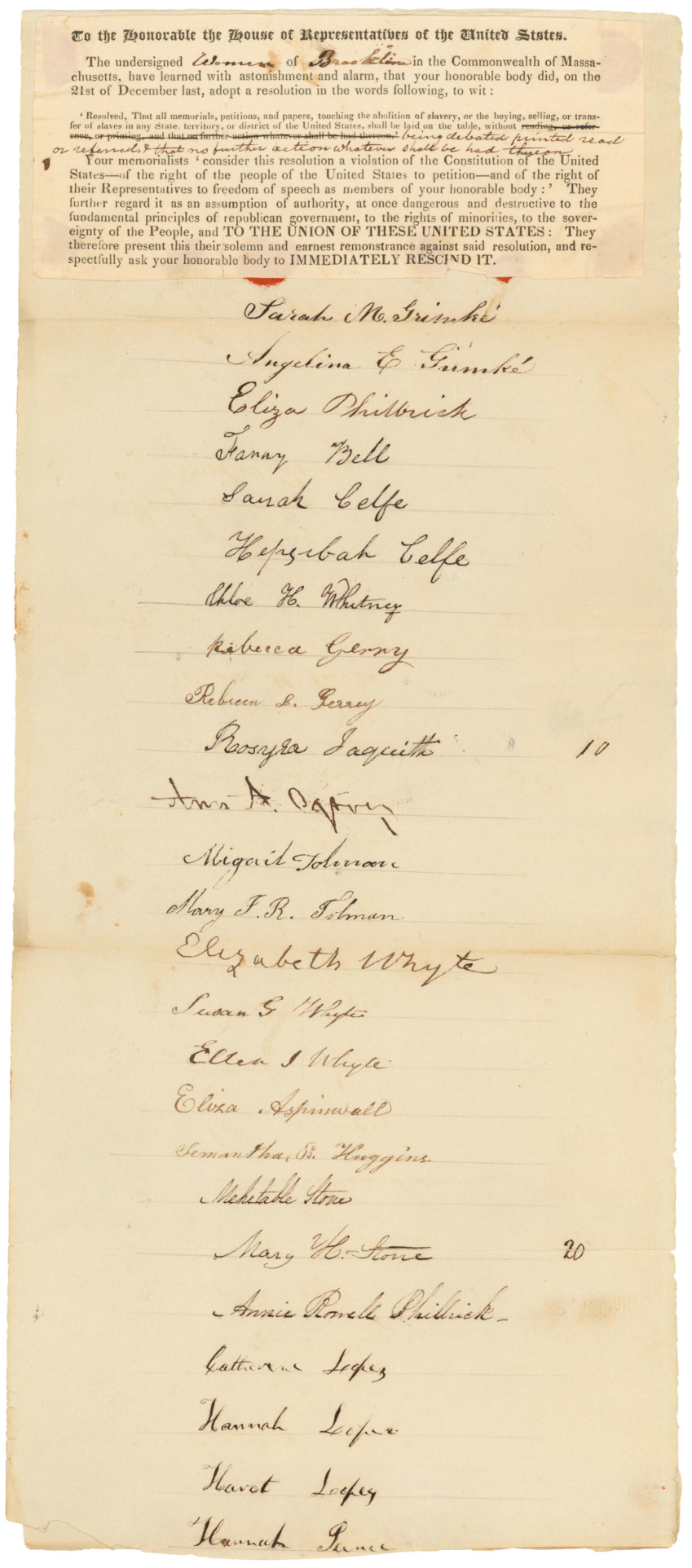
Petition to Rescind Gag Rule, February 14, 1838, from women in Brookline, Massachusetts. National Archives, Tabled Petitions and Memorials, 25th Congress, via U.S. House History, Art & Archives. Public domain. Locate the addressee and requested action before studying the signatures. Image source
Let a real petition give the verb a purpose
The 1838 petition from women in Brookline, Massachusetts, asks the House to rescind its gag rule on antislavery petitions. Use the document’s addressee and requested action rather than asking beginners to decode every signature. The signers were not simply announcing an opinion; they were asking a government body to change a rule.
Ask students to complete: “These petitioners asked ___ to ___.” Then return to their definition of petition. The House’s historical account notes that the gag rule remained until 1844. That gap between request and result makes a useful language distinction without turning the source into a generic, context-free example of civic participation.
Keep the limiting word in the paraphrase
Now use the Fourth Amendment phrase “against unreasonable searches and seizures.” Circle unreasonable before discussing possible situations. Compare “protects people against unreasonable searches and seizures” with “forbids every search.” Ask exactly which word disappeared and how that changes the claim. Students should not decide a real search case from this fragment; they are noticing what a paraphrase may not erase.
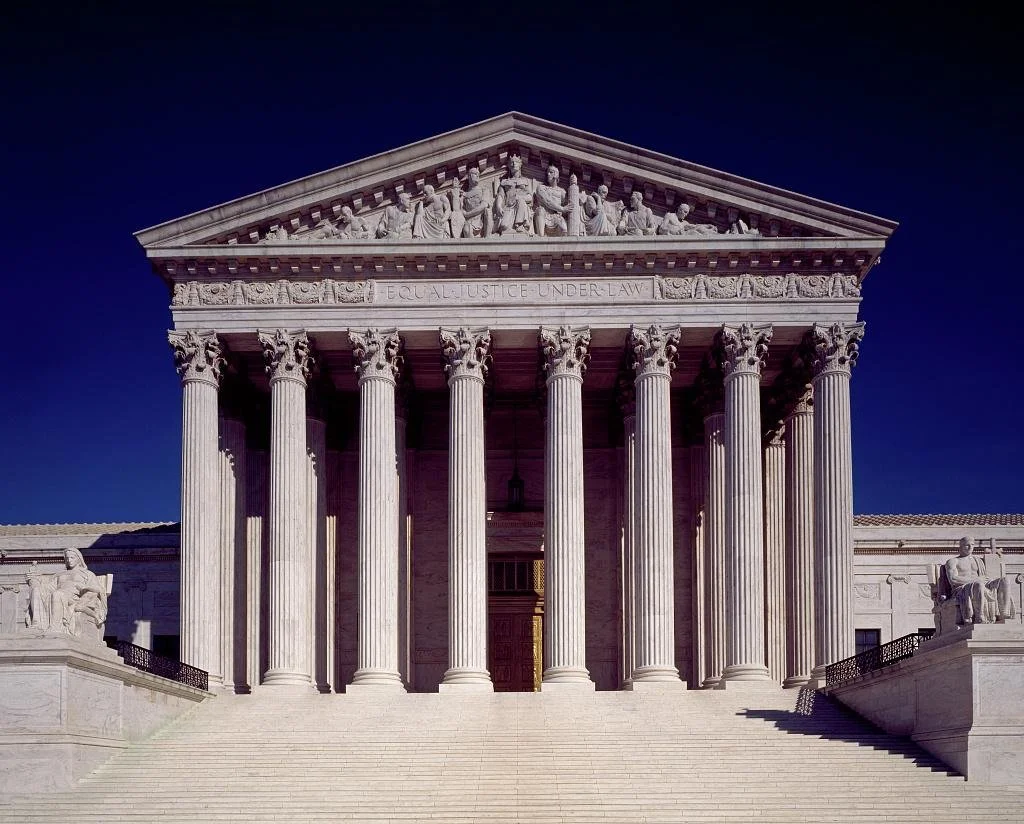
U.S. Supreme Court building, Washington, D.C., photographed between 1980 and 2006. Carol M. Highsmith, Library of Congress, LC-DIG-highsm-13879. Public domain. A building identifies an institution; it cannot tell us the outcome of a legal question. Image source
Check comprehension before moving to scenarios
Use a two-part exit ticket: paraphrase the petition phrase, then explain why “all searches” is not a faithful substitute for the quoted search language. Give feedback separately for the action, the protected interest and the retained qualification. A correct amendment number does not repair a changed meaning.
Students needing support can rehearse orally with a partner and use a short glossary beside the original words. Students ready for more can identify what information a scenario would need before a right could be applied. Neither adaptation requires rewriting a protection as an absolute rule. This is classroom civics instruction, not legal advice about an actual dispute.
Choose the next step, not another version of the same lesson
The annotation and paraphrase routine is an additional teaching suggestion, not a listed product inclusion. Use a shared reading first; add a scenario response only after students can explain the language they are applying.
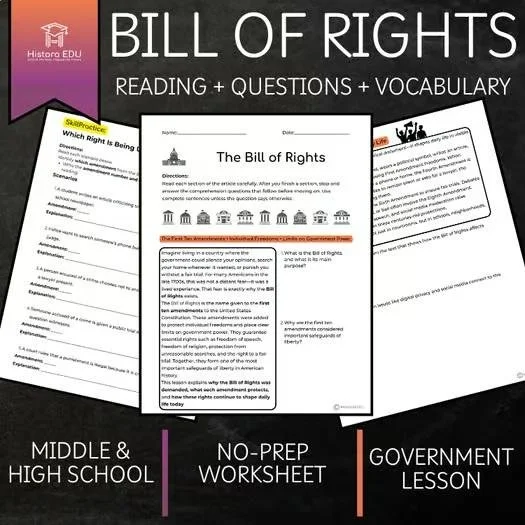
The Bill of Rights Explained |Ten Amendments & Individual Freedoms | Government
Bill of Rights Explained is the non-editable PDF reading option. The listing includes embedded comprehension questions and two skill-practice activities. It can supply a common text before the short constitutional-language routine.
Bill of Rights Review Activity: Real-Life Scenarios for the 10 Amendments
Bill of Rights Review Activity uses Canva-based scenarios covering all ten amendments, with feedback on answer choices. Use one response as a later comprehension check, not as a replacement for reading the constitutional words.
Bill of Rights Bundle | First Ten Amendments Lesson + Real-Life Scenarios Review
The Bill of Rights Bundle contains the reading lesson and scenario review above. It is an alternative to buying those two components separately; check what you already own.
Bill of Rights Complete Online Module | Civics & Government | Full mini-unit
The Complete Online Module lists three mini-lessons, four review games, a workbook and a performance task. For this language lesson, use teacher-led selected sections only, with the qualifications below. Online activities have not been tested for this article.
View this HistoraEDU resource on TPT
Treat short module definitions as starting points, not complete rules
Before assigning Lesson 1.2, compare its definitions with the source wording. Item F needs qualification: the Seventh Amendment preserves jury rights in federal suits at common law, with limits and exceptions—not whenever one person sues another. Ask which scope words a short definition leaves out.
Item A’s warrant-or-probable-cause wording is not a universal search rule. For the workbook’s public-school backpack scenario, teach T.L.O.’s two-part test: justification at the start and a scope reasonably related to the circumstances. Finding nothing does not decide reasonableness. Ask what supported the search and how far it went.
For Lesson 3’s three-day suspension, explicitly assume a public school and allow the Fourteenth Amendment in Step 3. Goss requires notice of charges, an explanation of evidence if disputed, and an opportunity to respond—not a criminal trial. Ordinarily these precede removal; urgent danger or disruption can justify removal first, with process as soon as practicable. These teaching qualifications do not mean the workbook has been revised.
Sources and credits
Bill of Rights original wording and numbering
Brookline petition and historical context
Founding-document image permissions
Civil-jury scope and exceptions — CRS
T.L.O. public-school search standard — U.S. Courts
Goss v. Lopez — U.S. Reports, syllabus pp. 565–566
Product covers: HistoraEDU, reproduced from the exact linked TPT listings at the owner’s request. Photographs and archival reproductions are credited beside each image. Source institutions do not endorse HistoraEDU or its products.
