
By HistoraEDU
A clear photograph of a cliff dwelling can produce an overconfident sentence: “This is exactly what the people built.” Students may not realize that the place has also been excavated, stabilized and sometimes reconstructed. Teach students to connect a visible feature with a conservation record—and to leave a feature unresolved when the record is insufficient.
Give the photograph a history of its own
Use Spruce Tree House at Mesa Verde as one named case. The National Park Service dates its construction to about 1211–1278 CE and identifies its builders as ancestors of Pueblo peoples. Its modern site description also explains excavation and wall stabilization in 1908. Put them on separate lines before students describe what they see.
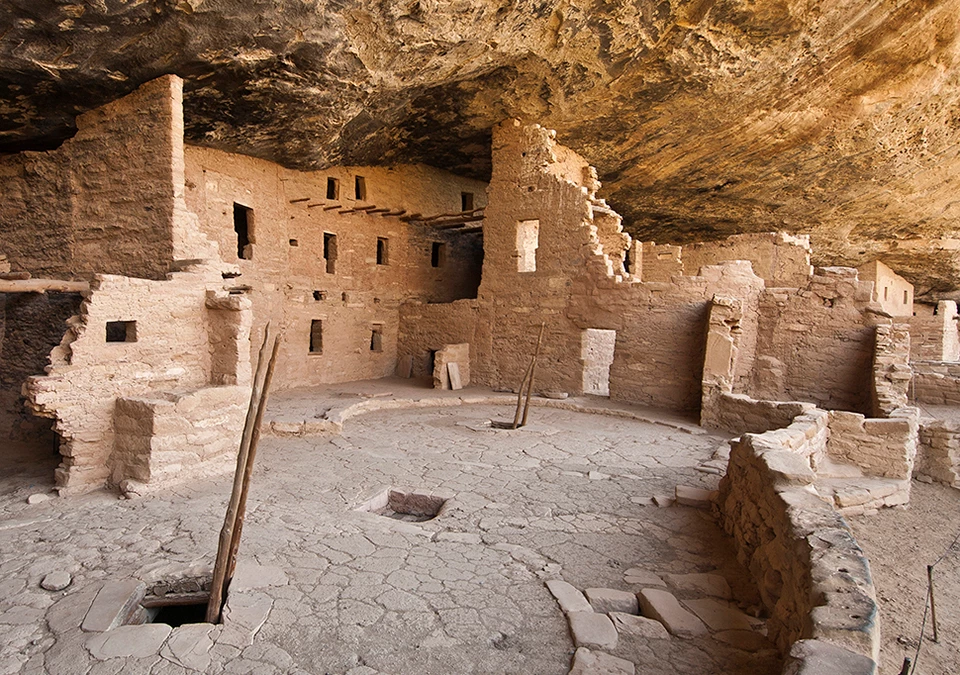
Modern post-stabilization view of Spruce Tree House, Mesa Verde. NPS Photo, public domain; photograph date not specified. The site record documents surviving material and modern interventions. This is not an unchanged thirteenth-century scene or a matched after-image for the brochure’s historical photograph. Image source
Ask students for an initial observation without an age claim: “Stone walls, openings, beams and a broad courtyard are visible beneath an alcove.” A photograph records a condition at the time of exposure; the history of that condition requires more evidence.
Use three labels rather than a real or fake vote
Give pairs three labels: surviving feature; documented modern intervention; unresolved feature. They annotate a classroom copy with numbered notes, not guesses based on which stones look cleaner. Require a source location beside every historical claim.
For the surviving-feature note, start with the NPS account that about 90 percent of visible material at Spruce Tree House is original. Keep that statement at its stated scale: it does not certify every stone in a selected wall. The site brochure, page 6, specifically identifies surviving plaster and wooden wall pegs along its described route. Students record the named feature and locator, rather than coloring the entire photograph as untouched original construction.
For the intervention note, consult the brochure’s courtyard discussion on pages 6–7. It identifies reconstructed kiva roofs forming part of the plaza surface and explains that surviving roofs elsewhere informed the reconstruction. On the photograph, bracket the courtyard area as the location discussed; do not claim that every visible surface or pole dates to the same intervention. The roofs are evidence of a documented reconstruction as well as an interpretation of earlier construction.
For the unresolved note, choose a small patch of mortar beside an opening and write: “The photograph alone does not establish when this patch was applied.” Ask what would help: a treatment record tied to that wall, a dated detail photograph or an architectural drawing. Leaving this note unresolved is more accurate than assigning a date from color.
Show what documentation adds
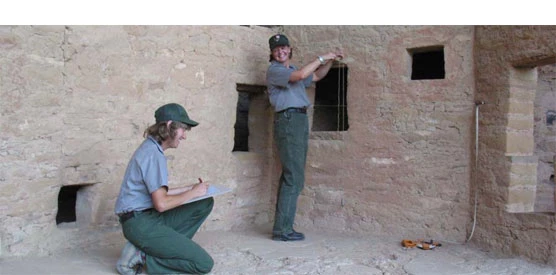
Archaeologists Kay Barnett and Julie Bell documenting an open area at Spruce Tree House. NPS Photo, public domain; date not specified. Measuring and recording are visible; the image does not show a wall being rebuilt. Image source
The NPS photograph of Kay Barnett and Julie Bell documenting an open area at Spruce Tree House makes the missing work visible. Students can observe measuring and recording; they should not relabel the scene “rebuilding an ancient wall.” The NPS architectural documentation account describes photographs, drawings and field records made to understand construction and preserve information before treatments alter fabric.
Use one further example from brochure page 13: its pre-excavation photograph and text identify a missing central section of a two-story wall reconstructed during Fewkes’s 1908 work. Open that linked page when discussing this feature. Do not invent a before-and-after match with the modern view above, which is not presented as the same camera position. A record can establish an intervention even when two convenient classroom images do not form a matched pair.
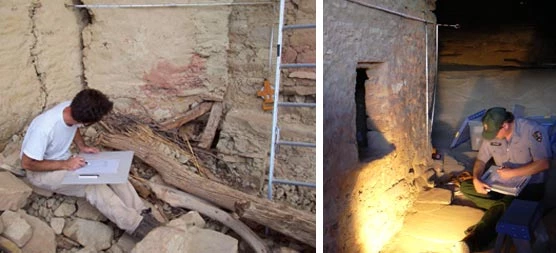
Two NPS fieldwork photographs, public domain; dates not specified. Left: Greg Stoehr recording at Spring House. Right: Aron Adams documenting at Spruce Tree House. The supplied paired image is preserved unchanged; the left frame is a different site, not an earlier view of the right frame. Image source
The paired fieldwork photograph needs its own careful caption. Its left frame is Spring House and its right frame is Spruce Tree House. Ask students to explain why a similar wall-recording method does not make the two locations interchangeable. This is the same source-handling habit they need when comparing Pueblo, Diné and Apache histories: name the place and people before transferring a claim.
Write a caption that keeps the distinctions
Model: “This modern photograph shows Spruce Tree House after excavation and preservation work. NPS records identify substantial surviving material and documented reconstruction, including courtyard roof features discussed in the site brochure. The image alone cannot date each repair or establish how every room was used.”
For support, give students the three labels with one source locator already filled in. For extension, have them explain what new evidence could move an unresolved note into another category. The exit ticket should include one supported survival claim, one documented intervention and one remaining question.
Keep the exercise about evidence and care, not reenactment. Do not ask students to copy ceremonial designs, enter restricted places or treat ancient buildings as abandoned materials to handle. NPS identifies continuing Pueblo and Hopi descendants and other associated communities. A conserved ancestral place is not a frozen stand-in for every Southwest people, past or present.
Match the background text to its limited job
The five separate resources below are reading options, not a required bundle. Their listings describe editable Google Docs with comprehension questions, vocabulary and answer keys. The conservation-record activity is supplied here as a teaching suggestion, not claimed as an included worksheet component.
Southwest Native Americans Reading Comprehension Worksheet
Use selected regional geography for orientation, not as the sole chronology source. Supply this correction before its Ancestral Pueblo section: Crow Canyon’s Mesa Verde sequence dates Pueblo II to 900–1150 CE and Pueblo III to 1150–1300 CE. Do not copy the reading’s 900–1150 Pueblo III label into the activity.
Ancestral Puebloans Reading Comprehension Worksheet
Use a selected settlement or architecture passage before checking the Spruce Tree House record. Separate the date of ancestral construction from excavation, stabilization and reconstruction; this reading is not a treatment report for an individual wall.
Pueblo People Reading Comprehension | Native American History
Use selected community-history passages to keep Pueblo people in the discussion as continuing communities, not simply a building style. Pair them with the NPS account of descendants; a preserved site does not dictate how every contemporary community lives.
Navajo People Reading Comprehension | Native American History
Use a named Diné passage for a source-selection extension: which statements concern Diné history, and which concern this Ancestral Pueblo site? The conservation photograph cannot serve as evidence that all Southwest peoples built or lived alike.
Apache People Reading Comprehension | Native American History
Use selected passages to distinguish specific Apache histories from the Spruce Tree House case. The Mescalero Apache Tribe’s public history identifies Mescalero, Lipan and Chiricahua constituent histories; it is not a description of every Apache community or this dwelling’s builders.
View this HistoraEDU resource on TPT
Sources and credits
NPS: Spruce Tree House construction and preservation
Mesa Verde Museum Association and NPS: Spruce Tree House brochure, pp. 6–7 and 13
NPS: architectural documentation methods and photographs
NPS: people and continuing communities
Crow Canyon: Mesa Verde Pueblo II chronology
Crow Canyon: Mesa Verde Pueblo III chronology
Mescalero Apache Tribe: constituent histories
Product covers: HistoraEDU, reproduced from the exact linked TPT listings at the owner’s request. Photographs and archival reproductions are credited beside each image. No claim to original U.S. Government works. Source institutions and depicted people do not endorse HistoraEDU or its products.
