
By HistoraEDU
A mock hearing can sound energetic while producing very little evidence. Students deliver speeches disguised as questions, assume facts the witness has not established, or ask three things at once. Pause before a vote or a bill-writing task. Teach the smaller skill that makes a hearing useful: asking a question whose answer can clarify a claim.
Give the hearing one limited purpose
Congress.gov describes hearings as a way for committees to hear from selected witnesses and ask questions about proposals or issues. A hearing is not the same activity as a markup, where members consider changes to legislative text. Nor is a hearing required for every bill to advance. For this lesson, keep the goal narrow: identify what evidence the committee still needs.
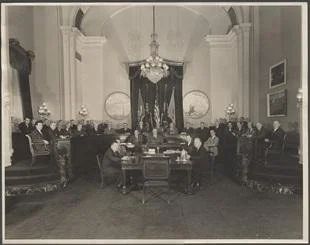
House Armed Services Committee, January 25, 1949, in Room 311 of the Cannon House Office Building. Photograph: U.S. Army; Collection of the U.S. House of Representatives, 2007.007.000. Public domain. This is not a library hearing. Image source
Show the historical committee photograph as a setting, not as evidence about the fictional issue below. Ask who appears to have a place at the table and what a photograph cannot reveal about the questions asked. Students should not infer that a formal-looking room guarantees neutral questions, complete evidence or agreement.
Read one explicitly fictional witness statement
Give every pair this invented statement: “I manage the fictional Riverbend Public Library. During four Saturday afternoons, staff counted 48 visits to our computer area. On 12 visits, a person left before a computer became available. Our busiest weekday afternoons were not counted. I believe adding computers would improve access, but I have not prepared a cost estimate.” These numbers, place and speaker are classroom inventions, not findings about a real library.
Ask students to mark three different things: something counted, a limitation of the count and a proposed conclusion. Visits are not necessarily unique people. Leaving before a computer is free does not by itself establish the person’s reason for leaving. A witness can report useful observations while acknowledging that the evidence is incomplete.
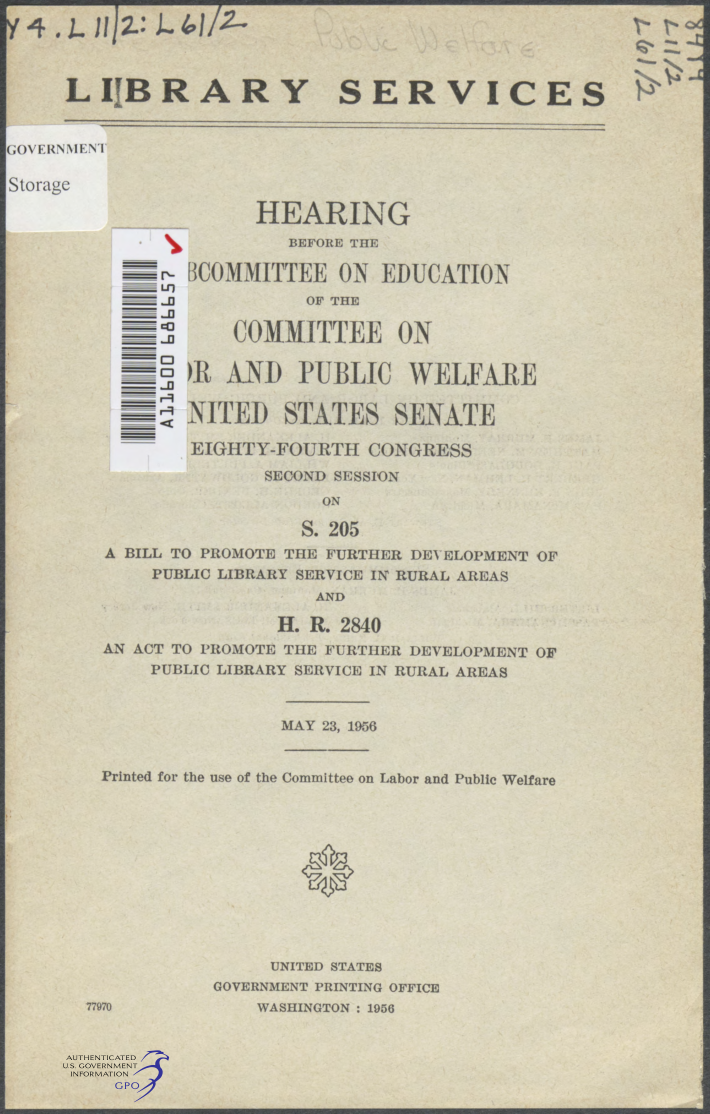
Title page of Library Services, a Senate Subcommittee on Education hearing held May 23, 1956. U.S. Government Printing Office, via GovInfo. Public-domain federal record. This real record is separate from the fictional Riverbend statement. Image source
Repair three weak questions
Leading accusation: “Why are you wasting money instead of helping readers?” This presumes waste and invites a defensive speech. Replace it with a neutral clarification: “What services would the proposed spending add?” Students should explain what information the revised question could produce.
Double-barreled question: “How many residents need computers and how much would the expansion cost?” A witness might answer only one part, and neither answer is established in the statement. Repair it as a source request: “What records support your proposal to add computers?” Ask a separate cost question later. One question should have one clear evidence target.
Unsupported generalization: “Since everyone in town needs a library computer, why not double the number?” Replace it with a scope check: “Do these four Saturday counts tell us about demand on weekdays or among people who never visited?” The revised question tests the boundary of the data instead of inflating 48 visits into a claim about every resident.
Rehearse an answer without inventing the missing evidence
In pairs, one student asks a repaired question and the other answers using only the statement. “The statement does not provide that information” is an acceptable response. The questioner then names a useful next source: counts from other days, a clearly described survey, or a cost estimate with assumptions. Do not reward a witness for improvising reassuring numbers.
Switch roles and have partners check three features: neutral wording, one focus and a clear connection to a claim. A polite question can still be vague, and a challenging question can still be fair. Ask students to replace “Can you explain more?” with the specific term, comparison or missing detail they need explained.
U.S. Capitol dome and Statue of Freedom, photographed between 1980 and 2006. Carol M. Highsmith, Library of Congress, LC-DIG-highsm-17865. Public domain. Connect this institution to Congress’s work, not to every action taken by government. Image source
Finish with an evidence request, not a verdict
The exit ticket has two lines: “The evidence currently supports ___” and “Before recommending action, I would ask for ___ because ___.” A useful response might say that the statement records computer-area visits and departures before a computer was available during sampled Saturdays but cannot establish the number of unique residents affected. It should explain why a proposed next source addresses that limitation.
For support, provide the three question stems—“What do you mean by…?”, “What record supports…?” and “Does this evidence also cover…?”—and read the statement aloud. For extension, ask which additional witness could supply a different perspective and what evidence that person might contribute. Do not turn disagreement into a contest to embarrass the witness.
The historical library-hearing cover establishes that library services have been a real subject of congressional hearings; it does not authenticate the invented Riverbend statement. Keep that distinction visible when students transfer the routine to an actual hearing excerpt. Read the real statement and its context before evaluating the questions.
Place the skill inside a lawmaking lesson
Use a process reading to establish where committees fit, then insert this questioning routine before students make a policy recommendation. The fictional testimony, question repairs and evidence exit ticket are additional teaching suggestions, not promised contents of the resource below.
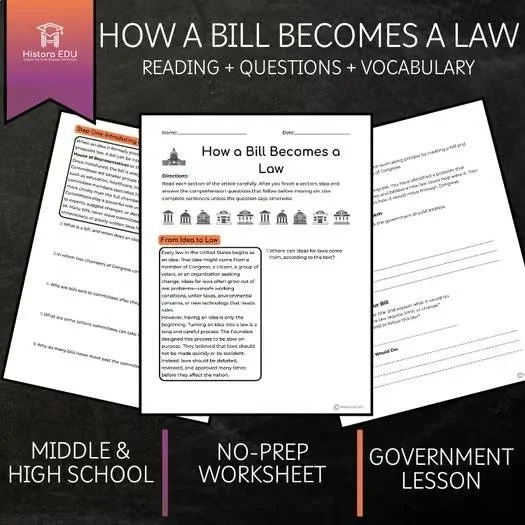
How a Bill Becomes a Law | Lawmaking Process | Government Lesson | Make a Bill
How a Bill Becomes a Law is a non-editable PDF lesson with a reading, embedded comprehension questions and a Create Your Own Law activity. Its listing covers committees, debate, voting and the President’s role. Use the hearing routine as a separate evidence-focused bridge; students need not draft or vote on a bill today.
View this HistoraEDU resource on TPT
Sources and credits
Congress.gov committee consideration explanation
Library Services hearing, May 23, 1956
House Armed Services Committee photograph
Product covers: HistoraEDU, reproduced from the exact linked TPT listings at the owner’s request. Photographs and archival reproductions are credited beside each image. Source institutions do not endorse HistoraEDU or its products.
