
HistoraEDU | A clause by clause reading routine
You ask students what a charter authorizes, and they start guessing from a few familiar words. Gold means greed; king means power; a long sentence means someone else should explain it. Instead of translating the whole document for them, teach one short passage as a set of relationships. Who grants permission, who receives it, what may they do, and what condition must they keep? A careful paraphrase should preserve those relationships even when the vocabulary becomes simpler.
Choose a passage with a visible condition
Use the First Charter of Virginia, dated April 10, 1606. The mining paragraph begins “And moreover, we do GRANT and agree.” It authorizes the colonial councils to arrange searching and mining for gold, silver and copper, and later specifies a share for the Crown. This makes a useful reading exercise because the permission and the obligation are in the same paragraph. Students must find both.
Display the linked transcription and select only the mining paragraph. Explain that the royal “we” refers to the monarch speaking in the charter, not to every English person. “Said” points back to something already identified. “Yielding” here introduces what must be given to the Crown; it is not a description of crops. These three glosses are enough to begin. Do not remove every unfamiliar word before students have a purpose for reading.
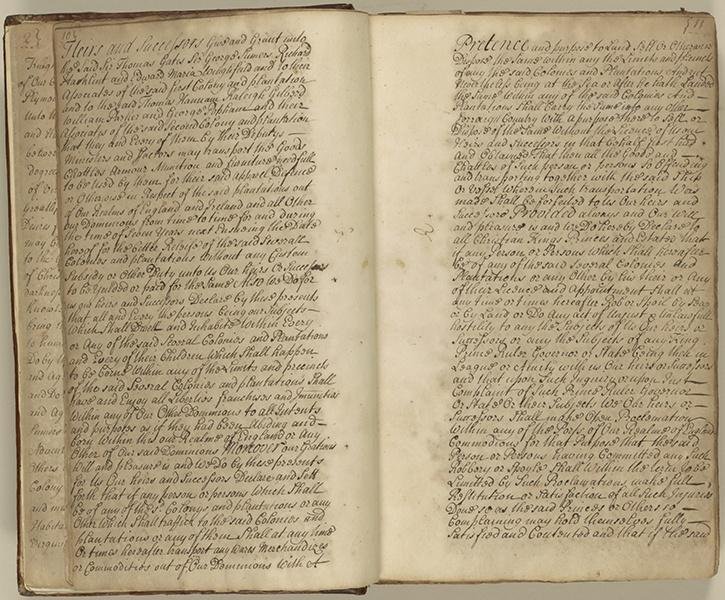
Charter of Virginia, 1606, in the Records of the Virginia Company. Thomas Jefferson Library Collection, Library of Congress, Rare Book and Special Collections Division, exhibition item 022.00.01. Public-domain historical manuscript. This is a manuscript record, not a photograph from 1606.
Mark the actor action and condition
First, have students bracket the opening grant. Next, underline “the said several Councils” as the recipients of the authority. Then circle the verbs about digging, mining and searching. Finally, put a double line under the portion beginning “YIELDING therefore.” Give each marking a job rather than asking the class to highlight whatever seems important.
Read the share clause slowly: the charter specifies a fifth of the gold and silver and a fifteenth of the copper obtained. A fifth and a fifteenth are not interchangeable. Ask students to write the two materials groups separately before paraphrasing. The exercise concerns a required share of metals obtained, not a modern tax rate on all colonial income.
Now model a teacher paraphrase: “The king authorizes the colonial councils to arrange searches and mining for gold, silver and copper in the specified areas. The colonies may use the metals obtained, while giving the Crown one fifth of the gold and silver and one fifteenth of the copper.” Label this a paraphrase of the selected passage, not a quotation or a summary of the entire charter.
Test a tempting wrong paraphrase
Offer an invented answer: “The king let anyone keep all the gold they found anywhere in America.” Ask students to repair it by returning to the words, not by adding an opinion about colonization. “Anyone” loses the named councils. “All” erases the Crown’s share. “Anywhere” ignores the passage’s stated colonial and geographical scope.
Pairs can use a simple four-part check: speaker, recipient, action and condition. One student reads the original while the other points to the matching part of the paraphrase. Then switch roles. If a part of the original disappears, the paraphrase is incomplete even if the new sentence sounds fluent.
For an extension, ask whether the passage proves that gold was found. It does not: authorization to search is not evidence of discovery or profit. Keep that distinction brief here. The main lesson is preserving a sentence’s conditions, rather than repeating a full lesson on colonial motives.
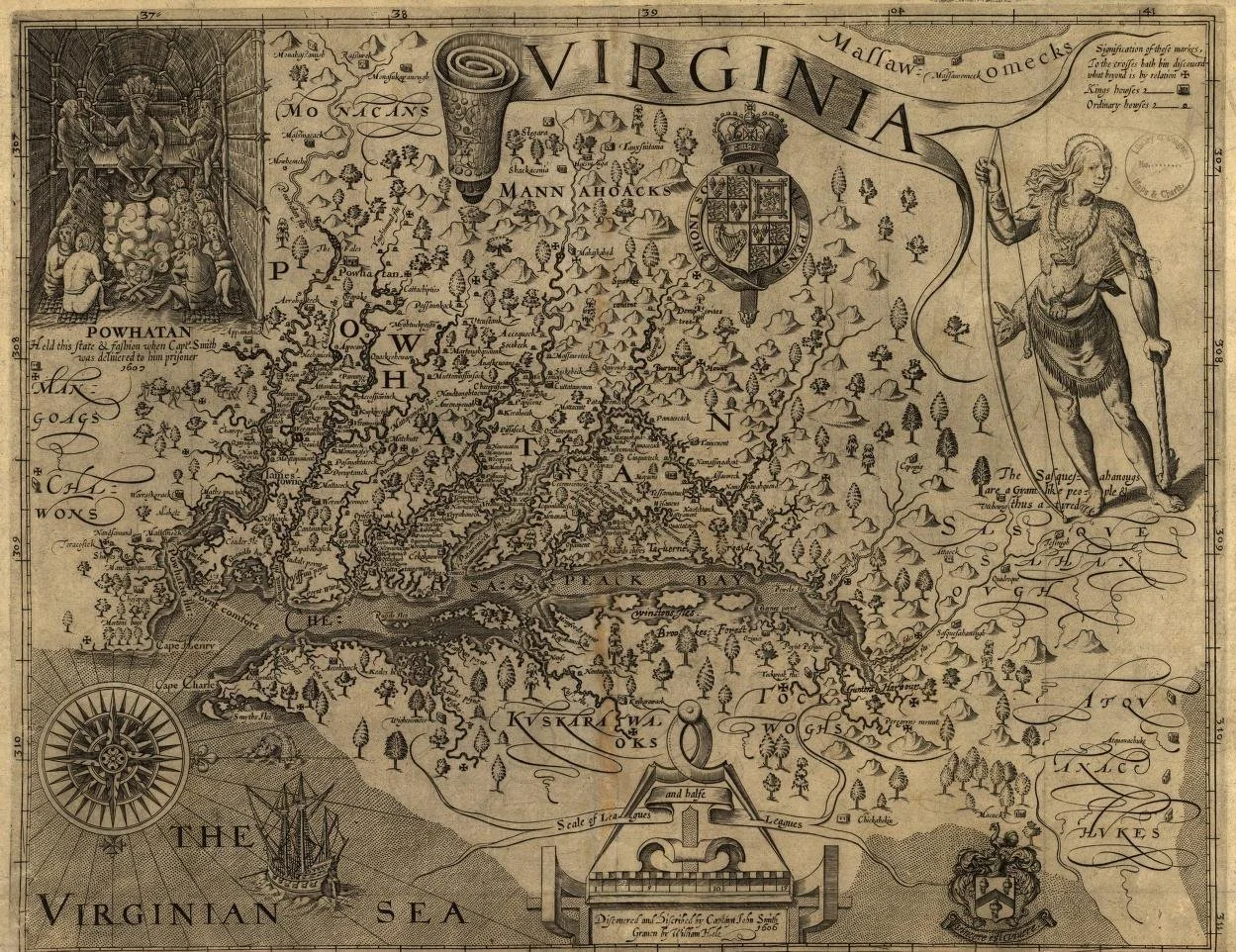
Virginia, John Smith, engraved by William Hole; sixth state, London, 1624. Library of Congress, Geography and Map Division, G3880 1624 .S541, item 99446115. Public domain; north is to the right. This later map provides geographic context; it is not the boundary attachment to the 1606 charter.
Do not let easier language erase the source perspective
A readable paraphrase can still reproduce a colonial claim as if it were an uncontested fact. Say “the charter claims or grants authority” rather than “the land belonged to the king because the charter says so.” The document records a royal position; it does not establish Indigenous consent. Keep the distinction between describing the source and adopting its authority.
Use the later John Smith map as a brief check on context. Its named Indigenous settlements make an “empty land” paraphrase especially misleading. The image shown is a 1624 state of the map, not a picture of the charter being signed or a map from 1606. Ask what additional perspectives would be needed to understand the consequences of the claimed grant. Do not invent an Indigenous speaker’s response to fill the gap.
Make one image question serve the reading
Show the modern photograph of the church ruin at Historic Jamestowne after the text work. Ask students to classify it: a source about a surviving site, a photograph of the 1606 grant, or proof that a mining venture succeeded? Only the first description fits this photograph. Its later date is not a defect; it is part of knowing what it can answer.
This source check helps prevent a common slide-deck problem: students assume every image on a page illustrates the exact event in the paragraph. Keep the caption visible and distinguish a manuscript reproduction, a later map and a modern site photograph. None is an invented view of settlers mining.
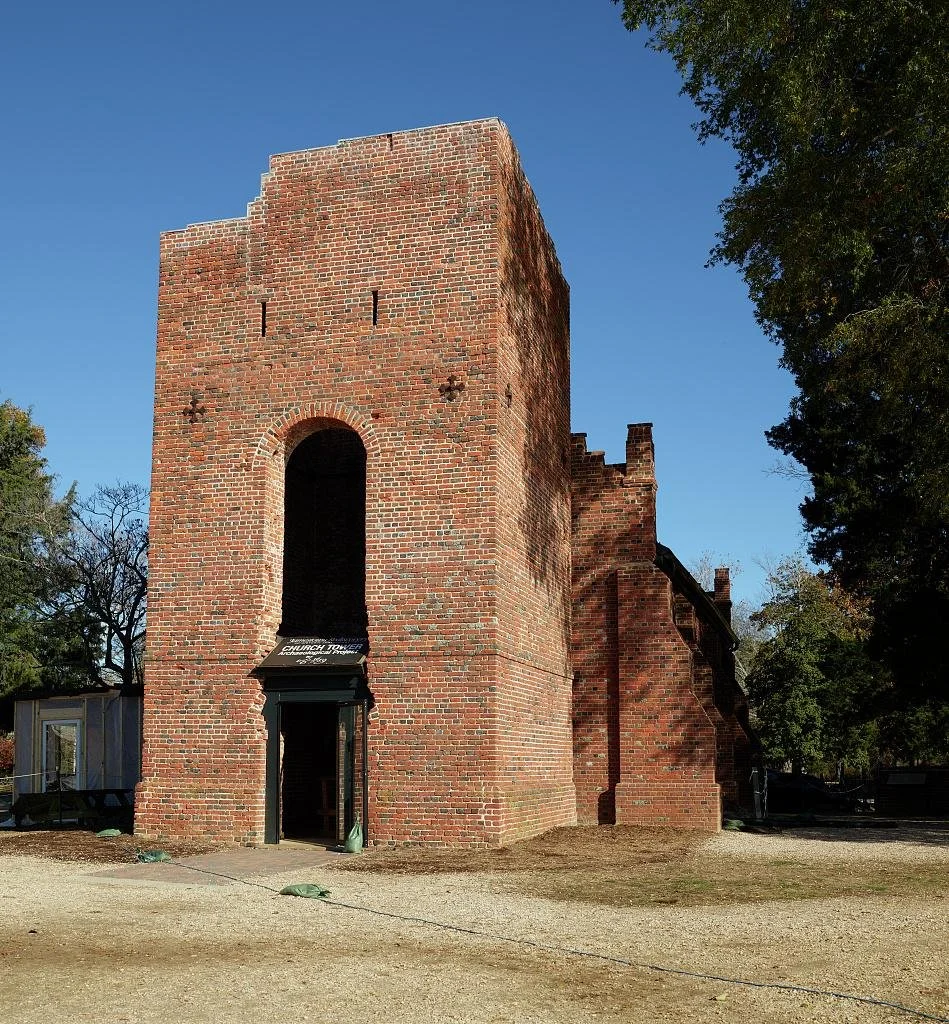
Ruin of a seventeenth-century church at Historic Jamestowne, photographed November 24, 2019. Carol M. Highsmith, Library of Congress, LC-DIG-highsm-61496. Public domain. Modern site photograph, not a reconstruction of colonial life.
Assess a faithful paraphrase rather than modern sounding prose
For an exit task, give students the selected mining passage again and ask for a two-sentence paraphrase plus one limitation. Look for the councils, the authorized action, the two different Crown shares and a limit such as “this does not prove what was actually found.” Do not award full credit merely because the answer is shorter than the source.
If students need support, supply the four category labels and let them annotate before writing. If they are ready for transfer, choose another short clause with an explicit qualification and ask them to find the equivalent relationship. Preserve the qualification when shortening the source; otherwise students practice reading a different document.
Use the resource as a companion to close reading
The HistoraEDU reading below includes two charter excerpts alongside background on colonization motives. The annotation routine here is a teacher-added way to slow down a selected passage. Check the passage in the resource against the full transcription before assigning the Crown-share extension; this article does not claim that its exact annotation marks, model paraphrase or image sequence appear in the download.
Reasons for Colonization Reading Comprehension | Motives & Sources
View this HistoraEDU resource on TPT
Reasons for Colonization provides separate five-page student and teacher PDFs. The current listing describes four reading sections, two charter excerpts, comprehension and source questions, vocabulary, cause and effect, and 19 numbered tasks including the warm-up. Use its reading and response structure around this focused paraphrasing lesson. The three archival visuals in this article are not a claim about the product’s two credited images.
Sources and image credits
First Charter of Virginia April 10 1606 transcription and mining clause
John Smith map catalog record and date
Highsmith collection rights statement
Product thumbnail reproduced from the exact HistoraEDU listing at the owner’s request. Historical photographs are separate evidence, not product endorsements.
