
HistoraEDU | Teaching government ideals alongside historical exclusions
A student reads “We the People” and concludes that everyone could vote when the Constitution was written. Another decides that exclusions make the Preamble meaningless. Neither response has done the historical work yet. Give the class a narrower task: distinguish a stated purpose from a rule about participation, then trace a documented change. The aim is a supported explanation, not a vote on whether the founding was entirely admirable or entirely fraudulent.
Put an ideal beside a dated rule
Start with the Preamble’s goal of securing liberty. Ask students what kind of statement it is: a purpose, an eligibility rule, or a record of what people actually experienced? It is a statement of purpose. It does not list who qualified to vote. Article I, Section 2 separately connects qualifications for electors of the House of Representatives to qualifications for voters of the most numerous branch of each state legislature. Do not turn the Preamble into a universal voting guarantee.
For a manageable comparison, use New Jersey rather than saying “all colonies” or “all Americans.” Its 1776 constitution, section 4, describes voters as inhabitants of full age who met a fifty-pound clear-estate qualification and had lived in the county for twelve months. The wording does not specify male or white. That is not the same as saying every resident could vote: age, property and residence are explicit limits. Mark the state and year on the board before reading the passage.
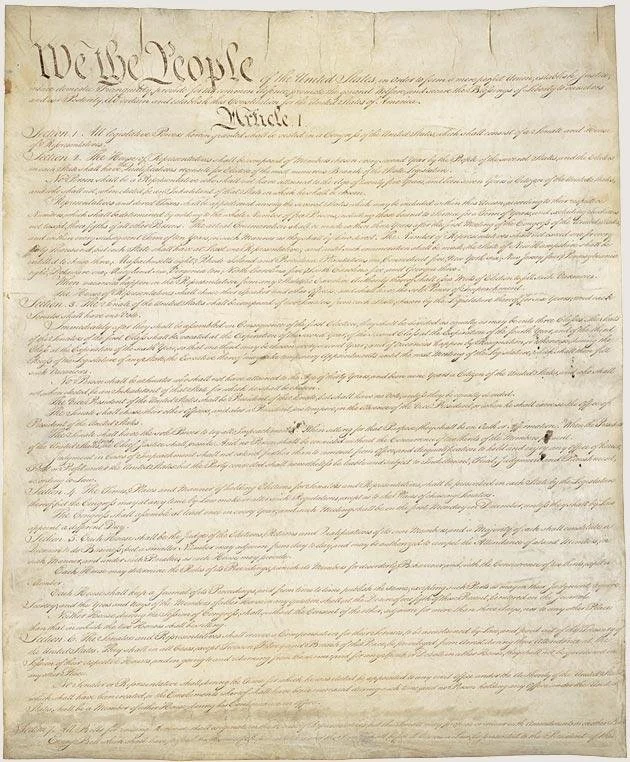
The first page of the Constitution, 1787. The Preamble states purposes; Article I then sets out governmental arrangements. Photograph of the original document, National Archives. Public domain. Use the linked transcript for close reading rather than expecting students to decipher this small reproduction.
Build an ideals access and change table
Give students three columns headed Ideal, Access rule, and Change or remaining limit. Add a separate date and place label to every entry. In the Ideal column, write a short paraphrase such as “secure liberty for the people and future generations,” labeled United States Constitution, 1787. In Access rule, record the New Jersey requirements from 1776. The entries are deliberately from different documents and dates; students are comparing them, not claiming the federal Preamble created that earlier state rule.
Now add a brief extract from New Jersey’s election act of November 16, 1807. Its opening section restricts eligibility to free, white, male citizens and also specifies age, estate and residence requirements. Have students underline the new race and sex restrictions rather than treating the later date as automatic progress. Use the linked full act if investigating its property and tax provisions; this short comparison is about the explicit racial and sex boundary, not a complete account of election administration.
In the Change column, add the Nineteenth Amendment, ratified in 1920. Its text prohibits denial or abridgment of United States citizens’ voting rights on account of sex. It does not say that every person may vote without other qualifications. National Archives context also explains that discriminatory state laws continued to prevent many women, including African American women, from voting. A constitutional change and equal access in practice are related questions, not interchangeable answers.
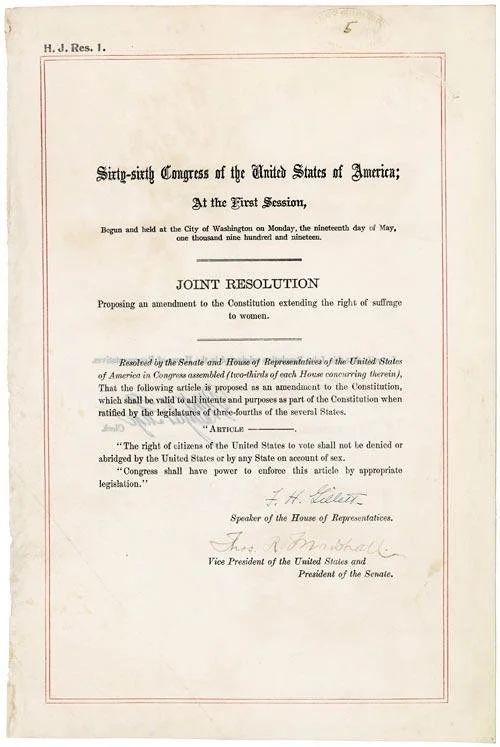
Congress’s joint resolution proposing the Nineteenth Amendment, June 4, 1919; the amendment was ratified August 18, 1920. National Archives, General Records of the United States Government, Record Group 11. Public domain. The dates distinguish proposing an amendment from ratifying it.
Model the sentence that needs revising
Offer this invented student claim: “The Preamble gave everyone the vote in 1787, and the Nineteenth Amendment made it equal.” Ask partners to identify two claims that the documents do not support. Then model a more precise response: “The Preamble expressed a purpose of securing liberty, but it did not define voter eligibility. New Jersey’s rules show that access could narrow as well as expand. The Nineteenth Amendment prohibited sex-based denial of citizens’ voting rights, while other barriers remained.”
Keep the writing demand modest. Each pair needs one accurate date, one named document and one limitation. A student who writes only “people were excluded” should identify the particular rule. A student who writes “all women could vote in 1920” should return to the amendment’s wording and the archival context. Neither response needs a longer paragraph until its categories are clear.
Do not assign students roles in a simulated vote that removes their classmates’ rights by race or gender. Analyze the historical rules as evidence. A source-based comparison can confront exclusion without making students perform it. This is a historical reading routine, not advice about present-day voter eligibility.
Show people acting rather than waiting for change
A timeline of legal documents can make political change appear to happen by itself. Add one named participant. Marie Louise Bottineau Baldwin, a member of the Turtle Mountain Band of Chippewa Indians, worked in the Office of Indian Affairs and participated in the 1913 woman suffrage parade in Washington, DC. Her personnel portrait, dated about 1911, is not a photograph of that parade. Pair the image with its archival description, and ask which facts come from the image and which require the accompanying record.
Students can observe a posed portrait and clothing details. They cannot infer a voting rule, a person’s entire political position or the experience of all Native women from her appearance. Use her documented participation to add an action to the timeline, while keeping individual biography distinct from a whole community’s history.
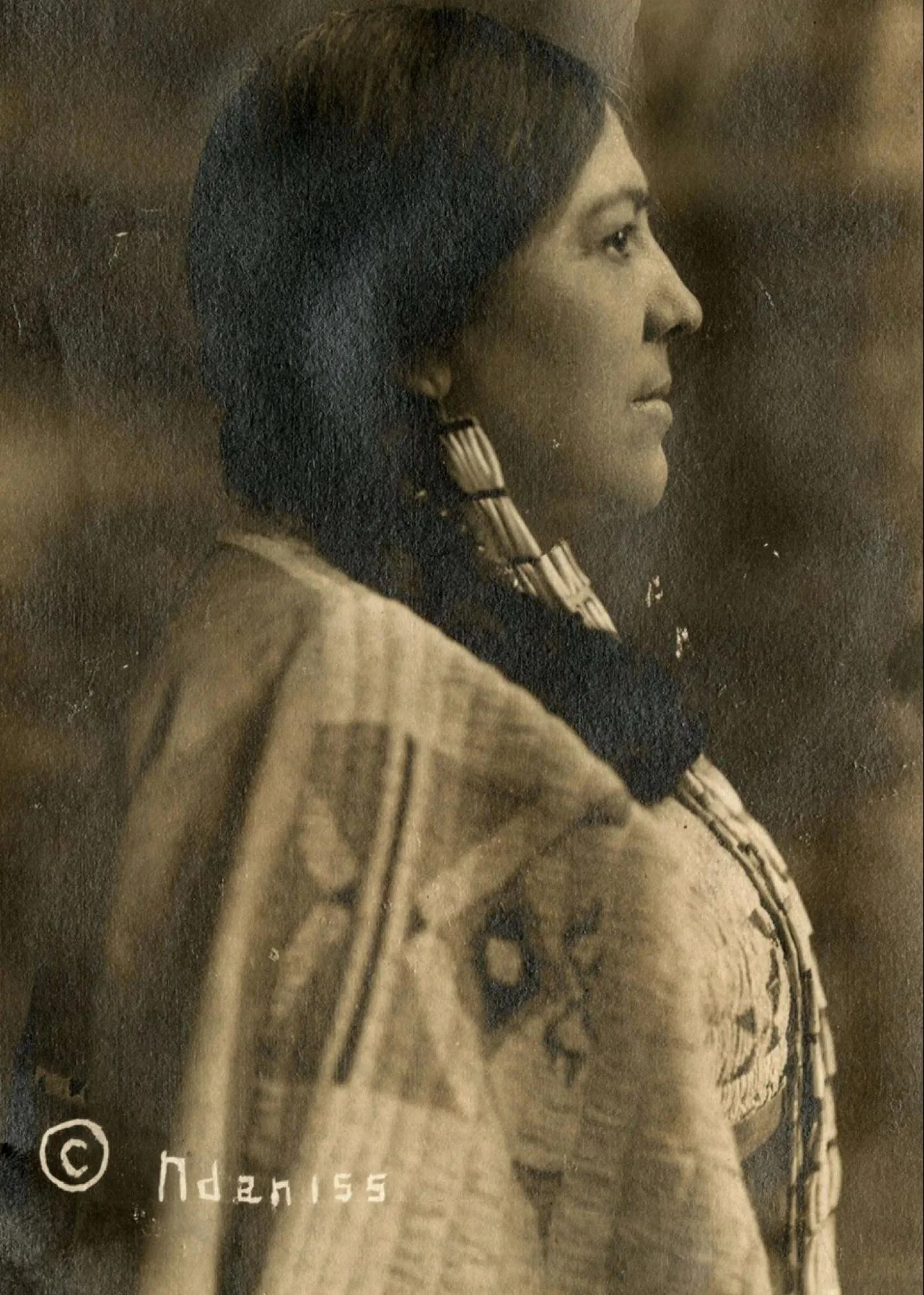
Marie Louise Bottineau Baldwin, about 1911, in a personnel-file photograph. National Archives at St. Louis, Records of the U.S. Civil Service Commission, Record Group 146. The specific DocsTeach record marks the photograph public domain. This portrait predates the 1913 suffrage parade; it is not a scene from the march.
Keep the assessment focused
End with a three-sentence exit response: identify one founding purpose, explain one dated participation restriction, and describe one later change without claiming it removed every barrier. Look for the distinction between purpose, formal eligibility and lived access. If those categories are still blurred, revisit one pair of documents instead of adding more amendments.
For readers who need support, supply short excerpts and define estate as property in this historical context, suffrage as voting rights, and ratification as formal approval. Keep the original wording alongside a teacher paraphrase. For students ready for more, ask what evidence would establish whether a formally eligible person could actually cast a ballot. A rule alone cannot answer that question.
Choose resources for background not as substitutes for the records
The HistoraEDU resources below can supply government vocabulary and reading practice around this inquiry. The New Jersey comparison, archival images and ideals/access/change table are additions described in this article, not promised components of those downloads. Choose the background reading your class needs; there is no need to complete five packets before discussing one carefully chosen source.
Why Do We Need Government? | Purposes of Government Lesson | Reading Passage
View this HistoraEDU resource on TPT
Use the chunked reading and comprehension questions to establish why communities create governments. Its create-your-own-government extension is separate from this article’s dated inquiry; it should not replace examination of actual historical rules.
The Preamble Explained | Goals of Government | Reading Comprehension & Skills
View this HistoraEDU resource on TPT
The reading, embedded questions and activity matching government actions to Preamble goals can build the vocabulary for the Ideal column. Add the primary records here to test the difference between a goal and a participation rule.
The Articles of Confederation | Government Lesson | Reading Comprehension
View this HistoraEDU resource on TPT
Use the reading and cause/problem/solution skill practice for background on the earlier national structure. Its relevance here is context for institutional change, not evidence of who could vote in every state.
Constitutional Convention | Government Lesson | Reading Comprehension | Vocab
View this HistoraEDU resource on TPT
The reading and questions introduce the Convention’s debates and representation arrangements. Keep representation in Congress distinct from individual voter eligibility when linking that background to this inquiry.
Rights & Responsibilities of Citizens | Civic Duties & Citizenship | Government
View this HistoraEDU resource on TPT
The citizenship reading, embedded questions and skill practice offer a vocabulary bridge to civic participation. Keep its general civics discussion separate from the dated New Jersey rules, and check the jurisdiction and period whenever discussing a particular legal duty.
Sources and image credits
United States Constitution transcript including Preamble and Article I Section 2
New Jersey Constitution of 1776 section 4 and original-page images
New Jersey election act of November 16 1807 original record
Nineteenth Amendment text dates and limitations of enfranchisement
Marie Louise Bottineau Baldwin personnel portrait and archival biography
Image record h053-constitution
Product thumbnail reproduced from the exact HistoraEDU listing at the owner’s request. Historical photographs are separate evidence, not product endorsements.
