
By HistoraEDU
A student calls the Moon program too expensive. Another says the achievement was worth any price. Before asking the class to choose a side, give both students a more answerable task: identify what a spending figure actually measures. A short comparison of NASA budget authority, federal outlays and a dated request to Congress can turn a free-floating opinion into a historically bounded question.
Make a spending measure card before making an argument
Ask pairs to give every number four labels: year, organization or program, accounting measure and dollar unit. “Billions for space” is not a complete label. NASA’s agency total is not the cost of Apollo alone, and NASA is not the whole U.S. government’s space effort.
Begin with Appendix E-1A on printed page A–30 of the 1995 Aeronautics and Space Report of the President. The table identifies its measure as budget authority and its unit as millions of real-year dollars. For fiscal 1966, NASA Total is 5,175: $5.175 billion in that year’s dollars. The table also separates NASA Space from NASA Total; its note explains that the latter includes aeronautics. Do not add those two columns together.
Explain budget authority as permission to enter financial obligations. Outlays record money disbursed to meet obligations. A payment in one year can relate to authority provided earlier; these are not interchangeable labels for the same annual figure.
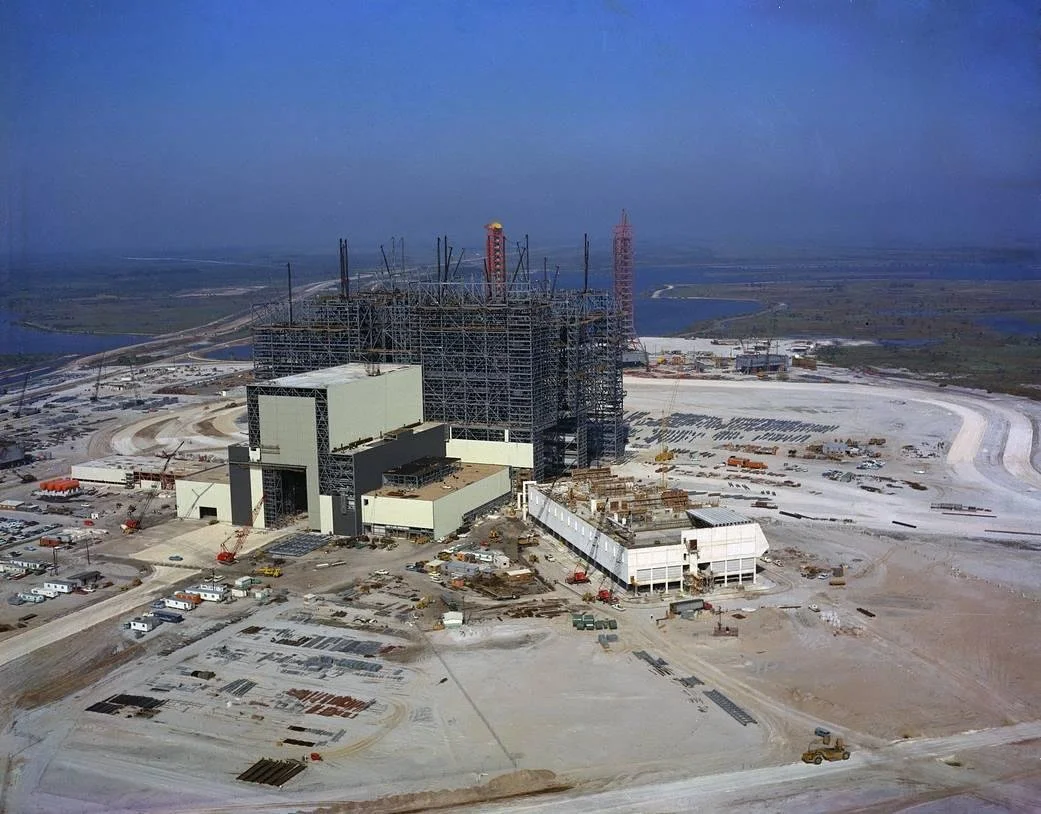
Construction of the Vehicle Assembly Building, November 9, 1964. NASA photograph, used as factual historical context under NASA media-use guidelines. The photograph identifies a facility and date; it does not price the building or represent all NASA spending.
Calculate a share using matching measures
Now open OMB Historical Table 4.1, Outlays by Agency, in the fiscal 2027 historical tables. Its fiscal 1966 column lists NASA outlays of $5,933 million and total federal outlays of $134,532 million. These are retrospective historical figures, not a 1966 classroom prop or a forecast of future spending.
Model the calculation explicitly: 5,933 ÷ 134,532 × 100 = approximately 4.41 percent. Both numerator and denominator are outlays for the same fiscal year and use the same dollar unit. Students can write: “NASA accounted for about 4.41 percent of total federal outlays in fiscal 1966 in this table.”
Then show the tempting wrong calculation: 5,175 ÷ 134,532. The arithmetic can be performed, but the numerator is NASA budget authority from the first table and the denominator is federal outlays from the second. It does not establish NASA’s share of federal outlays. The repair is to match the accounting measures, not simply to round more carefully.
The $5.933 billion amount and the 4.41 percent share answer different questions. One states the agency’s outlays in dollars; the other locates those outlays within a larger federal total. Neither is a figure for Apollo alone, a share of household income, or a measure of benefits.
Keep inflation adjustment separate from budget share
Use three sentence starters on the board. “Nominal dollars tell us the recorded dollar amount for that period.” “Inflation-adjusted dollars place amounts on a stated common price basis.” “Budget share compares a part with a specified whole.” Students match each starter to a question before choosing a number.
For example, comparing purchasing power across distant years requires an explicit inflation measure and base year. The 4.41 percent calculation does not perform that adjustment. A budget share can also change because the denominator changes. Do not turn a smaller share into a claim that nominal spending necessarily fell.
Keep the core activity to the one fiscal year. If you extend it, require the same accounting measure, a clearly identified price basis and a consistent organizational scope before students compare years. A longer spreadsheet is not automatically a better historical argument.
Read a request as a request rather than a final bill
Return to May 25, 1961. In his address to a joint session of Congress, President Kennedy requested a major space commitment and estimated additional costs over the next five years. He also raised the possible diversion of skilled people, materials and facilities from other important work.
Ask students to label the speech “contemporary proposal and argument.” It is not the later total cost of Apollo and cannot be substituted for an annual outlay entry. Conversely, the fiscal 1966 tables do not show what Kennedy or legislators knew with certainty in May 1961. Keep the request date and the retrospective spending year visible.
Students should identify one resource constraint in the speech and one value judgment that the budget table cannot settle. Recognizing a claim about national priorities is different from accepting that claim; the source lets the class examine the argument without inventing a single congressional opinion.
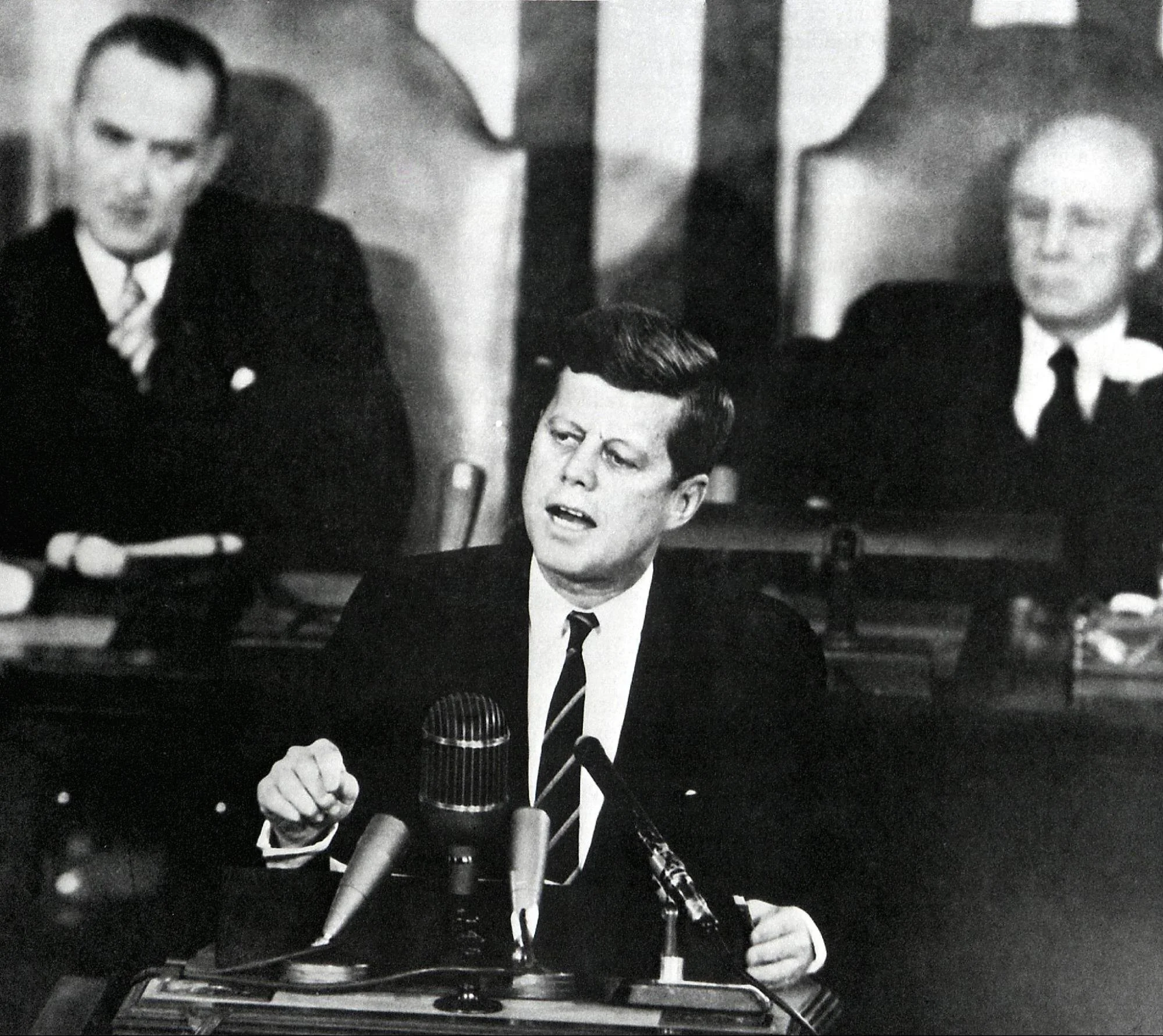
President John F. Kennedy addressing a joint session of Congress, May 25, 1961. Photograph supplied with NASA’s historical speech record; factual editorial use only under NASA media-use guidelines. The photograph documents the setting, not agreement by every listener.
Write a bounded opportunity cost question
Have pairs produce a three-part spending comparison: the $5.175 billion authority figure with its label, the $5.933 billion outlay figure with its label, and the approximately 4.41 percent outlay share with its denominator. Underneath, they write one question about an alternative use of resources.
A useful question is: “In the 1961 decision, how did advocates weigh the proposed lunar commitment against other demands on scientific and technical personnel?” It identifies a decision, a resource and a need for further evidence. “How many schools could that money have bought?” is not answerable from these tables alone: it would require a dated, comparable cost model, a defined alternative and evidence about what could actually be redirected.
Use the laboratory image below to ask what additional evidence would be needed to discuss scientific returns. A photographed sample is not a monetary valuation of research. Costs, outputs and judgments of importance must be connected by an argument, not treated as equivalent units.
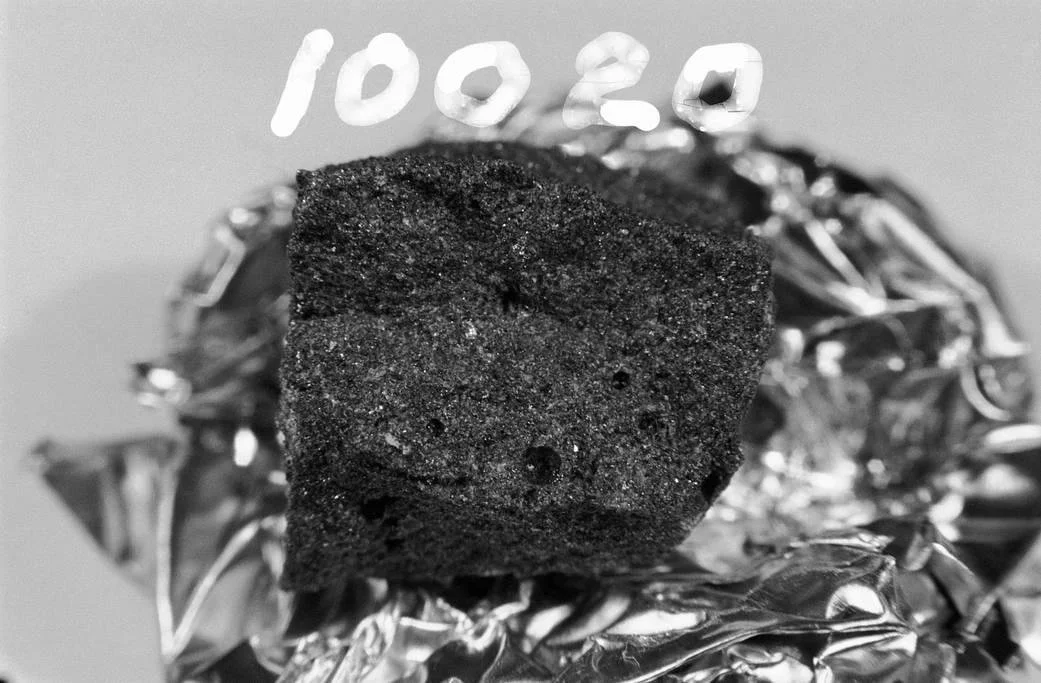
Lunar sample 10020, NASA photograph S69-46481. This laboratory photograph is a record of a sample, not an estimate of the financial value of lunar research. Factual editorial use under NASA media-use guidelines; no endorsement implied.
Assess the labels before the position
Collect the comparison and opportunity-cost question before any discussion of whether the commitment was justified. Look for a matched numerator and denominator, a distinction between a proposal and later spending, and an explicit limit on what the figures establish. Students may reach different judgments while still meeting those evidence requirements.
For students who need support, supply the two table headings and the relevant entries rather than the entire spreadsheet. For extension, ask what new source would help answer their question: a dated hearing, a program-specific expenditure record, or evidence about competing personnel demands. The next source should match the question, not just contain another large number.
Connect budget reading with the wider Space Race
HistoraEDU’s Space Race reading and photograph questions can establish the Cold War context before this numerical inquiry. Keep the budget sources and spending-measure card as separate teacher-supplied additions. The resource is a history lesson, not a NASA budget workbook.
Space Race Reading & Photo Analysis | Cold War | Grades 7–8

View this HistoraEDU resource on TPT
Use the sectioned reading, historical photographs and evidence questions for shared context. Keep the separate teacher guide private when distributing student work. Add the original comparison routine above when students need to examine a claim about costs rather than only recount milestones.
Sources and image credits
NASA historical budget authority table Appendix E1A printed A30
OMB historical tables and Table 4.1 Outlays by Agency
Exact OMB fiscal 2027 Table 4.1 workbook
Senate Budget Committee definitions of authority and outlays
Kennedy address to Congress May 25 1961 preserved by NASA
NASA image and media use guidelines
Product thumbnail reproduced from the exact HistoraEDU listing at the owner’s request. Historical photographs are separate evidence, not product endorsements. NASA images appear only as factual editorial evidence in the article body, not as advertisements, product covers or endorsements.
