
By HistoraEDU
Students can identify a nuclear symbol and still miss the argument in a Cold War cartoon. Instead of stopping at a symbol key, ask what the artist makes those symbols do. Jim Berryman’s 1957 cartoon Backing it Up offers a compact worked example: turn labels, placement and visual contrast into an interpretation, then use a dated policy record to test its historical scope.
Read the objects before explaining the message
Show the complete cartoon with its creator and date: Jim Berryman, May 6, 1957. Keep its title nearby but give students a moment to describe the arrangement first. It is a deliberately composed drawing, not a photograph of a weapon installation.
Students should notice the large letters of NATO seen from behind, the stone base and the oversized weapon shape labeled “Nuclear Retaliation Warning.” An atomic symbol appears above it. Ask where the weapon stands relative to the lettering and which element dominates the foreground. “There is a bomb” is an observation to refine, not yet an explanation of the argument.
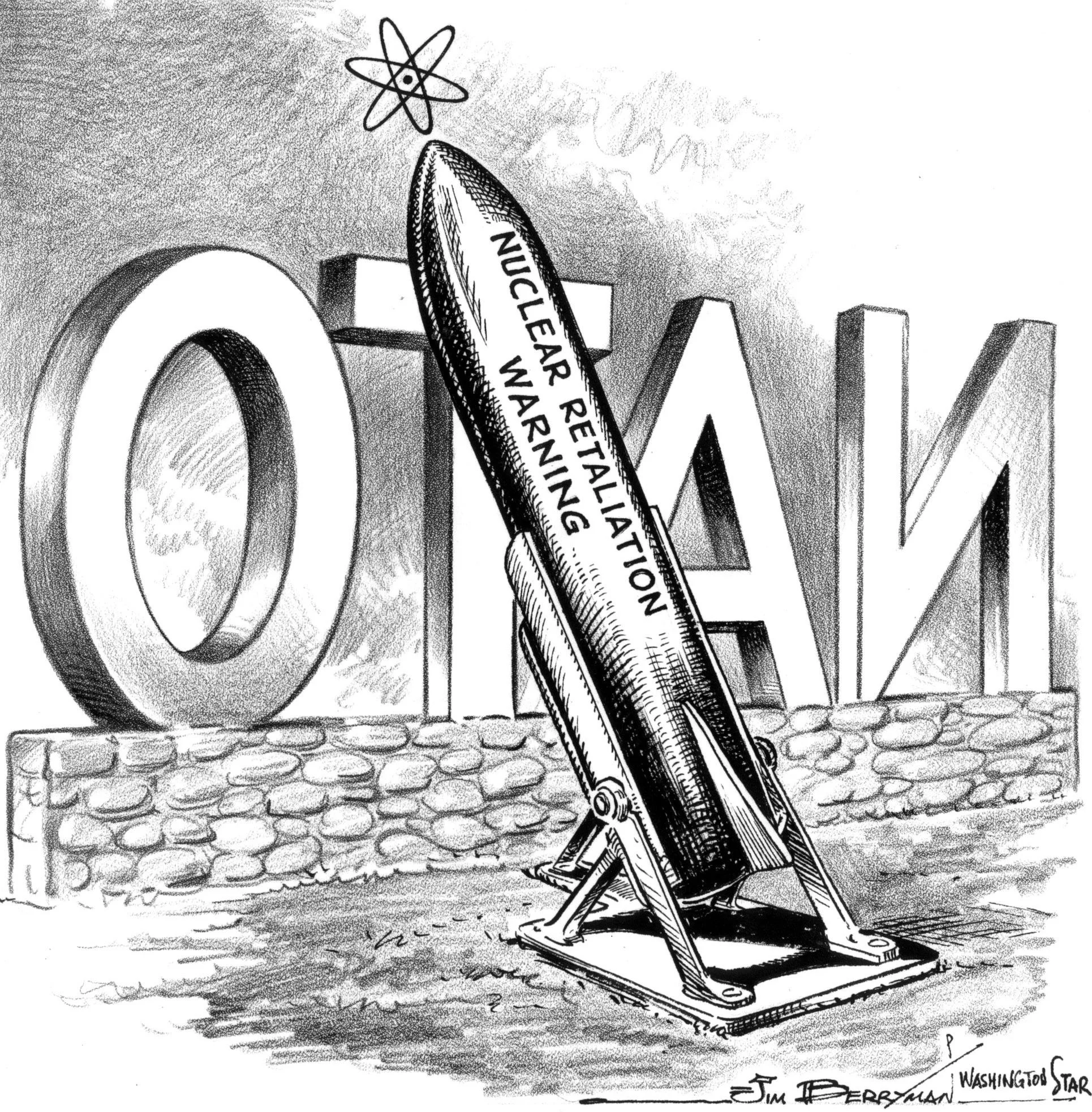
Backing it Up, Jim Berryman, May 6, 1957, Washington Evening Star. National Archives, Records of the U.S. Senate, NAID 5743241, local ID A-018. Original political cartoon reproduced without alteration; public domain. This is historical artwork, not a photograph or a weapons diagram.
Turn a list of symbols into a relationship
Give students two responses to compare. The first says, “NATO is an alliance and the atomic symbol means nuclear weapons.” The second says, “Berryman places a nuclear warning behind NATO’s name, making the threat of retaliation appear to back the alliance.” The second explains how placement creates meaning rather than simply translating objects.
Read the title aloud and ask what “backing” contributes. In this composition, literal position and political support work together. The reversed lettering helps place the viewer behind the sign. Do not mirror the scan to make NATO read normally: doing so would change the composition students are meant to interpret.
Ask pairs to select one visual detail and complete “This detail matters because…” A defensible answer can connect the oversized foreground weapon to the importance assigned to the warning. Students need not claim that the drawing proves retaliation was effective, morally justified, or universally supported. Its argument and its accuracy are different questions.
Use a source that can test the policy connection
Supply a short, labeled extract or teacher paraphrase from paragraph 24 of NATO’s MC 14/2 Revised strategic concept. The paragraph presents deterrence as its objective and identifies nuclear and other ready forces, together with a determination to retaliate, as principal elements. This supports the historical connection between the alliance and a nuclear warning; it does not independently prove that the policy prevented an attack.
Keep the chronology precise. The cartoon is dated May 6. The final-decision sheet is dated May 23, 1957 and records North Atlantic Council approval on May 9. Students may compare a cartoon with the policy record from the same period, but should not claim that Berryman had read that later final-decision sheet. The comparison corroborates a policy theme; it does not establish the artist’s research process.
For extension, use paragraph 19, which discusses responding to certain limited hostile actions without necessarily using nuclear weapons, while retaining the possibility of their use. This qualifies an overbroad reading that NATO had only one response to every situation. The single large weapon simplifies a more complicated policy.
Distinguish an alliance from one strategy within it
Place the August 1949 photograph below on a separate timeline position. It shows Truman signing the North Atlantic Treaty proclamation, not the May 1957 strategy approval and not the April 1949 treaty-signing ceremony. The alliance existed before this particular cartoon and policy document.
Ask students which source answers which question. The photograph and caption identify an institutional event; the cartoon interprets a strategic relationship; the policy text states an official approach. None replaces the others. A row of officials does not reveal their private agreement on every later military choice.
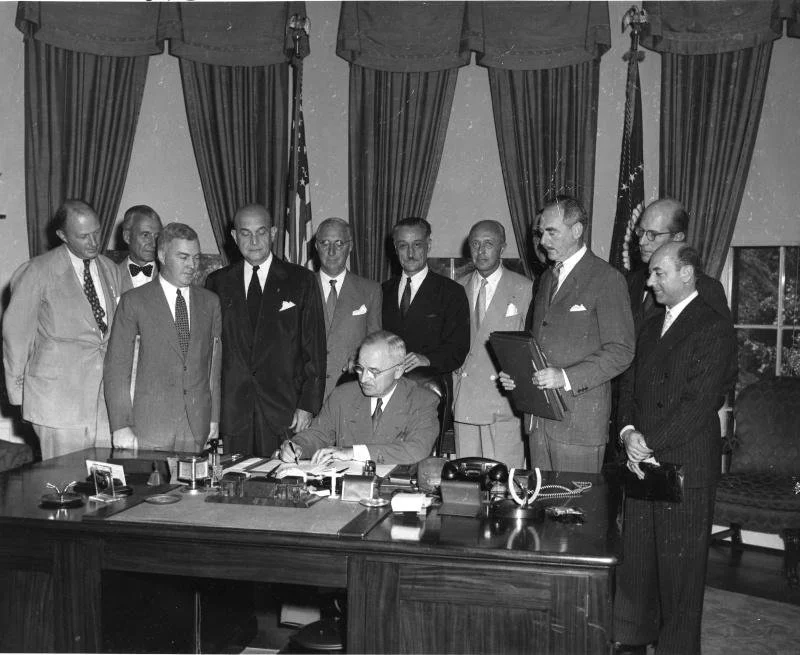
Truman signs the North Atlantic Treaty proclamation in the Oval Office, August 24, 1949. Abbie Rowe, National Park Service; Harry S. Truman Library & Museum, 73-3194. Public domain. This is neither the April treaty-signing ceremony nor the 1957 strategy decision.
Test what the cartoon leaves outside its frame
Return to the cartoon’s visual economy: a name, a warning and a large weapon. Ask what kinds of people or consequences are not depicted. Students can identify an omission without claiming to know the artist’s private intention. Absence from a cartoon is not evidence that an issue did not matter.
Use the Berlin photograph below to practice that limit. Its July 1946 date puts it before NATO’s formation and well before the cartoon. It shows actual clearing work after the war, not damage caused by a 1957 nuclear exchange. Students should never borrow an evocative photograph to make an unsupported consequence look documented.
Invite a narrower question: “Whose experiences would we need to investigate to assess the costs and risks of the strategy?” The picture can prompt attention to civilians and places without answering that question for all European residents.
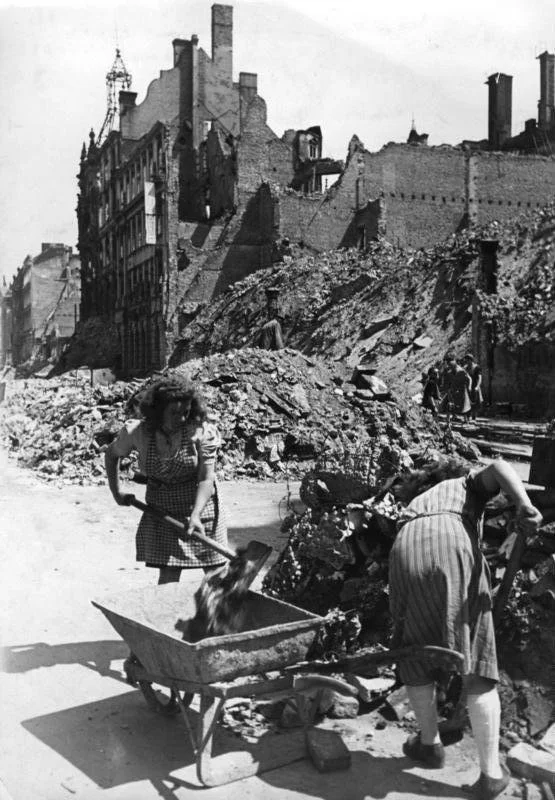
Clearing work in Jägerstraße, Berlin, July 1946. Bundesarchiv, Bild 183-H29659 / Peter Cürlis / CC BY-SA 3.0 DE. Commons version previously cropped by a contributor; no further crop here. This predates NATO and is not evidence of damage from its nuclear strategy.
Assess an argument rather than a decoded picture
Ask for three short sentences: the cartoon’s argument, a visual detail that creates it, and a historical fact that supports or qualifies the interpretation. A strong response could explain the nuclear warning as backing for NATO, cite its position behind the lettering, and use paragraph 24 while noting that other forces also appear in the strategy.
Reject “the cartoon proves nuclear weapons kept the peace” as a conclusion beyond these sources. Encourage “the cartoon presents” and “the policy document states.” Those verbs distinguish representations and stated intentions from demonstrated outcomes.
For support, provide the NATO expansion and the meaning of retaliation so the task measures interpretation rather than unexplained vocabulary. For extension, ask students how changing the weapon’s size or position might change the argument. Keep that as a hypothetical analysis of composition; do not alter the archival reproduction and present it as the original.
Choose background reading for the gap students actually have
If students lack the Cold War context, add one relevant HistoraEDU reading rather than assigning four resources at once. Containment is the closest fit for the NATO inquiry. The other readings support different background needs: origins of rivalry, political and economic ideas, or the contrast between aid and military alliance.
The cartoon, NATO document and analysis routine are supplied separately in this article. These product links identify reading-comprehension resources, not a promise that this exact cartoon or a complete nuclear-strategy lesson is included.
Cold War Ideologies Reading Comprehension | Democracy vs Communism
View this HistoraEDU resource on TPT
Use for background on political and economic ideas. Keep those categories distinct; identifying an ideology is not a substitute for explaining what the cartoon argues.
Cold War Origins Reading Comprehension Worksheet | From Allies to Enemies
View this HistoraEDU resource on TPT
Use when students need the transition from wartime cooperation to postwar rivalry before discussing the alliance. Return to the 1957 cartoon’s own date rather than placing all Cold War events in one moment.
Truman Doctrine & Marshall Plan Reading Comprehension | Cold War Containment
View this HistoraEDU resource on TPT
Use to distinguish the Truman Doctrine and Marshall Plan from the alliance and its military strategy. This provides a contrast between policy tools, not the evidence for a claim about nuclear deterrence.
Cold War Containment Reading Comprehension | Domino Theory & NATO Worksheet
View this HistoraEDU resource on TPT
Use the reading for containment and NATO context before the visual argument task. Supply the dated cartoon and strategic-concept extract separately; treat the domino theory as a historical claim rather than an inevitable rule.
Sources and image credits
National Archives cartoon collection and public domain statement
National Archives visual history cartoon 43 printed page 49
NATO MC14 2 Revised final decision and paragraphs 19 and 24
Reconstruction photograph license CC BY SA 3.0 DE
Product thumbnail reproduced from the exact HistoraEDU listing at the owner’s request. Historical photographs are separate evidence, not product endorsements. Archival artwork and photographs are contextual evidence, not institutional or personal endorsements.

