
By HistoraEDU
“The airlift flew supplies over the Berlin Wall.” That sentence sounds plausible when students have met several Cold War events in quick succession. It also combines two different crises. Rather than correcting the date and moving on, use the mistake to teach a more durable distinction: when each event happened, what authorities restricted, and whose movement was affected. Students should leave able to explain the difference, not merely recite two years.
Make the mistaken connection visible
Put the sentence on the board as a teacher-created example, not as a quotation from a student. Ask students to underline the claim that needs checking. Give them two event labels—Berlin Blockade and Berlin Wall—and space to record a date, an action and the movement affected. Do not show the answer immediately; let students identify what information would settle the question.
The blockade began on June 24, 1948. Soviet authorities interrupted the main road, rail and water connections to the Western-controlled sectors of Berlin. The Western response included an airlift of supplies. The Wall belongs to a later crisis: East German authorities began closing the sector boundary on August 13, 1961, using wire and other barriers that developed into the Wall. These are different actions, not two names for the same obstacle.
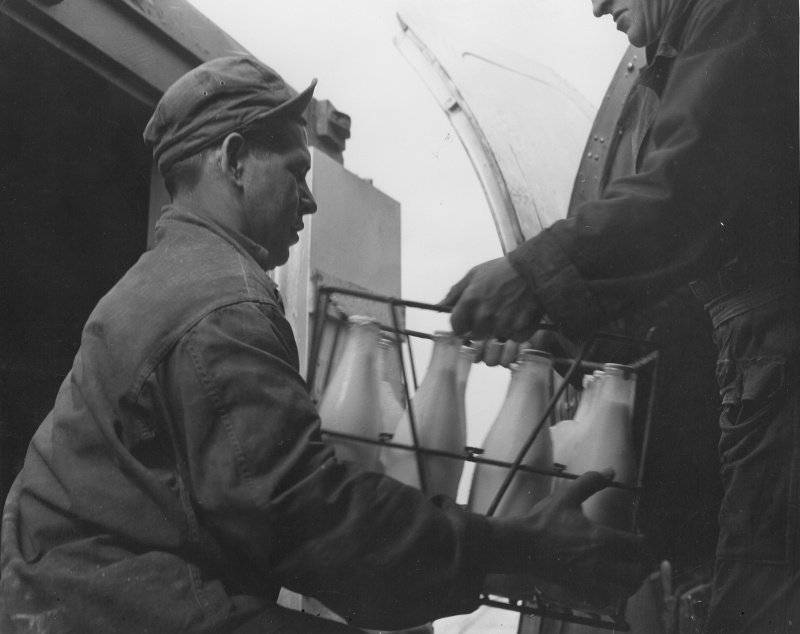
Supplies being loaded at Wiesbaden, August 18, 1948. This photograph belongs to the blockade and airlift period, not the construction of the Wall. Byers, Joint Export Import Agency; Harry S. Truman Library & Museum, 71-3984. Public domain. Image source
Compare what was restricted
Keep the comparison narrow. In the 1948 row, students should identify access to Western Berlin by surface transport and the resulting supply problem. In the 1961 row, they should identify restrictions on people crossing into West Berlin from East Berlin and East Germany. A useful question is “What was prevented from moving, along which route, and by whose decision?”
Avoid teaching a false contrast in which one crisis affected only things and the other only people. Both affected human lives. The comparison concerns the particular mechanism students are explaining: blocked surface access and an air supply response in 1948–49, versus a physically sealed boundary and restricted crossings in 1961. Neither event was simply a wall between the two halves of Germany.
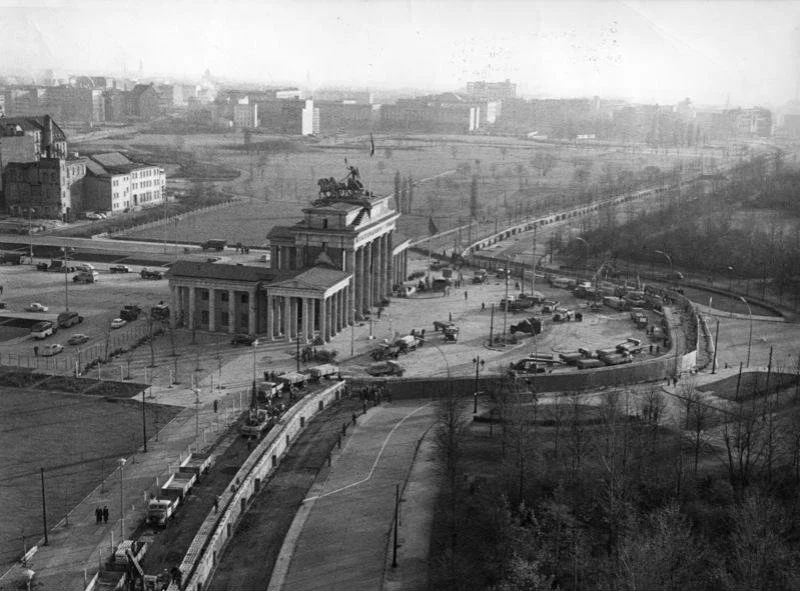
Construction near the Brandenburg Gate, summer or autumn 1961—not an exact August 13 photograph. Bundesarchiv, Bild 145-P061246 / o.Ang. / CC BY-SA 3.0 DE. Wikimedia Commons version already cropped by its contributor; no further crop or alteration here. No endorsement implied. Image source
Correct the explanation rather than swapping a number
Model a revision in two sentences: “During the 1948–49 blockade, aircraft carried supplies to Western Berlin because surface access had been blocked. This was not a flight over the Berlin Wall, whose construction began in 1961.” Ask students to explain why adding the date 1948 to the original sentence would not fix it. The wrong physical obstacle would still be there.
Then offer a second teacher-created claim: “The blockade ended when the Berlin Wall came down.” Have partners identify what evidence is needed to correct it. The May 5, 1949 four-power communiqué set May 12 for removing specified restrictions. That record addresses the earlier blockade; it is not an agreement to demolish a Wall that had not yet been built. Students need not add the entire later history to make this correction.
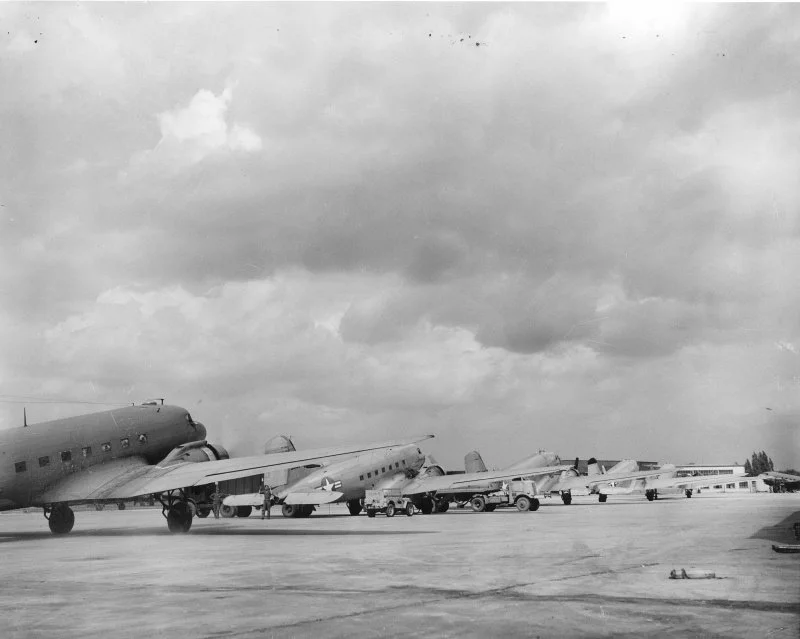
C-47 aircraft waiting at Wiesbaden, August 18, 1948. Use the dated record to place this scene in the earlier crisis. Byers, Joint Export Import Agency; Harry S. Truman Library & Museum, 71-3987. Public domain.
Keep the date attached to every image
Ask students to write the event name beside each caption and give one reason for their choice. The Wall photograph’s record supplies only summer or autumn 1961; do not turn that range into a precise day. Likewise, the two aircraft photographs were made in Wiesbaden, not in Berlin. A photo associated with an event does not automatically show its central location.
This is a quick classification task, not another full photo-analysis lesson. The important move is checking the record before allowing a familiar image to stand for every Berlin crisis. Keep captions visible when images are placed beside a timeline or projected separately.
Check whether the confusion has actually cleared
For an exit response, ask students to rewrite the original mistaken sentence and add one sentence contrasting the two restrictions. Look for an accurate event, date and mechanism. A response that says only “the Wall was later” has noticed the chronology but still needs the causal distinction.
If students need support, provide the event dates and ask them to complete the action column first. For a stretch, have them explain why the word blockade cannot be replaced by wall without changing the meaning. The goal is precise historical language, not more events to memorize.
Use the reading for the earlier crisis
HistoraEDU’s Berlin Airlift reading and primary-source evidence resource provides a focused way to establish the 1948–49 context before this comparison. Use its reading and archival photographs for the blockade side, then supply the separate 1961 source above. This article’s two-event comparison is an additional teaching routine; it is not a claim that the product contains a Berlin Wall lesson.
Berlin Airlift Reading Comprehension | Primary Source Evidence
View this HistoraEDU resource on TPT
A focused Berlin Airlift reading and evidence resource. Pair it with separately dated Wall material when your class needs to distinguish the two crises.
Sources and image credits
Foreign Relations editorial note on August 13 1961
Four-power communiqué issued May 5 1949
Wall photograph license CC BY-SA 3.0 DE
Product thumbnail reproduced from the exact HistoraEDU listing at the owner’s request. Historical photographs are separate evidence, not product endorsements.

