
Before mixing a set of examples, ask what makes the classification hard. Do learners confuse two categories that look almost identical? Or do members of one category look so different that learners cannot see what connects them? Those are different problems. An order that makes contrasts easy to notice may not be the best first view of a hidden common feature.

Photo license: Creative Commons Attribution-ShareAlike 3.0.
Two research findings that should not be collapsed
In Carvalho and Goldstone’s delayed-test study, adults learned artificial visual categories. Interleaving helped with highly similar categories; the low-similarity condition did not show an overall advantage for either schedule. The schedule-by-similarity pattern remained at a 24-hour test. That follow-up included a brief refresher; a separate control experiment addressed whether the refresher alone could explain performance. This is not evidence that blocking always wins when examples are varied. [1]
A companion paper supplies the narrower evidence for a blocking advantage. Its experiments manipulated category structure and presentation order. Experiment 1 favored interleaving for high-similarity categories and blocking for low-similarity categories; Experiment 3 also found an overall blocking advantage for its low-similarity categories. These were controlled artificial-category tasks, not a universal rule for every school subject or proof of long-term classroom transfer. [2]
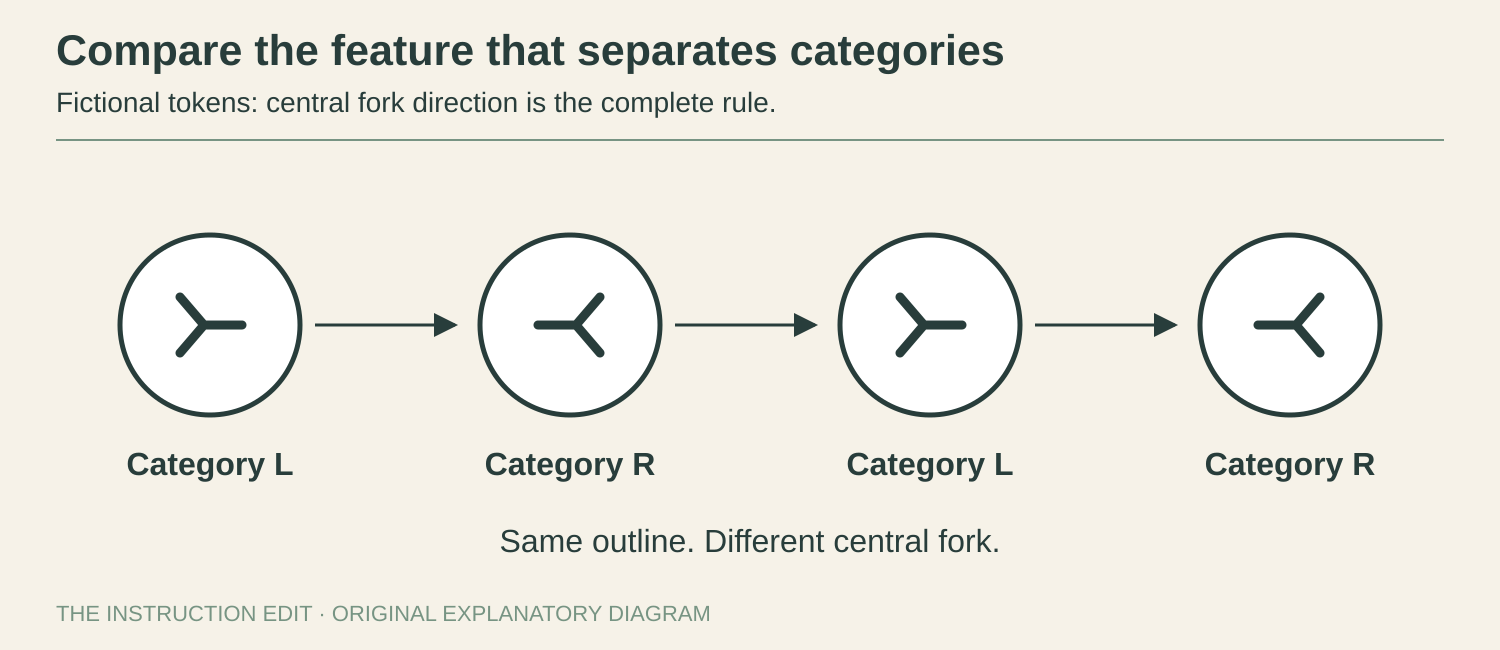
Figure 1. Original fictional inspection tokens: the central fork, not the outer circle, distinguishes L from R. Alternation makes a small between-category difference available for comparison.
The instructional question is therefore not simply “mixed or blocked?” It is “which comparison do learners need help making?” Treat your answer as a design hypothesis to check with their responses, not a label attached permanently to a subject.
Similarity is not a category definition

A real collection has more going on than one tidy visual rule. In this photograph, viewers could sort by outline, ridges, apparent size or color. Those would be different sorting tasks. Unless you specify the learning goal and obtain an appropriate identification source, a visually tidy pile is not evidence that students have learned the intended category.
For an original fictional demonstration, instead invent tokens with a rule you can state completely. Call a token L when its central fork opens left and R when the fork opens right. Outer shape is irrelevant. Start with identical circular outlines, as in Figure 1. Ask the learner to point to the feature that changes when an L token is followed by an R token.
Do not score only the label. A learner might alternate answers because the display alternates categories. Give a fresh token with the label concealed and ask both for its category and the feature used. Then change the order so that a successful classification cannot be produced by following a rhythm.
Then make the common feature harder to spot
Now vary the outer shape: use a circle, a square and a hexagon in each category while preserving the central-fork rule. A short within-category run can invite the learner to find what survives those changes. “They are all circles” no longer works as an explanation. This original example illustrates a comparison goal; it does not recreate the research stimuli or demonstrate a measured blocking effect.
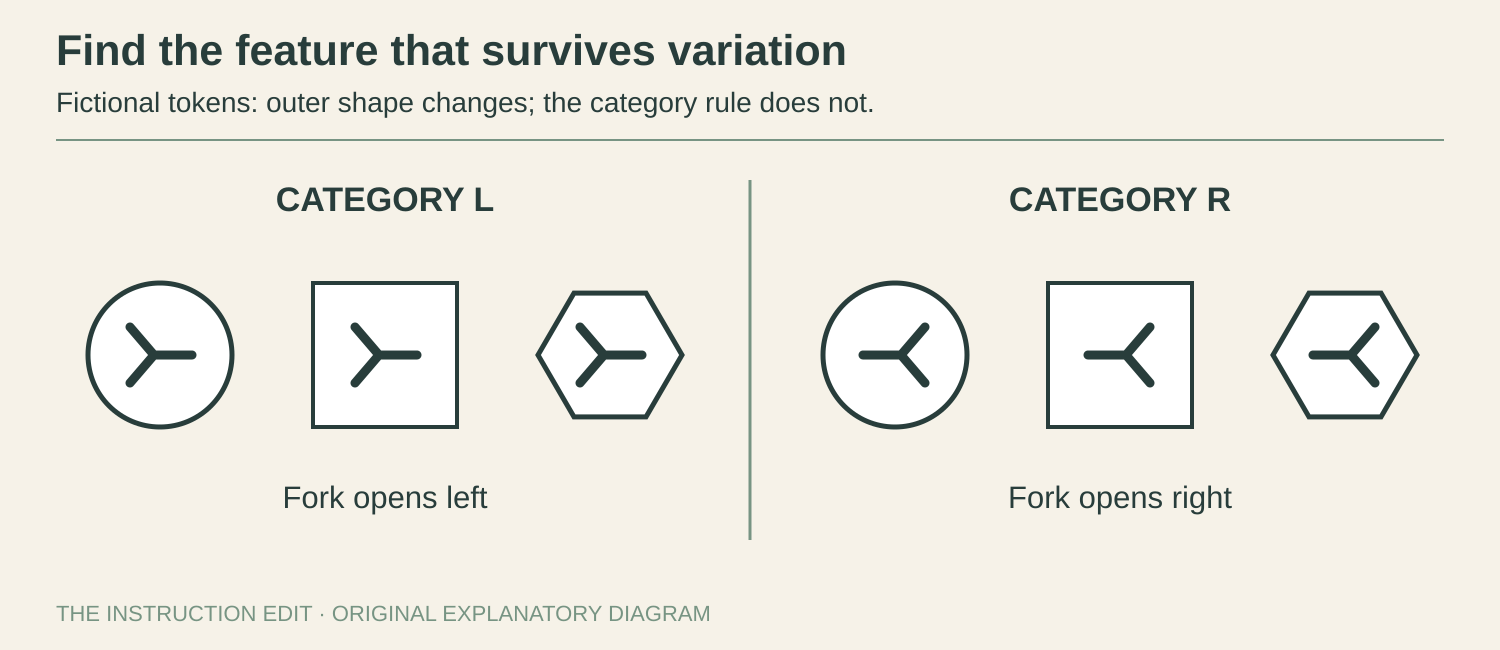
Figure 3. The same fictional rule across varied outlines. Grouping L examples first exposes a shared feature; the later R examples let the learner test what actually distinguishes the categories.
After the grouped view, show new outlines from both categories without a predictable sequence. If the learner relies on the outline, revisit the within-category variation. If they notice the fork but confuse its direction, use a closely matched L/R pair. Adjust the comparison in response to the actual error rather than declaring that one schedule is always superior.
A later independent check can ask whether the rule survives time and a different display. Keep that result separate from success while examples are labeled and side by side. The point of ordering is to make a relevant relationship available to notice; the evidence that it was learned must come from the learner’s decisions.
Ask whether learners first need to spot within-category commonalities or differences between easily confused categories.

