
By HistoraEDU
A student can define containment and still have no explanation for why the United States sent economic aid to Europe. Another can label the Soviet Union communist but cannot connect that label to a decision on the map. Before adding more vocabulary, ask students to build one complete explanation: a belief or concern, a policy response, and evidence for the connection. This lesson sequence gives those terms a job to do.
Start with a photograph that cannot tell the whole story
Show the Potsdam photograph before giving students a list of Cold War causes. Ask for two observations, one inference, and one question. Leaders sitting together is an observation; “they trusted one another” is an inference the photograph cannot establish. Then supply the caption and place the image on a 1945 timeline. Wartime cooperation and postwar disagreement can coexist. A meeting does not settle what the participants wanted.
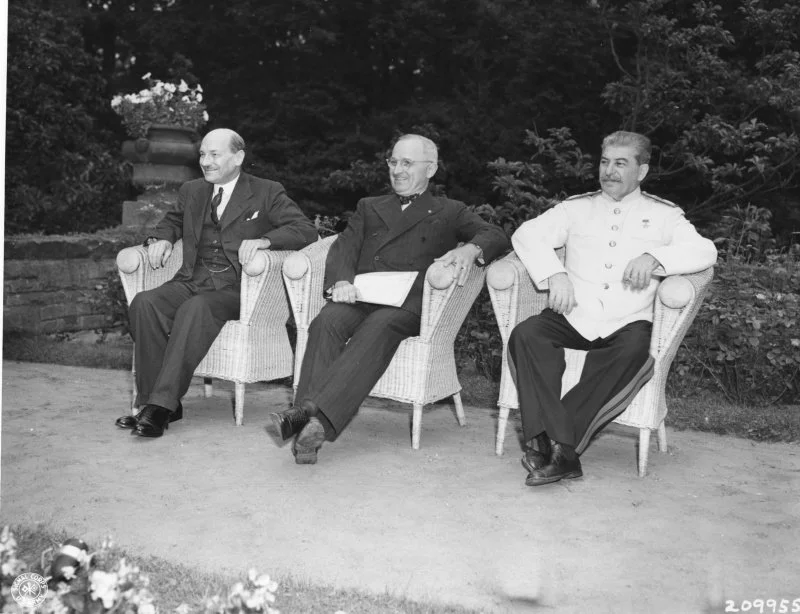
Clement Attlee, Harry Truman and Joseph Stalin at Potsdam, August 1, 1945. Photograph: U.S. Army Signal Corps, Harry S. Truman Library & Museum, 63-1457-22. Public domain.
Separate political rules from economic arrangements
Use two questions rather than a single democracy-versus-communism label: Who can make political decisions, and how is economic activity organized? Democracy describes political participation and accountability; capitalism describes an economic system. They are not interchangeable words. When discussing the Soviet Union, distinguish communist claims about equality from the actual concentration of power in the Soviet party-state. When discussing the United States, distinguish constitutional ideals from unequal access to rights in practice.
Give pairs a short background reading and ask them to underline a claim about political power once and a claim about the economy twice. A statement may require both marks. Have students explain their markings before they construct a comparison. That discussion is more revealing than a completed two-column list.
Model one evidence chain before asking for independent work
Write this model in ordinary language: U.S. policymakers feared that instability would strengthen communist influence; economic recovery was one response; the Marshall Plan offered assistance for rebuilding European economies. Then ask which part is a concern, which is an action, and which evidence would support the connection. The National Archives places Marshall’s proposal in June 1947 and the legislation in April 1948. Keep those dates separate.
Use the original speech and legislation alongside your background reading. A policy speech shows how a leader justified a choice; it is not neutral proof that every prediction was correct. Students can write “Marshall argued” or “Truman presented” instead of turning an official argument into an uncontested fact.
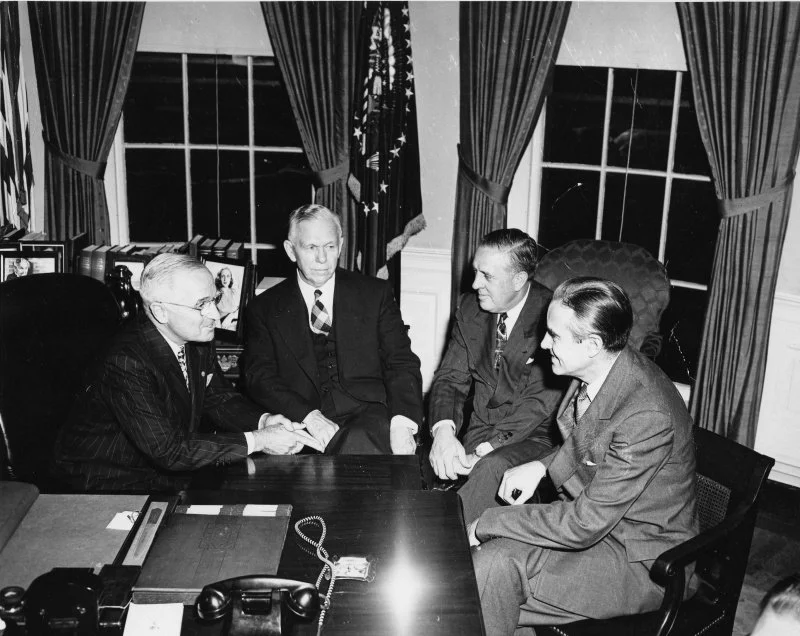
Truman confers with advisers about the Marshall Plan, November 29, 1948. Photograph: Abbie Rowe, National Park Service, Harry S. Truman Library & Museum, 73-2875. Public domain. This is a meeting, not the signing of the 1948 act.
Compare policy tools rather than memorizing names
Now give small groups three headings: assistance, economic recovery, and collective security. The Truman Doctrine speech requested aid for Greece and Turkey in March 1947. The Marshall Plan focused on European recovery. NATO, formed in 1949, organized collective security. These categories overlap in purpose, so students should explain their choices rather than treat them as perfectly sealed boxes.
For each example, students answer: What problem did its supporters describe? What action did they propose? Who was affected? What information would help us judge the result? Leave a separate space for a consequence students have not yet researched. “We need evidence” is better than a confidently invented outcome.
If you introduce the domino theory, call it a prediction used by policymakers, not a law of history. Ask what evidence would be needed to test a prediction that political change in one country must produce the same change in its neighbors.
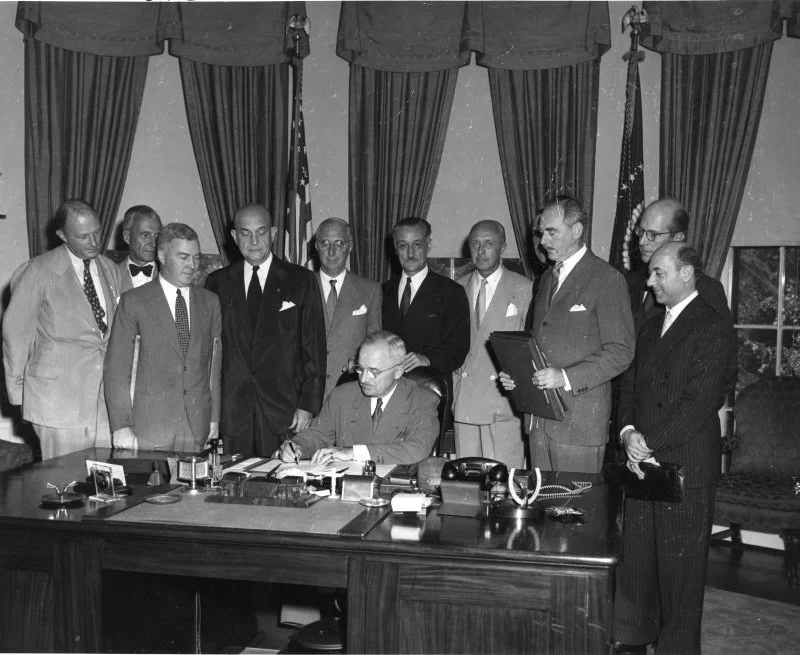
Truman signs the North Atlantic Treaty proclamation, August 24, 1949. Photograph: Abbie Rowe, National Park Service, Harry S. Truman Library & Museum, 73-3194. Public domain. This is not the April 4 treaty-signing ceremony.
Check the explanation instead of the vocabulary count
End with a two-sentence response: “One U.S. concern was [write here]. The policy of [write here] addressed that concern by [write here].” Require a source detail and a sentence explaining what the source does not establish. For students who need support, provide the policy names but not the connections. For students ready for more, ask how a different government might interpret the same policy.
Read a few responses for the link between concern and action. If students merely repeat “to stop communism,” return to the actual mechanism: money, reconstruction, an alliance, or military action. Those differences will matter when the class later studies Berlin or Korea.
Choose the reading that fills the actual gap
The routine above can be taught with public primary sources. If you want a structured reading and response sequence, these HistoraEDU resources cover different parts of it. They are not four required purchases for one lesson.
Cold War Origins Reading Comprehension Worksheet | From Allies to Enemies
View this HistoraEDU resource on TPT
Use Cold War Origins when students need the transition from wartime alliance to postwar rivalry before analyzing individual policies. The listing includes a reading, vocabulary work, questions, a comparison task, an exit ticket and an answer key.
Cold War Ideologies Reading Comprehension | Democracy vs Communism
View this HistoraEDU resource on TPT
Use Cold War Ideologies for the comparison stage. Keep the political-system and economic-system questions distinct when discussing the reading; avoid implying that every capitalist state is democratic.
Truman Doctrine & Marshall Plan Reading Comprehension | Cold War Containment
View this HistoraEDU resource on TPT
Use Truman Doctrine and Marshall Plan when students confuse those two responses. Its listed cause-and-effect work provides a place to connect a policy to a stated concern.
Cold War Containment Reading Comprehension | Domino Theory & NATO Worksheet
View this HistoraEDU resource on TPT
Use Cold War Containment when the class is ready to connect containment, NATO and the domino theory. Treat the theory as a historical claim to examine, not a guaranteed chain of events.
Sources and image credits
Truman Doctrine speech and context
Marshall Plan speech and legislation
Product thumbnails: HistoraEDU, reproduced from the exact current TPT listings at the owner’s request. Archival sources do not endorse HistoraEDU or its products.
