
A school can buy a set of discussion prompts more easily than it can make time for teachers to examine classroom talk together. The evidence for Dialogic Teaching should not blur those two undertakings. If you want to adapt the approach, start with the professional support behind it—not only the sentences pupils are invited to say.

Read the intervention as a package
The EEF evaluation compared 38 intervention schools with 38 control schools. The Year 5 programme combined training, materials, mentoring and recorded-lesson review over two terms. The original report described positive attainment estimates, with uncertainty differing by subject; the maths estimate was not statistically significant. This was a developer-supported efficacy trial, not a test of sentence stems used on their own. Missing post-test data also limited confidence. [1]
A later analysis of KS2 reading and mathematics found no statistically significant impact. It had no implementation data for the intervening four terms, so discontinuing the approach is a possible explanation—not an observed reason for the later result. Both findings belong in a school’s account of the evidence. [2]
Make the support visible
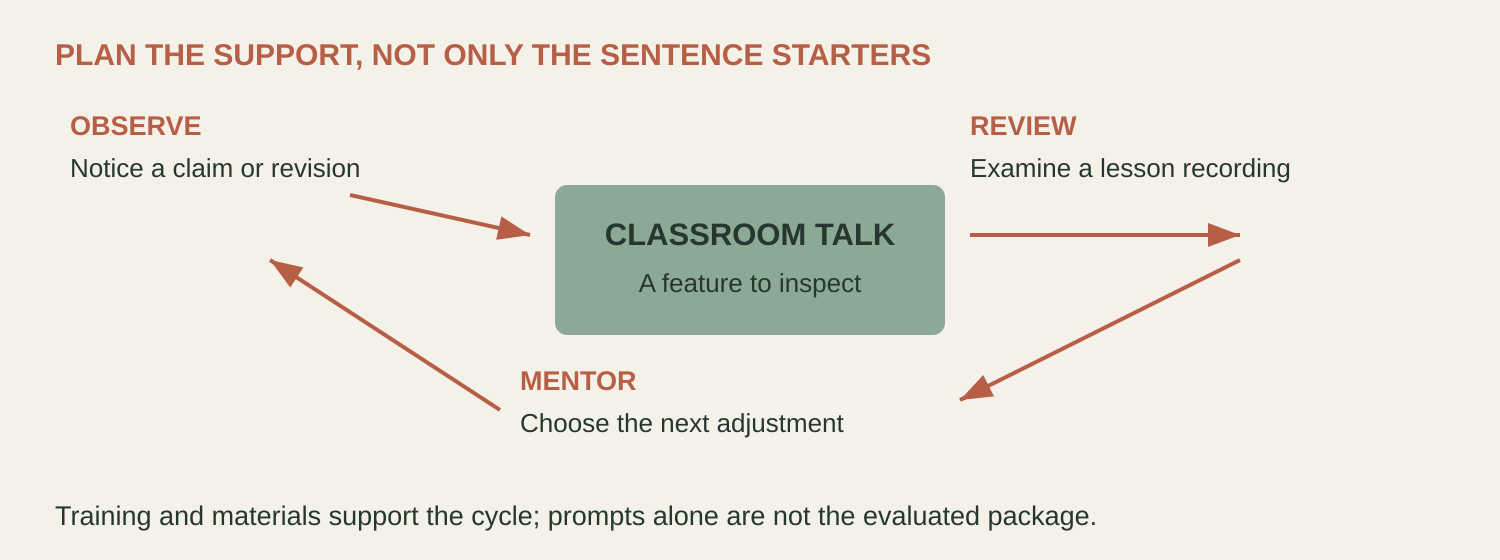
Figure 1. Observation, mentor discussion and review of a recorded lesson are connected parts of the original support model; a prompt sheet is not a substitute for the whole package.
For a local adaptation, write down who will help teachers interpret what happens in discussion. “We will use better questions” is an intention. A mentor appointment, a short recording to review and an agreed focus for the next lesson are arrangements that can make the intention workable. These are planning recommendations, not individually proven active ingredients.
Choose one feature of talk to inspect. For example, does a pupil connect a claim to evidence, respond to another pupil’s reasoning or revise an explanation? Counting speaking turns will not answer those questions. A quiet but consequential revision may matter more to your purpose than a long sequence of unrelated contributions.
If recording is part of your plan, use the school’s established consent, safeguarding and storage procedures. Do not invent an informal video archive because a programme report mentions video review. A written observation can support an initial conversation when recording is not authorized, but that is an adaptation, not an identical replication.
An original fictional conversation
Consider a fictional Year 5 class examining why a puddle becomes smaller. The following exchange is written for this article, not taken from a trial transcript. It illustrates a possible sequence of reasoning, not a guaranteed result of using discussion stems.
Asha: “The water has gone into the ground.” Ben: “But the puddle in the metal tray got smaller too. It could not go through the tray.” Asha: “Then going into the ground cannot explain both. Some of the water may have gone into the air.”
The teacher can ask, “Which observation made you change the explanation?” The useful event is not simply that three turns occurred. Ben introduces a relevant contrast, and Asha revises a claim to account for it. The teacher still needs to explain and check the science; productive discussion does not make every pupil inference correct.
Now imagine a mentor reviewing the lesson. A vague note—“Good participation”—gives the teacher little to work with. A more useful note identifies the contrast between ground and tray, who used it and what the revised explanation still leaves unclear. The next lesson can then test a specific question rather than chase a general impression of liveliness.

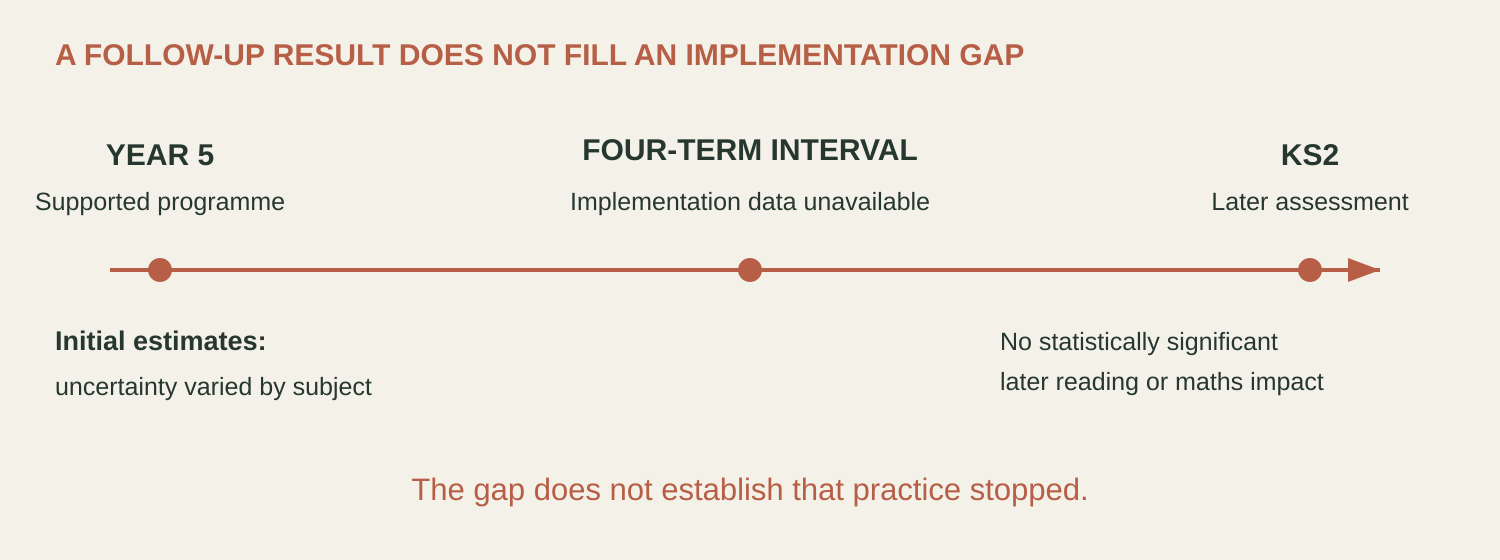
Figure 3. The supported Year 5 period, an interval without implementation data and the later KS2 assessment are different parts of the evidence story. The gap is not evidence that practice stopped.
Do not promise that an initial improvement will persist after support ends. Equally, do not describe a later non-significant result as proof that classroom dialogue can never help. Those statements outrun different parts of the evidence. A school adapting the approach should record what it actually continues, changes or stops, alongside the outcomes it chooses to examine.
For a small local start, name a review cycle: the talk feature to attend to, the evidence a colleague will collect, the conversation teachers will have about it and the next adjustment. Protect the time for that cycle before announcing an attainment expectation. A locally useful review is not a new efficacy trial and should not be reported as one.
Check what your promise depends on
Before presenting a discussion initiative, finish this sentence: “Teachers will receive support to change classroom talk through …” If the only answer is a list of pupil sentence starters, describe it as a prompt resource rather than the evaluated programme. Identify the coaching and review support behind your initiative before promising the trial’s outcomes.
Sources
[3] Education Endowment Foundation. Dialogic Teaching trial record.
