
A familiar photograph can make a lesson feel ready before the source is ready. A student recognizes Migrant Mother, supplies a story about hardship and moves straight to a conclusion. The useful teaching decision happens earlier: which information should learners get from the image, which should they obtain from its catalog record, and which still needs another source?
For that decision, the Library of Congress item page is worth using alongside the download. This review focuses on one specific print, item 2004681697, and an original three-column source card you can reuse. It is a source-based evaluation and suggested lesson design, not a report of classroom testing.
Why choose this resource
Choose this item when your goal is to help students distinguish kinds of evidence. The photograph is visually legible, while its catalog record makes a consequential detail explicit: this version was retouched. That pairing gives the teacher a concrete reason to teach the record, rather than merely attach a credit at the end. If your goal is a broad account of migration or a person’s life, one image is too narrow a resource.
Start with this specific print
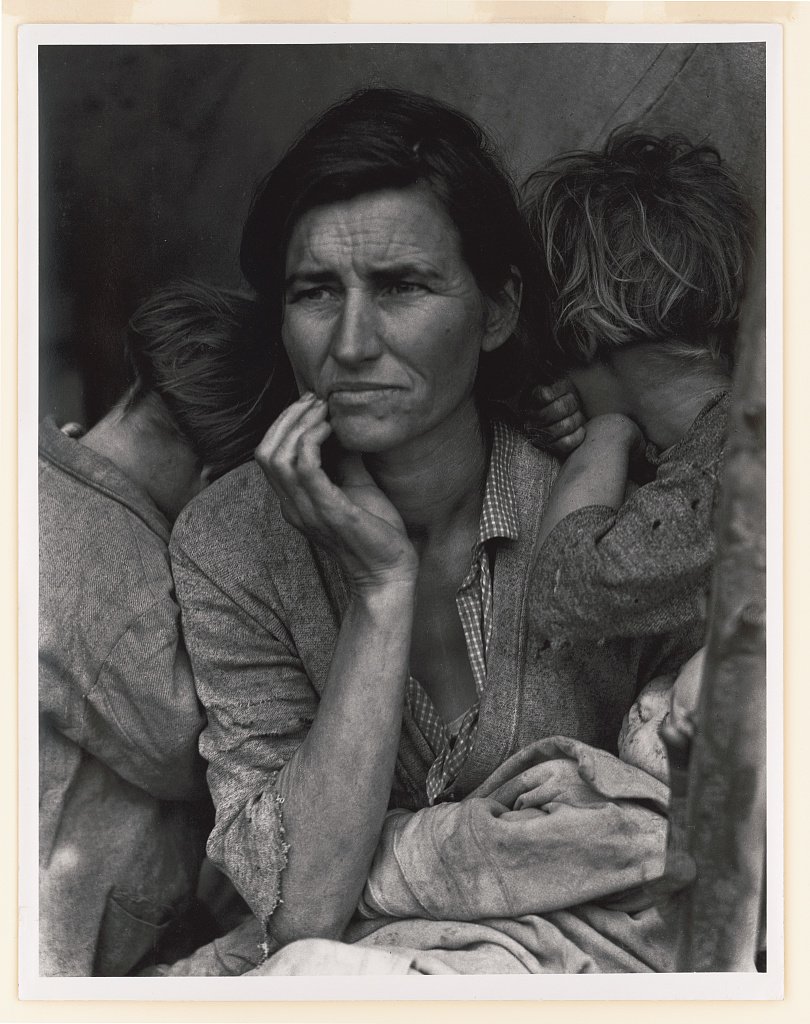
Dorothea Lange, Migrant Mother, March 1936. Library of Congress, Prints and Photographs Division, item 2004681697; digital file ppmsca.50236. This is the version with the thumb retouched out. Full downloaded image, including the print border; no editorial crop or reconstruction.
The item record identifies Lange, the date and the retouched version. The Library’s research guide places the photograph within a series made in Nipomo, California, and identifies the woman as Florence Owens Thompson. These are documented context, not details students can establish by looking at her face. Keep the item page and the broader guide available as separate sources. Read the LOC item record and Migrant Mother research guide.
The retouching note changes a useful question: what version are we looking at? It does not justify telling students that all photographic evidence is worthless. Ask which claims depend on the altered area and which depend on other evidence. Do not ask learners to diagnose a person’s feelings, income or character from appearance.
Decide what to reveal and when
Use the following sequence when attribution and provenance are part of your objective. Tell students that you will supply context shortly; this is an exercise in labeling evidence, not a guessing game. The stages below are an editorial teaching suggestion, not a prescribed Library of Congress protocol.
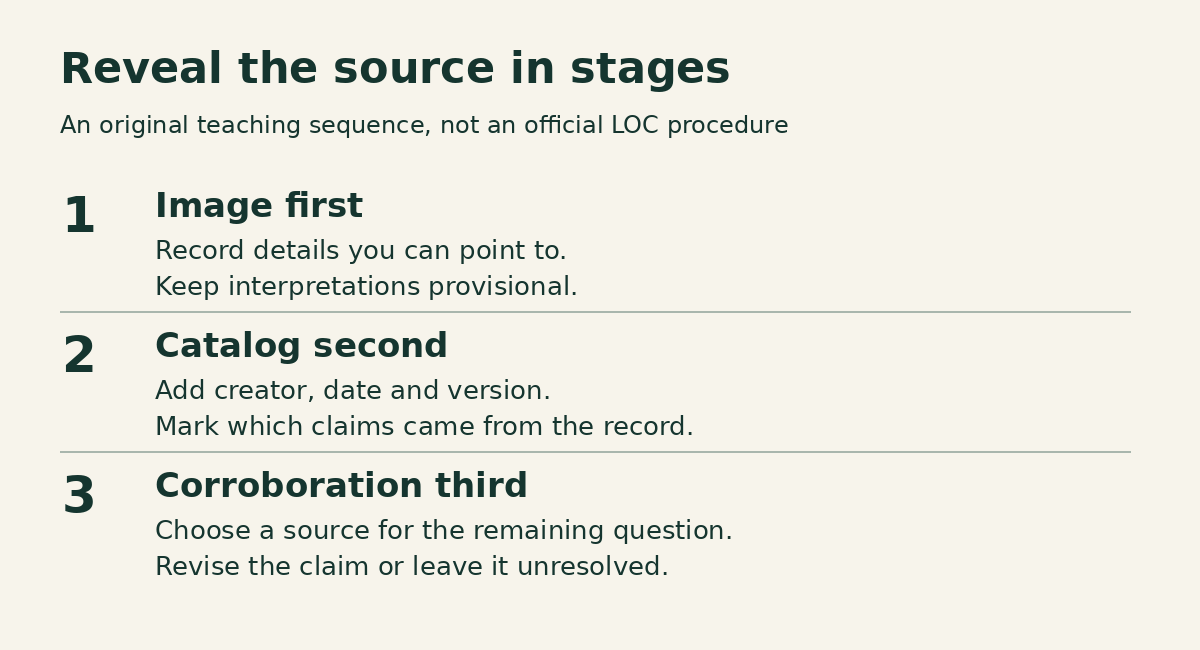
Original staged-reveal diagram by The Instruction Edit. Students can return to an earlier stage when new information changes a claim.
First, show the full image with a neutral description and invite two details that can be located. Accept uncertainty: “I cannot tell what is behind them” is more useful than a confident invention. Provide the same image description to students who need it; accessibility should never depend on withholding information.
Next, reveal the catalog and have students label newly available facts with their source. Finally, choose one unresolved question and specify what kind of evidence could address it. The Library’s own analysis tool supports observation, reflection, questions and further investigation; its teacher guidance allows movement between those activities. Our card adds a narrower distinction between visible detail and catalog information. See the LOC analysis resources.
A worked example without an invented biography
Suppose a learner writes, “The children are ashamed because their family is poor.” Treat that as an interpretation to inspect, not as an observation to reward. Ask the learner to point to the detail supporting the claim and name what the photograph cannot establish.
An illustrative revision for the visible-evidence column is: “Two children turn their faces away from the camera.” The catalog column can then record the date and creator, explicitly attributed to the item page. The third column might ask, “What did the people pictured say about the encounter?” That question calls for an account or interview with documented provenance; it cannot be answered by enlarging the photograph.
If students use the research guide’s account of Lange’s recollection, have them notice that the recollection was published in 1960, well after the 1936 photograph. A later account can add evidence while raising its own questions about perspective and memory. Do not quietly turn the photographer’s remembered account into the family’s testimony. The guide also explains that later-assigned negative numbers cannot establish the order in which the photographs were taken. Numbering is not automatically chronology.
What this resource does and does not give you
Its strongest feature is the connection between a specific object and a retrievable record. Students can return to the same item instead of relying on an unattributed copy from an image search. The practical cost is teacher preparation: save the precise record and version, select the relevant fields, and decide which additional source fits the question. A large catalog can distract students if the task is simply “explore the website.”
Historical catalog language deserves attention too. Explain that a title or description belongs to a record and has a history; students do not have to adopt its wording as their own description of a person. Avoid a simulation that asks students to impersonate Thompson or invent her private thoughts. A respectful evidence task can investigate what is known without filling every silence.
Do not claim that this sequence produces a measured gain in critical thinking. We have reviewed the source and official guidance, not compared teaching outcomes. Your check is the student’s revised claim: can they identify its evidence, attribute contextual information and leave an unsupported conclusion open?
Reuse the source card
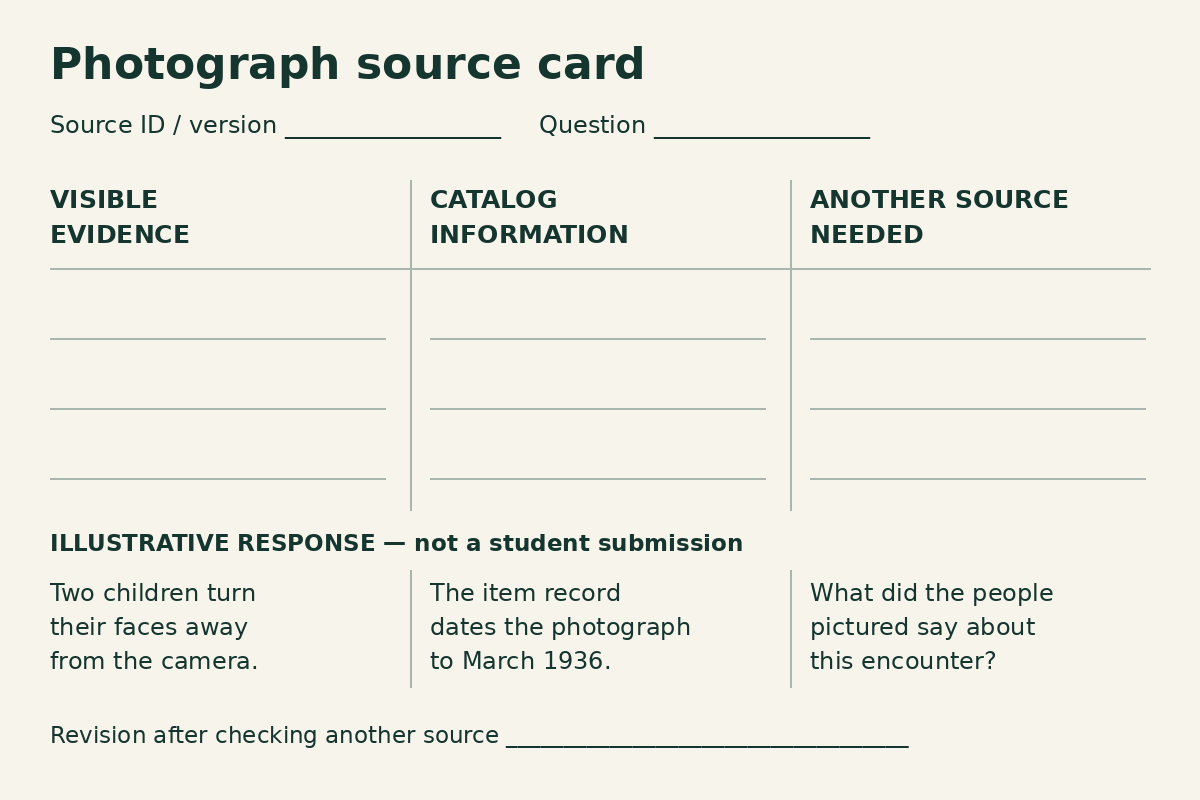
Original reusable source card by The Instruction Edit. The completed bottom row is illustrative, not an authentic student response or a quotation from the archive.
Copy these three headings into a document or notebook: Visible evidence; Catalog information; Questions requiring another source. Add the item ID and version above them. The graphic leaves space for responses; an editable plain-text version works equally well. Ask for one revision after students consult another source, and keep the earlier wording visible so the change can be discussed.
Before teaching, save the image and record for reliable classroom access, retain the credit and version note, and prepare a text description. The item’s rights advisory states “No known restrictions on publication.” That is an item-specific advisory, not a blanket license for everything on the LOC website or a guarantee about every possible use. This reproduction keeps the supplied image intact and credits its creator and repository.
Try the source card on one photograph before assigning a larger primary-source set. A successful first attempt need not end with a complete story. It should end with a clearer account of what the image supports and a better question for the next source.
Non-affiliate resource evaluation. No purchase or account is required to view the linked item. No sponsorship or Library of Congress endorsement is implied. Sources checked October 30, 2026.
