
Learning Commons, Mills Memorial Library, McMaster University, 2012. Photo: Ron Scheffler for McMaster University Library, CC BY-SA 2.0. Full frame, display-scaled only. Context photograph; not the fictional school or its students.
Give each question a job
A seminar can contain lively contributions and still leave students with several opinions that never meet. A learner names a preference, someone adds a different example, and the closing summary becomes a list of positions. When you plan seminar discussion questions, decide what each answer must contribute to the argument that follows.
The practical move is to connect six intellectual tasks: interpret the problem, establish a criterion, compare evidence, make a provisional claim, test a counterargument and qualify the conclusion. The route below is an original planning example for secondary and higher-education teachers. Its school-library case, numbers and sample responses are entirely hypothetical, not observations of a class.
Carnegie Mellon’s Eberly Center recommends planning questions with a logical progression, probing students’ reasoning and evidence, and making room for synthesis. It also cautions against asking several questions at once or steering students toward a preferred answer. That is instructional guidance, not evidence that this particular six-question sequence produces a measured learning gain. Read CMU’s discussion guidance.
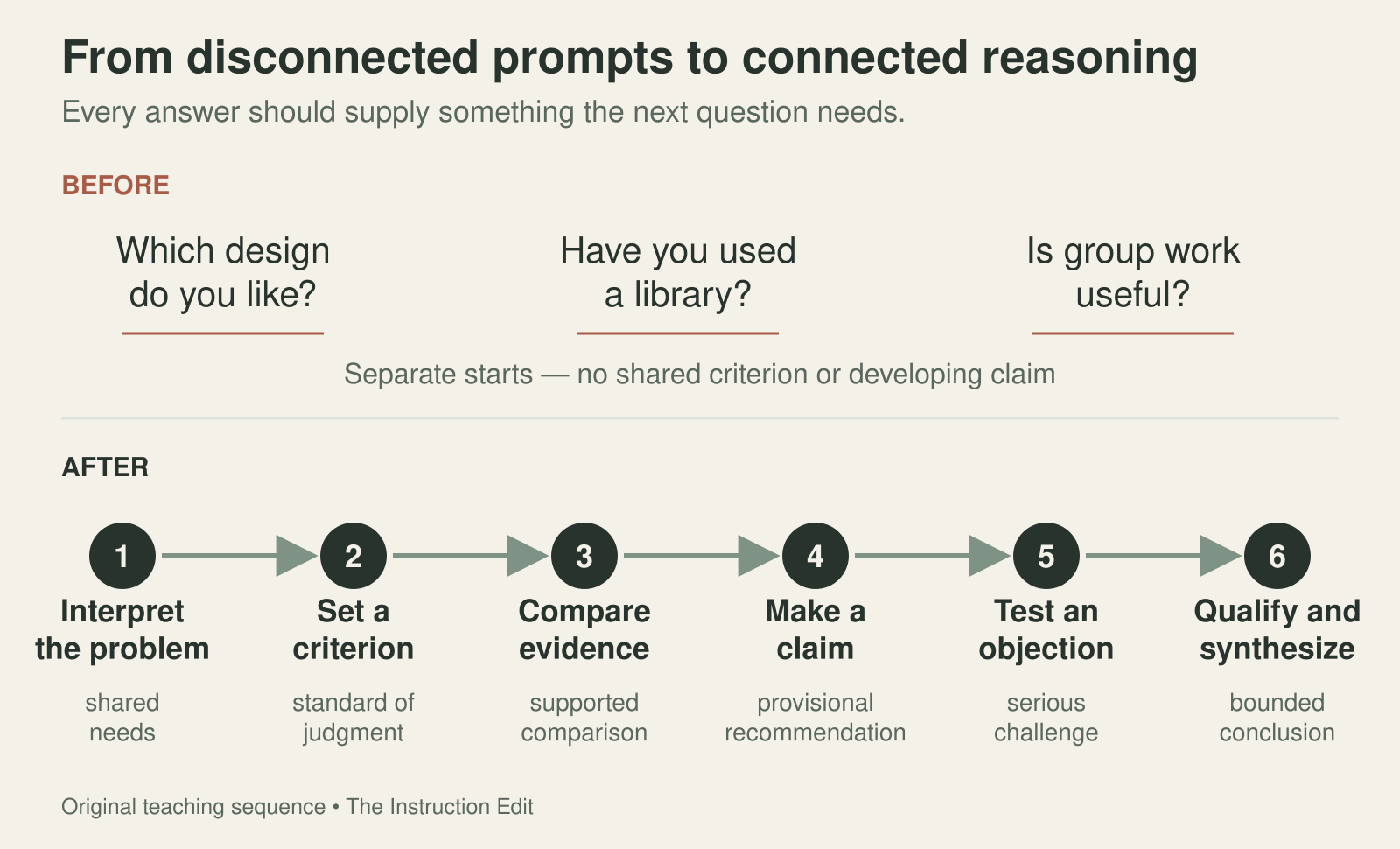
Figure 1. Each question supplies reasoning needed by the next. Original diagram by The Instruction Edit.
The library redesign case
Give everyone the same short brief. Their task is to recommend one proposal to a fictional school council, using the available evidence and naming an important uncertainty.
F1 — The school has 600 students and an $18,000 redesign budget. Both proposals cost $18,000, provide 36 seats, and retain the collection, help desk and opening hours. Each separates quiet and collaborative areas. No further construction or extra staffing is available.
F2 — Proposal A provides 24 quiet-study seats and 12 collaborative seats. Proposal B provides 12 quiet-study seats and 24 collaborative seats. Collaborative capacity is counted in individual seats, not tables or groups.
F3 — At one fixed point on each of five lunchtimes, staff recorded simultaneous requests for quiet seats of 18, 20, 21, 19 and 22. Requests for collaborative seats at those same points were 10, 12, 11, 14 and 13. These snapshots include unmet requests but do not cover mornings or after school.
F4 — In a voluntary survey, 80 students selected a preferred design: 46 chose B and 34 chose A. The brief contains no information about nonrespondents or why respondents chose their design.
F5 — A nearby classroom might supply 12 collaborative seats on Mondays and Wednesdays next term. Its availability is unconfirmed. Neither proposal has been tested with students.
A real space, not evidence for the fictional decision
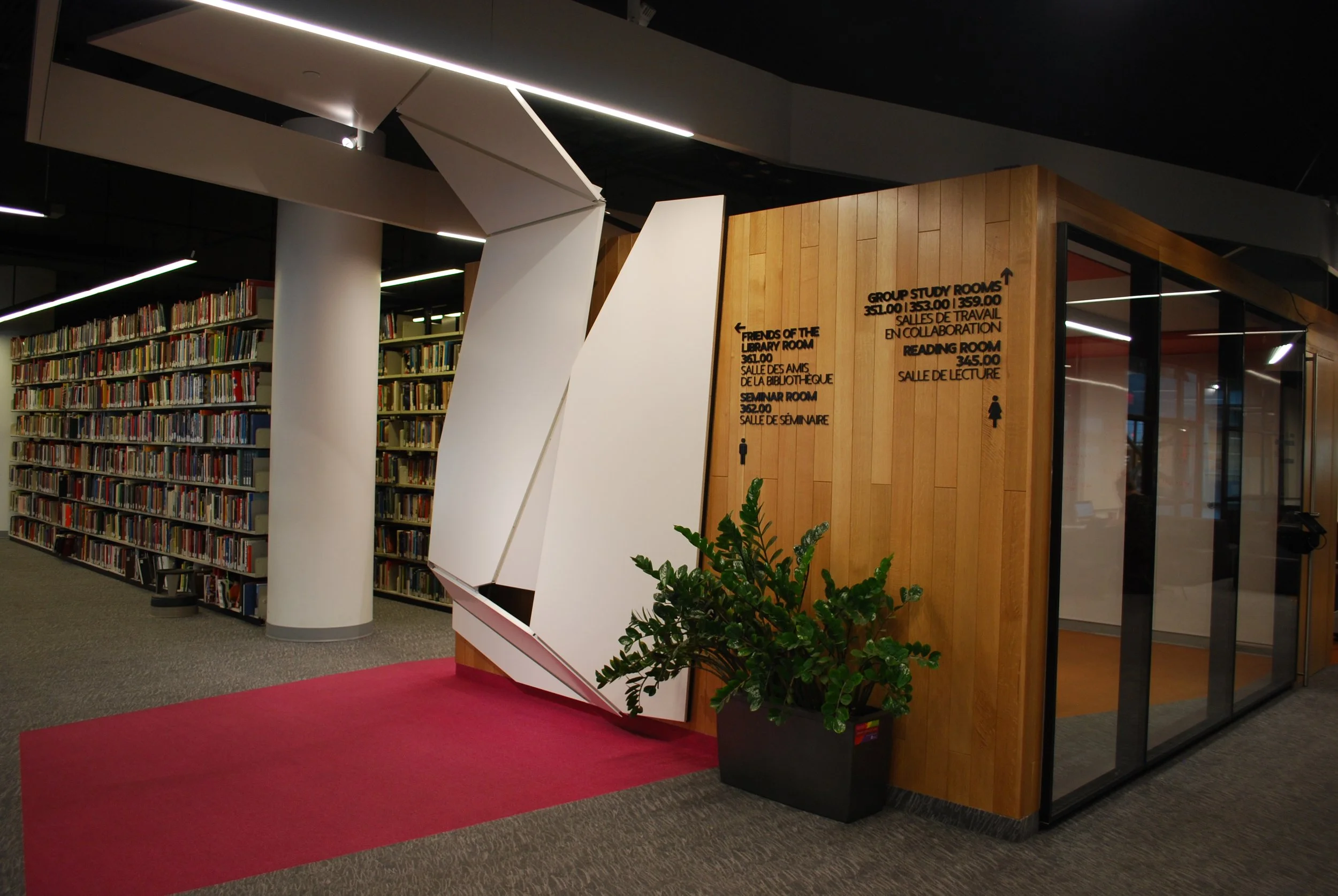
Context photograph: books and a group study room at Concordia University’s Webster Library, 2017. Photo: Librarianpam, CC BY-SA 4.0. Full frame, display-scaled only; not the fictional case location.
Use the visible signs for group study, reading and seminar rooms to notice that a library can accommodate different activities. The photograph cannot tell us how many seats this case needs, how sound travels, or which proposal is better. Those judgments require the case evidence, not an attractive room.
Prepare the destination before the discussion
Write the intended outcome on the board: a recommendation supported by case evidence, challenged by a serious objection and qualified where the evidence is incomplete. Leave six spaces underneath for the argument as it develops.
Allow three minutes to read the brief and mark one fact and one uncertainty, then two minutes to compare those annotations in pairs. Keep the model responses below in your facilitator notes rather than displaying them in advance. They illustrate defensible reasoning; they are not an answer key. A well-supported argument for B remains possible if students explain their priorities and confront its quiet-seat shortfall.
1 Interpret the problem
Question 1: “Which two needs does the library redesign have to balance?”
Purpose: establish a shared interpretation before anyone chooses a side. A possible response is: “Students need somewhere to work quietly and somewhere to work together, but the same 36 seats must serve both uses.” That connects the decision to F1 and F2 rather than to personal taste.
Record both needs. If someone describes B as having more seats, return to the 36-seat total before proceeding. Carry the two needs into the next question so the criterion addresses the actual trade-off.
2 Establish a decision criterion
Question 2: “What should count as a stronger proposal in this case?”
Purpose: make the standard of judgment visible. One possible response is: “Prefer the design that leaves fewer students without their requested kind of seat at lunchtime, while acknowledging what we do not know about other times.”
Write that criterion provisionally. Another group might prioritize future collaborative work or expressed preferences. Ask students to state their chosen standard clearly; do not quietly substitute the teacher’s preferred value. The example continues with unmet lunchtime demand.
3 Compare the evidence
Question 3: “Which case details most strongly support each proposal under that criterion?”
Purpose: connect quantities to the criterion rather than merely repeat them. A possible response is: “A’s 24 quiet seats cover the observed maximum of 22. Its 12 collaborative seats fall short by two and one on the last two observations. B covers all observed collaborative requests, but its 12 quiet seats leave six to ten requests unmet at each snapshot.”
Record those comparisons beside F2 and F3. F4 favors B as a stated preference, but it does not directly measure unmet seat demand. Keep that distinction available for the counterargument.
4 Make a provisional claim
Question 4: “Which proposal is better supported by the evidence examined so far?”
Purpose: turn the comparison into a claim with a warrant, the reasoning that connects evidence to a conclusion. A possible response is: “A is better supported under our lunchtime criterion because its observed capacity shortfalls would be smaller than B’s.”
Capture the words “under our lunchtime criterion.” Without that boundary, a defensible claim about the supplied snapshots becomes an unsupported claim about every student and every use of the library.
5 Build the strongest counterargument
Question 5: “What is the strongest case against that provisional recommendation?”
Purpose: test the argument against relevant resistance. A possible response is: “A still leaves some collaborative demand unmet. B won 46 of the 80 survey responses, and the five lunchtime observations miss other periods. The council could be choosing around an incomplete picture of library use.”
Retain all three concerns. Do not weaken the objection into a claim that students simply like talking. Equally, 46 survey responses cannot establish the preference of all 600 students. A strong objection respects both the evidence and its limits.
6 Produce a qualified conclusion
Question 6: “What recommendation can you now justify, including a condition that could change it?”
Purpose: synthesize the earlier work rather than hold a final popularity vote. A possible response is: “Recommend A provisionally, but check demand at other times before ordering; sustained collaborative demand that changes the comparison could justify B.”
A qualification should identify consequential missing evidence. Adding “more research is needed” leaves the council without a usable next step. Keep the final recommendation tied to the criterion, the objection and a specific uncertainty.
Two branches to keep beside the route
Branch A, for an unsupported assumption during Questions 3 or 4: “Which case detail supports that claim, and which part are we assuming?” If a contribution relies on the spare classroom, F5 supports only possible availability. Record “unconfirmed” beside it and return to the capacity comparison without treating those seats as guaranteed.
Branch B, for premature agreement during Question 5: “Which piece of evidence would an advocate of the other proposal use to challenge us?” Invite a pair to build that challenge from F3 or F4. Return to Question 6 once the group has a substantive objection to answer. These branches repair reasoning; they do not introduce an unrelated debate.
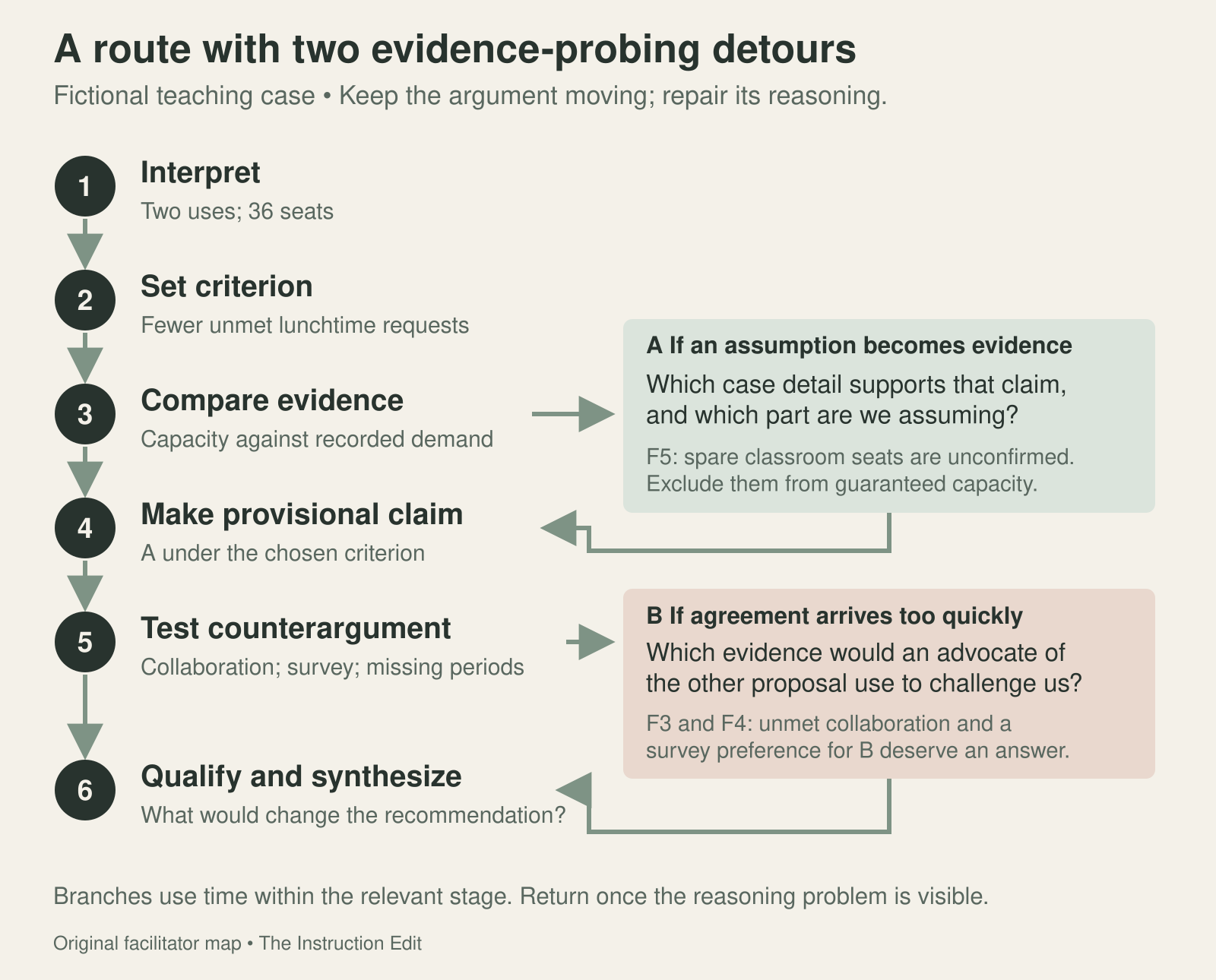
Figure 2. Two short detours repair reasoning without abandoning the route. Fictional teaching case. Original diagram by The Instruction Edit.
A completed facilitator map
For a 30-minute version after preparation, pencil in this route: Q1, 3 minutes → shared problem: two uses, 36 seats. Q2, 4 minutes → provisional criterion: fewer unmet lunchtime requests. Q3, 6 minutes → capacity comparison: A’s small collaborative shortfalls versus B’s larger quiet shortfalls.
Continue: Q4, 3 minutes → provisional claim: A under the chosen criterion. Q5, 6 minutes → challenge: unmet collaboration, survey preferences and incomplete observation coverage. Q6, 8 minutes → qualified recommendation and individual written argument. Use Branch A within Q3 or Q4 and Branch B within Q5; take their time from the relevant stage rather than adding another activity.
Move forward when the required piece of reasoning is available, not when a target number of students has spoken. If time tightens, shorten reporting and preserve the final synthesis.
The argument the sequence makes possible
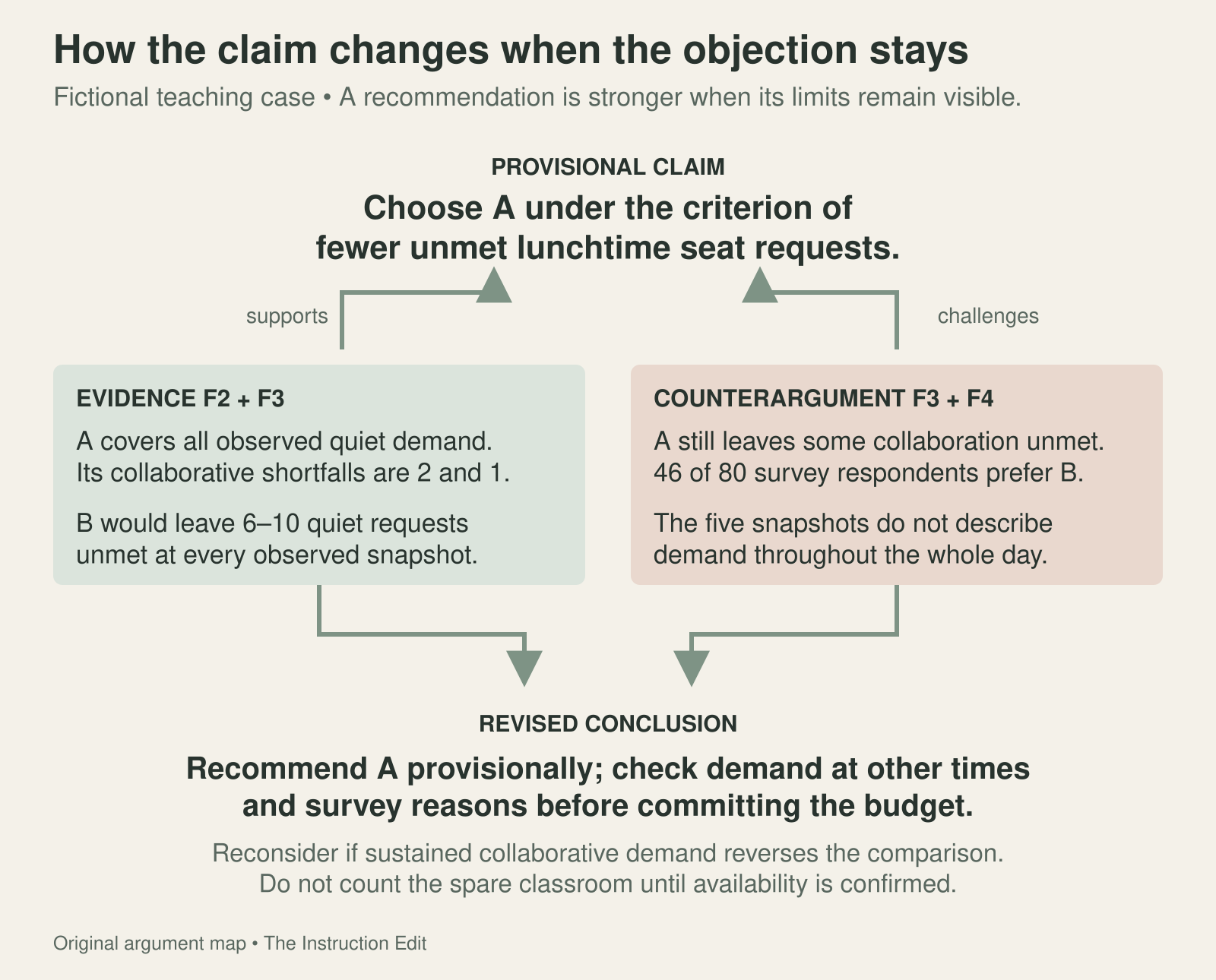
Figure 3. A qualified conclusion retains the objection and identifies evidence that could change the decision. Fictional teaching case. Original diagram by The Instruction Edit.
Here is one worked final response:
“The council should provisionally choose A because, under the criterion of reducing unmet lunchtime seat requests, it fits the supplied observations better. Its 24 quiet seats cover all five recorded quiet-demand snapshots, while its collaborative shortfalls would be two seats and one seat. B would leave six to ten quiet requests unmet at every snapshot. However, A does not satisfy every collaborative request, and 46 of 80 survey respondents preferred B. That preference deserves investigation, but a voluntary survey cannot establish what all 600 students want. Before committing the budget, the council should check demand at other times and ask why respondents preferred B. If that evidence shows sustained collaborative demand that reverses the comparison, we should reconsider. We should not count the possible classroom seats until availability is confirmed.”
Notice what the conclusion preserves: a claim, a numerical comparison, an objection, an evidence limitation and a decision-changing condition. Agreement on A is not the learning target. Producing that connected reasoning is.
Use the route in your next seminar
Choose one upcoming discussion and replace three disconnected questions with an argument-building route. Beside each prompt, write the contribution it should leave behind and the earlier answer it uses. Prepare one plausible response and one likely reasoning problem. Then reserve the closing minutes for students to assemble the argument themselves, including where it remains vulnerable.
Sources
Carnegie Mellon University Eberly Center — Discussions. Official instructional guidance, accessed October 30, 2026. The six-question sequence, case facts, sample responses and diagrams in this article are original teaching examples, not findings from an intervention study.


