
Original layout by The Instruction Edit, with the genuine cabin photograph by Smithsonian Institution / Eric Long, NASM2013-02663, CC0. No interface is pictured.
Before sending a class into a 3D viewer, finish this sentence: “Changing the viewpoint will help us establish…” If the answer is only that the object will look more impressive, a photograph may serve the lesson better. A shared still image gives everyone the same evidence to discuss and leaves more time for the question.
The Smithsonian’s Apollo 11 Command Module offers a useful test of that choice. This review uses the official object and model records plus a genuine cabin photograph. The live viewer could not be verified in our research environment, so the worked activity below deliberately uses a static alternative. We make no claim about loading speed, controls, accessibility or a hands-on classroom trial.
Choose the spatial question first
Our question is modest: how are the three crew seats arranged in relation to the main instrument panel? The supplied photograph supports a first description. A different task, such as inspecting a relation obscured from this viewpoint, could justify an interactive model after a teacher checks it. A question about reach, comfort or safe operation would require additional evidence even if the model rotates smoothly.
Inspect the identified photograph
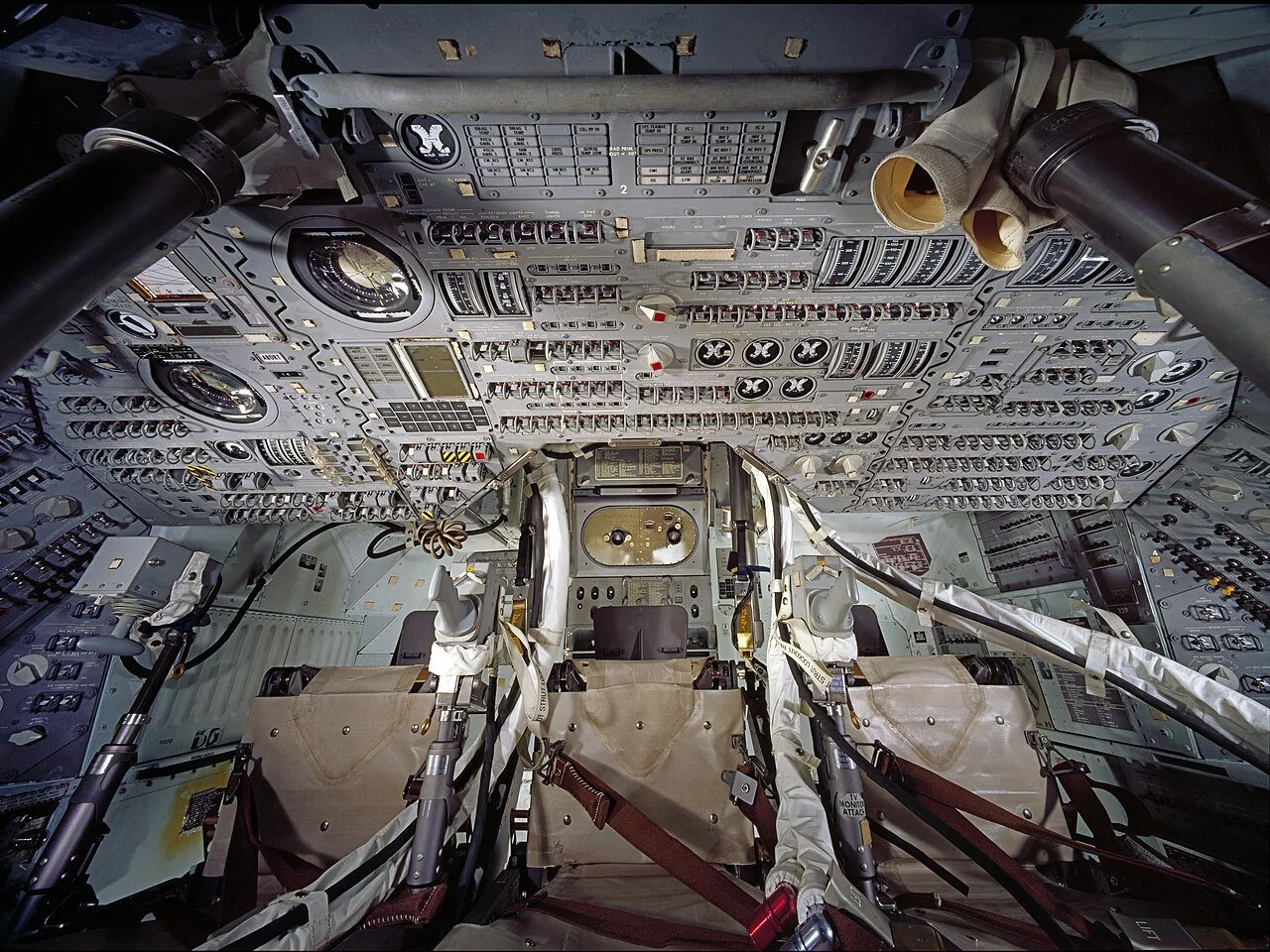
Interior of Apollo 11 Command Module Columbia, Smithsonian Institution / Eric Long, NASM2013-02663; object A19700102000. CC0 Open Access image, retrieved from its Wikimedia Commons mirror. Full frame; no reconstruction or interface overlay.
The Smithsonian catalog identifies Columbia as the living quarters for the three-person crew during most of the July 1969 mission. That context belongs to the catalog. The photograph supplies a particular view of the seats, surrounding equipment and densely arranged controls. Keeping those roles separate prevents a picture from silently acquiring claims it cannot show. Read the Smithsonian object record.
Ask learners to locate the seats and describe their relationship to the panel without measuring from pixels. Then ask what is hidden or ambiguous. A strong response can identify the limits of this view. It need not turn an interior photograph into a complete account of how astronauts moved or worked.
Use a model when another view matters
The official 3D record lists an interior model and downloadable meshes, including files labeled with scale in meters. That makes the model a candidate for a spatial task; it does not demonstrate that every desired surface, viewpoint or classroom device will work. View the official model record before planning an interactive extension.
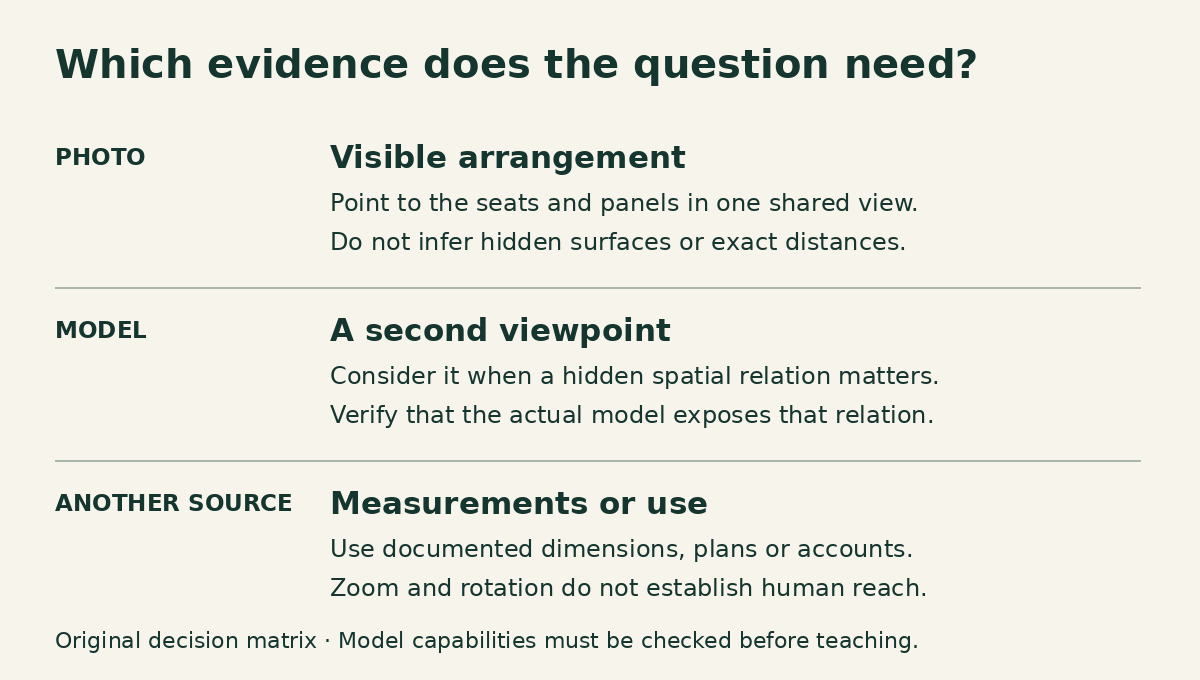
Original evidence-selection matrix by The Instruction Edit. The model column states a condition to verify, not an observed result of a viewer test.
During preparation, identify the exact relation a second view must reveal. If you can test the viewer, check that relation on the devices students will use and preserve a usable alternative. Avoid a task whose success depends on discovering undocumented controls under time pressure. If the relation remains hidden, record that result and change the evidence source rather than asking students to guess.
The still image is the working resource for this article; it is not a screenshot from the interactive viewer. Its credit and full frame are retained. A source identifier also helps another teacher find the same photograph instead of an unrelated Apollo interior.
A worked decision about cabin layout
Imagine a learner writes, “All three astronauts could reach every control because the panel is close to their seats.” There are two different claims inside that sentence. The photograph can support a description of the visible arrangement. It cannot establish an individual’s reach to every control, and apparent closeness in a wide interior view is not a measured distance.
A more defensible response is: “The view shows three seats below the main panel, with equipment around the cabin. We would need a plan, measurements and information about the occupants and working positions to judge which controls each person could reach.” This is an illustrative response, not a historical crew statement or an observed student answer.
Now decide whether 3D is necessary. For the task of describing that visible arrangement, keep the photograph. If the question changes to a spatial relation hidden by a seat, inspect whether the model actually exposes it before choosing 3D. For the reach question, changing viewpoint alone is insufficient: the evidence requirement has changed from describing a view to making a physical measurement and a claim about use.
Keep scale and historical use separate
The catalog provides overall dimensions, but an overall capsule dimension is not the distance between a seat and a control. Record what a published measurement refers to before using it. Likewise, a model file labeled in meters still requires correct units and the right endpoints in any measurement workflow. Enlarging the object on a screen is not evidence that a gap is large enough for a person.
The digital object is a representation of a museum collection object. Do not assume that every visible arrangement documents every moment of the mission. Questions about operation or experience call for appropriately dated plans, manuals or accounts. These additional sources have not been assembled or tested here; they are the next research requirement if that becomes the lesson’s goal.
This review supports a resource-selection decision, not a promise that interactive models improve learning. The useful check is whether the selected view supports the claim students are being asked to make.
Use the selection card
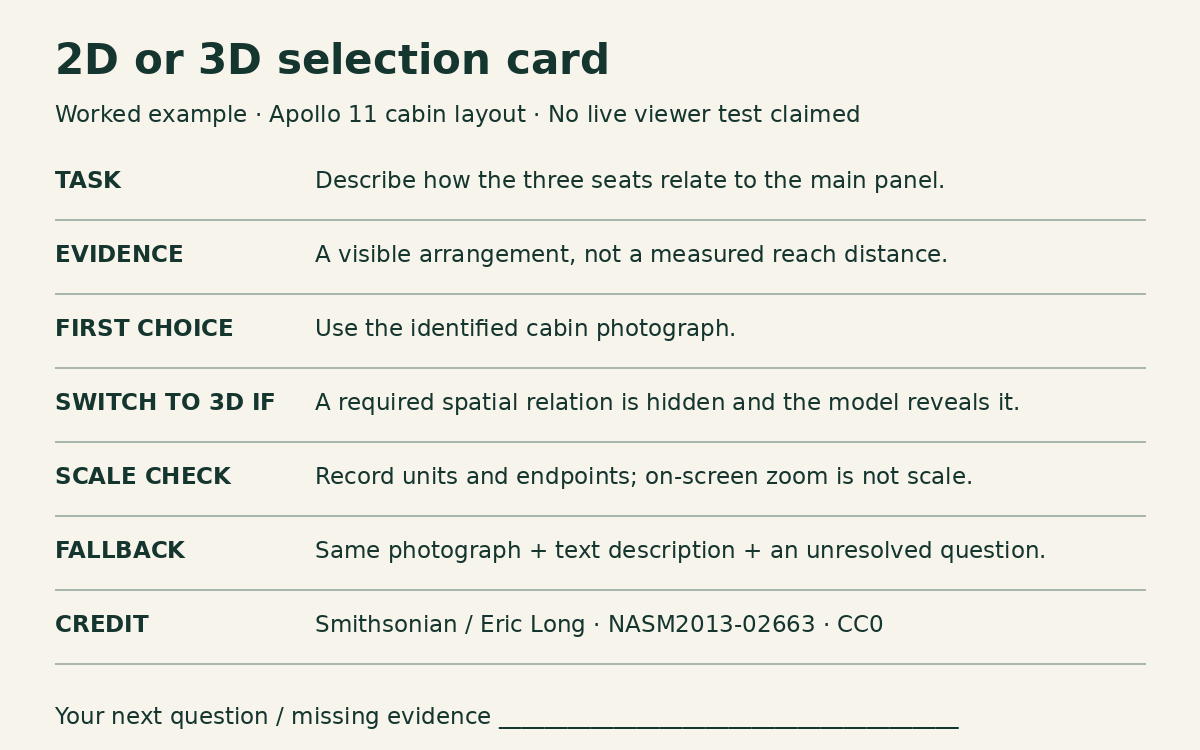
Original selection card by The Instruction Edit. The worked decision uses a static image; the model remains a conditional extension.
Reuse the card with another object by filling in the task, required evidence, first-choice view, reason to switch, scale check, fallback and credit. For a nonvisual alternative, provide a text description of the photograph and the same unresolved question. Do not make unsupported inferences the price of access to the activity.
For this asset, the Smithsonian’s Open Access route and the exact image mirror identify CC0 reuse. We retain Smithsonian and Eric Long’s credit and the image number so the source stays traceable. CC0 does not grant permission to suggest Smithsonian endorsement or use its logo as your own branding. See the Smithsonian Open Access FAQ and the exact photograph record.
Use the selection card to decide whether one spatial question warrants the interactive model. If the photograph already answers it, stopping there is a reasoned instructional choice.
Non-affiliate evaluation. No sponsorship or Smithsonian endorsement is implied. Sources and static image checked October 30, 2026; live viewer interaction and classroom outcomes were not tested.

