
By HistoraEDU
Suburban homes, televisions and anticommunist investigations can feel like three different lessons. A timeline alone does not explain how they belonged to the same society. Instead of asking students to summarize “life in the 1950s,” give them a narrower problem: What can evidence of material comfort tell us about security, and what can it not tell us? A source comparison can hold prosperity and fear together without pretending that everyone experienced the decade in the same way.
Begin with a house and a limit
Display this 1958 view from a Levittown, New York, residence. Ask students to describe visible details before interpreting them. Then challenge the class with an unsupported statement: “This proves that all American families were prosperous.” Students should identify the leap from one neighborhood view to an entire population.
Add the source information: the image belongs to the Gottscho-Schleisner collection and was made for a House Beautiful assignment. That context matters. A commissioned housing photograph is not a random sample of household income, housing access or family experience.
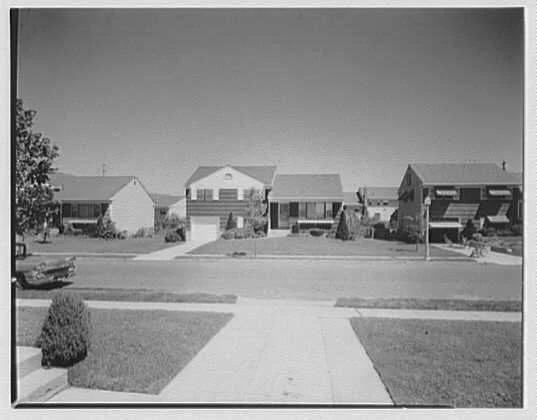
A street view from a Levittown, New York, residence, photographed August 28, 1958. Gottscho-Schleisner Collection, Library of Congress, Prints and Photographs Division, LC-G613-72796. Public domain.
Give each source a different question
Have students make three short entries in their notes: what the source shows, what they infer, and what additional evidence they need. For the house, a reasonable question is who could buy in that development. The National Archives’ Great Migration overview discusses housing discrimination and segregated neighborhoods; use it to complicate the idea that expanding opportunity meant equal access.
Do not ask a student to speak for an entire racial or economic group. Keep the inquiry attached to records and claims. The useful comparison is between the promise suggested by an image and the evidence needed to understand who could share in it.
Use television as the connection rather than decoration
A television could be a consumer object and a channel through which national politics entered a home. Ask students to examine the photograph below and identify what is actually visible. The archive does not know the date or the event being broadcast. Keep that uncertainty in the caption. It would be inaccurate to label this image the Army–McCarthy hearings.
Students can still ask a worthwhile question: How might seeing a political figure on a screen differ from reading a newspaper account? Their answers are hypotheses about the medium, not findings about this particular broadcast or its viewers.
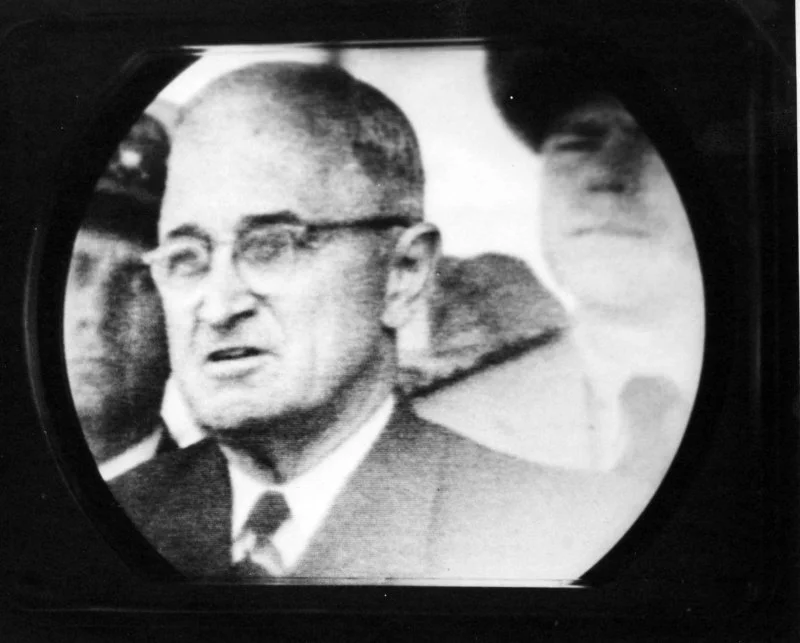
A television showing President Harry Truman speaking. Date and event unknown. Photograph: Kenneth Thompson, Harry S. Truman Library & Museum, 2002-68. Public domain.
Keep accusation separate from evidence
Introduce McCarthyism through a short factual account and a carefully chosen source excerpt, not a classroom game in which students accuse one another. The Senate’s history describes McCarthy’s rise to national attention in 1950 and the televised confrontation with the Army in 1954. It also distinguishes those hearings from the later censure process.
Put three labels on the board: allegation, supporting evidence, and consequence. When students read an accusation, ask what would be needed to substantiate it. A person being investigated is not, by itself, evidence that the accusation is true. Likewise, an image of microphones cannot tell us whether a speaker’s claim was supported.
The photograph below has uncertain catalog context. Use that uncertainty as a source-literacy example, or omit it from a student evidence set until students can handle the qualification. Do not turn a tentative archive identification into a precise event claim.
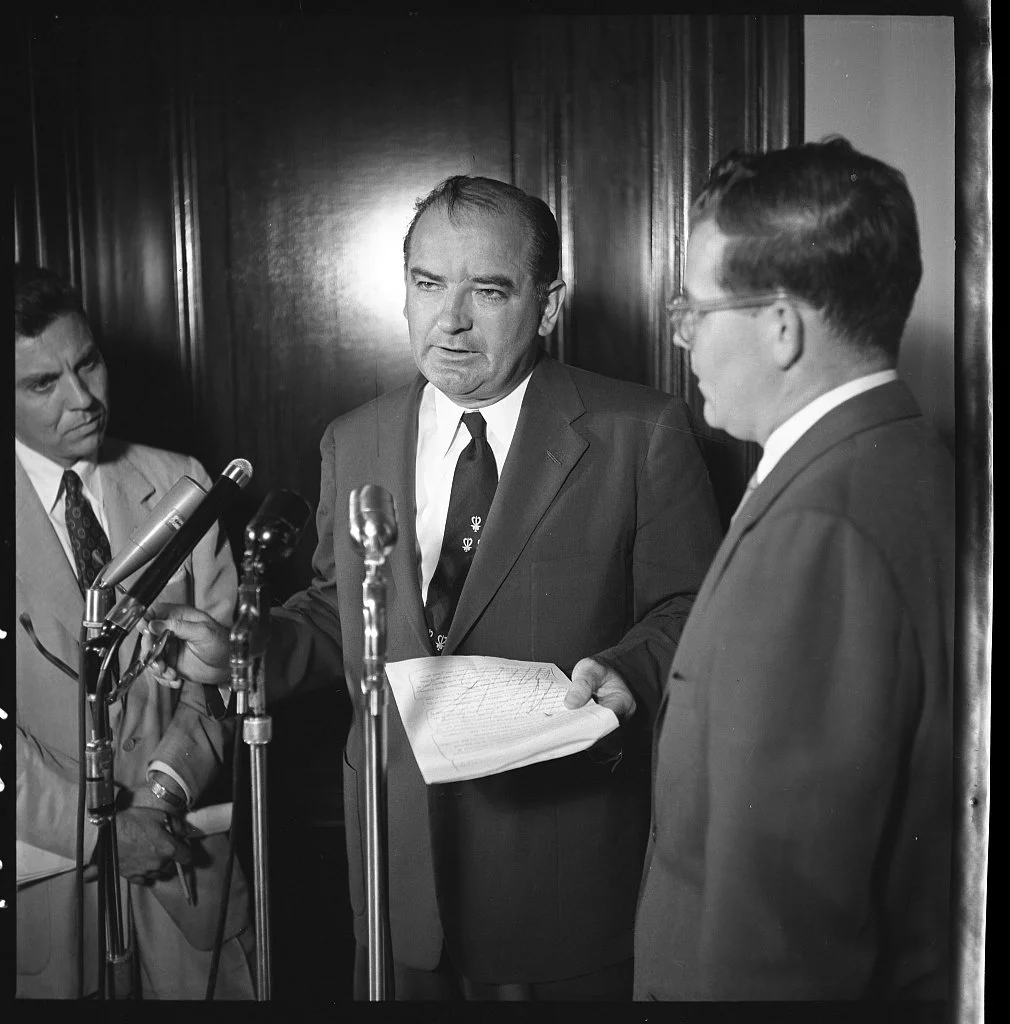
Senator Joseph McCarthy at a microphone with two other men. The Library of Congress tentatively identifies the context as discussion of the Watkins censure committee and catalogs the date as [June 1954]. Thomas J. O’Halloran, U.S. News & World Report Magazine Collection, Library of Congress, LC-DIG-ds-07186. No known publication restrictions; staff-photographer rights dedicated to the public.
Ask for a relationship without forcing a single cause
Try this response prompt: “A family could experience greater material comfort and still feel politically or socially insecure because [write here].” Require students to use one detail about everyday life and one detail about political fear. Then ask them to explain why the housing photograph alone cannot establish the second part.
Avoid a claim that buying a television caused anticommunist fear, or that every suburban resident shared the same beliefs. Sources can demonstrate that experiences coexisted without proving a simple causal chain. A stronger response may explain that different sources reveal different aspects of the decade.
For an exit ticket, give students the sentence “The 1950s were a time of prosperity.” Ask them to revise it with a qualification and an evidence question. Look for “for whom,” “where,” or a named limit—not just an added adjective.
Use two readings for one comparison
These two HistoraEDU readings provide complementary background. The source routine above is an additional teaching approach, not a claim that these exact archival photographs are included in either product.
Life in the 1950s Cold War Lesson | Red Scare, Suburbia & Consumerism | 8th

View this HistoraEDU resource on TPT
Life in the 1950s covers suburban growth, consumer culture and Cold War anxieties. Use it to establish the everyday-life context, then test broad generalizations against the photographic evidence.
Red Scare & McCarthyism Reading Comprehension | Cold War Civil Liberties lesson

View this HistoraEDU resource on TPT
The Red Scare and McCarthyism covers loyalty investigations, blacklisting and civil-liberties concerns. Use it to help students distinguish fear, accusation and evidence. The listing includes reading questions, vocabulary, a cause-and-effect organizer, an exit ticket and a key.
Sources and image credits
Housing discrimination in the Great Migration
Joseph McCarthy historical biography
Product thumbnails: HistoraEDU, reproduced from the exact current TPT listings at the owner’s request. Archival sources do not endorse HistoraEDU or its products.
