
Typing at a laptop, 2021. Photo: Devontae Lindsey / Alabama Extension, CC0 1.0, via Wikimedia Commons. Full frame, display-scaled only. Context for written online work; not a screenshot of the fictional discussion.
Give the reply a reasoning job
“Post your answer and reply to two peers” tells a cohort how much to contribute. It does not tell them what the second contribution should do. A perfectly compliant thread can contain three independent recommendations followed by several versions of “I agree.” The missing element is not necessarily another post. It is a connection between the posts.
For a workplace cohort, try a more specific sequence: recommend, compare, then revise or defend. The first contribution makes reasoning visible. The second tests a meaningful difference. The final contribution records what the comparison changed—or why the original position still stands. Changing your mind is not compulsory. Answering the challenge is.
Cornell’s Center for Teaching Innovation recommends explicit expectations for discussion contributions and a facilitator who is present without dominating. The University of Washington’s discussion guidance offers alternatives to rigid reply quotas, including refining an argument and connecting contributions. The sequence below is an original workplace adaptation, not a tested intervention from either institution. A reply count can still serve a logistical purpose; it should not substitute for the intellectual task.
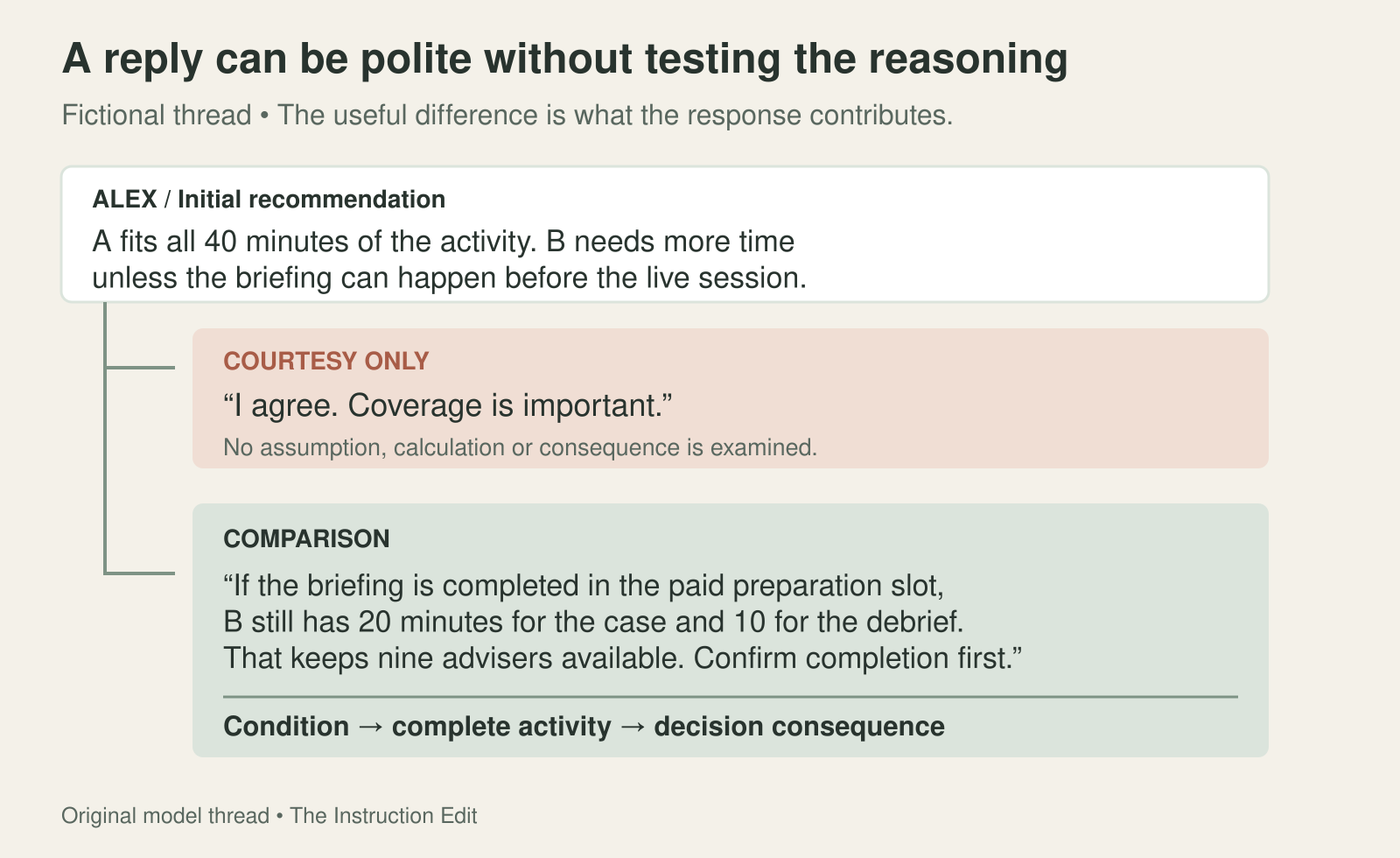
Figure 1. A useful reply tests a reason and explains its consequence. Original fictional thread diagram by The Instruction Edit.
A fictional case with a real trade-off
Use this short practice case with a cohort of service-team advisers. The numbers are invented for the exercise; they are not a recommended staffing policy. The decision is how to schedule one training activity for 12 advisers while keeping at least eight available for service during every session.
The facilitator has 150 minutes of live delivery time. The activity contains a 10-minute briefing, a 20-minute case discussion and a 10-minute debrief. All 12 advisers need the complete activity. Sessions run one after another, not simultaneously.
Option A is three groups of four, each booked for 45 minutes. That uses 135 facilitator minutes, leaves eight advisers available during each session and provides room for the full 40-minute activity. Option B is four groups of three, each booked for 30 minutes. That uses 120 facilitator minutes and leaves nine advisers available, but the complete activity will not fit as currently designed.
One more fact matters: advisers have a 10-minute paid preparation slot earlier in the week. The briefing could be completed then, but completion has not yet been confirmed. The practice question is: “Which option should the team provisionally choose, and what must be checked before it is booked?” Both coverage and the complete learning activity are constraints. Faster delivery alone is not the goal.
The three-stage brief to give participants
Use one thread per initial recommendation, and keep the final response in that thread. For this worked example, publish the brief on Monday with the deadlines below in the cohort’s stated time zone. These are design choices to adapt, not an evidence-based optimal timetable.
Stage 1 — Recommend, by Tuesday 12:00
In roughly 100–150 words, choose A, B or a clearly described modification. Show the coverage and facilitator-time calculations. Identify one condition your recommendation depends on. Refer to the supplied case rather than adding confidential details from your workplace.
Stage 2 — Compare, by Wednesday 12:00
Read your assigned partner’s recommendation. Reply with one specific difference in reasoning: a constraint they weighted differently, an assumption they used, or a calculation that changes the comparison. State the consequence for the decision. A respectful disagreement is welcome; agreement needs a reason that advances the analysis.
Stage 3 — Revise or defend, by Thursday 12:00
Return to your own thread. State what you changed or retained, name the peer’s reason you considered, and identify the remaining condition. A defensible “I still recommend A because…” is as acceptable as a justified switch. Do not delete the initial recommendation: the reasoning trail is the deliverable.
Assign partners rather than relying on the first posters to attract all the replies. In a large cohort, use small groups with an explicit comparison partner for each person. If a partner is absent, provide the model alternative below so the participant can still complete the comparison and final response. Make that route available before the deadline, not as a penalty for someone else’s absence.
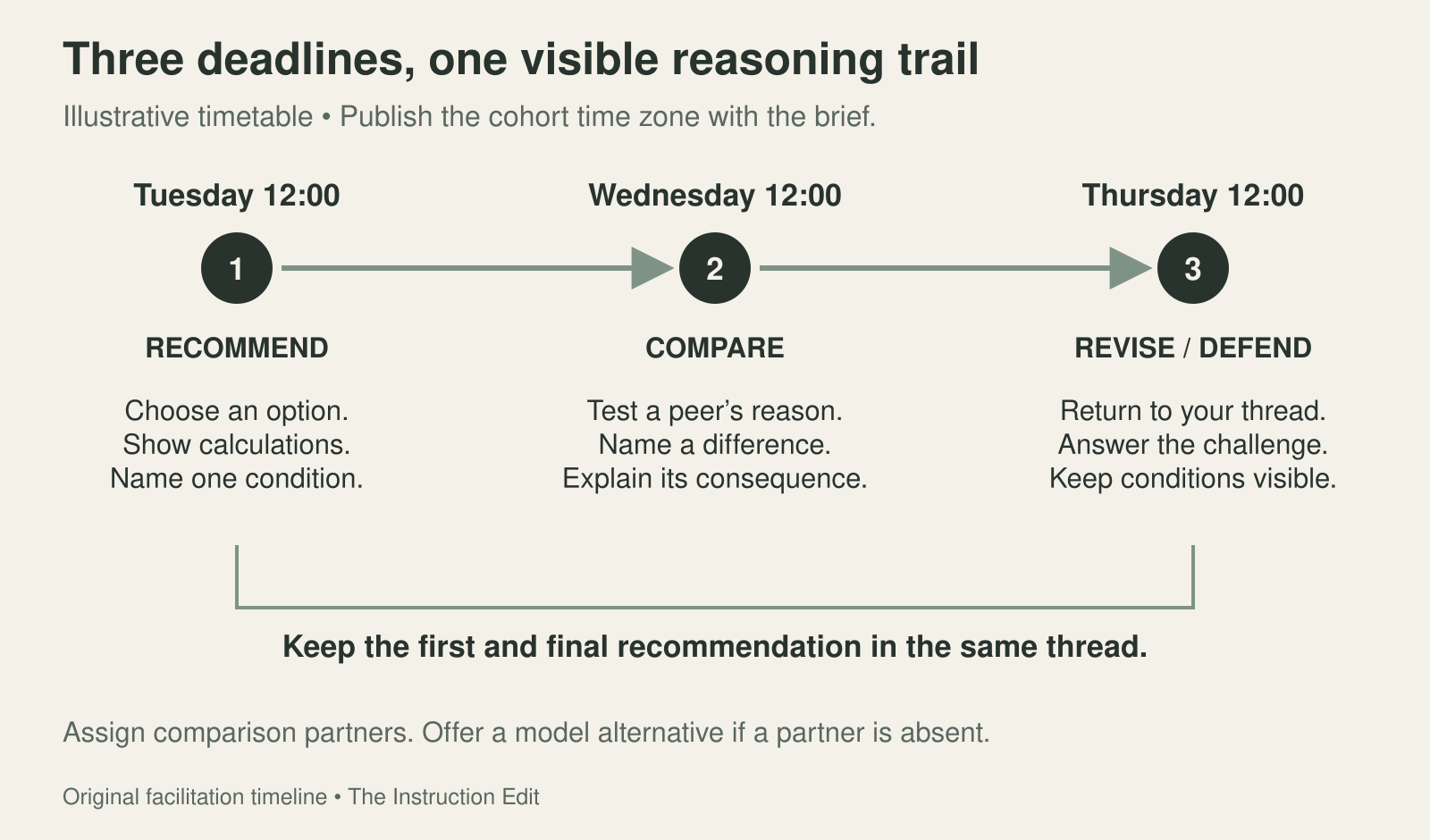
Figure 2. Staggered deadlines leave time to encounter and answer another contribution. Illustrative timetable; original diagram by The Instruction Edit.
A model thread: courtesy versus comparison
Initial post — Alex: “I recommend A. Three groups of four use 135 facilitator minutes and leave eight advisers available. Each 45-minute booking can contain the full 40-minute activity. B protects one more adviser for service, but a 30-minute booking cannot hold the briefing, case and debrief. I would keep A unless the missing briefing time can be accounted for.”
Courtesy reply — Sam: “I agree with your choice. Coverage is important and your explanation is clear.” This is friendly, but it does not examine a difference or add a decision-relevant reason. Do not disparage courtesy; simply distinguish it from the comparison the task requires.
Substantive reply — Sam: “I agree the full activity needs 40 minutes, but I interpret the paid preparation slot as a possible way to separate the briefing. If the 10-minute briefing is completed beforehand, B leaves 20 minutes for the case and 10 for the debrief. That gives nine advisers on service and uses 120 facilitator minutes. I would choose B only after briefing completion is confirmed. Without it, your objection stands.”
Final response — Alex: “I have changed from A to a conditional preference for B. Sam’s reason is not that shorter training is better; it is that the 10-minute briefing could happen in the paid preparation slot, leaving the full case and debrief in the live session. Before booking B, confirm that everyone has completed the briefing and can access it. If that condition is not met, retain A rather than quietly dropping part of the activity.”
The change is visible in three places: the selected option, the treatment of preparation time, and the booking condition. The coverage minimum and the complete activity remain unchanged. This is why the final response belongs beside the original: a separate “reflection” post would make the comparison harder to follow.
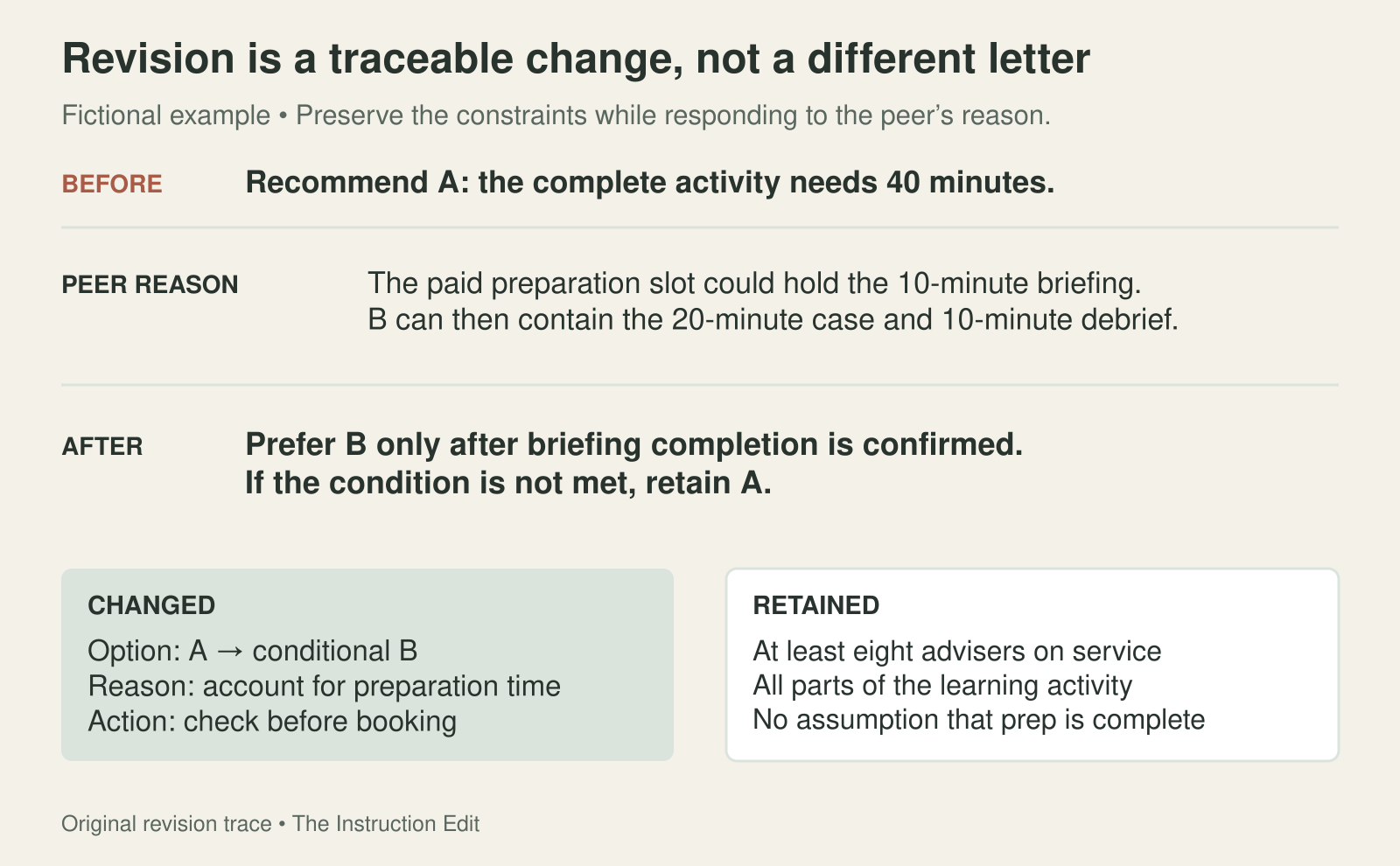
Figure 3. The revision names what changed, why it changed and which constraints remain. Original fictional example by The Instruction Edit.
Intervene at the break in reasoning
If a reply is only praise, ask: “Which part of their reasoning would you test, extend or qualify?” If someone recommends B without accounting for the briefing, ask: “Where are the ten briefing minutes in your plan?” If someone treats preparation as completed, ask: “Which case fact confirms that, and how does uncertainty affect the booking decision?”
If everyone chooses A, do not manufacture disagreement between people. Introduce the conditional B argument as an alternative to examine. If participants change answers merely to satisfy the task, remind them that a defended position is allowed. For example: “I retain A because the case provides no confirmation of preparation; I would reconsider once that condition is met.” That response engages the comparison without pretending uncertainty has disappeared.
Keep interventions short enough to return the reasoning to participants. Correct a consequential arithmetic error, but do not write the final recommendation for the cohort. In this fictional case, check 3 × 45 = 135, 4 × 30 = 120, 12 − 4 = 8 and 12 − 3 = 9. A real staffing decision would require additional operational evidence and the relevant decision-maker; this exercise does not authorize one.
What to look for in the finished thread
Use four checks: the first post identifies a recommendation and its support; the reply names a meaningful comparison; the final post answers that comparison; and unresolved conditions remain visible. Do not award extra credit merely for more words, more replies or a changed answer. If assessment is involved, publish these criteria before participants begin.
Provide the brief and worked example as selectable text, not only as screenshots. Keep descriptive links and short paragraphs, and allow an agreed equivalent contribution route when the discussion tool creates an access barrier. The graphics illustrate the structure; all case facts and example contributions are also written in the article.
Rewrite one forum instruction this week. Replace the vague reply requirement with a sentence naming what the reply must contribute, then reserve a final return to the original recommendation. The useful record is not a busy thread. It is a claim that has visibly encountered another person’s reasoning.
Sources
Cornell University, Center for Teaching Innovation — Tips for Using Online Discussion Tools. Official instructional guidance; accessed October 30, 2026. Supports explicit expectations and proportionate facilitation, not measured outcomes for this activity.
University of Washington — Discussions. Official instructional guidance; accessed October 30, 2026. Supports purposeful alternatives to rigid reply quotas. The case, three-stage brief, model thread and diagrams are original fictional teaching materials.

