
By HistoraEDU
“The First Amendment” is an answer, but it is not yet an explanation. When students can match rights to numbers but cannot justify a choice, slow the task down. Ask them to identify the government action, connect a detail to the constitutional text, and name a fact they still need. That routine makes uncertainty useful instead of treating every civics question as a race to the right amendment.
Show the document before simplifying it
Start with the National Archives image and an accessible transcription. The 1789 joint resolution proposed twelve amendments; ten were ratified in 1791 as the Bill of Rights. That distinction explains why the original sheet does not look like a modern list numbered one through ten.
Give students a small portion of the transcript rather than asking them to decipher the whole manuscript. The image establishes that they are working with a historical document; the transcript makes close reading possible. Ask them to underline a protected action and circle the institution whose power is being limited.
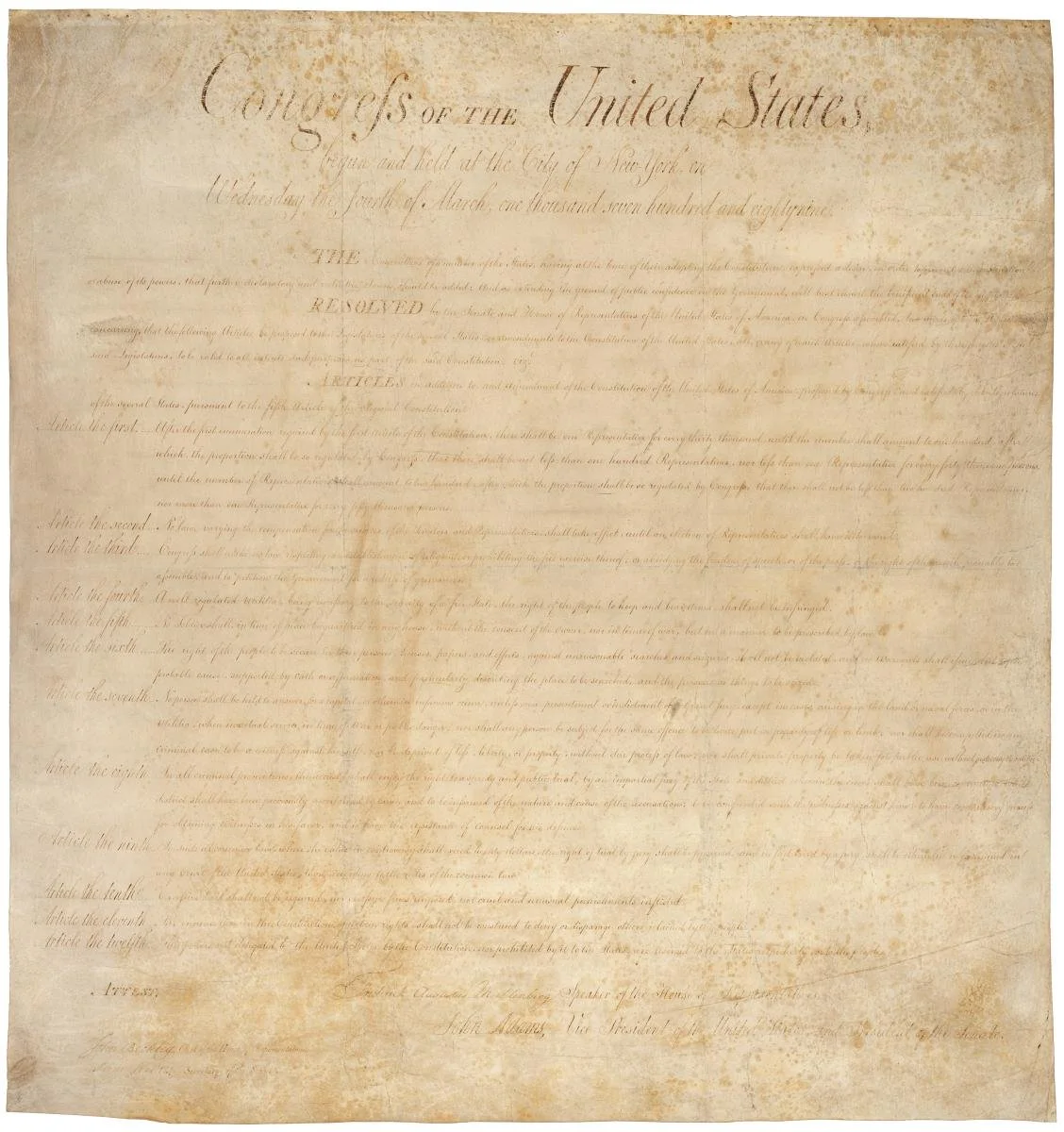
Digital reproduction of the 1789 joint resolution proposing twelve amendments, ten of which became the Bill of Rights in 1791. National Archives, General Records of the United States Government, Record Group 11. Public-domain federal record.
Model the reasoning without pretending to decide a real case
Use a clearly fictional introductory scenario: “Congress passes a law banning a newspaper from criticizing federal officials.” Ask students to identify the actor, the action and the relevant constitutional language. A useful response connects the government restriction to speech or press; it does more than repeat “Amendment One.”
Then change one fact: a friend refuses to read the newspaper. Students should notice that a private disagreement is not the same as government censorship. This is a starting distinction, not a claim that every real situation involving private organizations is legally simple.
Avoid beginning with school searches or student social-media disputes unless you are prepared to teach the relevant cases and context. A missing fact may change the analysis. A short scenario should invite a reasoned question, not impersonate a complete legal opinion.
Require one reason and one unresolved fact
Give students this response frame: “The relevant right may be [write here]. The detail [write here] matters because [write here]. Before reaching a firmer conclusion, I would need to know [write here].” The final blank prevents a vague declaration that all rights are unlimited or that safety automatically settles every dispute.
Ask partners to compare two plausible answers and point to the precise words that distinguish them. For an early lesson, use straightforward fictional government actions. Add more complex cases only after students can explain the basic connection between an actor, an action and a protection.
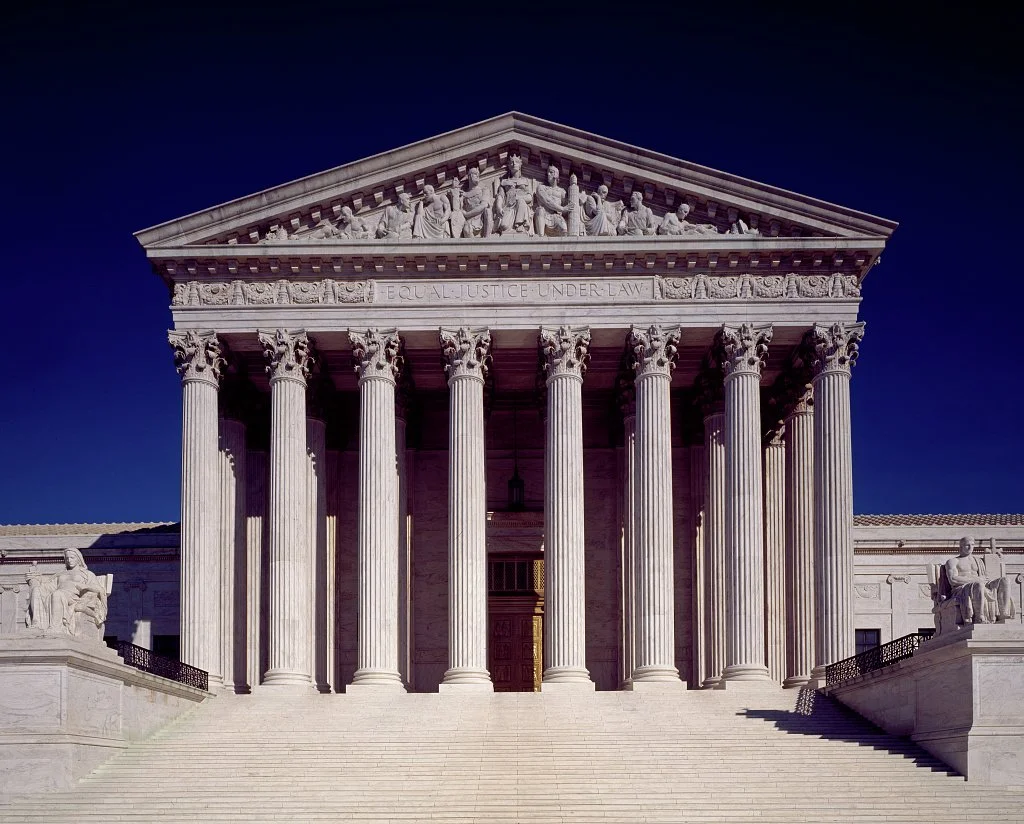
The Supreme Court building, Washington, D.C., photographed between 1980 and 2006. Carol M. Highsmith, Library of Congress, Prints and Photographs Division, LC-DIG-highsm-13879. Public domain.
Connect the right to petition with a specific historical struggle
The 1838 petition below asked the House to rescind its gag rule, which prevented consideration of antislavery petitions. Have students identify who was asking, which government body they addressed, and what change they sought. Then connect those details to the First Amendment’s petition language.
Do not reduce the source to a generic example of “people sharing opinions.” It concerns organized opposition to slavery and a congressional rule that silenced those petitions. The House’s historical record explains that the gag rule remained in effect until 1844. That context lets students distinguish exercising a right from immediately achieving the requested result.
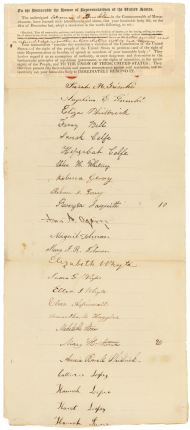
Petition to Rescind Gag Rule, February 14, 1838, from women in Brookline, Massachusetts. Tabled Petitions and Memorials, 25th Congress. Image courtesy of the National Archives and Records Administration, via U.S. House History, Art & Archives. Public-domain historical record.
Assess the connection rather than the confidence
Collect a short response to a new scenario. Award separate feedback for naming the relevant right, citing a meaningful detail, explaining the connection, and identifying a genuine limitation or missing fact. A confident amendment number should not compensate for absent reasoning.
For students who need support, offer a small set of relevant excerpts and read the scenario aloud. For students ready for extension, change one fact and ask whether their reasoning changes. These are suggested teaching adaptations, not tested guarantees of access or learning gains.
This article is a classroom planning guide, not legal advice about a student’s actual situation. Use current authoritative case materials when teaching contested applications of rights.
Choose a format without buying the same component twice
HistoraEDU offers a reading lesson, an interactive review activity, a bundle of those two items, and a broader online module. Choose by the instructional task rather than assuming that all four are needed. The activities above are original suggestions for using constitutional sources; they are not a list of promised product inclusions.
The Bill of Rights Explained |Ten Amendments & Individual Freedoms | Government
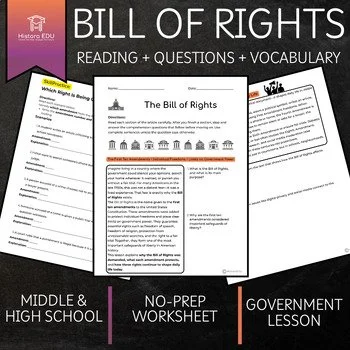
View this HistoraEDU resource on TPT
Bill of Rights Explained is the reading option. The current listing describes a non-editable PDF with embedded questions and two skill-building activities. Choose it when students need a shared text before applying rights.
Bill of Rights Review Activity: Real-Life Scenarios for the 10 Amendments
View this HistoraEDU resource on TPT
Bill of Rights Review Activity uses real-life scenarios and feedback in an editable Canva slide activity. Use a review response as the beginning of discussion, then ask students to justify it with constitutional language.
Bill of Rights Bundle | First Ten Amendments Lesson + Real-Life Scenarios Review
View this HistoraEDU resource on TPT
The Bill of Rights Bundle includes the reading lesson and scenario review activity above. It is an alternative to buying those two separately, not a third distinct lesson. Check what you already own.
Bill of Rights Complete Online Module | Civics & Government | Full mini-unit
View this HistoraEDU resource on TPT
The Complete Online Module is the broader option: its listing describes three mini-lessons, four review games, a workbook and a performance task. Use it as a teacher-led sequence, selecting sections that fit your goal. Before using the workbook’s Lesson 1.2 matching activity or Lesson 3 school scenarios, add the teaching notes below; the brief definitions are not complete legal rules. The online activities have not been tested for this article.
Three qualifications to teach explicitly
For matching item F, the Seventh Amendment preserves civil-jury rights in federal suits at common law, with scope and exceptions; it is not a promise of a jury whenever one person sues another.
For matching item A and the backpack scenario, teach T.L.O.’s public-school standard: a search must be justified at its start and reasonably related in scope to the circumstances. Do not use a universal warrant-or-probable-cause rule, or treat finding nothing as the deciding fact. Ask what supported the suspicion and how the search was conducted.
For the three-day suspension scenario, make the public-school assumption explicit and allow the Fourteenth Amendment in Step 3 rather than restricting answers to the first ten. Goss concerns notice and an opportunity to respond, not a criminal trial; ordinary short suspensions and urgent removals require different timing analysis.
Sources and image credits
Bill of Rights original and transcript
Petition to Rescind Gag Rule record
Federal courts educational resources
State action doctrine — Constitution Annotated, 2024 Supplement
Product thumbnails: HistoraEDU, reproduced from the exact current TPT listings at the owner’s request. Archival sources do not endorse HistoraEDU or its products.
