
By HistoraEDU
A student labels a cliff dwelling Navajo, calls every Southwest community Pueblo and explains every difference with the word desert. More vocabulary alone will not untangle those ideas. Build a comparison in which every claim has a named community, a place and a period. The goal is a defensible explanation of one example, not a completed chart that makes distinct peoples interchangeable.
Start with a question that requires a specific example
Ask students how a community addressed a particular problem, such as growing food or obtaining water. Provide one short account with its creator and date. Before reading for details, have students circle the community name and underline the period. If either is missing, identify that gap rather than filling it from a familiar regional stereotype.
Use Southwest as a location label, not as the name of a people. Separate the regional reading from the readings about Ancestral Pueblo people, contemporary Pueblo communities, Diné and Apache peoples. These are not interchangeable stages on a single cultural timeline.
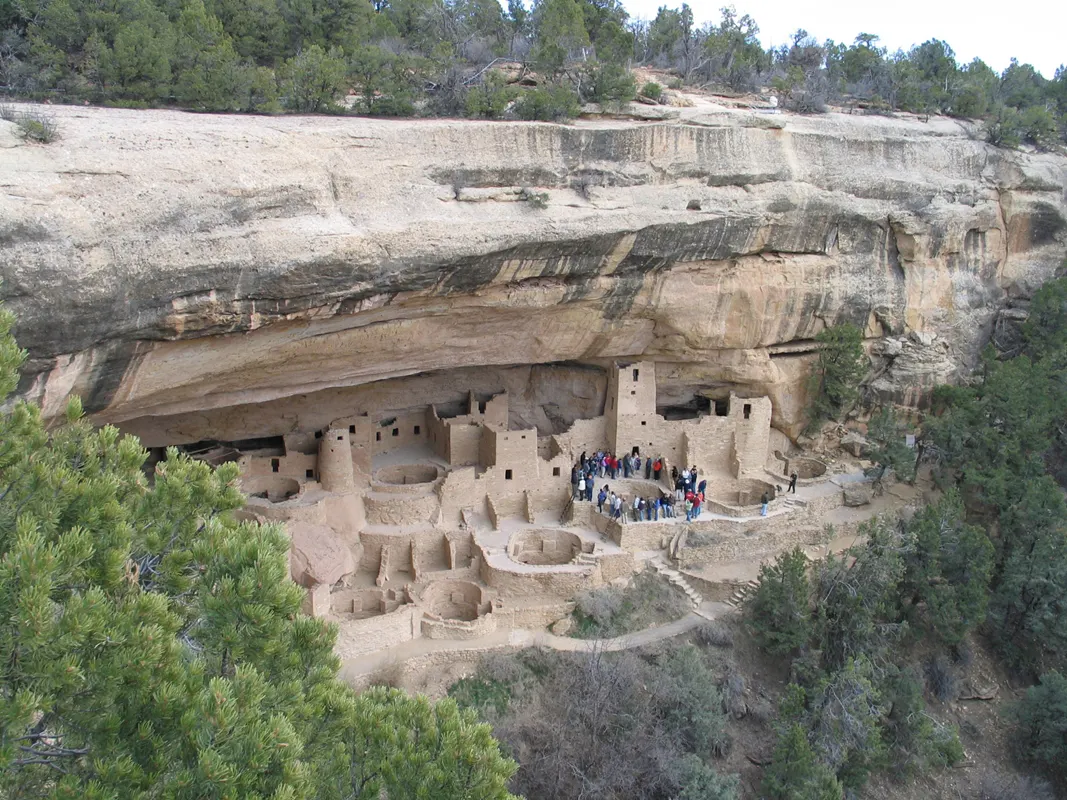
Modern photograph of Cliff Palace at Mesa Verde; surviving architecture, not an image of its former residents. Credit: NPS Photo. Public domain; no endorsement implied.
Ask what the photograph can actually establish
Show the Cliff Palace photograph with its modern date context. Students can describe an alcove and surviving architecture. They cannot identify the language spoken by an individual resident from the image. Nor does the photograph establish how every Southwest community built or lived.
The National Park Service explains that descendants of Ancestral Pueblo people continue in communities today. Use that account to replace a disappearance story with questions about movement, relationships and continuity. Do not infer that a modern community must resemble a historic photograph to be authentically connected to the past.
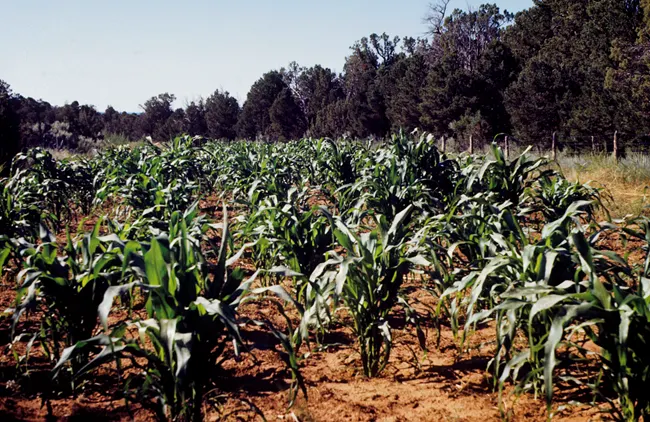
Experimental corn fields planted with Hopi corn varieties using traditional techniques; modern research plot, not an ancient photograph. Credit: NPS. Public domain; no endorsement implied.
Compare knowledge rather than rank adaptation
The corn photograph shows a modern experimental field planted with Hopi varieties using traditional techniques. That makes it useful for asking how people study agricultural knowledge; it is not a photograph of an ancient harvest. Ask students what additional information they would need to compare two farming methods fairly.
For a short written task, provide two bounded source excerpts about the same problem. Students record a decision, the evidence for it and a question left unanswered. Avoid a best-adapted ranking. A method suited to one place, season and social setting is not automatically superior everywhere.
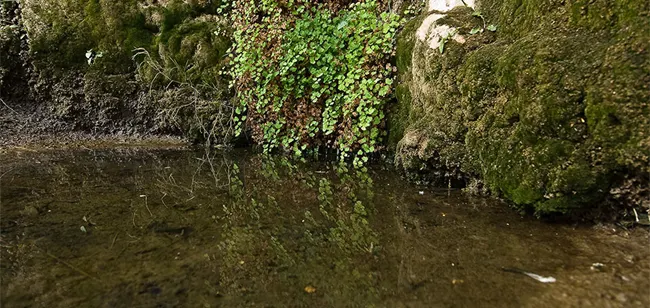
Modern photograph of a spring beside a Mesa Verde cliff; illustrates water availability at one site rather than a universal Southwest explanation. Credit: NPS. Public domain; no endorsement implied.
Put a limit beside each explanation
The spring photograph makes water visible at one Mesa Verde site. Ask students to revise “The desert had no water” into a claim that accounts for this evidence. Then ask why one spring cannot explain settlement across an entire region.
Model a sentence that distinguishes evidence from inference: “The photograph shows water beneath this overhang; the historical account is needed to explain how people used it.” Students should not claim to know a community’s decisions from a scenic image alone.
End with a correction rather than a list
Give students this claim to repair: “All Southwest peoples lived the same way because they lived in a desert.” A satisfactory response names one community and period, cites a detail and explains why the regional label is insufficient. A stronger response identifies a second source needed for a fair comparison.
For current community perspectives, use the Mescalero Apache Tribe’s account of its constituent histories alongside the NPS account of Pueblo continuity. These sources serve different purposes; neither speaks for every Southwest nation. The practical win is a habit of naming whose history a claim describes.
Use the readings selectively
The catalog offers a regional entry and four more specific readings. Choose the text that supplies the missing example instead of assigning all five as repetitive background. Use selected passages with the chronological qualification below, and check that each example names a community and period rather than treating the region as one culture.
Southwest Native Americans Reading Comprehension Worksheet
View this HistoraEDU resource on TPT
Use this regional reading to locate the Southwest and identify a community-specific question, not as the sole chronology reference. Before using its Ancestral Pueblo section, supply this correction: in Crow Canyon’s Mesa Verde chronology, 900–1150 CE is Pueblo II and 1150–1300 CE is Pueblo III. The reading’s label for 900–1150 CE should not be copied into a student timeline. Archaeological period labels organize a regional chronology; they do not turn Pueblo, Diné and Apache peoples into stages of one culture.
Ancestral Puebloans Reading Comprehension Worksheet
View this HistoraEDU resource on TPT
A community-history entry for distinguishing ancestral settlement and movement from a disappearance narrative. Select a dated passage and corroborate it with the NPS account rather than assuming every claim is independently certified.
Pueblo People Reading Comprehension | Native American History
View this HistoraEDU resource on TPT
Use to bring Pueblo communities into the comparison as distinct continuing communities, not merely an architectural style. Preview the exact passage and current community terminology.
Navajo People Reading Comprehension | Native American History
View this HistoraEDU resource on TPT
Use a named Diné example instead of treating Navajo history as interchangeable with Ancestral Pueblo history. Preview the scope and dates of the chosen section.
Apache People Reading Comprehension | Native American History
View this HistoraEDU resource on TPT
Use alongside the Mescalero Apache Tribe’s public history to distinguish particular Apache communities. Avoid presenting a single account as universal across all Apache peoples.
Sources and image credits
Mesa Verde people and continuing communities
Crow Canyon Pueblo III chronology
Product thumbnails: HistoraEDU, reproduced from the exact current TPT listings at the owner’s request. Archival sources do not endorse HistoraEDU or its products. No claim to original U.S. Government works.
