
By HistoraEDU
When students remember the Preamble but cannot explain why the Articles of Confederation came first, the documents become isolated vocabulary. Start with a shared problem and carry one question through the sequence: who has the authority to act, and what limits that authority? A short comparison helps students see why people argued over the design of government without pretending that the Constitution was an inevitable or universally fair solution.
Start with a problem that exposes a choice
Imagine several communities that share a road but disagree about maintenance. Ask who should decide, who should contribute, and what should happen if one community refuses. There is no need to declare a winning design. Students should explain the trade-off in their choice: local control, coordination, cost, or accountability.
Make the boundary explicit. The road problem is a teaching analogy, not a reenactment of the 1780s. Its purpose is to give students a question to bring to the historical documents. Do not let an engaging opening replace the historical evidence that follows.
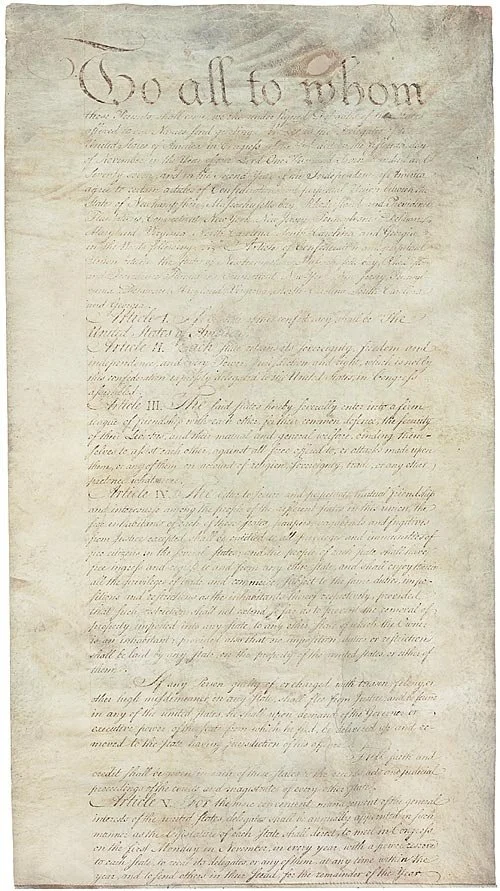
Articles of Confederation, adopted in 1777 and effective from March 1, 1781. National Archives, Record Group 360. Public-domain historical document.
Read the Articles as a design with reasons and limits
Give students selected passages rather than a list headed “everything wrong with the Articles.” Article II reserved powers to the states unless expressly delegated; Article V gave each state one vote in Congress. Ask what concern those arrangements might address, then ask what coordination problem they could create. A feature can serve a purpose and still produce a difficulty.
The National Archives explains that the Articles were adopted in 1777 but did not take effect until 1781. Keep adoption and operation separate on the timeline. Avoid suggesting that the United States had no government before the Constitution or that every difficulty had one cause. Students can compare a power granted in the document with a limitation described in the historical context.
Connect the Convention to disputed decisions
Show a modern photograph of Independence Hall and ask what the building image can establish. It gives a place, not a record of what every delegate thought. Use a short account of the 1787 debates to identify a specific disagreement, such as representation. Students should record the competing proposals and the arrangement adopted.
Do not use “compromise” as a synonym for fairness. The Constitution’s protections for slavery and the exclusion of many people from political power require direct explanation. Students should not role-play enslaved people or bargain over their rights. Analyze the text and its consequences instead, distinguishing whose interests were represented from whose were denied.

Independence Hall in Philadelphia, photographed between 1980 and 2006. Carol M. Highsmith, Library of Congress, LC-DIG-highsm-15403. Public domain. A modern photograph, not an image of the 1787 Convention.
Use the Preamble as a statement of purposes
Return to the opening community problem. Ask students to choose one Preamble goal that could help frame the discussion and explain the connection. More than one goal may be relevant. A reasoned answer is stronger than a worksheet that forces every action into one supposedly exclusive category.
Then separate a purpose from a power. The Preamble introduces the Constitution’s aims; students must look to the operative provisions for how government is structured and authorized. A phrase about the general welfare does not, by itself, settle whether a particular action is lawful. Keep the task at the level of civic reasoning rather than personalized legal advice.
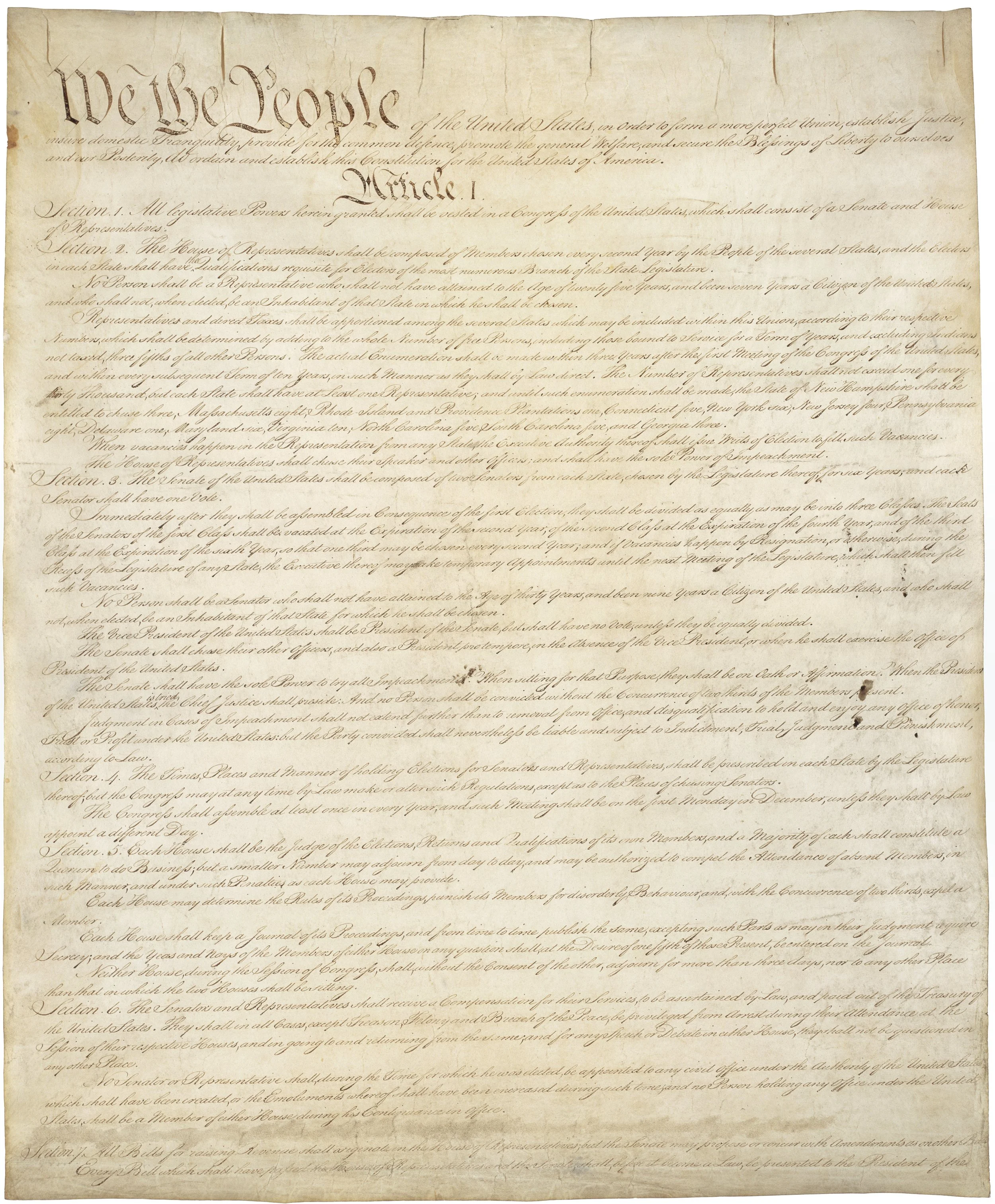
First page of the U.S. Constitution, 1787. National Archives, Record Group 360. Public-domain historical document. Pair the image with a readable transcript rather than requiring students to decipher the handwriting.
Bring participation back into the explanation
Ask how people can respond when they disagree with a public decision: learning about the issue, contacting representatives, attending a public meeting, or voting when eligible. Distinguish a legal duty from a voluntary civic responsibility, and verify the applicable rules before giving specific examples. Many constitutional protections apply to persons, not only citizens; avoid turning a citizenship lesson into an inaccurate list of exclusive rights.
For an exit response, students explain one connection between a problem, a governing arrangement, and a question people could still debate. Read for the connection rather than the number of document names. A student who can explain one trade-off has given you a clearer next teaching step than a student who merely recites a sequence.
Choose the reading that matches the missing connection
These five resources address different points in the sequence. They are options for targeted background and practice, not a requirement to buy five lessons for one activity. Preview the reading level and selected content before choosing.
Why Do We Need Government? | Purposes of Government Lesson | Reading Passage
View this HistoraEDU resource on TPT
Why Do We Need Government introduces protection, order, rights, and services, with chunked reading and a Create Your Own Government extension. Use it before the document comparison if students need the basic question clarified.
The Preamble Explained | Goals of Government | Reading Comprehension & Skills
View this HistoraEDU resource on TPT
The Preamble Explained focuses on goals of government and matching actions to those goals. Add the distinction between a stated purpose and an operative constitutional power.
The Articles of Confederation | Government Lesson | Reading Comprehension
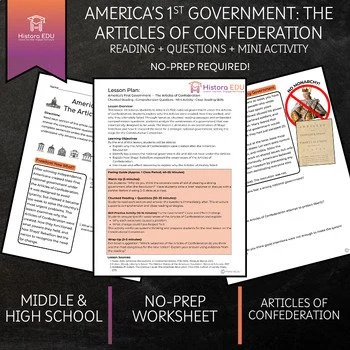
View this HistoraEDU resource on TPT
The Articles of Confederation reading includes a cause-and-effect skill activity. Use it to connect a specific structural choice to a problem rather than treating the Articles as a list of failures.
Constitutional Convention | Government Lesson | Reading Comprehension | Vocab
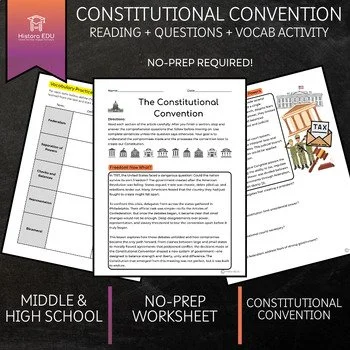
View this HistoraEDU resource on TPT
Constitutional Convention provides reading and questions about debates and compromises. Teach the consequences of slavery-related provisions explicitly; compromise is not automatically an ethical success.
Rights & Responsibilities of Citizens | Civic Duties & Citizenship | Government
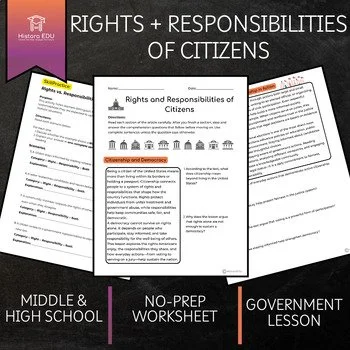
View this HistoraEDU resource on TPT
Rights and Responsibilities of Citizens introduces participation and the distinction between duties and responsibilities. Check examples against current authoritative rules and avoid implying that noncitizens have no constitutional rights.
Sources and image credits
Articles of Confederation text and context
Image record articles-confederation
Image record independence-hall
Product thumbnails: HistoraEDU, reproduced from the exact current TPT listings at the owner’s request. Archival sources do not endorse HistoraEDU or its products. No claim to original U.S. Government works.
