
Featured photograph: Working with a calculator and notebook. Photo: Mikhail Nilov, Pexels License. Full frame, display-scaled only. Contextual stock photograph, not the fictional planning task or a learner’s assessed work.
Make the resources part of the assessment design
An open-resource task can still reward the wrong thing. If the instructions say “use any references” but the answer depends on finding one obscure rule, the assessment mixes operational judgment with search luck.
Start with the decision learners must make, then specify the information and assistance available while they make it. Require a short chain from source to calculation to action. A correct number without that chain can hide a misunderstood constraint; a copied rule cannot show how the learner applied it.
UNSW’s open-book guidance distinguishes locating information from interpreting and applying it, and reminds students to check resource restrictions. Its rules about independent work and AI concern its own assessment context. The workplace example below sets its own explicit boundaries. It is an original fictional exercise, not UNSW policy, a validated assessment or a report of training results.
The assessment brief
You are planning a fictional training centre’s morning preparation run. Produce 120 workshop folders: 80 standard-print and 40 large-print. All must be ready for dispatch at 11:00. Work can start at 09:00. Use only Reference Pack v1.0 reproduced below to construct a feasible sequence, then respond to a printer delay.
Submit one decision sheet with four elements: your normal-run timeline; the calculation showing whether the required reserve is preserved; a revised timeline if the printer is unavailable until 09:10; and the action you would take if that revision violates a constraint. Attach a reference pointer to each calculation or decision. A pointer such as “P2-D” is enough; no formal citation style is required.
Allocate a 45-minute planning session, with access arrangements established beforehand. This duration is an illustrative scheduling choice, not a tested completion standard. Do not award points for finishing early. Before using this exercise with learners, copy the reference rules and blank response fields below into your chosen accessible format, without the worked answer. Practise finding a named rule on a different example. Keep the worked answer below for the trainer until the task is complete.
State the resource and assistance boundaries
Allowed during the task: this assessment brief; Reference Pack v1.0, sections P1 and P2 below; the blank response fields below; blank scratch paper; a basic calculator; and a plain-text editor or word processor with generative features disabled. All case rules and response prompts are included in this article; no separate download is required. Learners may copy and annotate these reference rules during the task.
Not allowed in this example: personal notes, other manuals, web searches, messaging, shared documents, help from colleagues, or generative AI for drafting, summarising, calculating or checking the answer. These boundaries isolate the learner’s own resource-based planning for this exercise; they are not a universal rule for workplace learning.
Screen readers, magnification, text-to-speech, speech-to-text dictation, and basic spelling correction are allowed. They must not supply substantive reasoning. The facilitator may resolve access problems or clarify wording, but must not suggest a sequence, verify a calculation or approve a recommendation. Any clarification that changes the task’s meaning goes to every participant. Ask learners to identify any assistance used without requiring disclosure of a diagnosis.
“Servicing the old office printer,” 2020. Photo: Shixart1985, CC BY 2.0, via Wikimedia Commons. Full-frame 3840-pixel source derivative, proportionally displayed. Actual equipment context, not the fictional printer or evidence of its rates; no repair task is assigned.
The photograph shows the exposed mechanism of an actual office printer. It makes equipment availability concrete, but it supplies none of this case’s rates, release rules or timing assumptions. Read those from the pack, not from the pictured machine. No repair work is part of this assessment.
Reference Pack v1.0 — page 1 of 2
Fictional planning data. These are the complete case rules, not actual workplace procedures or measured production rates. Page 1 supplies the commitments and workflow; page 2 supplies the rates and checks.
P1-A — Order and dispatch
Prepare exactly 80 standard-print folders and 40 large-print folders. Each folder contains one complete insert set in its required print format. There are 120 empty folders and sufficient printing supplies for the planned run. Dispatch is fixed at 11:00. No work begins before 09:00.
P1-B — Assigned resources
One operator controls one printer. Two assemblers each have one assembly station. The operator handles printing and the final verification; the operator does not assemble folders. Roles do not change during this exercise. No additional staff, printers or assembly stations are available without an approved change to the brief.
P1-C — Release and reserve rules
Print all sets of one format as a batch. Release that batch for assembly only when its entire print run is complete; no partial-batch release. Either format may go first. Printing the second batch may overlap assembly of the first. Preserve at least 20 minutes between completion of final verification and dispatch. This reserve is not available for planned work. Escalate a plan that cannot preserve it.
Reference Pack v1.0 — page 2 of 2
Fictional planning data, continued. Use these fixed rates without adding assumed breaks, changeovers, productivity gains or staffing. All required setup and checking time is stated here.
P2-D — Printing
Standard-print rate: 4 complete insert sets per minute. Large-print rate: 2 complete insert sets per minute. Each format requires 5 minutes of setup immediately before its run, including the first format. The printer handles only one format at a time. Setup cannot happen while the printer is unavailable. Run duration equals quantity divided by the relevant rate.
P2-E — Assembly
Each assembler completes 1 folder per minute, using one printed insert set. With both assemblers working, the combined rate is 2 folders per minute. Assemblers may divide a released batch equally. They may not begin with an unreleased batch. There is no additional assembly setup time.
P2-F — Final verification
After all 120 folders are assembled, the operator performs a 10-minute final verification of the quantities and formats. This check cannot overlap assembly or be shortened. In the normal and delayed calculations, assume no defects or reprints; the task tests whether the required reserve remains available, not an unstated defect rate.
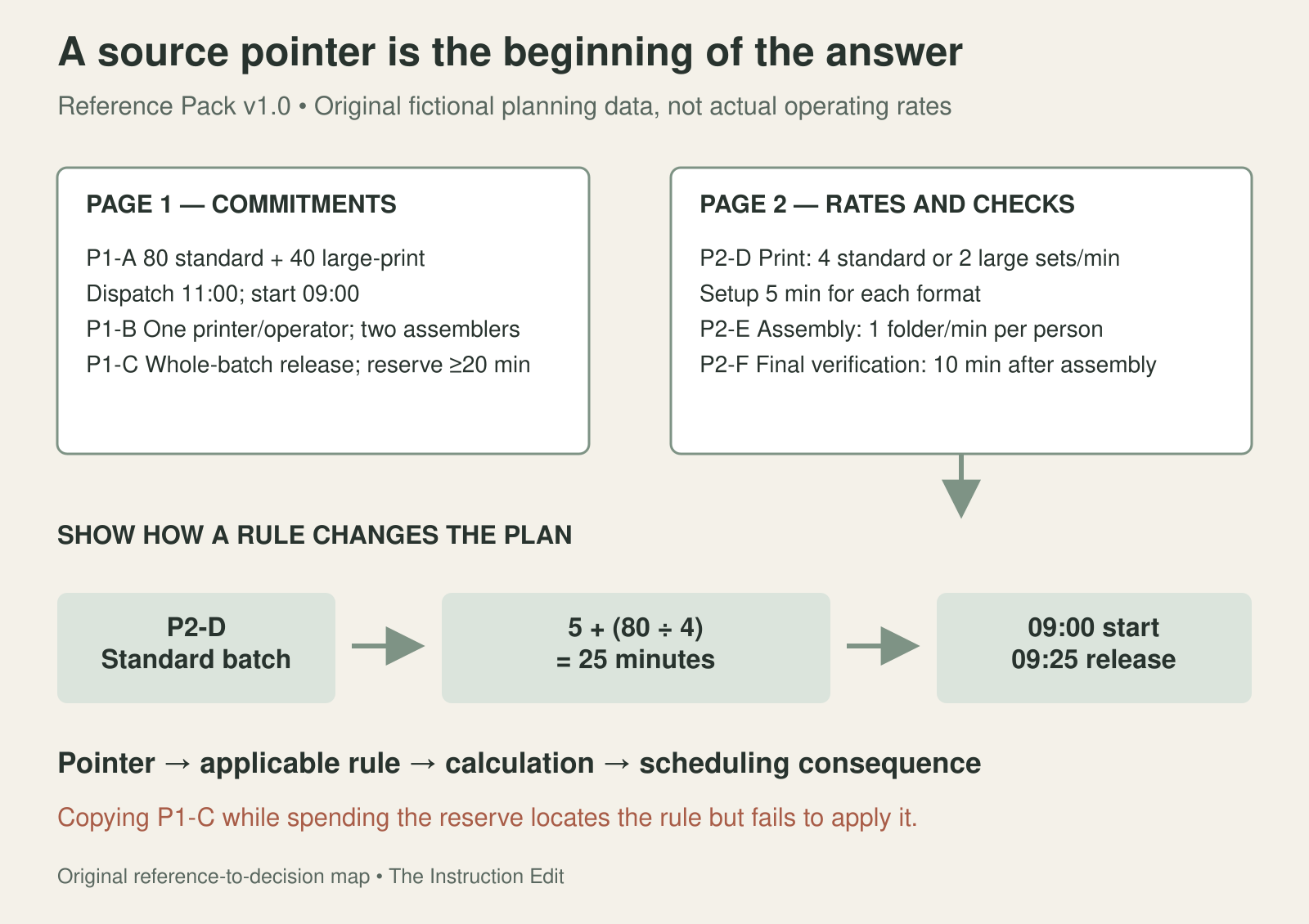
Figure 2. Follow a source pointer through a calculation to its scheduling consequence. Original fictional reference map by The Instruction Edit; the full pack text appears above.
Blank response fields
Copy these prompts into a document or onto paper. Add a reference pointer beside each calculation or decision, such as P2-D. These are response spaces, not worked answers.
1. Normal-run timeline. Chosen batch order: ____. Setup, printing, release, assembly and final verification start/end times: ____. Overlap or waiting: ____. Calculations and reference pointers: ____.
2. Reserve check. Final verification finishes at: ____. Dispatch time: ____. Remaining reserve: ____. Required reserve and reference pointer: ____. Is the plan feasible under every rule, and why? ____.
3. Printer-delay revision. With no printer access until 09:10, revised timeline and calculations: ____. Remaining reserve: ____. Does a different batch order change the decision? ____. Reference pointers and feasibility conclusion: ____.
4. Constraint conflict and next action. Conflict: ____. Supporting calculation and reference pointer: ____. Proposed escalation: ____. State what still requires authorization; do not invent an approved change. Assistance used, if any, without disclosing a diagnosis: ____.
Worked answer: follow a rule through to a decision
Choose standard-print first. Printing takes 5 + (80 ÷ 4) = 25 minutes, so setup and printing run from 09:00 to 09:25. Large-print also takes 5 + (40 ÷ 2) = 25 minutes, running from 09:25 to 09:50. The two 5-minute setups are separate obligations, not one shared allowance (P2-D).
Both assemblers start the released standard batch at 09:25. They need 80 ÷ 2 = 40 minutes, finishing at 10:05. The large-print batch has been ready since 09:50, so they can immediately assemble its 40 folders in 40 ÷ 2 = 20 minutes, finishing at 10:25 (P1-C; P2-E).
The operator verifies the complete order from 10:25 to 10:35 (P2-F). Dispatch at 11:00 leaves 25 minutes. That exceeds the required 20-minute reserve by 5 minutes, so the normal plan is feasible under the supplied assumptions (P1-A; P1-C).
Large-print first is also defensible. It releases at 09:25, assembles by 09:45, and then the assemblers wait until the standard batch releases at 09:50. Standard assembly ends at 10:30; verification ends at 10:40. The reserve is exactly 20 minutes. Accept this answer if the learner shows the five-minute wait and checks every constraint. The brief requests feasibility, not a unique optimal sequence.
The delay changes the decision
With the printer unavailable until 09:10, the standard-first batches release at 09:35 and 10:00. Standard assembly runs 09:35–10:15, large-print assembly runs 10:15–10:35, and verification runs 10:35–10:45. Only 15 minutes remain before dispatch. The folders could be physically ready before 11:00, but the plan violates the required reserve by 5 minutes.
Changing the batch order cannot rescue the reserve within these rules. Neither batch can release before 09:35. Assembly needs at least 120 ÷ 2 = 60 minutes after work first becomes available, followed by 10 minutes of verification. The earliest possible finish is therefore 10:45, even without idle time (P1-C; P2-D; P2-E; P2-F).
The response should flag the constraint conflict and seek an authorised change, rather than silently borrow reserve time or assume extra staff. A concise escalation is: “The printer delay makes the required reserve infeasible under the current resources. Our earliest verified finish is 10:45, leaving 15 minutes instead of 20. Please confirm an authorised revision before we commit to a plan.” No approved revision is supplied, so the answer must not invent one.
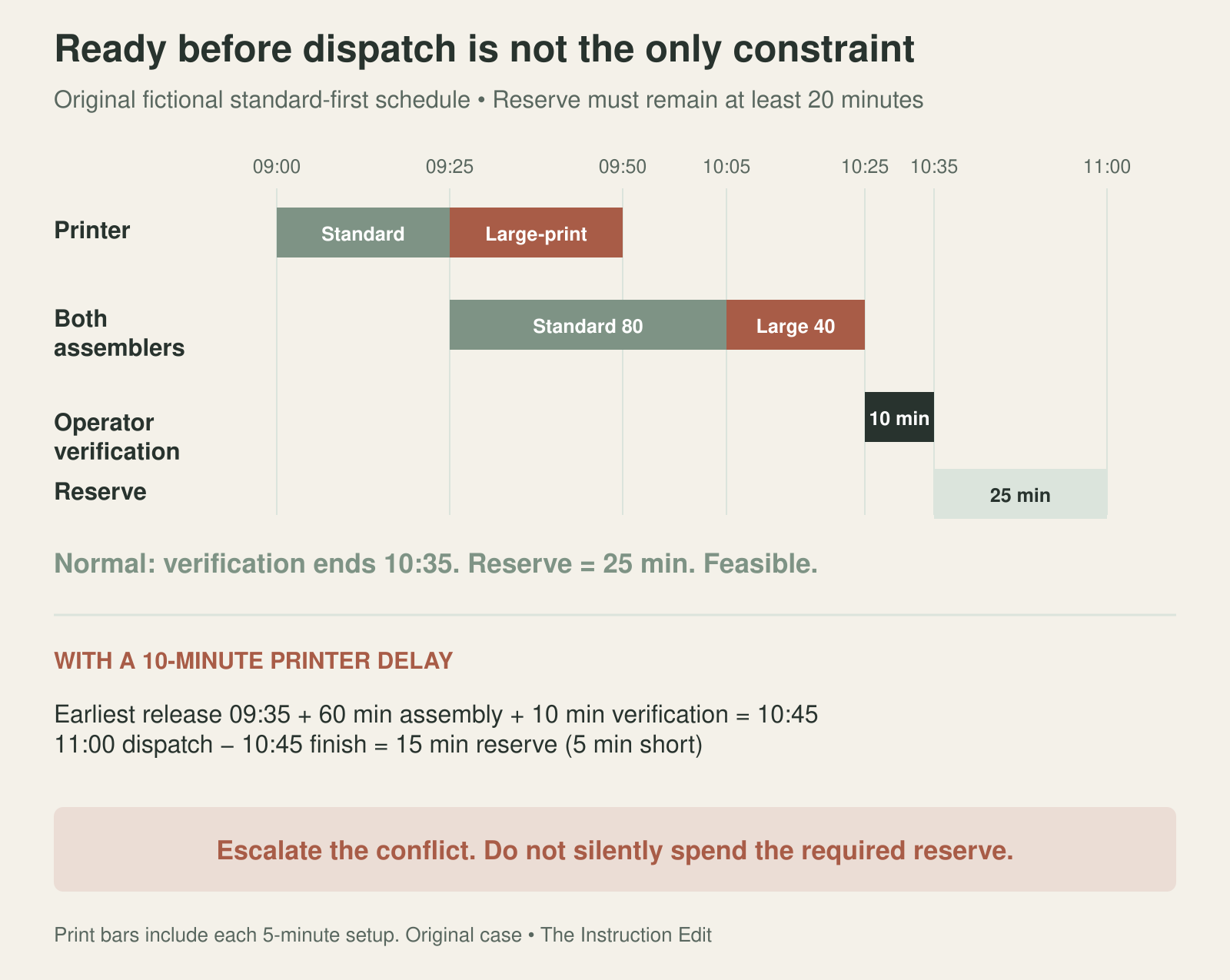
Figure 3. The normal plan meets the reserve rule; the delayed plan does not. Original timeline and arithmetic by The Instruction Edit, not measured production results.
Score the use of information
Use four criteria, each worth two points: selecting and pointing to relevant rules; correct capacity and timing calculations; a feasible normal sequence with reserve shown; and a justified delay response that respects the constraints. For each criterion, award two for complete, correct evidence, one for a material omission or partly correct reasoning, and zero when the required evidence is absent or contradicted.
Do not give a source pointer credit for application unless the explanation shows what that rule changes. Conversely, accept different wording and either feasible normal sequence. A response that copies P1-C but spends the reserve has located information without applying it. Explain such distinctions in the learner-facing guidance before the task, and review this draft scoring scheme before using it for consequential decisions.
For your next open-resource assessment, state the permitted materials and collaboration or AI boundaries before writing the scoring guidance. Then solve the task using exactly that resource set. Check that every necessary fact is available, every claimed decision follows from it, and the task rewards an explained use of information rather than an accidental discovery.
Source
UNSW Sydney — Open-book & take-home exams, accessed October 30, 2026. Official student guidance on applying information and checking assessment conditions. The reference pack, workflow, numbers, resource boundaries, scoring scheme and worked responses above are original fictional materials, not institutional or workplace policy.

