
By HistoraEDU
A timeline can be perfectly ordered and still explain very little. When students list the Missouri Compromise, the Compromise of 1850 and the Kansas Nebraska Act, ask them to name what changed between the entries. A causal chain centered on slavery and political power helps students move beyond “then this happened” without reducing the Civil War to a single event.
Give every arrow a job
Begin with three spaces: a dispute, a political response and a consequence. Students can place dates inside those spaces, but the arrows must contain verbs. “Restricted,” “reopened,” “required” and “intensified” make a more useful starting vocabulary than “led to,” which can conceal an unexplained relationship.
Make slavery explicit in the central question. Ask how decisions about its expansion affected political power and the lives of people subjected to enslavement. Do not turn the lesson into a debate over whether slavery was acceptable. Students are evaluating historical evidence and institutions, not defending the denial of human freedom.
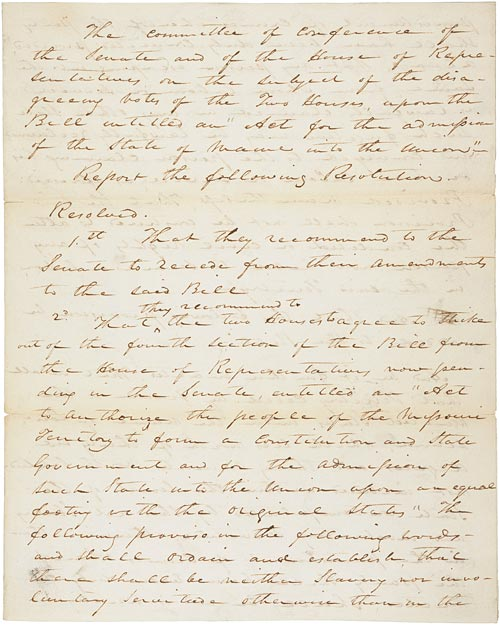
Conference committee report on the Missouri Compromise, March 1, 1820. Use the linked transcript for close reading; this page image establishes the document’s form and provenance. Credit: National Archives, Records of Joint Committees of Congress, Record Group 128; public domain federal historical document. No endorsement implied.
Model the difference between a rule and its scope
Use the Missouri Compromise as the first worked example. The legislation addressed Missouri’s admission and prohibited slavery in a specified part of the Louisiana territory, with Missouri excepted. Ask students to mark where the rule applied. Do not draw a line across the entire United States and imply that every place north or south of it followed one simple rule.
Then ask what political problem the arrangement addressed and what it did not resolve. A student can distinguish an immediate congressional settlement from the continuing conflict over slavery’s expansion. That is a stronger explanation than claiming the compromise permanently solved the problem or made later war inevitable.
Keep a proposal separate from an enacted law
Show the image of Henry Clay’s January 1850 resolutions. The National Archives identifies these as proposals, not the final enacted package. Give students the corresponding explanation and ask them to label the difference. This small source check prevents an attractive manuscript image from being misidentified in an otherwise accurate lesson.
Next, select two provisions from the final measures: California’s admission as a free state and the strengthened Fugitive Slave Act. Ask how each affected a different question. The second provision makes it particularly important not to evaluate “compromise” only from the perspective of legislators who wanted to preserve political agreement.
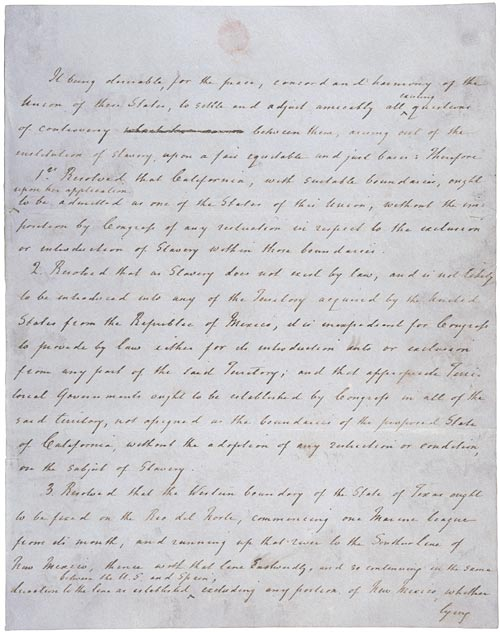
Henry Clay’s handwritten resolutions of January 29, 1850. These are not the five statutes ultimately enacted as the Compromise of 1850. Credit: National Archives, Records of the United States Senate, Record Group 46; public domain federal historical document. No endorsement implied.
Explain what changed in 1854
Add the Kansas Nebraska Act to the chain. Its repeal of the Missouri restriction and use of popular sovereignty reopened conflict over slavery in the territories. Have students explain the change in a sentence that names the earlier rule. “People disagreed again” is less precise than identifying what the new law altered.
When discussing popular sovereignty, ask who was permitted to participate. The statute’s initial voting provisions excluded many people affected by the outcome. A phrase such as “the people decided” needs qualification. Connect the subsequent violence in Kansas to the contested struggle rather than presenting it as a mysterious outbreak after a neutral vote.
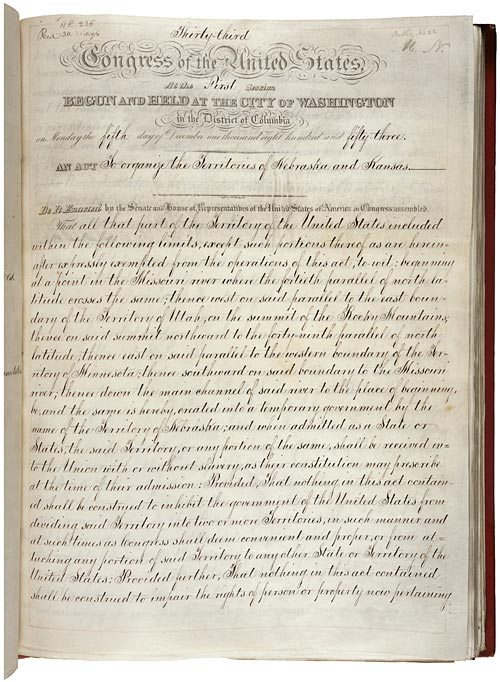
First page of the Kansas Nebraska Act, 1854. The linked National Archives transcription includes the territorial and voting provisions students can examine. Credit: National Archives, General Records of the United States Government, Record Group 11; public domain federal historical document. No endorsement implied.
Use the tariff crisis as a comparison rather than a replacement cause
The Nullification Crisis can help students examine an earlier conflict over federal authority. Keep its immediate tariff dispute clear. Ask how political arguments were used in that setting, then compare them with later disputes over slavery. Do not substitute a generic “states’ rights” label for explaining which claimed right was at issue in a particular source.
End with a paragraph built from two arrows in the chain. Require a specific change, evidence and an explanation of why it mattered. Students who need support can complete fewer events well; students ready for extension can identify a competing interpretation or an outcome that was not predetermined. The assessment is the reasoning between dates.
Expansion of Slavery Reading Comprehension Worksheet | Causes of the Civil War
View this HistoraEDU resource on TPT
Use the expansion reading to establish why new western territories sharpened conflict over slavery. It supplies background for the chain rather than replacing the primary evidence.
Missouri Compromise Reading Comprehension Worksheet | Sectionalism
View this HistoraEDU resource on TPT
Use the Missouri reading for an initial event summary, then check the geographical scope against the act.
Compromise of 1850 Reading Comprehension Worksheet | Sectionalism
View this HistoraEDU resource on TPT
Use the 1850 reading to identify different provisions before students explain how their effects differed.
Kansas-Nebraska Act Reading Comprehension Worksheet | Popular Sovereignty Civil
View this HistoraEDU resource on TPT
Use selected Kansas Nebraska sections to prepare students to compare the earlier restriction with the new territorial policy. When using that reading, keep the Missouri restriction tied to the Louisiana territory, with Missouri excepted, rather than treating it as a rule across the entire country.
The Bleeding Kansas Reading Comprehension Worksheet
View this HistoraEDU resource on TPT
Use the Bleeding Kansas reading to connect legislation with conflict on the ground, keeping the distinction between an event summary and a causal explanation.
Nullification Crisis Reading Comprehension Worksheet | States’ Rights
View this HistoraEDU resource on TPT
Use this reading as a comparison of arguments about federal and state authority. Keep tariffs in its immediate context and slavery central to the later secession conflict.
Sources and image credits
Missouri Compromise primary text
Clay proposal and enacted 1850 statutes
Kansas Nebraska Act primary text
Product thumbnails: HistoraEDU, reproduced from the exact current TPT listings at the owner’s request. Archival sources do not endorse HistoraEDU or its products. No claim to original U.S. Government works.
