
By HistoraEDU
Harriet Tubman deserves a central place in a lesson on resistance to slavery, but a unit can become less accurate when every form of action is folded into one heroic story. Help students distinguish self-emancipation, organized assistance, public advocacy and antislavery writing. A comparison built around actions and evidence makes room for Tubman’s work without erasing the people who sought freedom or the wider movement.
Begin with the person acting
Ask students to identify the subject of each sentence in a short historical account. Who seeks freedom? Who organizes help? Who writes, publishes or speaks? Revising a passive sentence can make agency visible. “People were rescued” leaves out both those who escaped and the networks involved.
The National Park Service describes the Underground Railroad as a movement of self-emancipation and a network of assistance, not a literal railway or a single route. Use that distinction before students draw a map. A line on a map should represent a documented journey or a clearly labeled general pattern, not a universal path followed by everyone.
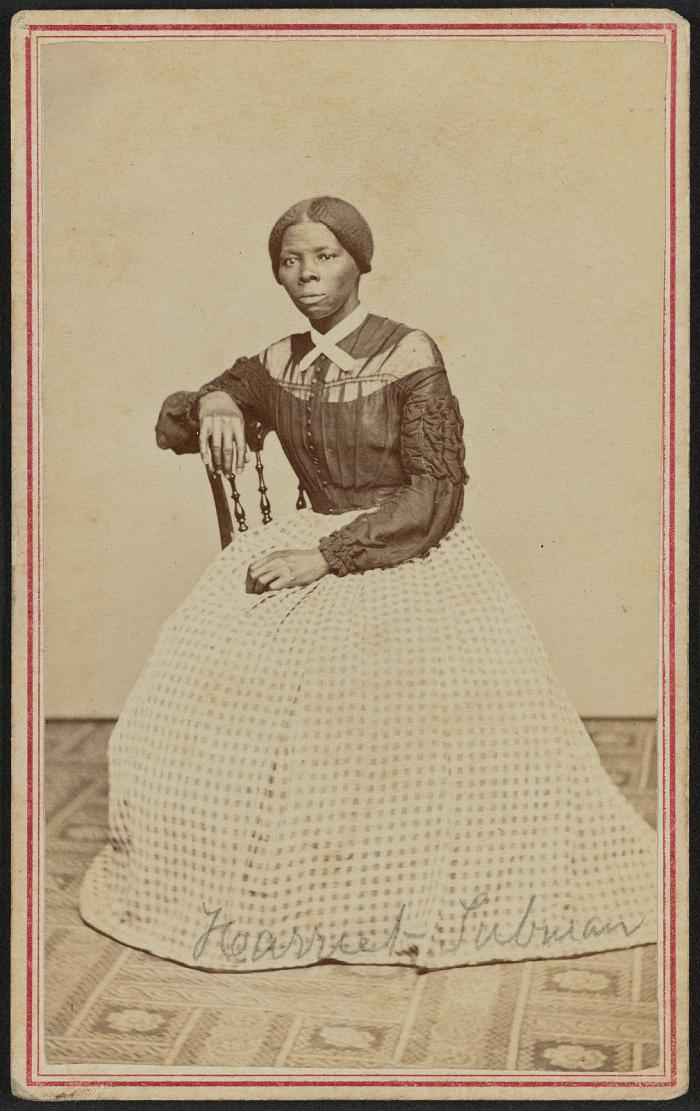
Harriet Tubman photographed by Benjamin F. Powelson in Auburn, New York, 1868–1869. This postwar studio portrait is not a photograph of an escape journey. Credit: Benjamin F. Powelson, 1868–1869; Collection of the National Museum of African American History and Culture shared with the Library of Congress, 2017.30.47; Public Domain CC0. No endorsement implied.
Use a portrait without asking it to tell the whole story
Invite students to describe the photograph before reading a caption. Then supply the sitter, photographer, place and date. Ask which questions the image can help answer and which require other sources. Clothing and pose are visible; the details of an Underground Railroad journey are not.
Read a short sourced account of Tubman’s actions alongside the portrait. Keep her work connected to family, community and historical circumstances rather than turning courage into a magical explanation. A useful prompt is “What did she do, what made it difficult, and what evidence supports your answer?” Avoid inventing dialogue or asking students to simulate being hunted.
Show why laws changed the risks
Introduce the strengthened Fugitive Slave Act of 1850 as part of the legal context, not a detached vocabulary term. The National Archives provides the enacted statute alongside the wider compromise measures. Students can identify how enforcement and penalties affected freedom seekers and those who assisted them.
Use the image below carefully: it shows Clay’s initial resolutions, not the enacted fugitive statute. That distinction creates a small but valuable sourcing task. Ask students to find the final law in the linked transcription and explain why they should not quote a proposal as if it were the final rule.
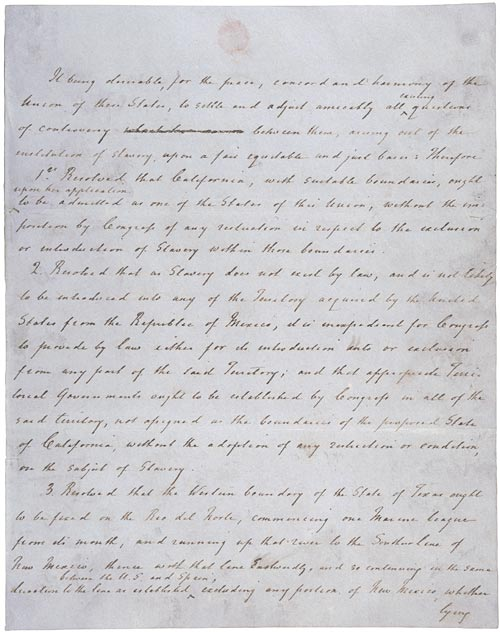
Clay’s January 1850 proposal precedes the enacted compromise measures. Pair it with the final statute’s transcript when examining the Fugitive Slave Act. Credit: National Archives, Records of the United States Senate, Record Group 46; public domain federal historical document. No endorsement implied.
Compare different forms of antislavery action
Create a compact comparison with the headings action, audience, evidence and limitation. One row can examine direct assistance to freedom seekers; another can examine a speech, newspaper or antislavery novel. Students should explain how each action worked rather than rank them as if only one mattered.
When discussing Uncle Tom’s Cabin, distinguish a fictional narrative from a first-person account and from a later historian’s interpretation. Its influence is worth studying, but a novel should not stand in for every enslaved person’s experience. Keep Black abolitionists and freedom seekers visible rather than presenting a white author as the movement’s beginning or sole engine.

A modern visitor overlooks marshland at the Harriet Tubman Underground Railroad site. This present-day landscape photograph is not evidence of a specific historical escape route or a reenactment. Credit: National Park Service, credited NPS Photo; public domain federal photograph. No endorsement implied.
Let geography raise questions rather than create a game
Use the marsh photograph to generate questions about terrain, knowledge and movement. Then return to a documented account to answer them. Students should not be asked to plan a successful escape as a competitive game or infer that a particular person traveled through the exact photographed spot.
For the final response, ask students to compare two forms of action and explain a relationship between them. They might connect a law’s enforcement to organized assistance or compare the audiences of a public text and private aid. Require two sourced details and one qualification. A nuanced explanation is a better outcome than a single hero poster or an invented map of every escape.
Abolitionist Movement Reading Comprehension Worksheet | Causes of the Civil War
View this HistoraEDU resource on TPT
This reading introduces the abolitionist movement and can prepare students to compare different forms of action. Pair it with a named primary source rather than treating the movement as one uniform voice.
Uncle Tom’s Cabin Reading Comprehension Worksheet | Abolitionism
View this HistoraEDU resource on TPT
For this lesson, select only the first paragraph on PDF page 4 and questions 8–9, which introduce Frederick Douglass, William Lloyd Garrison and The Liberator. Pair them with the NPS account of The Liberator to identify who wrote or published, for which audience and when. This gives students a concrete starting point for comparing antislavery print with direct assistance. Use the action-and-evidence comparison above instead of assigning the full reading or ranking a single most powerful method. The novel is fiction, not testimony for every enslaved person’s experience.
Underground Railroad Reading Comprehension Worksheet | Slavery & Resistance
View this HistoraEDU resource on TPT
The Underground Railroad reading offers background on the network. Use selected passages before students distinguish individual journeys from general patterns.
Harriet Tubman Reading Comprehension Worksheet | Underground Railroad Civil War
View this HistoraEDU resource on TPT
The Tubman reading supports a focused biography component. Pair its account with the accurately dated portrait and the linked NPS research rather than turning the portrait into an illustration of an escape.
Fugitive Slave Act Reading Comprehension Worksheet | Civil War Causes Activity
View this HistoraEDU resource on TPT
Use this reading to establish legal context, then examine the actual 1850 statutory text. The teacher-created comparison and source prompts above are extensions, not a claim about included activity sheets.
Sources and image credits
NPS Underground Railroad overview
Tubman research and changing interpretations
1850 statutes and proposal distinction
Product thumbnails: HistoraEDU, reproduced from the exact current TPT listings at the owner’s request. Archival sources do not endorse HistoraEDU or its products. No claim to original U.S. Government works.
