
A teacher can explain why a science idea matters without knowing why it might matter to each student. An invitation to make a connection gives learners a different job: identify a context worth thinking about, then explain how the science helps them understand it. The connection still needs scientific substance; enthusiasm alone is not the task.

That invitation need not become a demand for autobiography. A student can connect a concept to an interest, a public issue or a fictional situation without sharing family circumstances or claiming that the subject changed their life.
Keep the research comparison in view
Hulleman and Harackiewicz studied 262 students taught by seven science teachers at two high schools. Students were randomly assigned within classes to write about connections between course material and their lives or to summarize course material. Writing occurred across a semester, not as one isolated prompt. Results depended on initial expectations of success: the relevance condition benefited science interest and course grades at lower modeled expectancy levels, while the corresponding higher-expectancy comparisons were not significant. Grades were available for only one school, comprising 100 students. This was not a comparison with a teacher delivering a relevance speech, and it does not establish that every student benefits. Initial expectancy was measured, not experimentally assigned. [1]
Do not turn that subgroup result into a public label such as “students who need motivation.” It is a reason to examine variation in response, not a way to identify a fixed type of learner. The privacy-preserving prompt below is an original adaptation; its particular alternatives were not tested in that study.
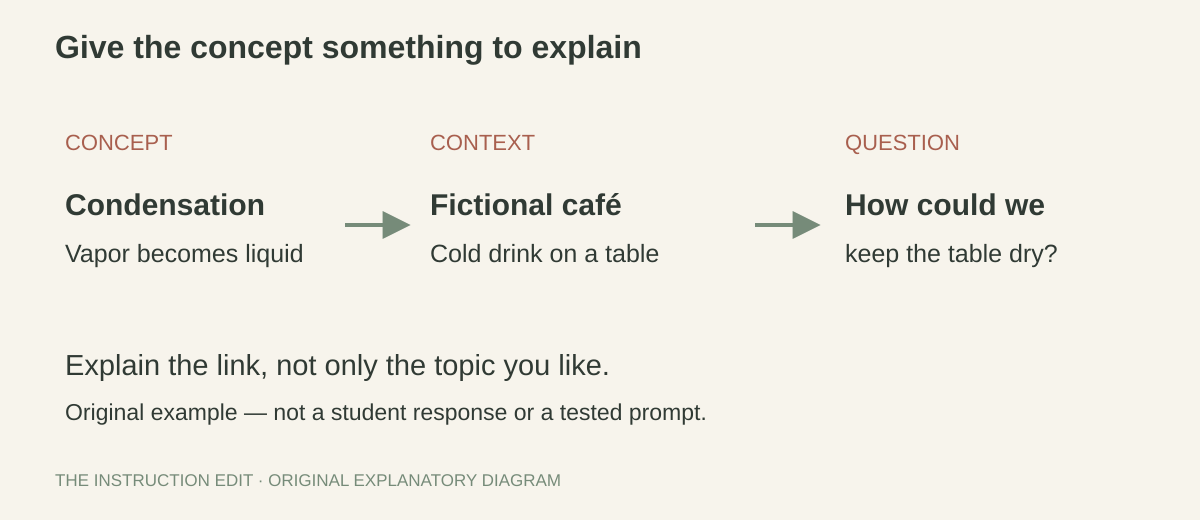
Figure 1. A connection needs an explanatory link. Naming a context is only the middle step; the final question gives the science something to explain.
Before asking for relevance, make sure students can use the concept at all. A learner who cannot yet distinguish a change of state from a leaking container needs scientific support, not a more emotional reason to care.
An original fictional example with condensation
Condensation is water changing from vapor to liquid. A familiar case is moisture forming on the outside of a cold glass in humid air. The water can come from surrounding air rather than through the glass. [2] Use that idea as the concept to connect, not as a conclusion drawn from a photograph alone.

Offer this original prompt: “Choose an interest, a person or community you wish to consider, or the fictional café below. Explain how condensation could matter in that context. State one question the concept helps you ask. You do not need to include private information.”
Fictional café scenario: a server puts a cold sealed drink on a dry table in humid air. Later, moisture appears on the outside and reaches the table. An example response is: “Water vapor in nearby air can become liquid on a sufficiently cold surface. I would ask whether a coaster could catch the drips and protect the tabletop.” This is a worked explanation, not collected student data.
Assess the connection rather than the disclosure
Use the same criteria for every route: the concept is accurate, the context is understandable and the explanation states a defensible relationship. Do not award extra credit for revealing something sensitive, praising science or describing an impressive career. A thoughtful fictional response can demonstrate the intended reasoning.
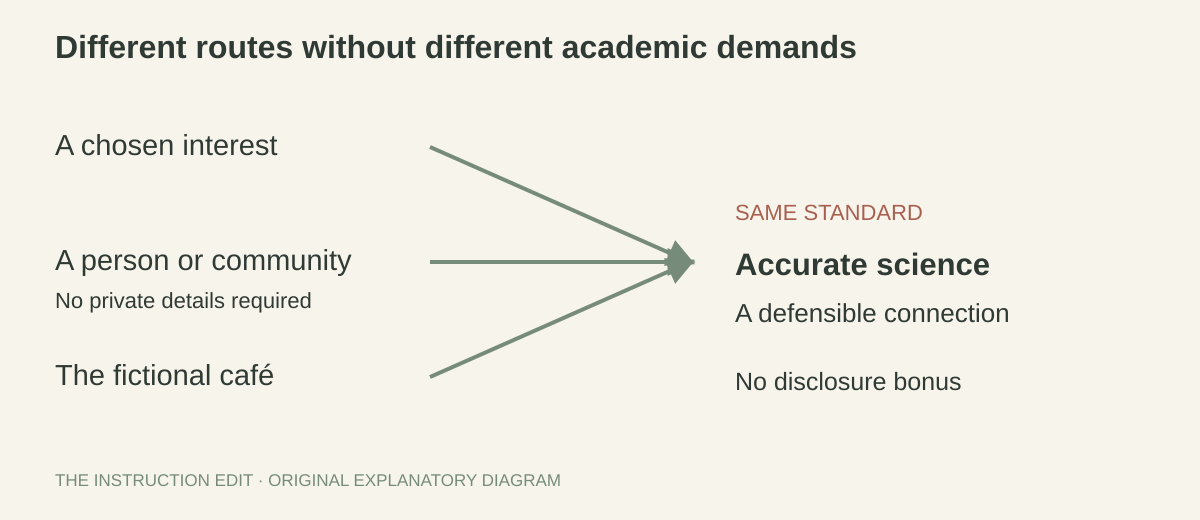
Figure 3. Original response routes converge on one academic standard. These are design alternatives, not three conditions whose effects have been compared.
A weak response might say, “Condensation matters at cafés because science is everywhere.” Ask what changes state, where the water comes from and what practical question follows. A different weak response might say that water passes through an intact glass. Correct that mechanism before celebrating the connection. Feedback can be specific without judging how personally meaningful the topic ought to feel.
Let students revise the explanation after feedback. If you also ask about interest, keep that response separate and optional; a scientifically sound explanation does not require a declaration of increased interest. Notice whether the prompt produces more precise connections over time, but do not call a before-and-after classroom impression a causal test of the research intervention.
Offer one low-pressure way for students to connect an idea to a chosen interest, person or community—not a compulsory personal story.
