
By HistoraEDU
“Gold, God, and glory” is memorable, but it can leave students treating every European colonist as the same person with the same goal. A better question is narrower: whose purpose does this source express, and what can it actually prove? Use two short excerpts from one charter, then test their limits against a map and evidence of the place. Students can learn to explain a motive without confusing a promise, a result, and consent.
Name the speaker before sorting the motive
Begin with the First Charter of Virginia, dated April 10, 1606. Identify it as a royal authorization, not a survey of settlers’ private thoughts. Ask students to mark language about spreading Christianity and searching for valuable minerals. Those passages support different official aims within the same document. They do not require students to choose only one motive.
Use a small claim frame: “The charter expresses [write here] because it authorizes [write here].” A student who writes “everyone came for gold” should return to the source’s author and scope. The correction is not merely to add two more words; it is to make the claim fit the evidence.
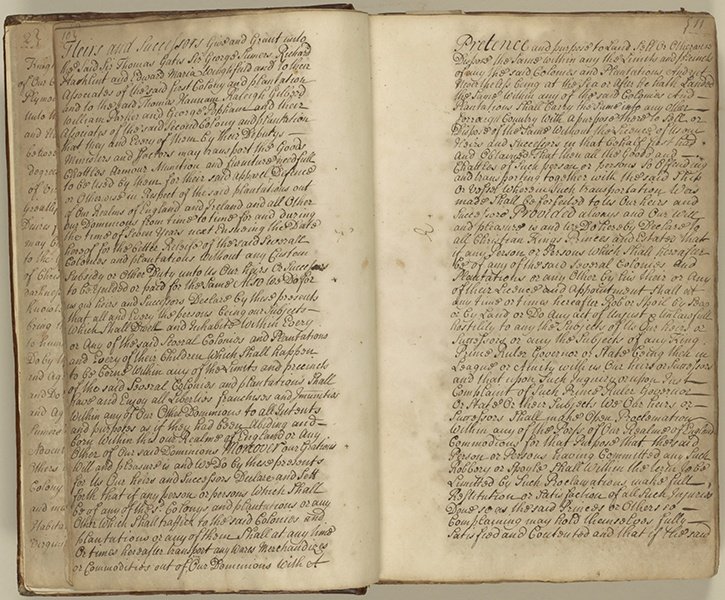
Charter of Virginia, 1606, in the Records of the Virginia Company. Thomas Jefferson Library Collection, Library of Congress, Rare Book and Special Collections Division, exhibition item 022.00.01. Public-domain historical manuscript. This is a manuscript record, not a photograph from 1606.
Separate intention from outcome
Have students place “hoped to earn money” beside “earned money” and explain why the statements need different evidence. The National Park Service’s history of Jamestown glassmaking describes an attempt to produce goods for profit. The existence of that goal does not establish that the venture succeeded. A charter is especially useful for identifying authorization and ambition; later records are needed to evaluate results.
Ask students to name the missing evidence before supplying it. Accounts, correspondence, archaeological findings, or records of production might help answer different questions. Not every source answers every question equally well. This is a practical way to make sourcing part of a short reading lesson rather than a separate vocabulary exercise.
Read the map without accepting an empty land story
John Smith’s map includes named Indigenous towns as well as geographical features. The copy shown here is the sixth state dated 1624 in the Library of Congress catalog, not the first 1612 printing. Ask students to identify details that contradict the idea of an unoccupied continent, then consider how an English map presents a place through an outsider’s purposes.
A map can preserve valuable information and still have limits. It does not record the consent of the nations whose lands it depicts. The National Park Service notes that Indigenous people supplied important geographical and cultural knowledge to Smith. Recognize that contribution instead of presenting Europeans as discovering a place no one understood.
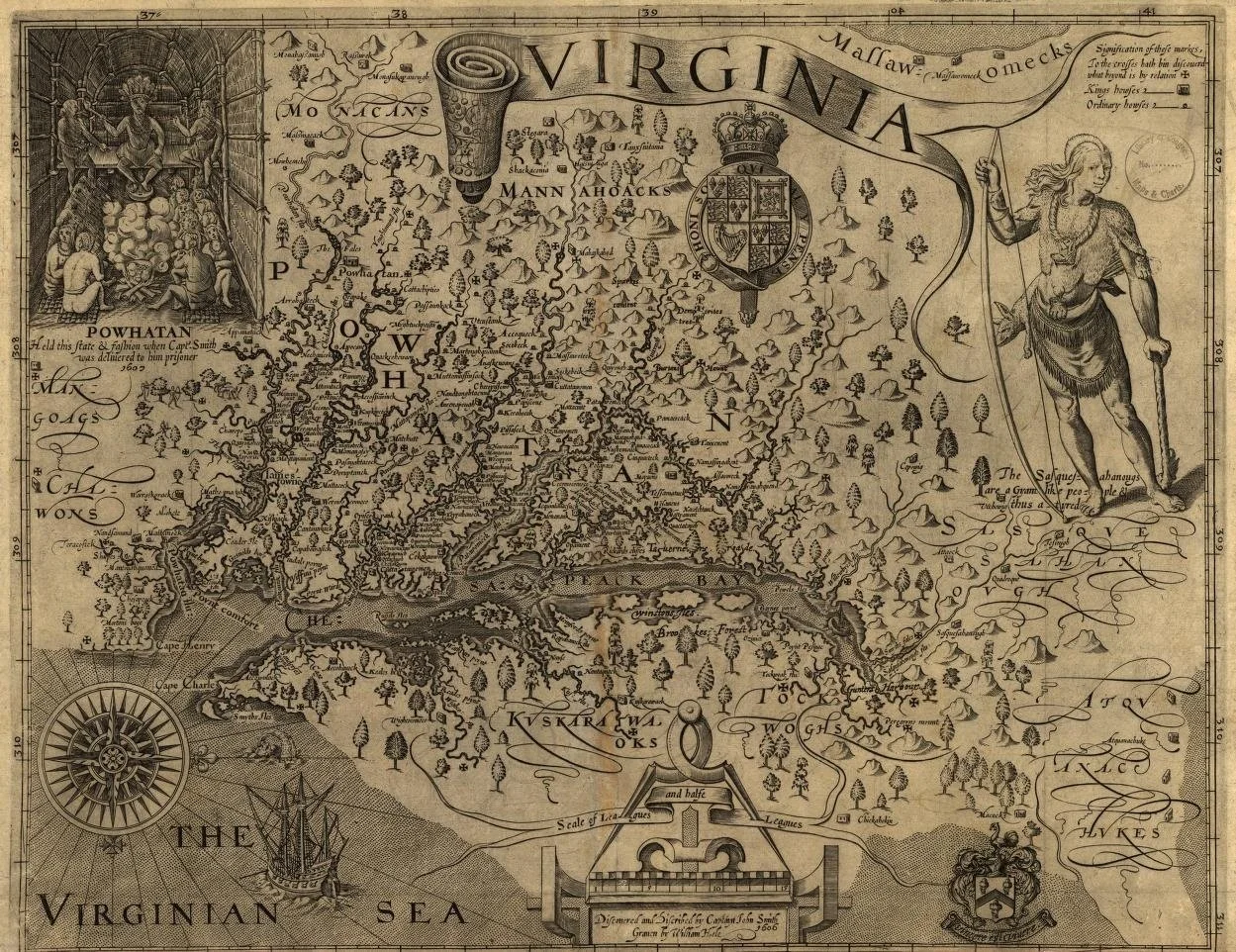
Virginia, John Smith, engraved by William Hole; sixth state, London, 1624. Library of Congress, Geography and Map Division, G3880 1624 .S541, item 99446115. Public domain; north is to the right.
Use a real photograph without inventing a past scene
The church ruin photograph gives students something concrete to examine, but it was taken in 2019. It cannot show what a settler thought in 1606. Ask what a surviving structure might help investigate, then what additional evidence would be needed to connect it to a particular community or period. A photograph of a historic site and a contemporary colonial document have different relationships to the past.
Likewise, religious refuge and religious conversion are not interchangeable motives. A community might seek freedom for its own worship without granting equal freedom to others. Keep the actor and the goal in each sentence; do not let a broad category erase coercion or Indigenous resistance.
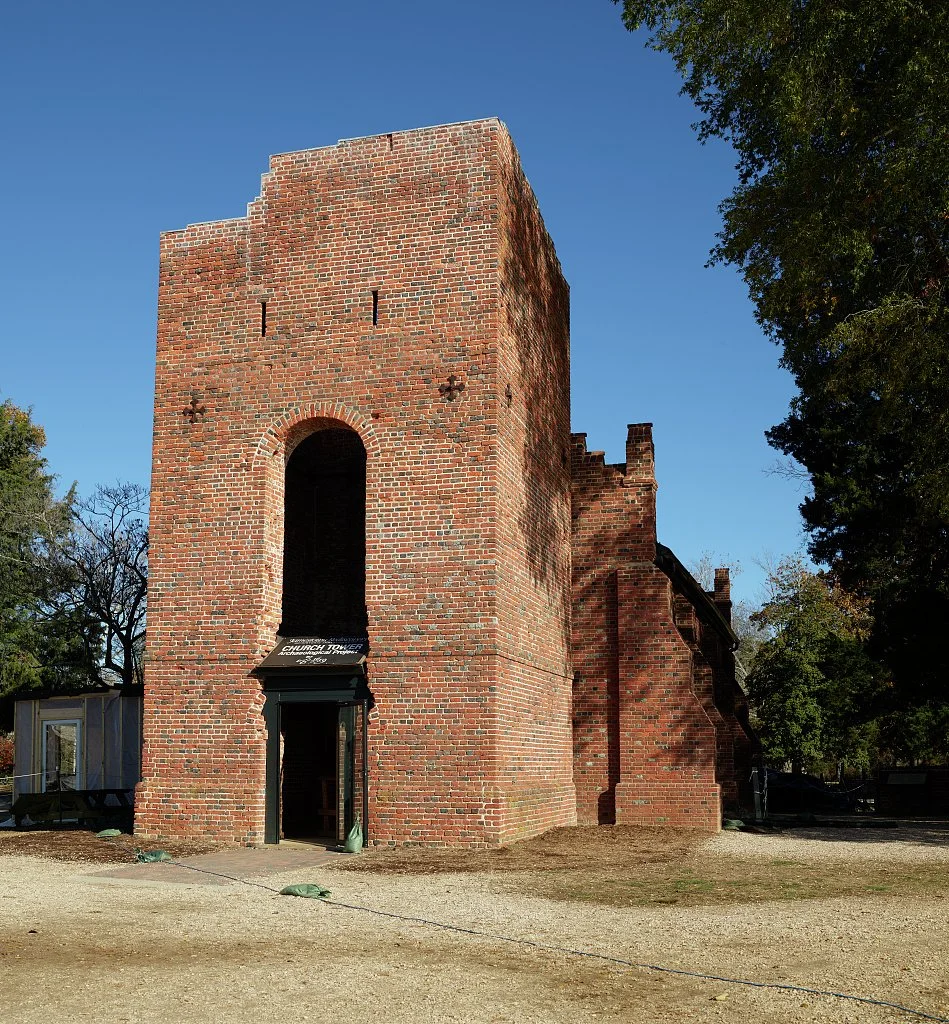
Ruin of a seventeenth-century church at Historic Jamestowne, photographed November 24, 2019. Carol M. Highsmith, Library of Congress, LC-DIG-highsm-61496. Public domain. Modern site photograph, not a reconstruction of colonial life.
Assess the limit as well as the claim
End with a short response that names an actor, explains a motive, and identifies one limit of the evidence. For example, a student may use the charter to explain an official economic aim while noting that it cannot establish every settler’s personal reason or whether the investment paid off. The limitation should relate to the actual source, not be a generic sentence that all sources are biased.
For students who need support, provide two possible claims and ask which is narrower and why. For extension, add a different actor’s record and ask whether the sources disagree or simply answer different questions. Keep Indigenous perspectives grounded in identified communities and sources, never an invented first-person role-play.
Use a structured lesson for the reading and response work
The source routine can stand on its own. If you need a reading and aligned practice already organized, the resource below offers that structure while keeping official aims separate from outcomes and individual motives.
Reasons for Colonization Reading Comprehension | Motives & Sources
View this HistoraEDU resource on TPT
Reasons for Colonization includes a five-page student file and a separate five-page teacher file, with two 1606 charter excerpts, 19 numbered tasks, vocabulary, cause and effect, and an evidence-based exit response. The archival visuals in this blog are not a promise that all three appear in the product.
Sources and image credits
First Charter of Virginia transcription
Library of Congress charter record and context
Product thumbnails: HistoraEDU, reproduced from the exact current TPT listings at the owner’s request. Archival sources do not endorse HistoraEDU or its products.
