A timeline of space firsts can tell students who reached a milestone before someone else. It does not automatically explain why people treated that milestone as evidence of national power.
Give your middle school Space Race lesson a question that connects the science to the Cold War: What could a space achievement demonstrate, and what claims would need more evidence? Students can compare a stated goal with a mission’s outcome, examine the work behind the achievement, and distinguish evidence of technical capability from assumptions about public admiration.
Keep the early milestones distinct
On October 4, 1957, the Soviet Union launched Sputnik 1, the first artificial satellite to orbit Earth. The launch carried political weight because American and Soviet leaders were already competing over security and influence. Soviet launch capability also raised U.S. concerns about rockets carrying nuclear weapons over long distances. Office of the Historian background; NASA history.
Sputnik was uncrewed. Yuri Gagarin’s April 12, 1961 flight was a different milestone: the first human orbit of Earth. Have students label what was new about each achievement rather than writing only “Soviets first.” Precise labels make the later comparison with a lunar landing much clearer. NASA’s Gagarin record.
Before introducing national prestige, ask students to distinguish two statements: “This country completed a difficult launch” and “Everything about this country was superior.” The first is a narrower claim. The second would require evidence well beyond a spacecraft’s flight.
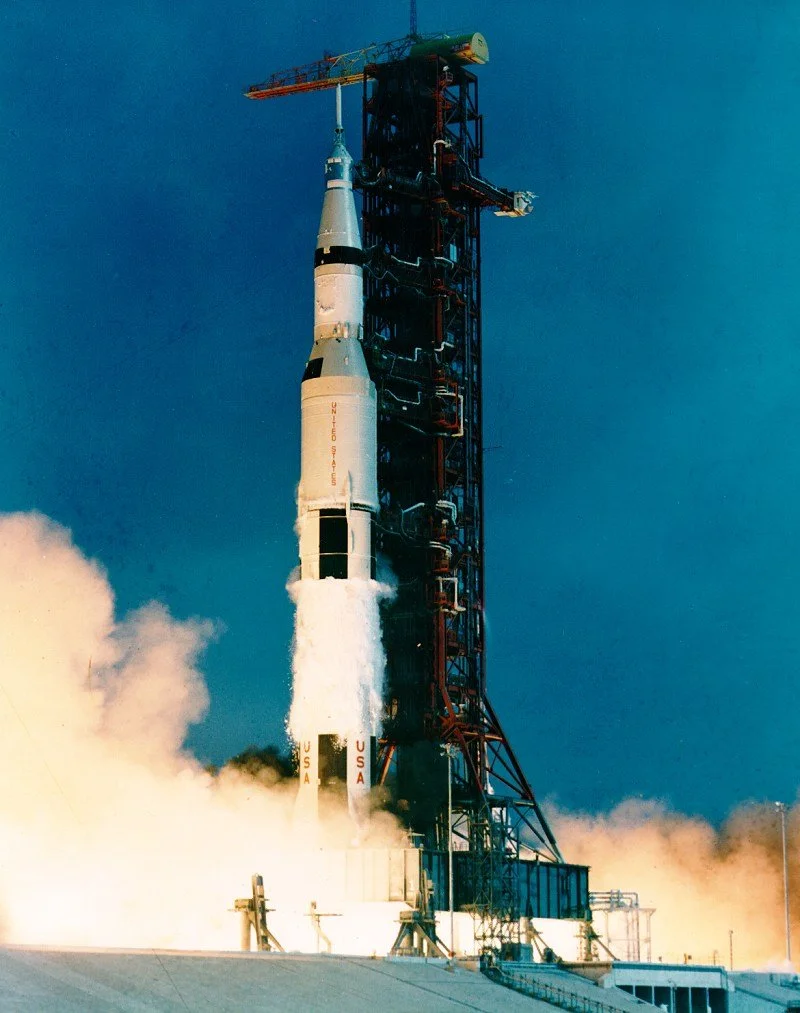
Apollo 11 lifts off on July 16, 1969. Credit: NASA, S69-39525. A launch photograph records one stage of the mission; it does not by itself establish a successful lunar landing. NASA archival record.
Use Kennedy’s goal as something students can test
John F. Kennedy’s May 25, 1961 address to Congress proposed a lunar landing and safe return before the decade ended. He also described the difficulty, expense, and national commitment the effort would require. The speech provides a stated goal against which students can compare a later outcome.
Give pairs three headings: destination, return, and deadline. Ask them to paraphrase the goal under those headings. Then ask, “What would we need to know before saying the goal had been met?” This makes safe return part of the task instead of letting the landing photograph become the entire story.
Students can then consult the reading or NASA’s Apollo 11 mission record. Armstrong and Aldrin landed on the Moon on July 20, 1969; the crew returned to Earth on July 24. Have students write a brief comparison between the proposed goal and the documented outcome.
Keep the distinction between intention and result visible. A speech can establish what a leader called for. It cannot establish that the later mission succeeded.
Bring the work behind the mission into view
Astronauts are an understandable focus, but students also need to see how technical work supported spaceflight. Katherine Johnson calculated Alan Shepard’s trajectory and checked electronic-computer calculations for John Glenn’s orbital flight. NASA’s record connects that work to particular missions. NASA’s Katherine Johnson photograph and account.
The photograph used in the HistoraEDU lesson shows Johnson at her desk in 1966. Start with a visible detail, such as papers on the desk, and then use the caption for her name, workplace, and date. The image alone does not reveal the exact calculation she was doing.
Ask students to connect one documented task to a practical need: Why would calculating a flight path matter? Why might a team check a computer’s calculations? They should explain the contribution using the reading, rather than trying to read technical information that the photograph does not provide.
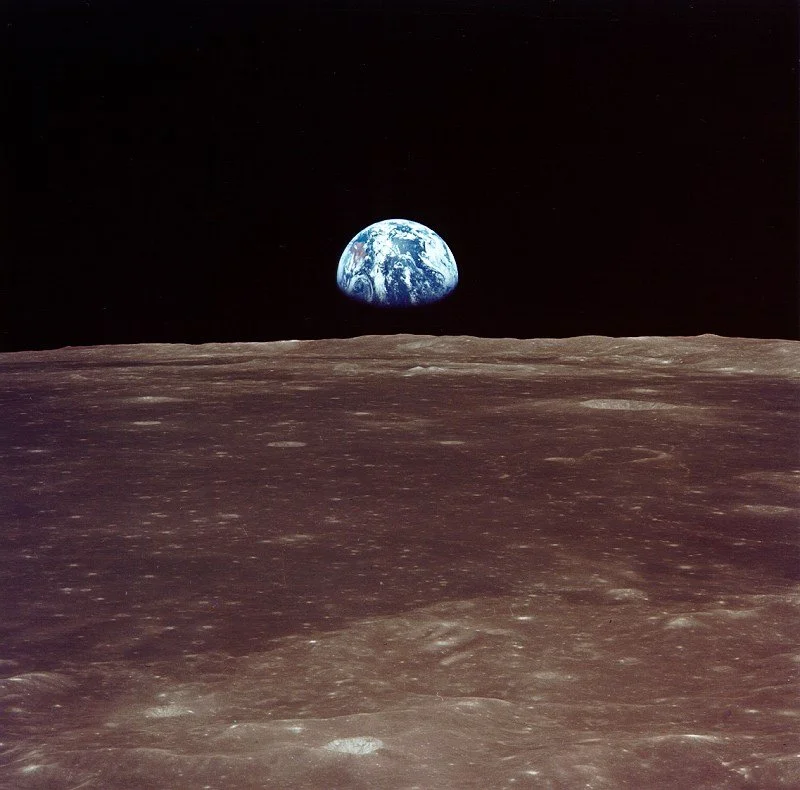
Earthrise photographed from Apollo 11 in lunar orbit before the landing. Credit: NASA, AS11-44-6550. The image documents a viewpoint near the Moon, not how audiences on Earth responded. NASA archival record.
Test a claim about prestige with the right evidence
The lesson pairs Johnson’s photograph with an Apollo 11 image of Buzz Aldrin on the lunar surface. Ask students to explain how the two images relate to different parts of spaceflight. Then offer a deliberately overextended claim: “These photographs prove that everyone admired the U.S. space program.”
Students should be able to explain why that conclusion exceeds the evidence. Neither scene records the reactions of everyone who saw it. Both photographs also come from NASA; different subjects do not make them independent national viewpoints.
Invite students to propose a source for investigating reactions. A newspaper, letter, interview, or opinion survey could contribute, but each would bring its own limits. Ask whose views the source represents, when it was created, and how widely a student could reasonably generalize from it. One approving letter would establish one person’s expressed response, not universal admiration.
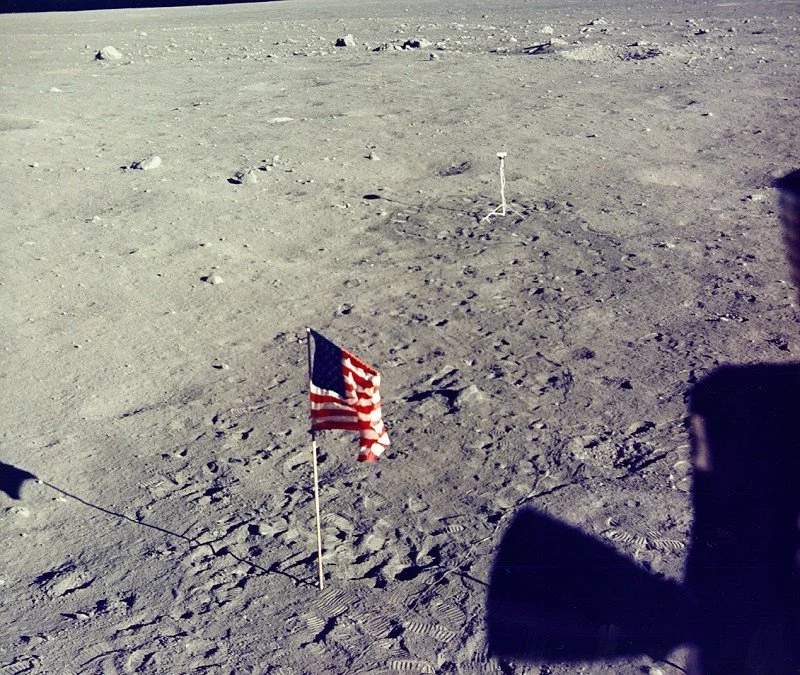
A flag and television camera photographed from the Apollo 11 lunar-module window. Credit: NASA, AS11-37-5480. Visible equipment and tracks can support observations about activity at the landing site; claims about worldwide opinion need additional evidence. NASA archival record.
Leave room for cooperation and a qualified conclusion
For an extension, add the July 17, 1975 Apollo-Soyuz docking. American and Soviet crews met and worked together in orbit while their countries remained Cold War rivals. Ask students how this complicates a timeline framed only as competition. National Archives account.
Support readers by chunking the passage and rehearsing answers aloud. Keep “satellite,” “trajectory,” and “prestige” attached to examples. For the exit ticket, require a claim about capability, a reading detail, a visible photograph detail, and a limitation. Students can argue that Apollo 11 demonstrated a major technical achievement without claiming it proved superiority in every field.
Bring the reading and evidence work together
HistoraEDU’s Space Race reading and photo-analysis lesson for grades 7–8 includes a sectioned background reading, the Johnson and Aldrin photographs, comprehension questions, vocabulary, cause-and-effect practice, and an evidence-based exit ticket. The separate teacher guide provides model answers and scoring criteria. Use the linked speech and mission record as optional extensions when students are ready to compare a proposed goal with the evidence of its achievement.