
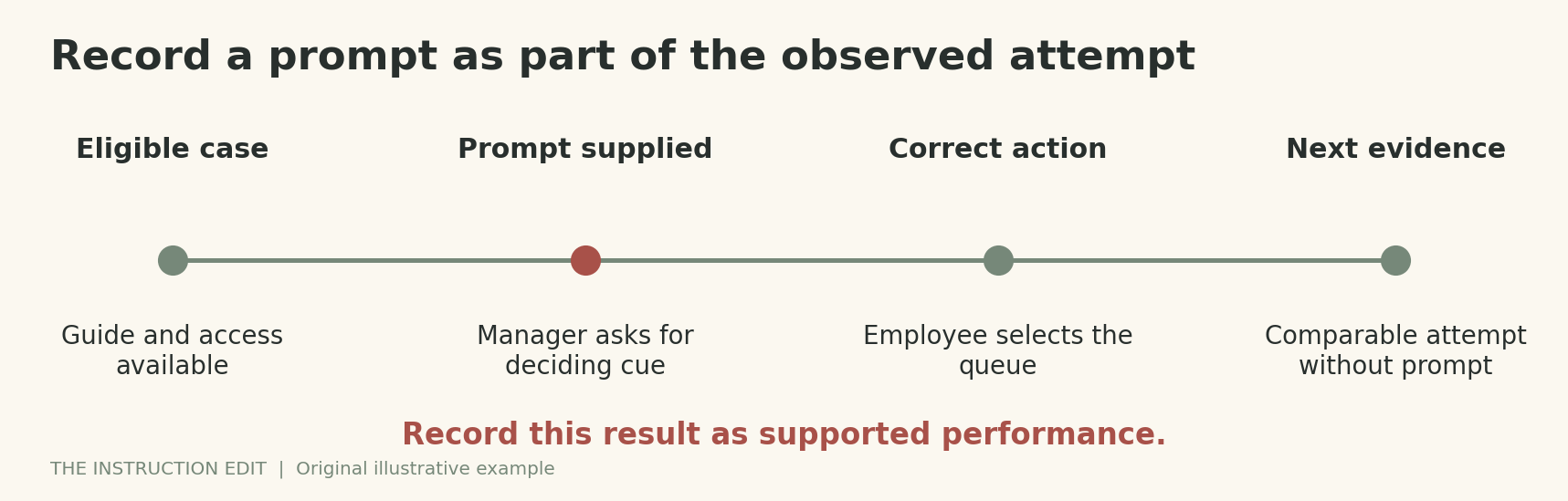
Give the manager a short observation guide that records what the employee did, what support was available and what should happen on the next attempt. A single score is rarely enough to explain a first real use of a skill. The guide should distinguish a missed action from a missing opportunity or a blocked process.
This is a developmental conversation, not automatically a performance rating. State the purpose before observing and use the organization’s normal requirements for consent, privacy, supervision and employee evaluation. A learning-team template should not quietly become a new high-stakes assessment system.
Choose one real task and define the observation window
Use a fictional internal service-request task. After training, an employee will route a routine request with the required details. The manager observes the first suitable low-risk opportunity, using the current routing guide and normal authorized tools.
Define what makes an opportunity suitable. The employee should have the information and permissions needed to act, the task should fall within the trained scope, and an appropriate supervisor should be available if intervention is required. Do not use an exceptional or safety-critical case merely because it happens to arrive first.
The CIPD Learning at Work 2023 report provides context on workplace learning practice, while the CDC’s evaluation guidance distinguishes learning from application at work. The observation guide below is an original example, not a validated rating scale or evidence that manager observation alone causes transfer.
Agree what will be observed before the task starts
Select a small number of actions tied to the work. For the fictional routing task, these might be identifying the request type, checking the deciding information, choosing the queue, preserving any uncertainty and recording the next action.
Discuss the available support. If the employee may use the guide at work, allow it during observation. Record whether the manager prompted a decision, demonstrated a step or took over. Supported performance can be valuable, but it should not be reported as independent performance.
Tell the employee when the manager will intervene. In real work, safety, privacy and required controls take priority over an uninterrupted assessment. The observation should not create an avoidable operational risk just to produce a cleaner score.

Record actions and conditions together
Illustrative first-attempt observation guide. The task and entries are fictional. Adapt the fields to the organization’s approved process.
Observation field: Opportunity and scope
Example entry: Routine request with complete information; trained categories apply
What it means for follow-up: Suitable case for this limited observation
Observation field: Resources and permissions
Example entry: Current guide available; both relevant queues visible
What it means for follow-up: No observed access barrier for this case
Observation field: Observable action
Example entry: Employee checked the request’s purpose before selecting the queue
What it means for follow-up: Evidence of the intended decision process
Observation field: Support used
Example entry: Manager asked, “Which detail decides between these categories?”
What it means for follow-up: The decision followed a prompt, so independence is not yet established
Observation field: Result and uncertainty
Example entry: Correct queue selected; employee recorded one unresolved detail
What it means for follow-up: Check whether uncertainty was handled through the approved route
Observation field: Next attempt
Example entry: Use a comparable case without that prompt when a suitable opportunity occurs
What it means for follow-up: Observe the same decision with reduced instructional support
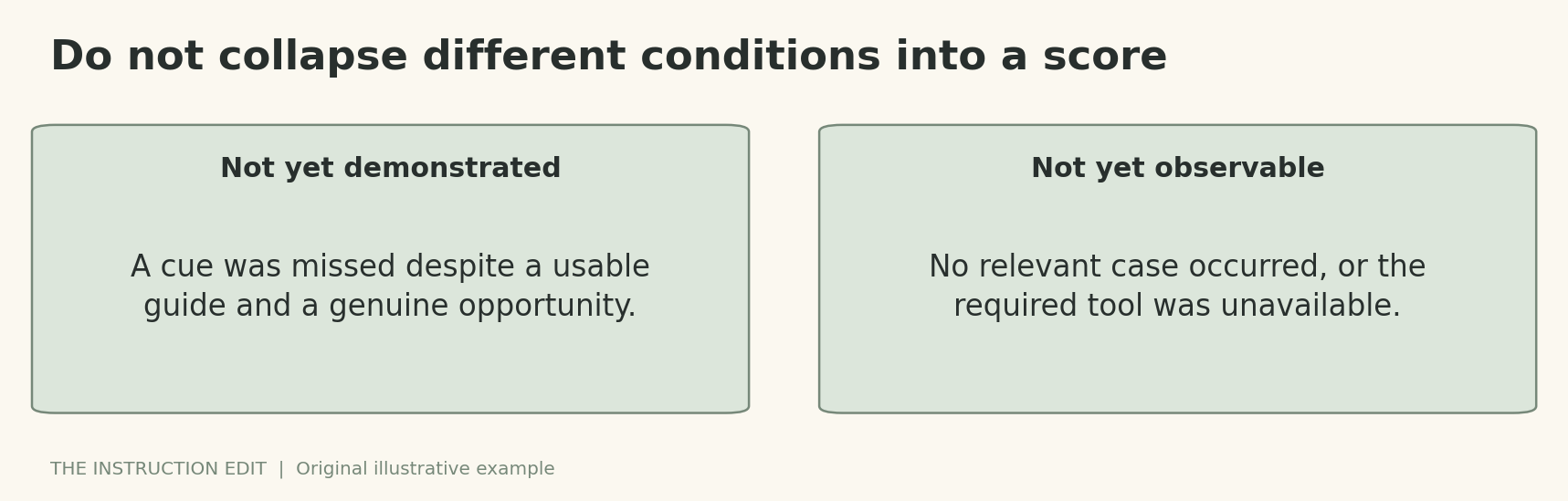
Leave space for “not observed.” If no exception arose, you have no evidence about exception handling. Do not translate absence of an opportunity into either success or failure.
Ask for the employee’s reasoning after the action
Begin with a neutral question: “What information made you choose that queue?” Then ask whether anything in the tools, instructions or timing made the decision difficult. The answer can reveal a correct choice made for an unreliable reason, or a sound decision constrained by the work environment.
Use the recorded action to anchor feedback: “You checked the purpose before selecting the queue. On the next request, identify the deciding detail before asking for confirmation.” Avoid broad judgments such as “be more confident” when the intended change is a specific action.
Invite the employee to correct your account. A manager may not see a lookup, a prior instruction or a system limitation. Observation is evidence from one viewpoint, not an infallible account of everything that influenced the task.
Separate a learning need from a working-condition problem
If the employee cannot see the required queue, the next action belongs with the system owner. If two instructions conflict, the process owner must clarify the expectation. If the guide is usable but the employee cannot distinguish the categories, additional practice may be appropriate.
Record both kinds of action when both are present. “Practice the distinction” and “repair access” are different tasks with different owners. A manager should not ask an employee to demonstrate independent performance while an unresolved barrier makes that performance impossible.
Be cautious about speed. A first supported attempt may be slower because the employee is checking a new process carefully. Unless timing is a legitimate and defined requirement, do not treat speed as a substitute for accuracy, appropriate escalation or sound judgment.
Plan the next opportunity rather than a vague reminder
Agree one priority for the next attempt and the conditions under which it can be observed. For example: “On the next routine request with complete information, use the guide to identify the deciding detail before selecting the queue. The manager will observe without the earlier prompt unless intervention is needed.”
The follow-up date should reflect how often the task occurs. If the employee has no suitable opportunity, record that and arrange an appropriate simulation or later observation. Do not report failure to transfer when the task never arose.
Use repeated observations across relevant cases before drawing a broad conclusion. One successful routine case does not establish competence with every exception, and one difficult attempt does not establish a general inability.
Keep the record proportionate
Store only the information needed for the agreed developmental purpose, in an approved location with appropriate access. Avoid copying customer data into the guide. Use a case reference or de-identified description when that is sufficient and permitted.
For the next training project, give the manager three things: the task to observe, a few observable actions and a way to record support and opportunity. Add a short post-attempt conversation and a next-step field. That creates a more useful account than a score with no explanation of the conditions behind it.
