“Who won?” can be a tempting opening question for a Korean War lesson. It can also rush students past the question that makes a judgment meaningful: What were the participants trying to achieve?
For a middle school lesson on containment, give students two aims to evaluate separately: defending South Korea from invasion and resolving Korea’s political division. This creates room for an explanation that recognizes an achievement without treating the outcome as a complete settlement. A short chronology, a public statement, and carefully read photographs can give students the evidence they need.
Build a short chronology with clear turning points
Begin in 1945, when the end of Japanese rule was followed by Soviet occupation in northern Korea and American occupation in the south. The division at the 38th parallel became part of a wider Cold War rivalry as competing Korean governments took shape. North Korean forces invaded South Korea on June 25, 1950. Office of the Historian background.
Keep the first overview manageable. The September 1950 Incheon landing helped UN forces advance from the south. Their advance into North Korea was followed by Chinese intervention later that year and another reversal. The front eventually stabilized, but fighting continued until the 1953 armistice. These turning points prevent students from imagining a steady march toward an inevitable outcome. National Army Museum overview.
Ask pairs to arrange event cards before discussing causes. Then have them explain one connection between adjacent cards. If students reverse the order, return to the chronology before asking for a judgment about policy.
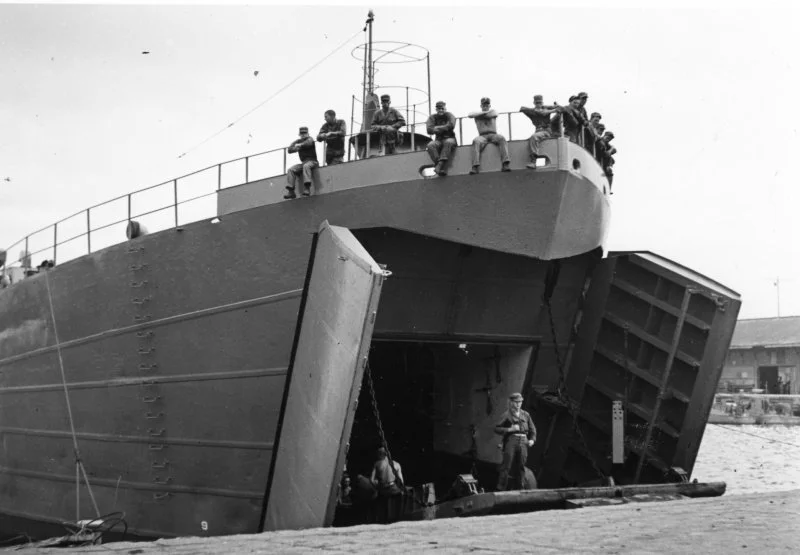
Landing ship with its ramp open near Pusan (Busan), September 11, 1950. The archival description does not identify its cargo or destination. Credit: U.S. Army; Harry S. Truman Library & Museum, 2007-646. Public domain. Archive record.
Read containment as a reason for action
Define containment in this context as an effort to prevent communist expansion. Then ask how an invasion in Korea became a concern for leaders outside Korea.
Harry Truman’s June 27, 1950 statement offers direct evidence of his public explanation. He connected the invasion to a wider communist threat and announced air and naval support for South Korea. The statement helps explain his position; it does not supply every Korean, Chinese, or Soviet aim.
For a brief source activity, read the opening paragraphs and ask:
Who is explaining the decision, and when?
What danger does Truman describe?
What action does he announce?
Whose perspective would we still need to investigate?
Students can mark a reason in one color and an action in another. Their written answer should connect the two. “Truman supported South Korea” identifies a response; explaining why he framed the invasion as a wider threat shows the relationship to containment.
Bring military movement and civilian displacement into the lesson
Policy language can make a war seem distant from the people living through it. Photographs give students a way to investigate particular scenes without pretending to know every person’s experience.
The HistoraEDU lesson includes a U.S. Army photograph of refugees traveling south after evacuation orders near Pohang, dated August 12, 1950. It also includes a September photograph of a landing ship with its ramp open near Pusan, now commonly spelled Busan. The archive does not identify that ship’s cargo or destination. Refugee photograph record; landing ship record.
Ask students to record one visible detail in each image before reading the captions. Then ask what the captions add. People and loaded carts can support an observation about movement; the evacuation circumstances come from the archival record. An open ramp offers evidence about how a ship could load or unload, but not proof of what it carried that day.
Keep the discussion respectful. Students should not have to share personal experiences of displacement, and they should not be asked to invent the feelings or political beliefs of the photographed people.
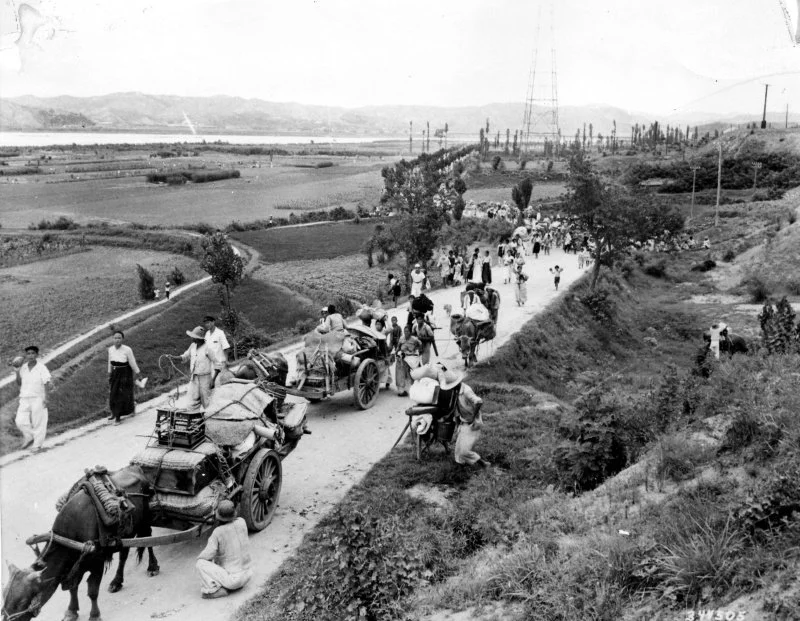
Refugees traveling south after evacuation orders near Pohang, August 12, 1950. Credit: U.S. Army; Harry S. Truman Library & Museum, 67-7417. Public domain. Archive record.
Make the armistice distinction explicit
On July 27, 1953, military commanders signed an agreement that suspended hostilities and established a buffer zone. South Korea survived, but Korea remained divided. The agreement was not a permanent peace treaty. The 1953 military demarcation line also should not be treated as identical to the earlier occupation division. National Archives introduction and transcript.
For an extension, compare paragraph 12, which concerns stopping hostilities, with paragraph 60, which recommends a political conference. Ask students to explain why both appear in the same agreement. Keep the task focused on the distinction between a military arrangement and a political settlement rather than assigning the entire document.
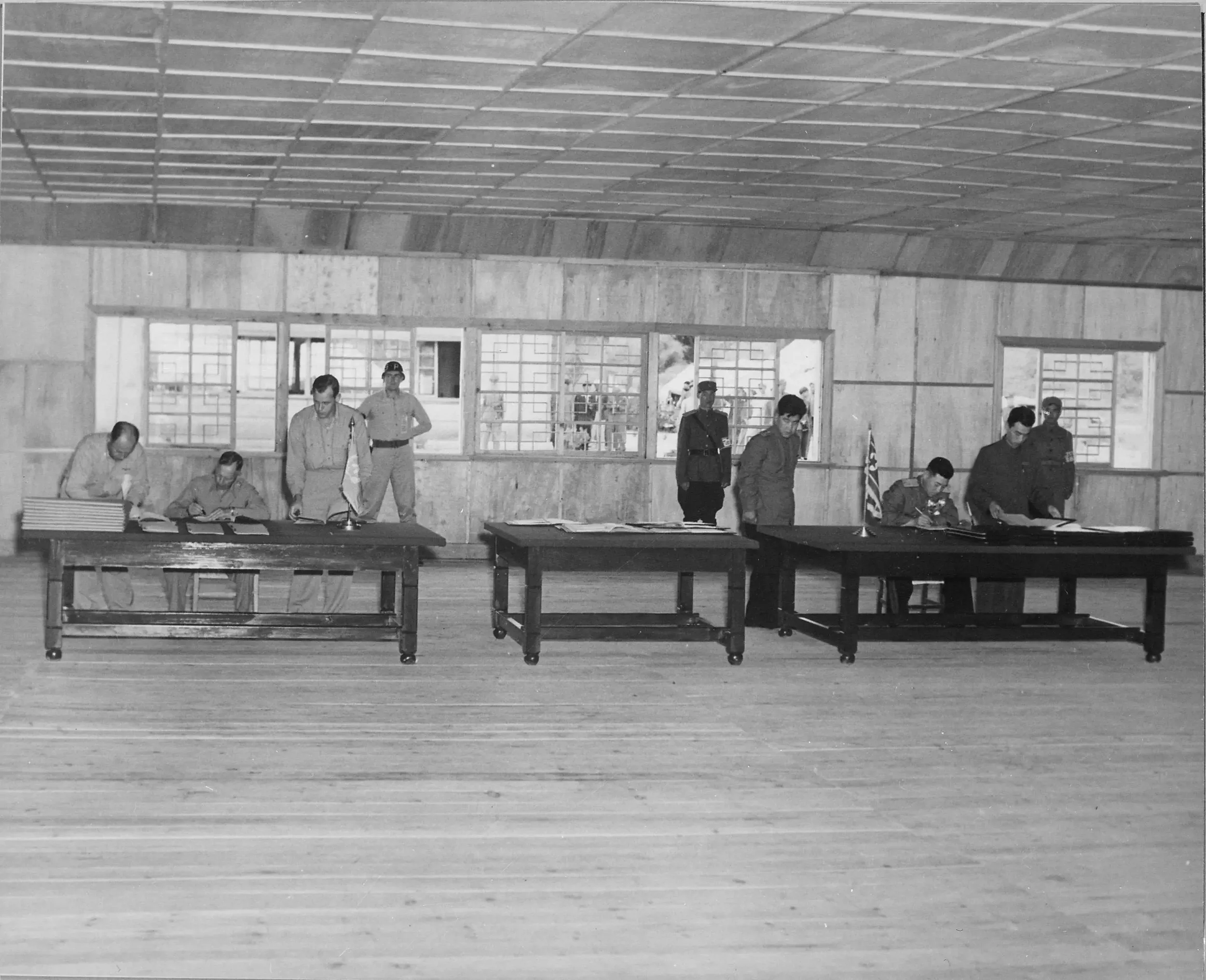
Delegates sign the Korean Armistice Agreement at Panmunjom, July 27, 1953. General W. K. Harrison Jr. signs at the left table; General Nam Il signs at the right. Credit: National Archives, 80-G-625728 (NAID 520995). Public domain. Archive record.
Support students in writing a qualified judgment
Return to the opening aims. Offer the frame: “Military containment achieved ___, as shown by ___. However, ___ remained unresolved.” Students should choose the evidence before completing the conclusion.
For readers who need support, read one section aloud, preview “coalition” and “armistice,” and let partners rehearse an answer. For students ready to extend the argument, ask what a Korean civilian account could add to the two U.S. Army photographs. Different scenes from one institution should not automatically count as independent national viewpoints.
Finish by asking whether a photograph from 1950 can establish the outcome of the 1953 settlement. A strong answer names the date mismatch, proposes a relevant additional source, and explains how that source would help.
Use a prepared reading and evidence sequence
HistoraEDU’s Korean War reading and photo-analysis lesson for grades 7–8 brings together a sectioned background reading, the two archival photographs, comprehension questions, vocabulary, cause-and-effect work, and an evidence-based exit ticket. A separate teacher guide includes model answers and scoring criteria. Use the article’s linked primary documents as optional extensions, keeping the main task centered on what the evidence supports and what remains beyond it.