
By HistoraEDU
A student answers “Pearl Harbor” to a question about American entry into World War I. Another places the Treaty of Versailles after World War II. They recognize important terms, but the terms have slipped into the wrong timeline. Before mixing both wars in a review game, give students a chance to retrieve each war separately and then explain the differences they keep confusing.
Use two timelines before one comparison
Put two timelines on the board and label them clearly. Add the course’s major start and end anchors, then leave room for U.S. entry, wartime mobilization, and peace settlements. Ask students to place six familiar terms independently. Circle uncertain placements rather than letting the fastest classmate settle them all.
Choose one error to model. A declaration of war, a battle, an armistice, and a peace treaty are different kinds of events. Have students label the type as well as the date. That extra step helps reveal whether the difficulty is chronology or a misunderstanding of what the event actually did.
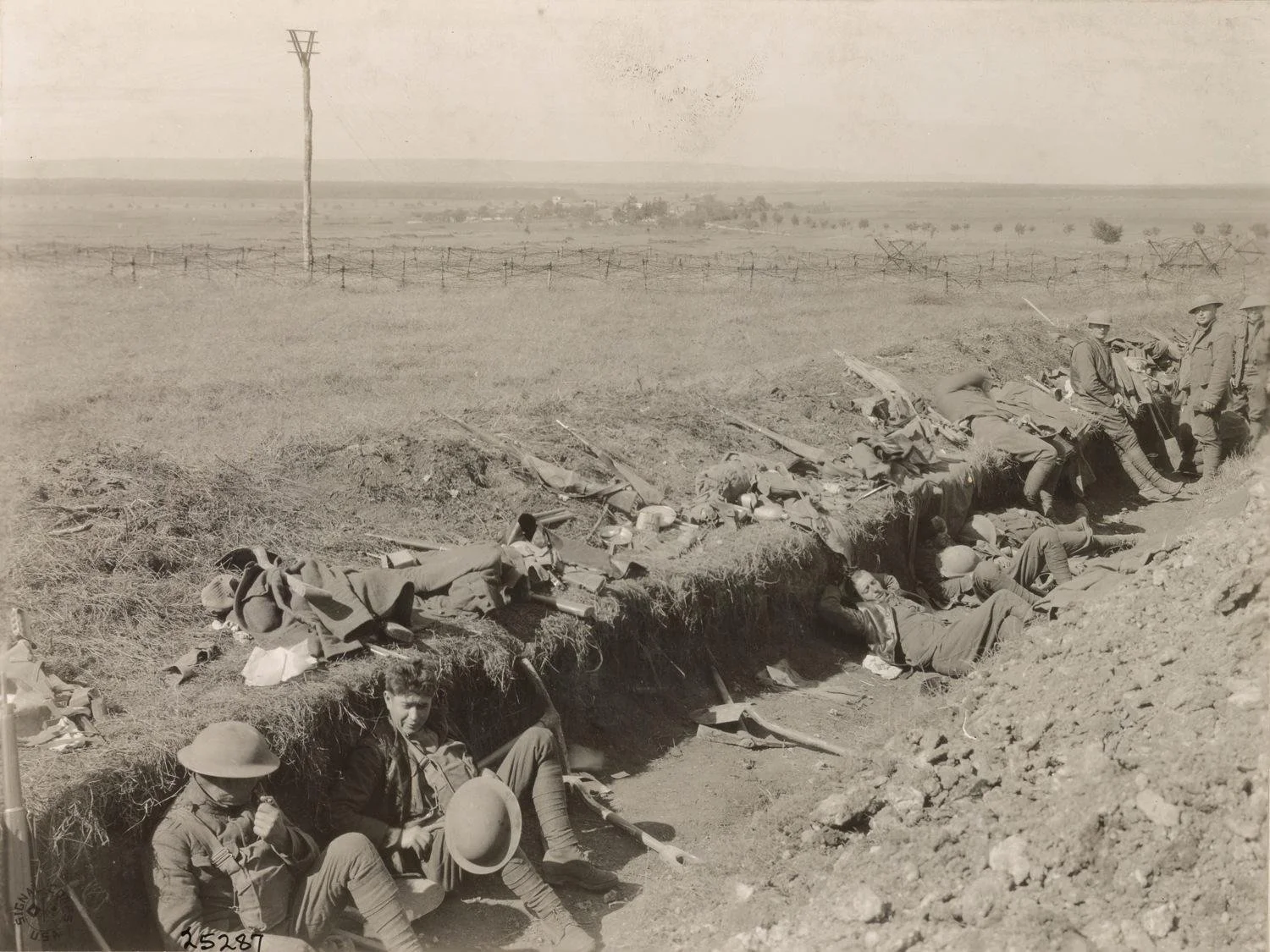
American soldiers in a trench near Beney, France, September 25, 1918. The archival caption connects the position to the Saint-Mihiel offensive. This is World War I, not the Normandy campaign. Credit: U.S. Army Signal Corps; individual photographer not named in the NARA explanatory page. National Archives, NAID 55210121. Unrestricted use per item record.
View the archive record | Image reuse terms
Retrieve within one war first
Use a short selection from HistoraEDU’s World War I game while the first timeline remains visible. The listing describes questions about causes, U.S. neutrality and entry, warfare, mobilization, and the peace settlement. After each answer, ask students where it belongs and whether it describes a cause, a wartime development, or a consequence.
Then run a separate World War II round. That game’s listing includes U.S. entry, theaters of war, home-front production, and major turning points. Keep a map beside the timeline when a question depends on location. Students should not have to reconstruct both geography and chronology entirely from memory before they can explain a connection.
Use a primary document to correct the mix up
Read the heading and a brief passage from Roosevelt’s December 8 1941 address. Students identify the speaker, audience, date, and requested action. The address supports a specific claim about the request for war against Japan; it is not a complete explanation of every cause of World War II.
Compare that source with the dated World War I material you already teach. Ask: which details make it impossible to place this source in the other war? Students can underline a named country, policy, or event and explain its significance. Avoid accepting “the picture looks older” as the reason a source belongs on one timeline.
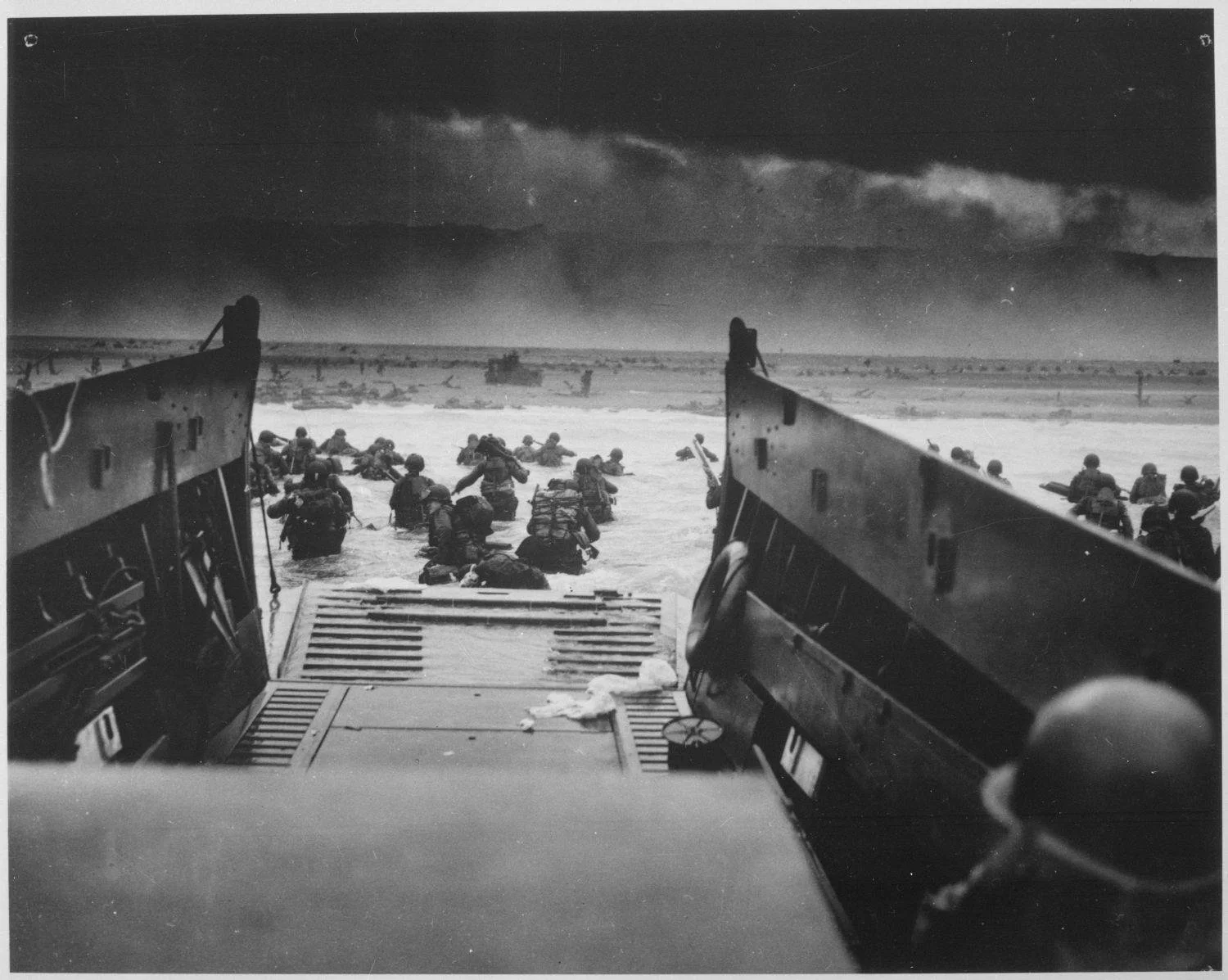
U.S. troops leave a Coast Guard landing craft during the Normandy invasion, June 6, 1944. Robert F. Sargent made the photograph commonly titled Into the Jaws of Death. Credit: Robert F. Sargent, U.S. Coast Guard. National Archives, NAID 513173. Public domain.
View the archive record | Image reuse terms
Compare a category rather than everything at once
Choose one category, such as mobilization. Pair the 1918 trench photograph with the 1944 landing photograph, keeping the full captions and dates. Ask what each shows about people, equipment, or military activity. Then use the 1943 group portrait to ask how evidence about wartime industry differs. Students can identify a similarity without claiming the same conditions existed everywhere.
A comparison sentence should name both examples: “In this photograph from ___, I can observe ___; in the photograph from ___, I can observe ___.” Follow it with a question for further research. A source may document one place or task, while a claim about an entire home front needs more evidence.
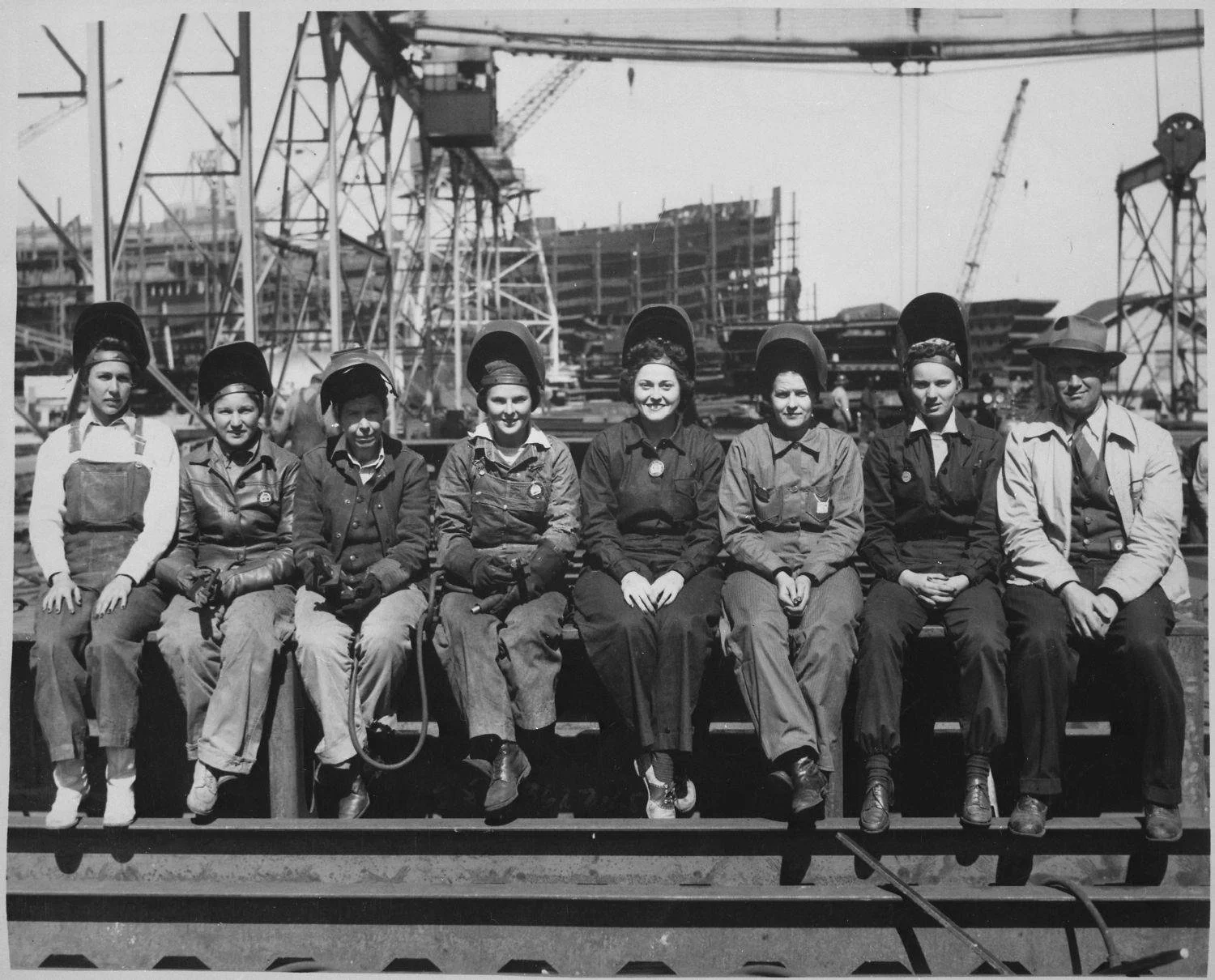
Women welders at Ingalls Shipbuilding in Pascagoula, Mississippi, 1943. This is a posed group photograph of wartime industrial workers, not a photograph of welding in progress. Credit: Spencer Beebe. National Archives, NAID 522890. Public domain.
View the archive record | Image reuse terms
Keep sensitive history out of speed based competition
The World War II listing includes the Holocaust. Teach genocide through carefully chosen, contextualized sources and respectful discussion, not points for reenacting persecution or treating victims’ experiences as entertainment. You can omit sensitive questions from a competitive round and address the learning goal through a separate written response.
Similarly, distinguish reviewing the chronology of a bombing from asking students to play at making life-and-death choices. Give content notes when needed and offer a non-graphic source route. Students can analyze decisions, consequences, and evidence without role-playing people facing violence.
Mix the wars only after students can explain the correction
For the final round, alternate selected questions from the two games. Students must name the war and justify the placement before the team submits an answer. Keep a correction log with three spaces: my first placement, the corrected placement, and the detail that changed my mind. This log is a teacher-created addition, not a built-in game feature.
Provide a word bank or partially completed timelines for students who need support. Ask more confident students to distinguish a long-term condition from a specific trigger, or a wartime decision from a later consequence. End with one fresh example that students answer independently. That gives you a clearer check than replaying a question the team has already rehearsed.
Find the matching review resource
World War I Review Game | Social Studies | Interactive Test Prep History Trivia
View this HistoraEDU resource on TPT
A separate interactive digital game for World War I retrieval, with a student link, teacher guidance, and editable Canva materials listed.
World War II Review Game | Social Studies | Interactive Test Prep Trivia
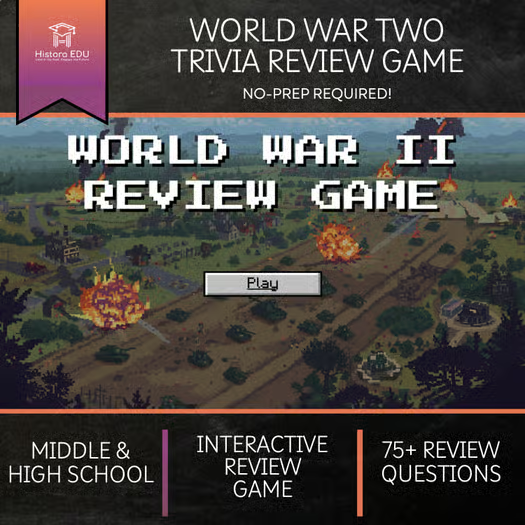
View this HistoraEDU resource on TPT
A separate interactive digital game for World War II retrieval; select questions appropriate to the class and handle sensitive content outside competitive play.
Product covers: HistoraEDU, reproduced from the exact TPT listings with the owner’s authorization. Archival photographs are credited above. No archive, photographer, or person pictured endorses HistoraEDU.
