
By HistoraEDU
A map can place Kentucky in one category without telling students what life was like for everyone who lived there. When a class turns Union and Confederate labels into two unanimous teams, add a second question: whose government, whose choices and whose legal position does the label describe? Use a map of 1861 alongside a later Kentucky case to separate political geography from the experiences of particular people. The goal is a better caption, not another round of coloring states.
Read the legend before making a claim
Open the linked U.S. Army Center of Military History Gettysburg Staff Ride Briefing Book to printed page 71, PDF page 74. Its retrospective map is titled United States in 1861 and distinguishes North, South and Border States. Kentucky has the border-state pattern. The title gives a year, not a single day; do not treat it as a precise snapshot of every political change during that year.
Ask students to write two statements in separate columns: what the legend classifies and what it does not measure. This map classifies places. It does not count individual loyalties, identify who could vote, or show whether a person was free or enslaved. A state label is not a survey of all residents. Keep the map open at its source rather than relying on a small screenshot.
The map’s time frame also predates the Kentucky example below. Label the comparison clearly: map of 1861; case evidence from 1864–1865. Do not insert later policies into the map’s date or use a later photograph as evidence of what a person believed in 1861.
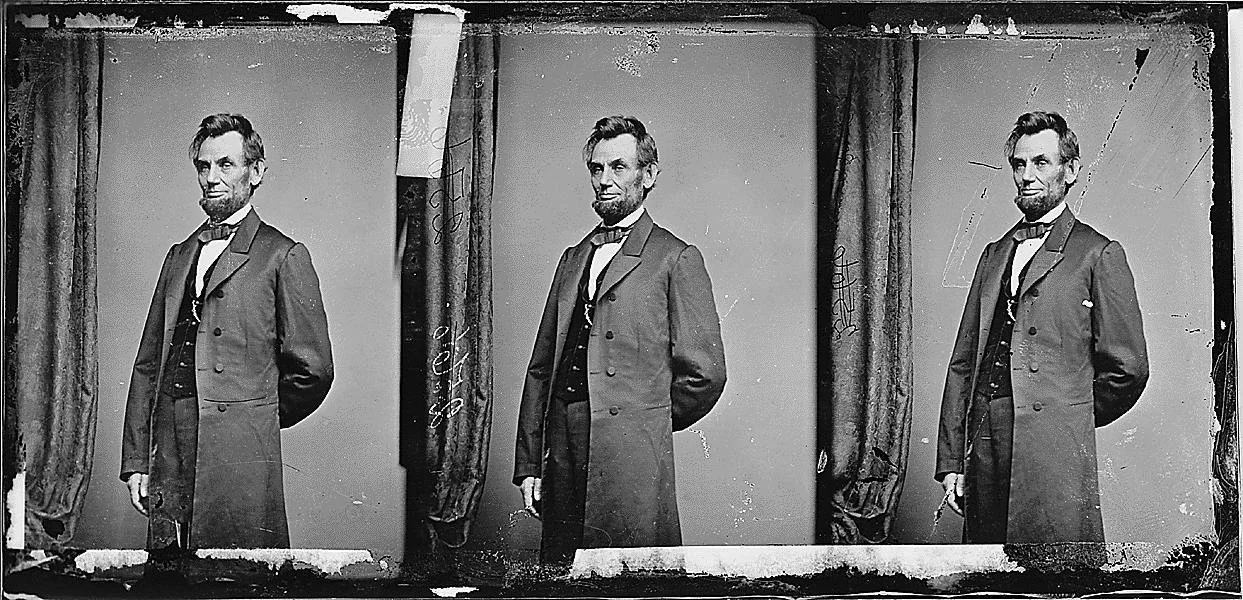
Abraham Lincoln, approximately 1863, National Archives identifier 527823. The portrait is later than the map’s 1861 frame. Use it to identify a policymaker, not to illustrate unanimous Northern opinion. National Archives, public domain; no endorsement implied.
Give the border state a specific human example
Kentucky remained in the Union while slavery remained legal there. The Emancipation Proclamation did not apply to Kentucky. The National Park Service account of Camp Nelson explains that enslaved men could gain freedom through enlistment in the U.S. Army, while family members did not automatically gain the same legal protection. These distinctions cannot be read from a state’s shading.
Use William Wright as a named example rather than inventing a typical resident. The NPS biography records that he enlisted at Lexington on June 29, 1864, in Company H of the 114th U.S. Colored Infantry. His enslaver, John Russell, was pro-Union and consented to his enlistment. Wright gained freedom through military service. The two men’s relationship shows why pro-Union and opposed to slavery cannot be treated as synonyms.
Ask pairs to record three facts separately: Kentucky’s political status, Wright’s action and the legal relationship that constrained him before enlistment. Do not ask students to impersonate an enslaver or debate whether enslavement was acceptable. They can analyze the evidence without performing those roles.
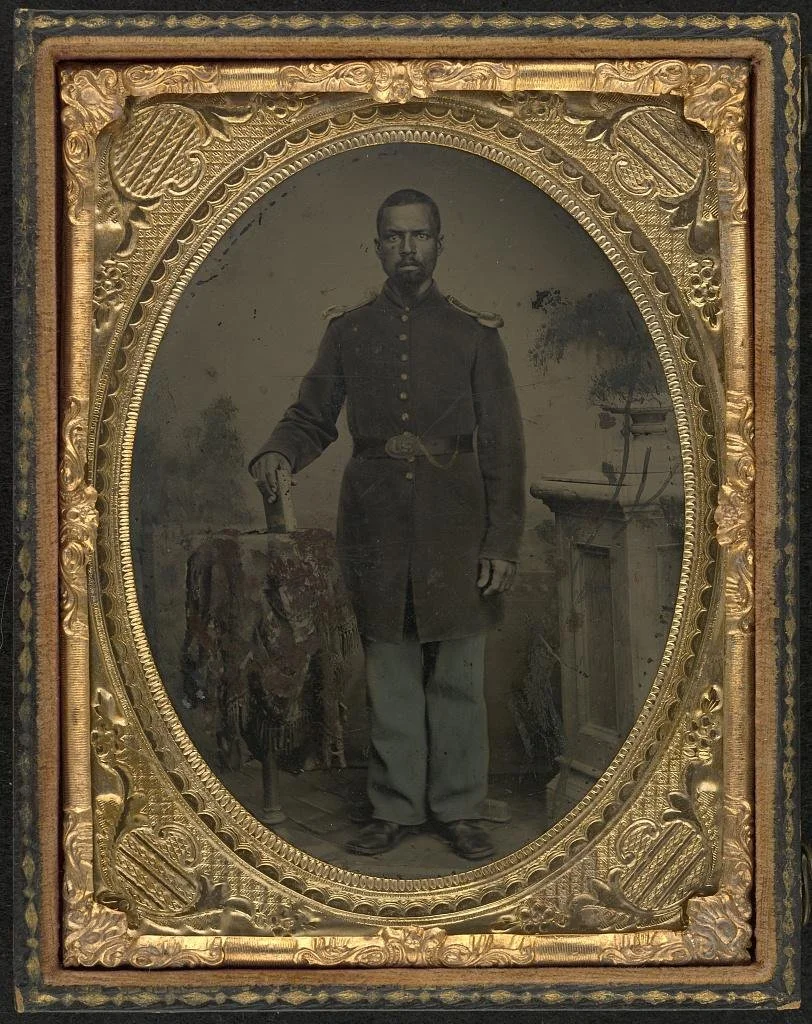
Private William Wright, Company H, 114th U.S. Colored Infantry, photographed between 1864 and 1867. This is an identified individual, not a stand-in for every Black Kentuckian or every Union soldier. Library of Congress, Liljenquist Family Collection, LC-DIG-ppmsca-68761. No known restrictions on publication; no endorsement implied.
Separate military service from protection for families
Add a short source about the women and children who sought refuge at Camp Nelson. Enlistment offered a path to freedom for eligible men, but the position of their family members was different. The Army’s forced expulsion of refugees in November 1864 makes it impossible to equate arrival at a Union base with secure freedom for everyone. Discuss this non-graphically, with attention to the people affected rather than a simulation of flight or expulsion.
Then read the March 3, 1865 congressional resolution linked below. It freed the wives and children of men mustered into U.S. military or naval service, with provisions for recognizing family relationships. Have students identify the people named and the date the measure took effect. Do not expand this particular measure into a claim that it freed every enslaved person in Kentucky.
Build a four-column organizer: place and date; person or group; action or policy; what the map leaves out. One row might name Wright’s 1864 enlistment; another might identify the different position of soldiers’ wives and children before the 1865 resolution. Both rows concern Kentucky, but they do not describe identical rights, power or choices.

Modern commemoration at Graveyard No. 1, Camp Nelson National Monument: the fourth annual Luminaria and Memorial Walk, November 23, 2024. The NPS identifies the event as marking the 160th anniversary of the final expulsion of African American refugees. This is not a wartime photograph. Credit NPS/AG; public domain U.S. Government photograph. No endorsement implied.
Write a caption that keeps people visible
Offer this teacher-created starting caption: “This retrospective map groups Kentucky among the border states in its 1861 frame. That classification does not mean that all residents had the same loyalties or legal freedom. Later evidence from William Wright’s 1864 enlistment and the 1865 law for soldiers’ families shows why a state label is not a complete account of the people within it.”
Have students improve the caption with one precise source reference and one limit. A strong response should not claim that Wright represents everyone or that the map itself proves his story. Ask what additional source would be needed to describe another resident’s position. An election result or secession ordinance can record a political outcome without demonstrating unanimous consent from every person affected.
Keep slavery central to explaining secession and the Confederacy. Recognizing differences among individuals does not erase a government’s policies or make all political projects equivalent. This lesson concerns the limits of territorial labels, not a replacement explanation for the causes of the war.
Choose background readings by the question students need answered
The map-caption routine and named Kentucky case above are separate teacher-created work. These HistoraEDU PDF readings offer possible background selections. Choose the relevant one or two; eight related resources are not an eight-worksheet assignment. Return to the dated primary or institutional sources for the precise case evidence.
Rise of the Republican Party Reading Comprehension Worksheet Civil War Causes
View this HistoraEDU resource on TPT
Use selected party-system background to distinguish an organization’s platform from the opinions of every resident in a state. Do not substitute a modern party comparison for the historical question.
Dred Scott Decision Reading Comprehension Worksheet Supreme Court Case
View this HistoraEDU resource on TPT
Use selected background on the historical Supreme Court ruling to separate legal exclusion from consent. The ruling is historical evidence, not current constitutional law.
John Browns Raid Reading Comprehension Worksheet Harpers Ferry Civil War
View this HistoraEDU resource on TPT
Use a particular person’s antislavery action as another test of the idea that everyone within one region acted alike. Do not treat one raid as the whole abolitionist movement.
Election of 1860 Reading Comprehension Worksheet
View this HistoraEDU resource on TPT
Use election background before discussing what a result can and cannot show. Ask who participated and whose position is not recorded by the outcome; do not translate a winning result into unanimous public agreement.
Southern Secession Reading Comprehension Worksheet
View this HistoraEDU resource on TPT
Use selected secession background to distinguish an official political act from agreement by every person in the affected territory. Keep slavery and the people denied freedom visible.
Confederate States of America Reading Comprehension Worksheet
View this HistoraEDU resource on TPT
Use selected background on the Confederate government to distinguish government policy from the varied circumstances of people living under it. Individual differences do not erase the government’s defense of slavery.
Attack on Fort Sumter Reading Comprehension Worksheet

View this HistoraEDU resource on TPT
Use the attack as a dated event when checking a map’s time frame. This resource supplies outbreak-of-war background; the Kentucky case requires its own later evidence.
Border States Reading Comprehension Worksheet Civil War Divided Loyalties Act
View this HistoraEDU resource on TPT
Use selected border-state background before the Kentucky organizer. The advertised resource is a non-editable PDF; the map-caption activity above is a separate teacher-created routine.
Sources and image credits
US Army map of 1861 printed page 71 PDF page 74
Camp Nelson establishment proclamation and Kentucky context
Congressional resolution of March 3 1865 primary text
NPS on refugees and emancipation
NPS on the causes of the Civil War
Product thumbnail reproduced from the exact HistoraEDU listing at the owner’s request. Historical photographs are separate evidence, not product endorsements. No claim to original U.S. Government works.
