
By HistoraEDU
When a Maya lesson opens with a mysterious calendar or an impossible ancient calculation, students can remember the spectacle and miss the reasoning. Start smaller. Give them a bounded dot-and-bar convention, two values they can check and one two-level place-value example. They should leave able to explain a number and also explain why that skill does not translate an entire inscription.
State exactly what students are learning
This lesson uses the familiar dot-and-horizontal-bar form: a dot represents one and a bar represents five. Zero has its own signs, including a shell-like form in the codices. Maya numerical writing includes variations and different contexts; this is a selected introductory convention, not a complete account of every period or inscription.
Use the scholarly discussion by Rojo-Garibaldi and colleagues for that distinction, and the Smithsonian’s calendar explanation for the Long Count. Keep historical reading separate from classroom construction. The three practice numbers below are original teaching examples, not copied Maya inscriptions or claims about the objects pictured.
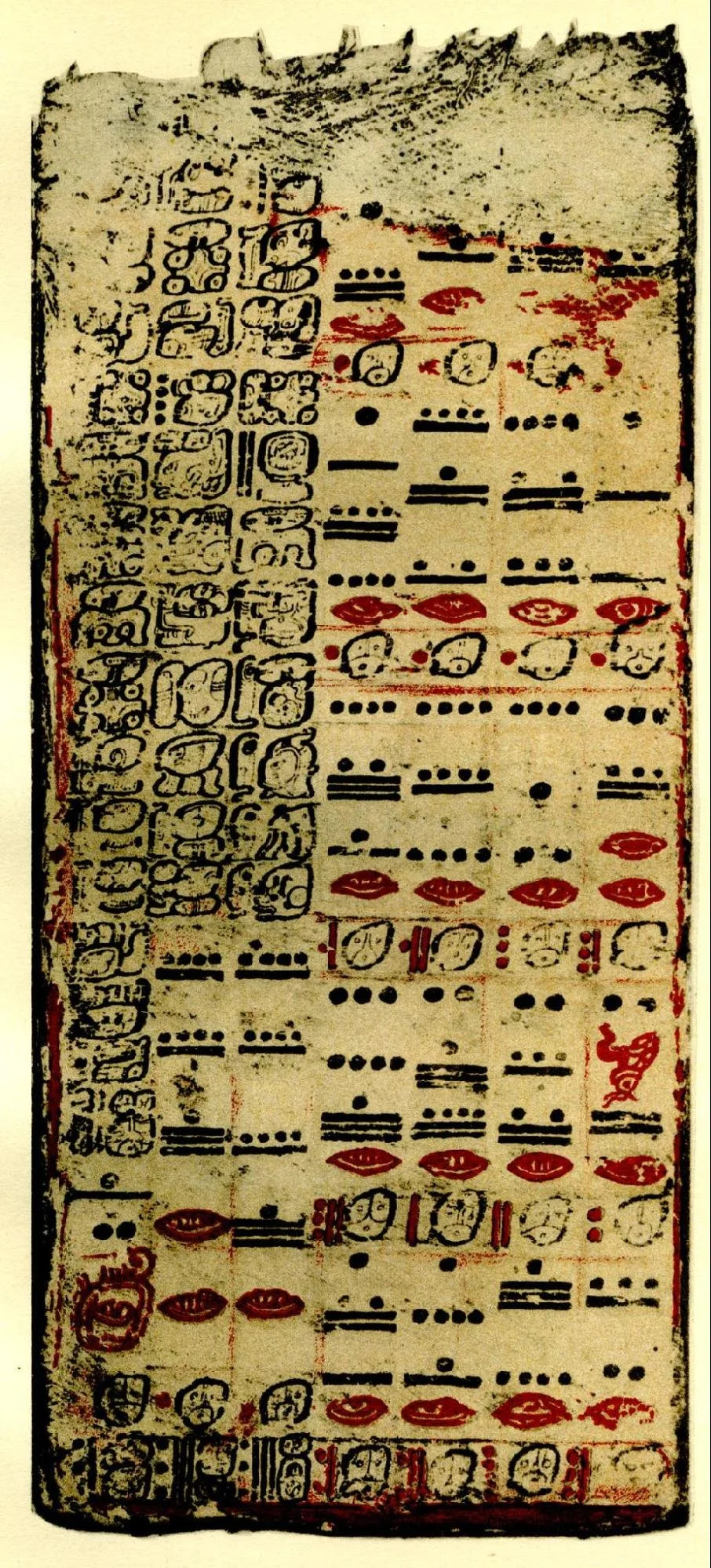
Page 24 of the Dresden Codex, reproduced as plate 31 in Sylvanus G. Morley’s 1915 publication. This is a historical printed reproduction of a manuscript page, not an original practice sheet or a modern photograph of the codex. Public domain. The page contains more than the simple notation taught here.
Make two small values explainable
Original practice example A: draw one horizontal bar and place two dots above it, within one clearly marked group. The value is 5 + 2 = 7. Ask students to explain why counting the three visible marks as three gives the wrong answer: the bar and the dots do not have equal values.
Original practice example B: draw three horizontal bars stacked together and place four dots above them, still within one group. The value is 3 × 5 + 4 = 19. Keep all marks of this numeral close enough to read as one group, rather than implying that each bar occupies a separate place.
Have a partner read each example aloud as an equation. If the partners disagree, they should inspect the grouping and count before drawing more symbols. This is a useful check on notation, not a timed competition or an imitation of a ceremony.
Add one higher place and name its value
Original practice example C uses two separated levels. Label the lower level “ones” and the upper level “twenties.” Put three dots in the lower level and one dot in the upper level. Read the upper dot as one group of twenty: (1 × 20) + (3 × 1) = 23. It is not four, because position changes the value of the upper group.
Ask what would change if the lower three dots were replaced by a zero sign from the verified reference. The result would be 20, not one. Conversely, three dots by themselves in the ones position represent three. These are classroom representations of a two-place convention, not translations of dates on the photographed stela.
For a quick check, give students the value 27. A correct response uses one dot in the twenties level and a single group of two dots above one bar in the ones level: 20 + 7. Label this as a new practice example too. An explanation of the two places matters more than how ornamental the marks look.
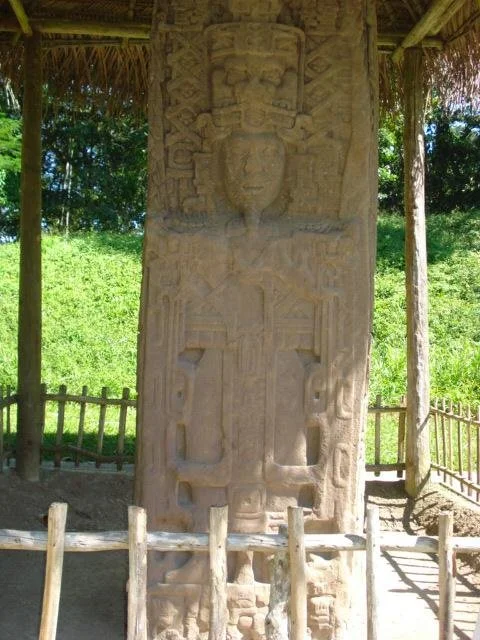
Stela C at Quiriguá, Guatemala, photographed by Renata Avila on March 28, 2009. This view shows the monument in its protected site setting; it is not a legible diagram of the Long Count inscription discussed by the Smithsonian. CC BY 2.0, unchanged. No endorsement implied.
Stop before a small rule becomes a false universal rule
The Long Count needs its own place labels. The Smithsonian gives the sequence of one day, twenty days and then 360 days, because eighteen twenty-day units make a tun. Do not extend the classroom pattern automatically to a third place worth 400 and label the result a Long Count date.
The Smithsonian’s discussion of Stela C at Quiriguá places a Long Count inscription in historical context. Use its attributed explanation rather than asking beginners to decode the photographed monument from three examples. The important distinction is between learning a numerical convention and reading a complete record with its signs, arrangement and context.
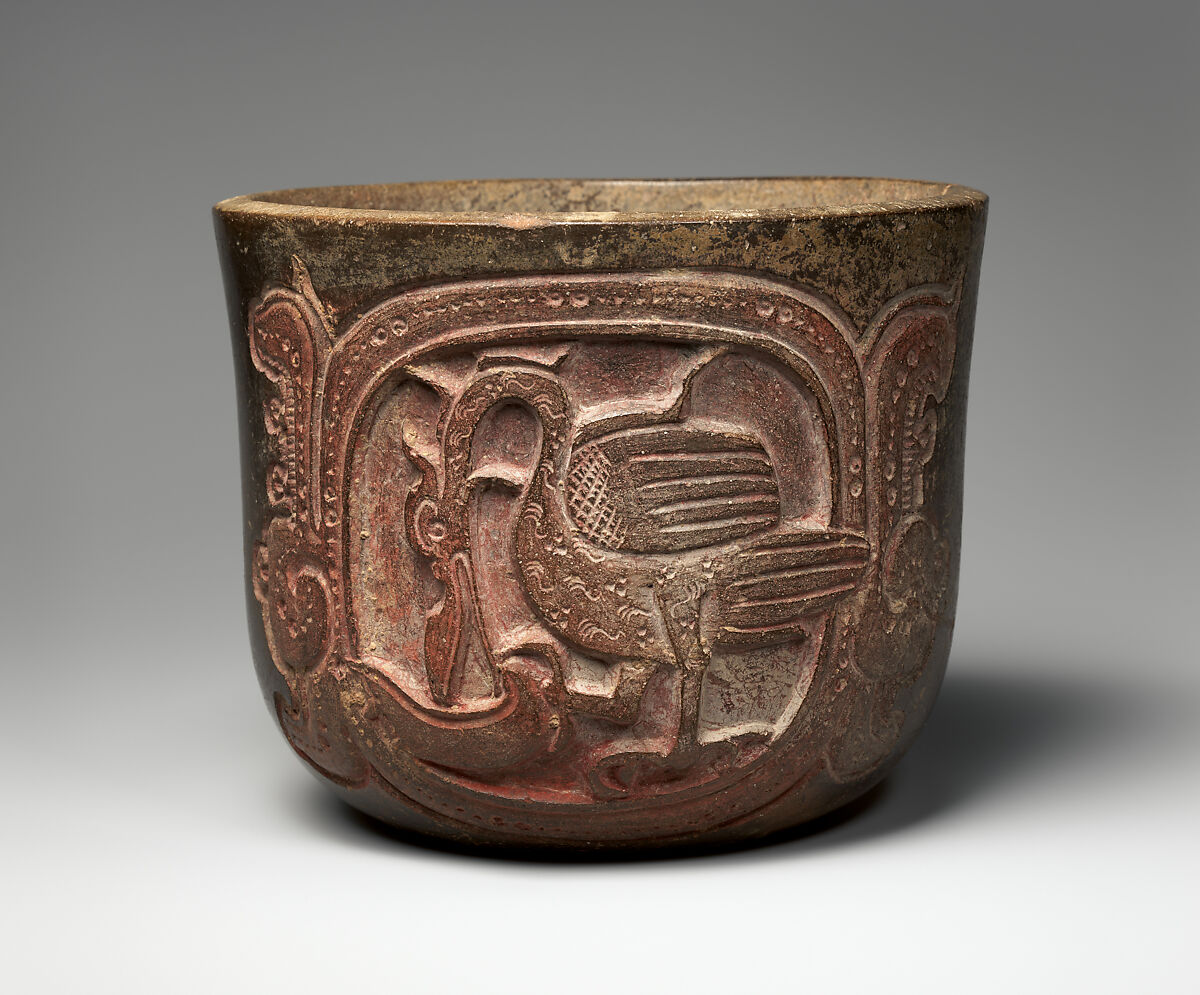
Maya vessel with water bird and hieroglyphic text, 600–900 CE, The Metropolitan Museum of Art, Gift of Justin Kerr and Dicey Taylor, 2017, 2017.396. This photograph is not a numeral chart. Public-domain image; no endorsement implied.
Return from practice to an actual object
The Met describes the waterbird vessel’s inscription as identifying its use for a cacao drink and an owner with a noble title. Knowing that a dot can have the value one does not supply that reading. Ask students what additional expertise or source information the museum interpretation required.
The Dresden Codex page offers a parallel caution. SLUB Dresden identifies page 24 with the Venus tables. Students can notice repeated marks without claiming to have calculated the table or translated every sign. Keep the printed reproduction’s provenance visible, and do not use its nineteenth- or early twentieth-century explanatory text as unquestioned current scholarship.
Assess one calculation and one limit
For the exit response, ask students to explain 23 from the two-level example and finish this sentence: “This exercise does not let me conclude that…” A strong response names a limit such as reading a full calendar date without the correct place labels or translating an entire inscription from the photograph.
Offer larger writing space or a prepared two-level frame when drawing makes the task harder than the mathematics. Leave the arithmetic and source distinction intact. The lesson is an invitation to understand a specific intellectual practice, not evidence that one civilization was inherently smarter than another.
Use a reading to supply context rather than extraordinary claims
The resources below can introduce the historical setting or a selected mathematics passage. The source-based qualifications matter: this activity does not require a ranking of calendar accuracy, an apocalypse story or a claim that every Maya community used an identical form of notation.
Maya Civilization Reading Comprehension | Ancient Americas Worksheet
View this HistoraEDU resource on TPT
The current listing includes Maya mathematics, writing and calendars within a broader civilization reading, with an editable Google Doc and comprehension questions. Choose a short context passage before the number task. The dot-and-bar practice examples here are original additions, not an advertised feature of this worksheet. Keep the reading’s recognition of living Maya peoples visible rather than presenting the exercise as a puzzle left by a vanished population.
Maya Achievements Reading Comprehension | Ancient Americas Worksheet
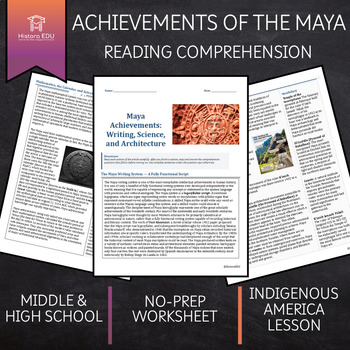
View this HistoraEDU resource on TPT
The listing specifically includes base-20 notation, zero and calendar systems. Use selected mathematics material with the limited two-place convention and source notes in this article. Do not carry forward unsupported claims of exact astronomical precision or the claim that the El Castillo shadow effect occurs only on equinoxes. The routine above does not require either claim.
Sources and image credits
Rojo Garibaldi and colleagues numerical notation research 2021
Smithsonian calendar systems and Long Count place values
SLUB Dresden codex content and page24 Venus tables
Met waterbird vessel interpretation and public domain image
Renata Avila photograph license CC BY2.0
Product thumbnail reproduced from the exact HistoraEDU listing at the owner’s request. Historical photographs are separate evidence, not product endorsements. Renata Avila’s photograph is reproduced unchanged under CC BY 2.0 with attribution and a license link. The codex image is the public-domain 1915 printed reproduction, not a figure copied from the modern research paper. The Met image is marked Public Domain. No institution or photographer endorses the products.


