
By HistoraEDU
The review lesson is ready, the class is seated, and the game will not load. The useful backup is not a different lesson assembled under pressure. It is a small, prepared version of the same review goal that does not depend on a website, student login or live answer reveal. Build that version before class, and give it a clear trigger so troubleshooting does not consume the lesson.
Separate three dependencies
On your plan, write three questions: How will I show the question? How will students respond? How will I reveal and explain the answer? A projected slide, a student-access link and an online feedback screen are separate dependencies. A working projector does not prove the game will load, and a saved screenshot does not preserve interactive behavior.
For each stage, name a non-network substitute: a printed teacher question list, paper numbered 1–6, and a printed key with source notes. Prepare enlarged or otherwise accessible copies of the actual materials your students need. Test readability and the planned response method before class; do not call a backup accessible merely because it is on paper.
Choose a stop rule in advance, such as moving to the paper round if the opening question cannot be displayed after your initial connection check. Do not spend the review period repeatedly asking students to refresh or create accounts. This is a classroom planning suggestion, not a claim that any listed game has a tested offline mode.
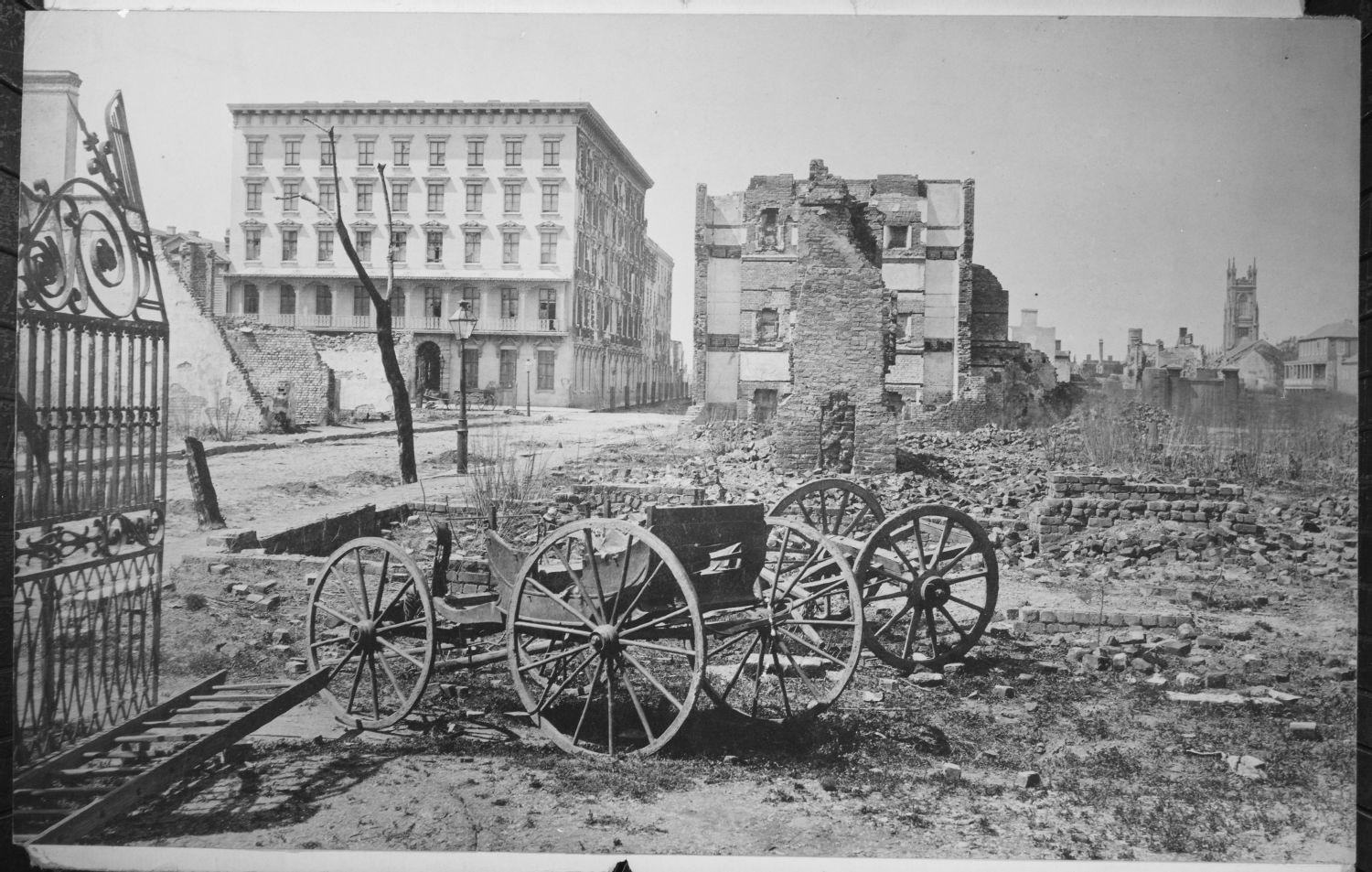
Mills House and nearby damage in Charleston, South Carolina, photographed in 1865. The photograph records a place at the end of the Civil War; it does not document all of Reconstruction. Credit: National Archives, NAID 533131. George N. Barnard. Public domain.
Keep the content goal when the medium changes
Select six questions addressing what you intended to review, not six unrelated easy questions. If adapting material from a purchased resource, check its actual file and permitted classroom use first; a student link is not automatically a printable question bank. Keep the backup within your classroom permissions rather than posting game content publicly.
The original sample below reviews the distinction between constitutional change and later struggles over rights across Reconstruction and the twentieth century. It is not copied from a HistoraEDU game and is not a promised included set. Use it only after the class has studied the relevant content. For a single-era lesson, write six questions for that era instead.
Before an outage, prepare the three photographs here with their captions and a short source note: the Fourteenth Amendment was ratified in 1868; its first section addresses citizenship, due process and equal protection. The Fifteenth Amendment was ratified in 1870 and prohibits denying or abridging citizens’ voting rights on account of race, color or previous condition of servitude. The National Archives transcripts below supply the wording; do not substitute “everyone could now vote freely.”
Prepare six original questions and a separate key
Student question 1: Put these captioned subjects in chronological order: the 1912 Pittsburgh workshop, Charleston in 1865, and the 1965 voting-rights campaign associated with the Selma bridge. Use the historical event date for the last item, not the modern photograph date.
Student question 2: Which came first—the Charleston photograph or ratification of the Fourteenth Amendment—and how many years separate them?
Student question 3: In Section 1 of the Fourteenth Amendment, distinguish the people described in its citizenship sentence from the people protected by its equal-protection clause.
Student question 4: Which three grounds for denying or abridging voting rights are named in Section 1 of the Fifteenth Amendment?
Student question 5: The workshop photograph is dated 1912. Does that date alone show whether its workers could exercise their voting rights without barriers? Explain what is missing.
Student question 6: How does the 1965 Selma campaign challenge the statement “ratifying a voting-rights amendment ended the struggle to exercise that right”? Use a dated source detail.
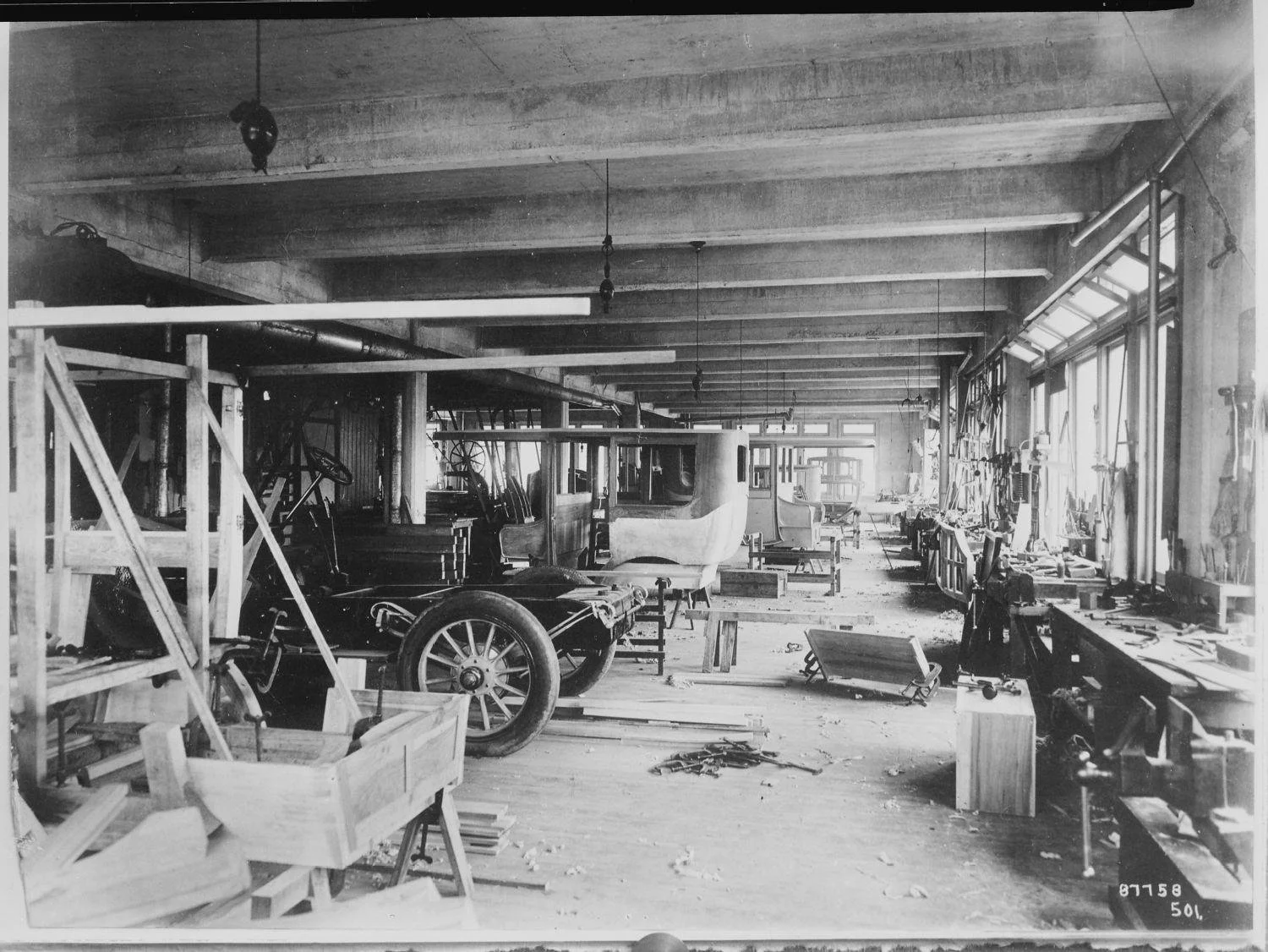
Interior of a Pittsburgh factory making wooden limousine bodies, October 1912. This particular workshop can anchor industrialization review without assuming every factory used the same materials or methods. Credit: National Archives, NAID 523030. Public domain.
Print the key before the lesson
Key 1: Charleston 1865; Pittsburgh workshop 1912; Selma campaign 1965. The bridge photograph itself was taken in 2006. Key 2: The 1865 photograph precedes the 1868 ratification by three years.
Key 3: The citizenship sentence covers people born or naturalized in the United States and subject to its jurisdiction; the equal-protection clause protects any person within a state’s jurisdiction. Do not drop the jurisdiction qualification or equate every protection in the section with citizenship alone. Key 4: Race, color or previous condition of servitude.
Key 5: No. The image and date do not identify each worker’s citizenship, eligibility, location of registration or experience of discriminatory barriers. A well-supported answer identifies the missing evidence rather than inventing a biography. Key 6: The NPS describes the March 1965 marches as protests for voting rights and the March 7 attack on marchers. Those events occurred long after the 1870 amendment, showing that a constitutional prohibition and its effective protection were not the same thing.
Keep this key on a separate teacher sheet when making the classroom fallback. The article displays both parts so you can prepare them; it is not itself a student-ready test. Source references belong on the teacher copy even when the internet is unavailable.
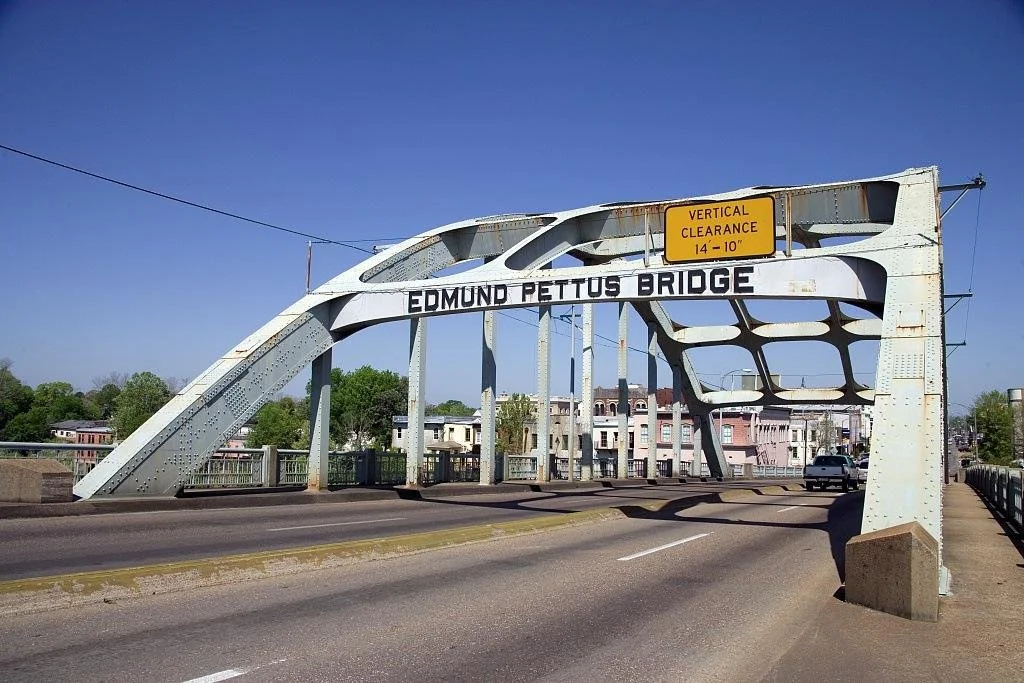
Modern photograph of the Edmund Pettus Bridge in Selma, Alabama, April 11, 2006. The bridge was the site of the March 7, 1965, attack on voting-rights marchers known as Bloody Sunday; this image does not show that event. Credit: Carol M. Highsmith, LC-DIG-highsm-04116. The Library of Congress, Carol M. Highsmith Archive. Public domain.
Rehearse the handoff once
Run one question with the network-dependent elements unavailable before class. Can you find the printed prompt, identify the matching image and caption, collect a response, and explain the answer without opening a link? If not, the fallback still has a hidden dependency.
During the lesson, use the same announced learning goal. You can retain simple paper scoring if it serves the class, or remove points and run a six-question discussion. Do not promise students that paper play reproduces the digital game’s animations, timing or tower mechanics.
Afterward, record the actual failure and what worked. A prepared paper route is a plan until you have tried it; one successful rehearsal is not proof that every device, classroom or assistive-technology setup has been tested. The practical win is being able to continue the intended history review without improvising a new content target.
U.S. History Tower Defense Game | Interactive Review Activity | Editable Canva
View this HistoraEDU resource on TPT
The listing describes an editable Canva board and question slides, a premade version and instructions. Check your actual delivery files and prepare your own permitted classroom fallback. Treat the paper route as a separate teacher-prepared activity, not an offline feature of the game.
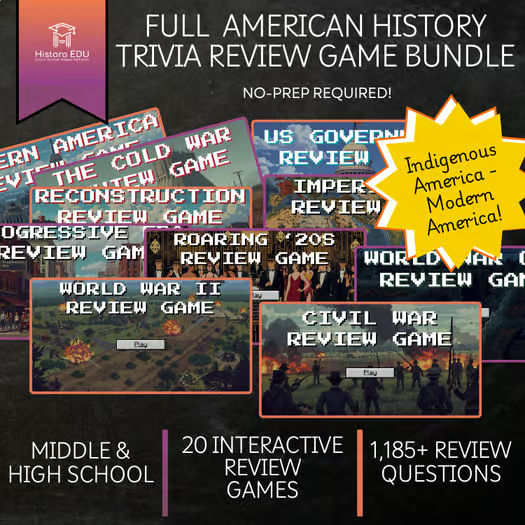
Full U.S. History Review Game Bundle | Interactive Test Prep | 1000+ Trivia
View this HistoraEDU resource on TPT
The full collection lists 20 era games. Use the eras you teach to choose a narrow backup goal. This overlaps the two half-course collections; it is an alternative purchase route, not an extra non-overlapping set.
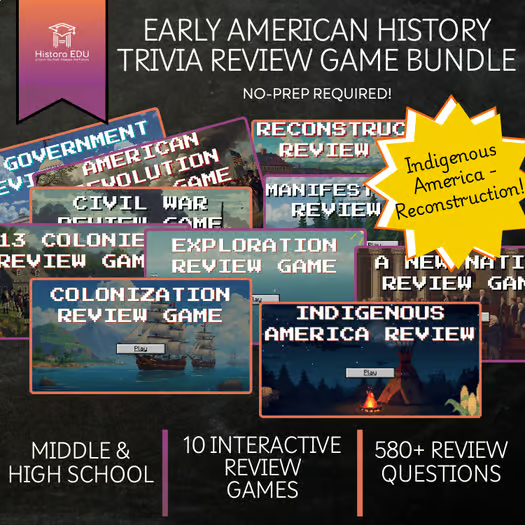
Early U.S. History Review Game Bundle – Early America through Reconstruction
View this HistoraEDU resource on TPT
The early-America-through-Reconstruction collection lists 10 games. Build a fallback from the selected early-history topic rather than using the twentieth-century portions of the sample above.
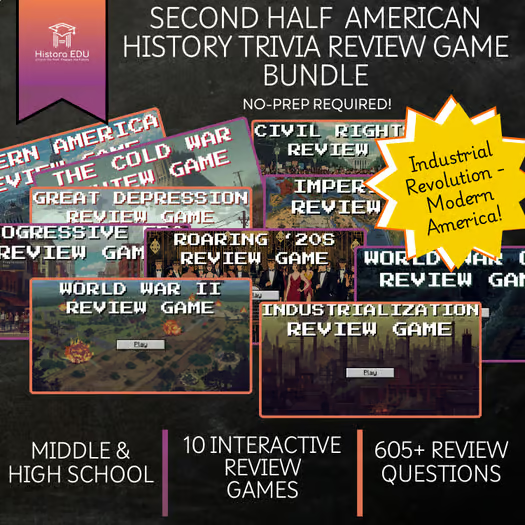
Second Half of U.S. History Review Game Bundle | Interactive Test Prep Trivia
View this HistoraEDU resource on TPT
The later-history collection lists 10 games from industrialization through modern America. Prepare the specific questions and key needed for your lesson before relying on student-access links.
Sources and image credits
National Archives Fourteenth Amendment transcript and ratification
National Archives Fifteenth Amendment transcript and ratification
NPS Selma to Montgomery history
Image record pittsburgh-factory
Product thumbnail reproduced from the exact HistoraEDU listing at the owner’s request. Historical photographs are separate evidence, not product endorsements.
