
By HistoraEDU
A student reads one vivid letter and writes, “Civil War soldiers enjoyed camp life.” Students are giving a small piece of evidence a much larger job than it can do. Teach them to name whose experience a source records before deciding how far a claim can travel.
This lesson pairs Private Samuel D. Reck’s February 7, 1863 letter to his wife with Annie Davis’s August 25, 1864 appeal to Abraham Lincoln from Belair, Maryland. Their dates, audiences and circumstances differ. Reck’s letter does not name his camp’s location; leave that field unstated rather than supplying a plausible place from memory.
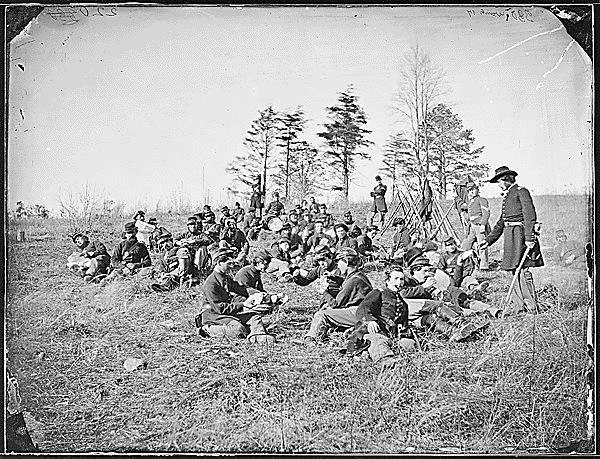
Soldiers at rest after drill, Petersburg, Virginia, 1864, as identified in the National Archives’ selected list. This is not an identified portrait of Reck or his camp. Credit: National Archives, NAID 524639, 111-B-220. Public domain. Image source
Read a letter before calling it typical
Use the Library of Congress’s scan and linked two-page transcription of Reck’s letter. The catalog identifies him with Company F of the 165th Pennsylvania Infantry. In the opening passage he describes pleasure in receiving his wife’s letters, says he enjoys camp and expects time to pass quickly. Later he expresses uncertainty about surviving to return home and concern for his wife and children. Select a short, non-graphic passage and explain its religious language without asking students to share the writer’s beliefs.
Write two competing claims: “Reck tells his wife that he enjoys camp in this letter” and “Soldiers enjoyed camp throughout the war.” Ask students to underline the people and time covered by each statement. The first has a named writer, recipient and date. The second silently expands one person’s account to a population and four years.
Writing to a loved one is a reason to investigate audience and purpose, not proof that reassuring statements are false. Ask what Reck chose to discuss without pretending to reconstruct his unrecorded experiences.
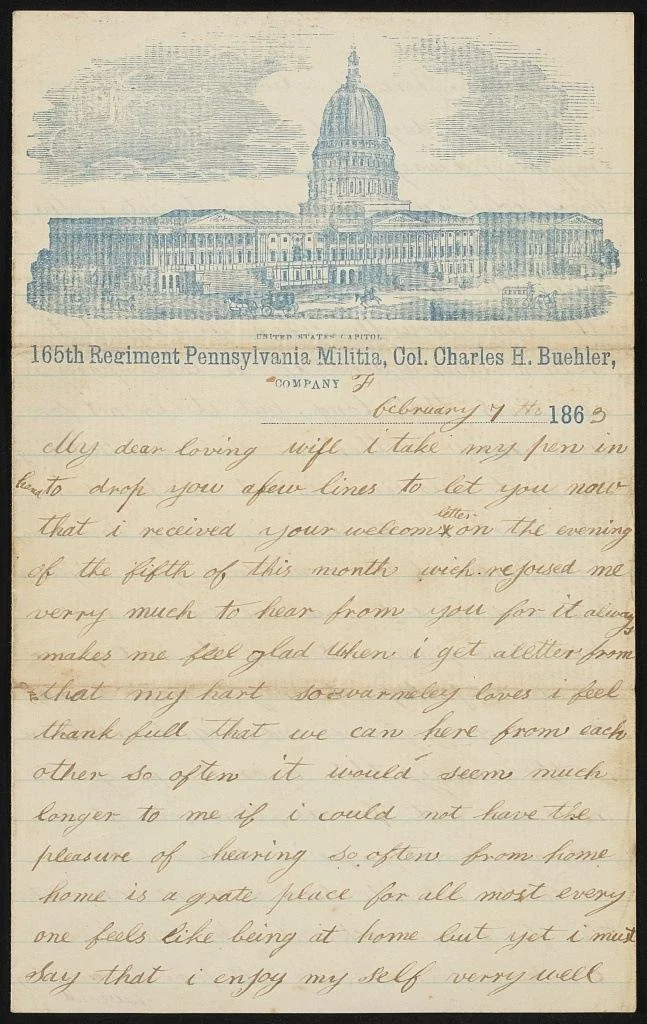
First page of Samuel D. Reck’s February 7, 1863 letter to his wife. The printed Capitol image does not establish where he wrote it. Credit: Library of Congress, Liljenquist Family Collection, LC-DIG-ppmsca-94487. No known restrictions on publication. Image source
Pair records without averaging experiences
The National Archives identifies Davis’s appeal as a letter written from Belair on August 25, 1864. She asks Lincoln about her freedom. The Archives supplies an essential context: Maryland was not covered by the Emancipation Proclamation, and the state’s new constitution ended slavery there in November 1864. Treat that explanation as institutional context, not as a later outcome already known to Davis when she wrote.
Give each source its own record card with five fields: writer, date, place, audience and the particular matter addressed. Add a sixth field for what the source cannot establish. For Reck, students can record the unstated camp location and the absence of evidence about all soldiers. For Davis, this selected letter does not establish Lincoln’s response, her subsequent journey or the experience of every enslaved person. Her age is not supplied here; do not turn her into a child character.
Model a bounded comparison: “Reck’s February 1863 letter describes his response to separation from his family and contact by mail. Davis’s August 1864 appeal from Maryland asks the president about her freedom. These records reveal different concerns directed to different recipients; they do not combine into a typical wartime day.”
The records need not contradict each other. Nor does a shared reference to family make military separation equivalent to enslavement. Ask what additional evidence would be needed for a broader question: letters from other people, records from another date or place, or a clearly defined collection studied systematically. Finding a second vivid example is not the same as establishing how common an experience was.
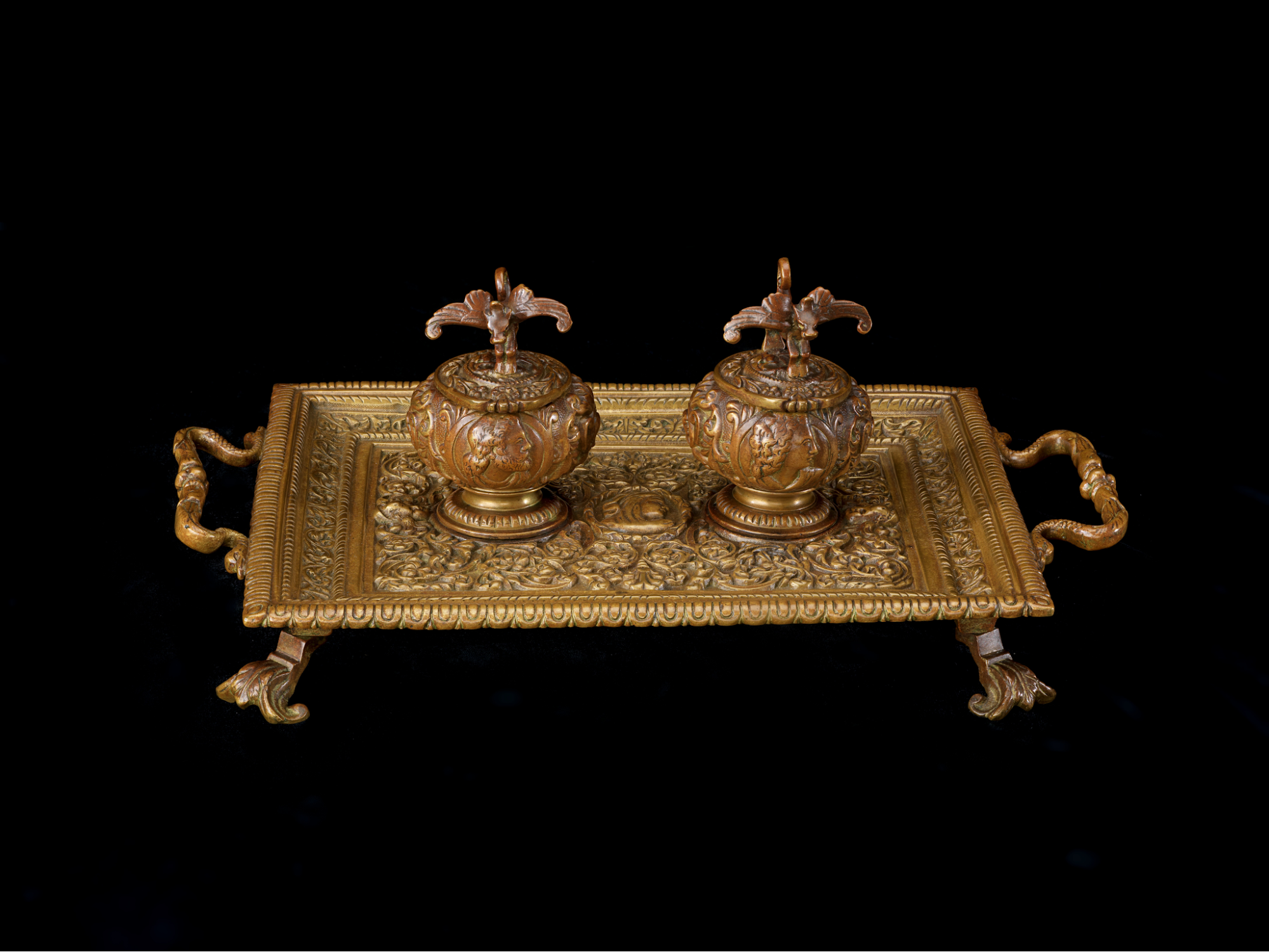
Mid-nineteenth-century inkstand from Major Thomas Eckert’s desk, associated with Lincoln—not the equipment of either letter writer. Credit: Smithsonian National Museum of American History, PL.244699.02; transfer from Library of Congress. Image CC0. Image source
Ask why these pieces of evidence survived
The Smithsonian preserves an inkstand associated with Major Thomas Eckert’s War Department Telegraph Office desk and Lincoln. It is not Reck’s or Davis’s writing equipment. Use that distinction to ask why a presidential association might lead students to encounter one object more readily than an ordinary correspondent’s tools. Phrase this as an inquiry about collecting and visibility, not an unsupported account of exactly why every object survived.
For a twenty-minute routine, spend four minutes identifying each record, six reading selected passages, five testing an overbroad claim and five drafting the bounded comparison. Keep the source cards beside the writing. A memorable quotation should not lose its writer, date or audience when it moves into a paragraph.
For support, provide the metadata and read the excerpts aloud while students mark one supported statement and one unanswered question. For extension, ask students to define the population in a claim before proposing a new source. “Everyone in the South” needs much more work than “this writer in this letter.”
Finish with an exit ticket: revise one sentence that overgeneralizes, then name the evidence still needed to expand it. Assess the match between evidence and claim, not a student’s imagined ability to survive the war. Do not require first-person trauma diaries or reenactments of coercion.
Choose background reading to fit the question
These HistoraEDU non-editable PDF readings list comprehension questions and teacher materials. Choose a focused reading to establish context, then use the independently linked records above to test the reach of a claim. The source-card routine is a suggested classroom extension, not an included product organizer.
Would You Survive as a Civil War Soldier? | Reading Comprehension Worksheet
Use the soldier-life reading to generate questions about whose experience a broad description represents. Reframe the survival-style title as evidence analysis rather than an endurance game.
Civil War Camps: Why Disease Killed More Than Battle | Reading Worksheet
Use the camp and disease topic to ask which records could support a population-level claim. One personal letter or photograph cannot establish disease frequency or mortality totals.
Children in the Civil War: Growing Up During War | Reading Worksheet
Use the children’s reading for a separate, age-identified source inquiry. Do not label Annie Davis a child when the selected record does not establish her age.
Northern Home Front | Civil War Reading Comprehension Worksheet
Use the Northern home-front reading to distinguish regional context from evidence about a particular household, writer or legal situation.
Southern Home Front | Civil War Reading Comprehension Worksheet
Use the Southern home-front reading to ask whose conditions a generalization includes. Keep enslaved people’s circumstances distinct from those of enslavers and other civilians.
View this HistoraEDU resource on TPT
Sources and credits
Samuel D Reck letter and transcript at the Library of Congress
National Archives on Annie Davis’s August 1864 letter
National Archives Civil War photograph descriptions and rights
National Archives infantry resting photograph 524639
Smithsonian Emancipation Proclamation Inkstand record
Product covers: HistoraEDU, reproduced from the exact linked TPT listings at the owner’s request. Photographs and archival reproductions are credited beside each image. No claim to original U.S. Government works. Source institutions and depicted people do not endorse HistoraEDU or its products.
