
By HistoraEDU
Students may remember that Tenochtitlan stood in a lake yet struggle to explain why that setting mattered. Give the lesson a problem worth solving: how could a large city obtain water and food, move people and goods, and organize shared work? A short systems inquiry can turn a list of Aztec achievements into an explanation. It also gives students a reason to distinguish what an object shows from what a historical account establishes.
Begin with needs rather than superlatives
Write four questions on the board: Where does drinking water come from? How does food reach households? How do people move around? Who organizes work and access? Ask students to make an initial prediction about an island city, then label that prediction as a hypothesis. They will revise it from evidence rather than receive points for guessing correctly.
Use Mexica when discussing the people who established Tenochtitlan and explain how the broader label Aztec is being used in the lesson. Avoid treating every community in the empire as interchangeable. A map and a short account of the city should establish location before students investigate individual systems.
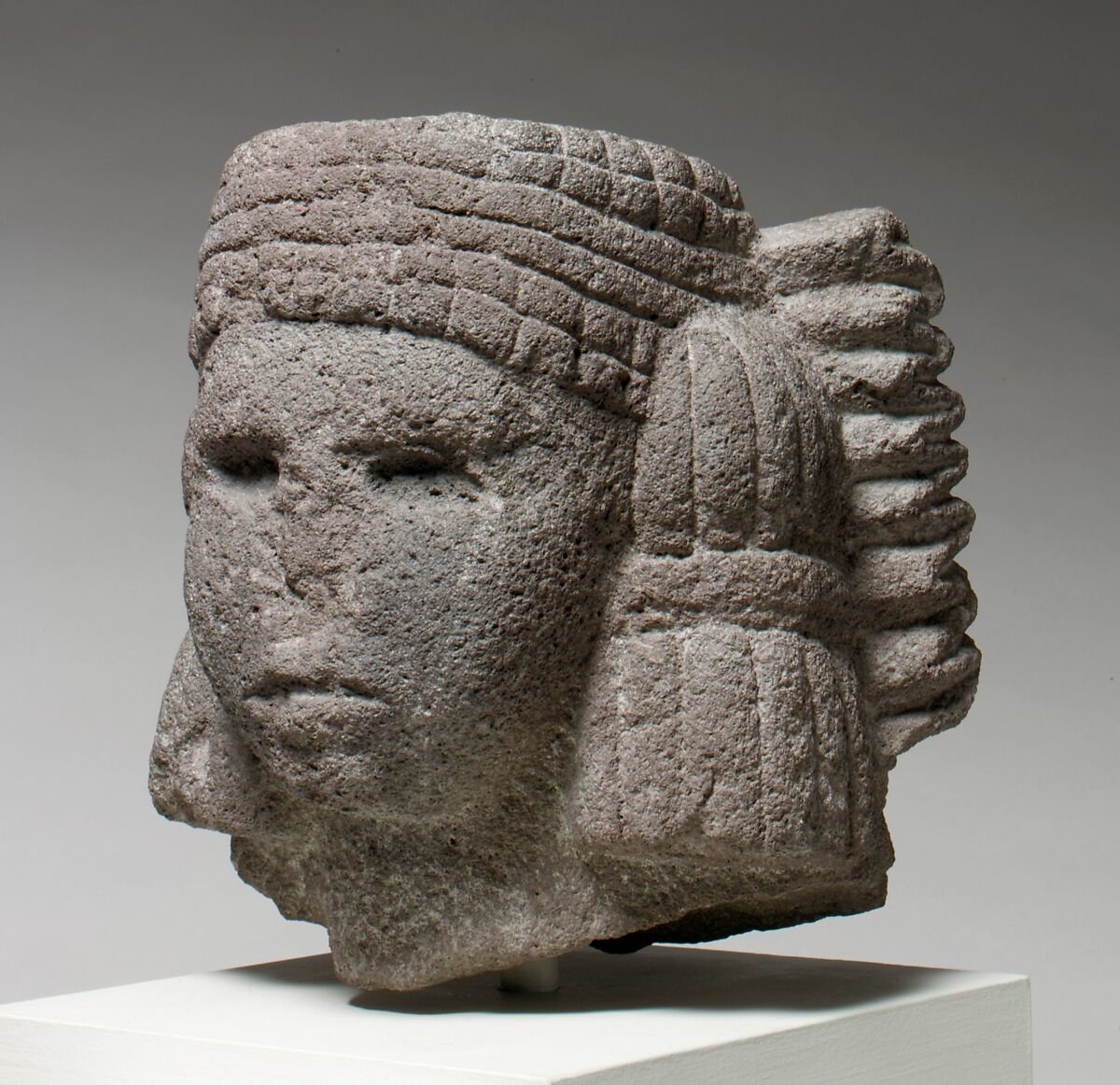
Head of the water deity Chalchiuhtlicue, fifteenth to early sixteenth century. This is a religious sculpture, not a photograph of a waterworks or evidence of a particular aqueduct design. Credit: The Metropolitan Museum of Art, Museum Purchase, 1900, 00.5.44; Public Domain. No endorsement implied.
Connect water to more than one kind of evidence
The Met’s account describes causeways, canals and aqueducts connecting the city to its surroundings. Give students a short selected passage and ask them to explain the job of each feature. A causeway allows movement across water; an aqueduct carries water. Similar looking lines on a diagram do not necessarily perform the same function.
Place the water deity photograph beside that account. Ask what questions the object adds about the cultural importance of water. The sculpture cannot tell us an aqueduct’s capacity, route or reliability. Students should name the source they would need before making an engineering claim. This distinction keeps an engaging image from becoming decorative proof of something it does not show.
Follow food from a landscape to a household
Introduce chinampas as raised agricultural plots in shallow lake areas, not floating rafts. Have students trace a possible chain from cultivation to transport to exchange, using the reading to support each connection. Leave any unsupported step as a question. Do not require a precise yield or population estimate to explain why production and transport must work together.
Now ask who is missing from a diagram made only of buildings and roads. Farmers, carriers, makers, traders and household workers all raise questions about labor. Students can add people to their explanation without inventing a universal job description for every man or woman.
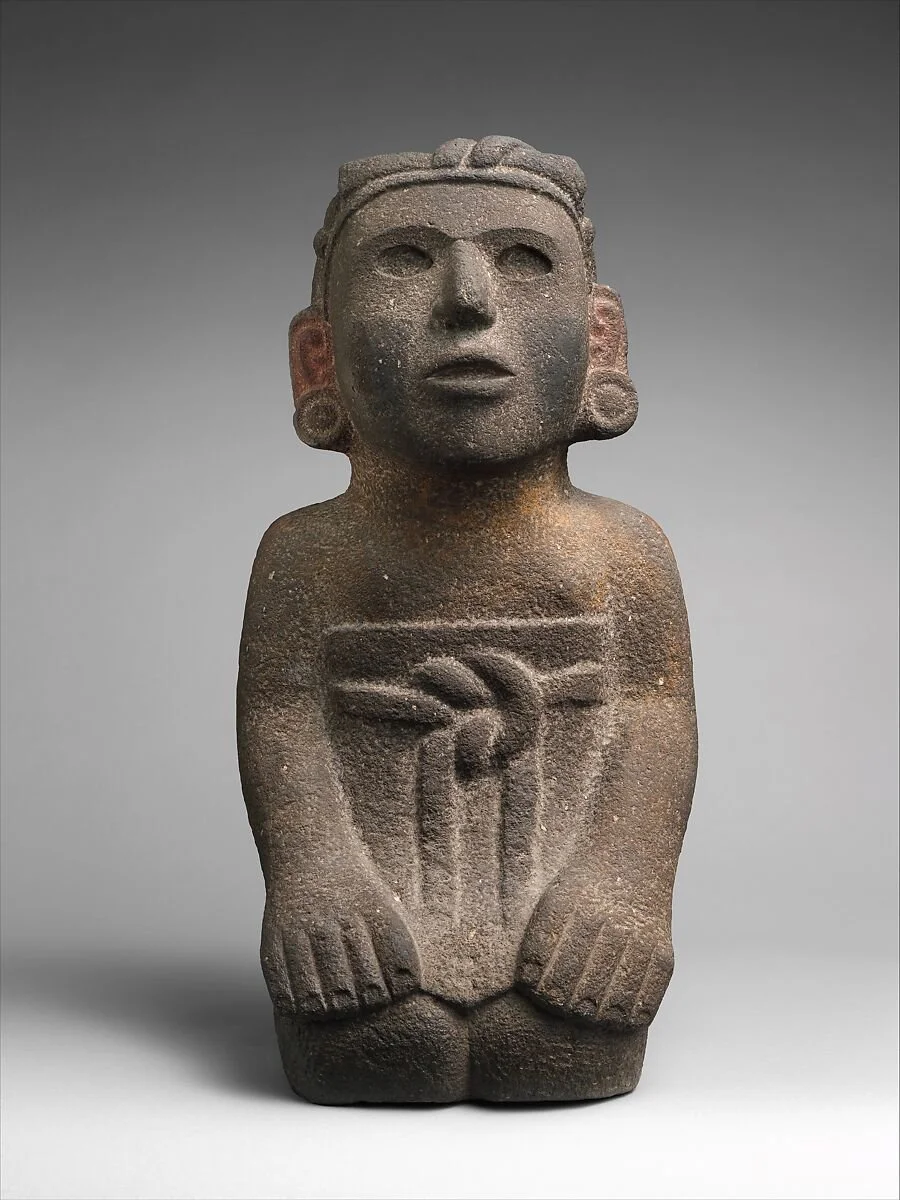
Mexica kneeling female figure, 1325–1521 CE. The museum discusses possible ritual uses; the photograph is not a record of a named city resident or a specific household task. Credit: The Metropolitan Museum of Art, Museum Purchase, 1900, 00.5.16; Public Domain. No endorsement implied.
Keep civic and religious life in the same inquiry
The city’s central sacred precinct should not become a detached final slide. Ask how a shared urban space could connect movement, authority and religious practice. Use a sourced account of the Templo Mayor rather than asking students to infer the entire system from the appearance of a sculpture.
The Macuilcoatl object below offers a useful source check. The museum interprets it as a deity figure that probably held a banner. Students can compare the visible evidence with the catalog’s interpretation and its discussion of comparable works. They should not label it a portrait of a ruler or assume its original location is certain.
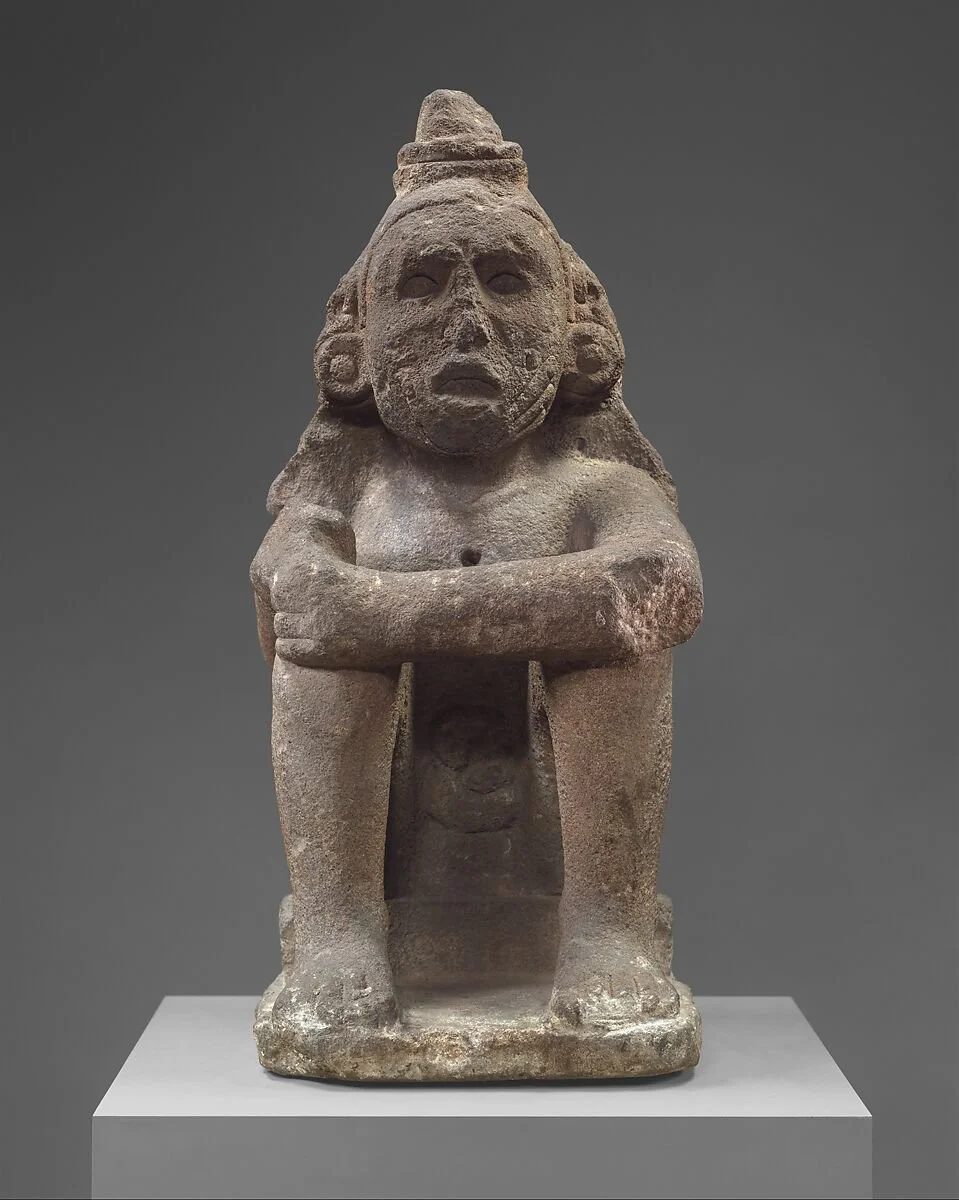
Macuilcoatl, 1450–1521 CE, a Mexica deity sculpture interpreted as a standard bearer. Its photograph supports object observation, not an exact reconstruction of Tenochtitlan’s streets. Credit: The Metropolitan Museum of Art, Museum Purchase, 1900, 00.5.8; Public Domain. No endorsement implied.
Finish with one explained connection
Ask students to draw two linked systems and write a paragraph explaining their relationship. For example, they might connect food production to transport and then identify the labor that kept both working. Require one source-supported statement and one limit on the evidence.
For students who need support, provide the sentence frame “This feature helped address ___ because ___.” For a stronger extension, ask what might happen if one connection were interrupted, clearly labeling the answer as a reasoned inference rather than a documented event. The goal is an explanation with evidence, not the longest list of impressive facts.
Aztec Empire Reading Comprehension | Ancient Civilizations Worksheet
View this HistoraEDU resource on TPT
Use selected political and social context passages to distinguish Tenochtitlan from the wider empire, then verify the specific city features against the Met’s account. Keep this task focused on urban needs and connections. Leave the conquest section out: its repeated religion passage does not supply a conquest narrative, and conquest is not the question this systems lesson asks.
Tenochtitlan Reading Comprehension | Aztec Empire Worksheet
View this HistoraEDU resource on TPT
The city-focused reading provides passages about its setting, engineering, markets and society, with comprehension questions. Use those sections as background for the teacher-created systems task; the drawing and exit prompt above are extensions rather than advertised included files.
Sources and image credits
Product thumbnails: HistoraEDU, reproduced from the exact current TPT listings at the owner’s request. Archival sources do not endorse HistoraEDU or its products. No claim to original U.S. Government works.
