
By HistoraEDU
“Industrialization helped America.” The sentence sounds like an explanation, but its subject hides the question students need to answer: which people experienced which changes? A business’s increased output, a child’s working day and a government’s expanded authority are not interchangeable measures of national success.
Use review time to replace the oversized subject with named groups and evidence. The goal is not to calculate whether exploitation was ‘worth it’ or to assign society a net-benefit score. Students should produce a short verdict that identifies an affected group, explains a supported consequence and marks what remains unknown.
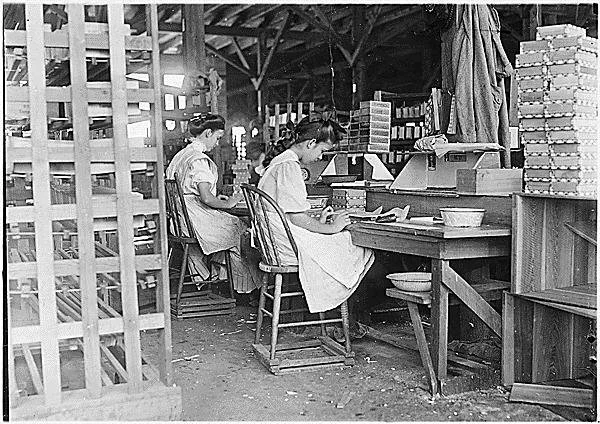
Girl working in a Tampa box factory, January 28, 1909. Hine’s accompanying caption reports ten small boys and girls working; the image alone does not supply their wages or hours. Credit: Lewis Wickes Hine, National Archives, NAID 523166, 102-LH-584. Unrestricted use. Image source
Begin with one workplace rather than a national average
Lewis Hine photographed a girl working in a Tampa box factory on January 28, 1909. The National Archives preserves the photograph with his caption reporting ten small boys and girls at work. Attribute that count to the caption; it is not a count students can reconstruct from this single view.
Ask students to name the production task before judging its consequences. The image and record document children’s participation in this workplace. They do not provide payroll figures, profit totals, each worker’s hours or a school-attendance record. Do not infer an individual child’s health or feelings from appearance.
Write two possible questions beneath the photograph: “What did the business obtain from this work?” and “What did the children and their households receive or give up?” These are investigation questions, not permission to invent wages or family circumstances. A payroll, time book or household account would help answer different parts of them.
Model a revision: “Hine’s January 1909 record documents children working in a Tampa factory. To judge how the arrangement affected workers and the business, we need evidence about pay, time, conditions and production—not merely the fact that goods were being made.” The improvement is a specified population and an evidence plan, not a more emotional adjective.
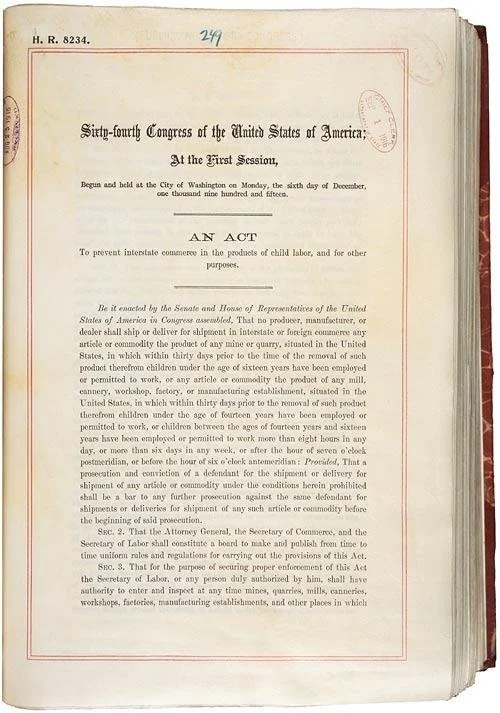
First page of the Keating–Owen Child Labor Act, approved September 1, 1916. Use the linked transcript for the complete provisions. Credit: National Archives, General Records of the United States Government, Record Group 11. Public domain. Image source
Read a reform as a distribution of protections and obligations
Bring in section 1 of the 1916 Keating–Owen Child Labor Act. Its mechanism restricted interstate or foreign shipment of specified goods connected with child labor. Among its conditions were factory employment below age fourteen and certain hours or night work for children aged fourteen to under sixteen; mines and quarries had a separate under-sixteen threshold. Use the actual text, including its thirty-day production window, rather than turning it into a universal ban on all children’s work.
Ask students to underline two kinds of people: the children described in the conditions and the producers, manufacturers or dealers addressed by the prohibition. The provision sought to protect children by constraining covered commerce. That is an interpretation of the rule’s design, not evidence that every child benefited equally.
Keep timing visible. The act was approved in September 1916, years after Hine’s photograph, and the Supreme Court invalidated it in 1918. It cannot establish that the pictured factory violated this later law or that federal legislation permanently ended child labor in 1916. A legal text and evidence of enforcement answer different questions.
Students can now write a second sentence naming who faced an obligation and whose protection was intended. Ask what records would establish an actual effect on children’s hours, household income or employers’ practices. Do not fill missing evidence with an assumed happy ending.
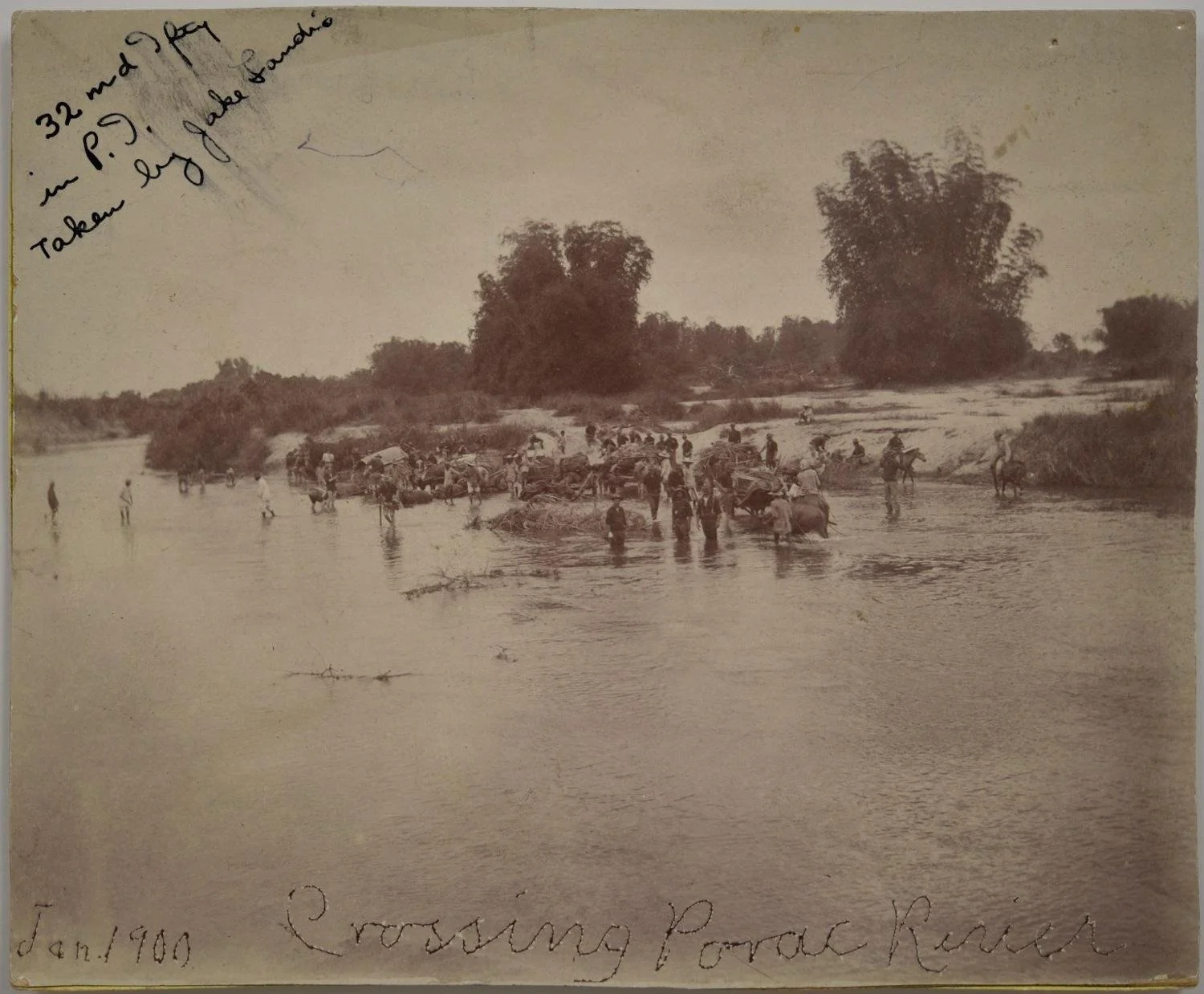
The 32nd Infantry crossing the Porac River in the Philippines, January 1900, during the Philippine-American War. This is a U.S. military view, not Filipino testimony or a treaty-signing photograph. Credit: Jake Landis, as credited on the original; National Archives, NAID 155510276. Unrestricted use. Image source
Treat overseas authority as a different question
Use a separate case for imperialism rather than drawing an automatic arrow from factories to empire. In the December 1898 Treaty of Paris, Article III provided for Spain’s cession of the Philippines to the United States. Article IX assigned Congress the determination of the civil rights and political status of the people it called “native inhabitants” of the ceded territories. Read those provisions with the treaty’s named U.S. and Spanish representatives.
The supported contrast concerns authority: the agreement provided for enlarged U.S. authority and placed consequential decisions about those inhabitants under Congress. The treaty is not testimony that Filipinos welcomed that arrangement, nor a survey of how different communities experienced it. Students should request Filipino political statements and local records before making claims about consent or lived consequences.
The January 1900 Porac River photograph records U.S. military movement during the Philippine-American War. It is neither Filipino testimony nor an image of the 1898 treaty negotiations. Keep its date and military viewpoint visible; avoid celebratory captions that erase affected communities.
Finish with a qualified verdict instead of a single score
Give pairs three short claims to revise: “Factory growth helped everyone,” “The reform solved the problem,” and “Expansion benefited the country.” They must replace each vague subject, identify the kind of consequence being evaluated and attach the source or the evidence still needed.
For a twenty-five-minute routine, spend five minutes on the workplace, seven on the reform text, seven on the treaty and six on individual revisions. Provide a glossary of shipment, provision, cession and authority. For support, pre-mark the relevant sentences; for extension, ask students to explain why output, income, working time and political control cannot be added into one simple total.
Do not assign students to defend child exploitation or colonial rule. They can analyze historical power and arguments without performing them. An exit ticket should name one supported consequence for a particular group and one unresolved question about another group.
Use games for retrieval before evaluating consequences
Use selected questions from HistoraEDU’s three digital games for retrieval, then pause for the evidence work. Listings describe student-access links, teacher instructions and editable Canva materials. The verdicts and primary-source selections above are teacher-added, not built-in game features.
Industrialization Review Game | Social Studies | Interactive Test Prep Trivia
Use selected questions on industry, working conditions and child labor to identify actors before students evaluate a claim about who gained or bore costs.
Progressive Era Review Game | Social Studies | Interactive Test Prep Trivia
Retrieve reform vocabulary, then compare a specific provision’s intended protection with evidence needed to judge its implementation. Do not treat a correct law-name answer as proof of results.
Imperialism Review Game | Social Studies | Interactive Test Prep | Trivia
Review overseas expansion and its debates, then distinguish U.S. government authority from the experiences and political claims of people affected by it.
View this HistoraEDU resource on TPT
Sources and credits
National Archives Hine photograph and original caption, NAID 523166
National Archives Keating–Owen Act text and historical context
Treaty of Peace, December 1898, Articles III and IX, Yale Avalon transcription
National Archives Porac River photograph, NAID 155510276
Product covers: HistoraEDU, reproduced from the exact linked TPT listings at the owner’s request. Photographs and archival reproductions are credited beside each image. No claim to original U.S. Government works. Source institutions and depicted people do not endorse HistoraEDU or its products.
