
By HistoraEDU
A colorful poster assignment can look successful while hiding weak historical thinking. Students reproduce a slogan, add a flag and earn points for persuasion—but never explain who wanted whom to do what. Worse, asking them to become wartime propagandists can reward the very manipulation you want them to recognize.
Replace the recruitment-poster task with a short analytical caption. Students will compare two food-related U.S. government posters, identify a requested action and explain one persuasive choice. Their final sentence must distinguish a message’s purpose from evidence that anyone followed it. They analyze the appeal rather than perform it.
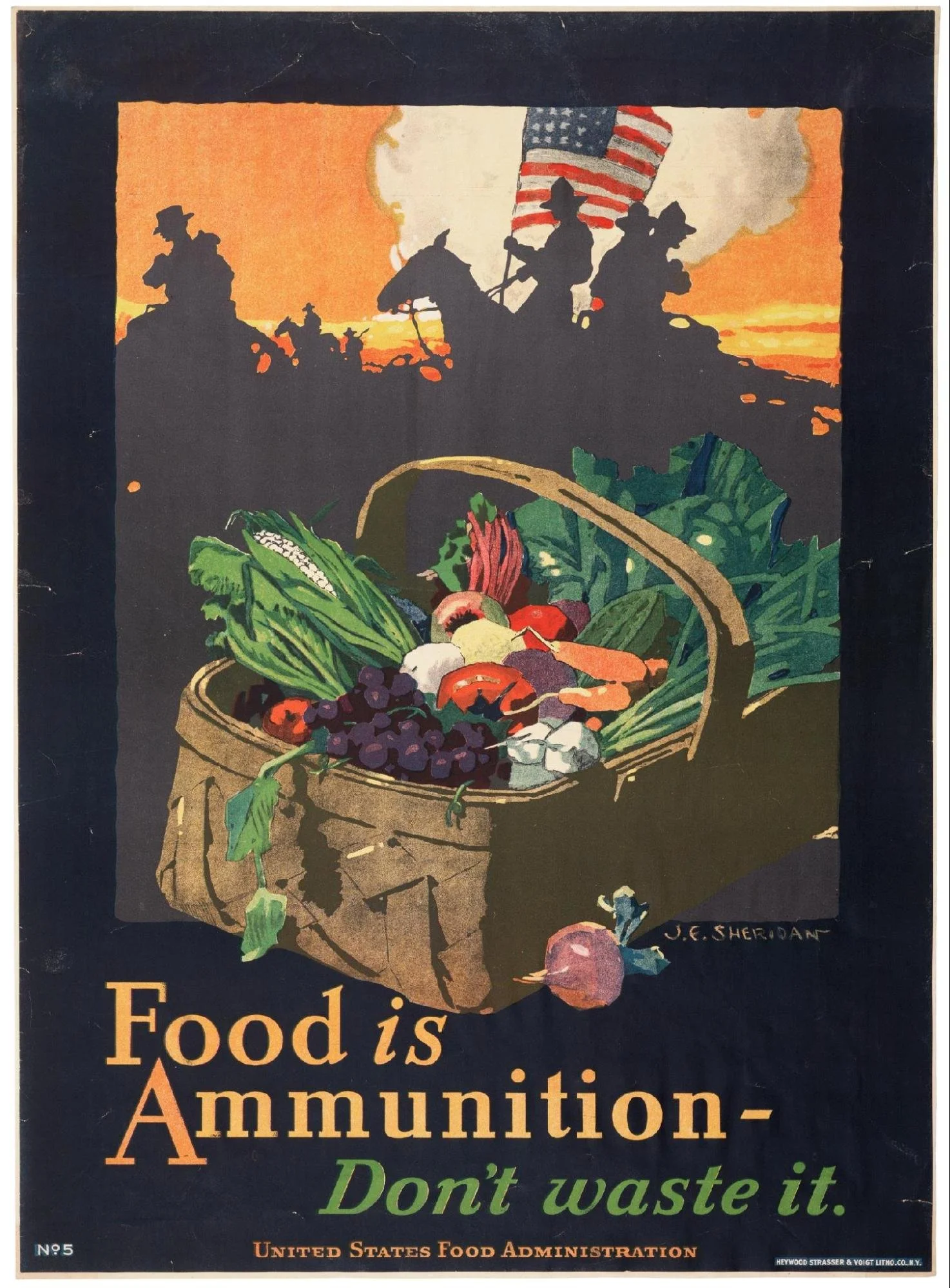
Food is Ammunition—Don’t Waste It, about 1918. Artist signature: J. E. Sheridan. United States Food Administration. Credit: National Archives, NAID 512488, 4-P-49. Unrestricted use. Image source
Start with a request rather than a technique label
Use the World War I poster Food is Ammunition—Don’t Waste It, preserved by the National Archives as item 512488 and dated about 1918. The image places a basket of produce beneath mounted soldiers and a U.S. flag. The United States Food Administration’s name appears along the bottom. Keep that institutional identification with the image.
Before introducing labels such as symbolism or emotional appeal, ask: “What action does the issuer want?” A defensible answer is conserving food, not buying ammunition. Then ask students to connect that answer to the wording and the relationship between the food and military figures. The metaphor makes a household decision appear connected to soldiers’ needs.
For audience, require a reasoned inference: “People able to reduce food waste are a plausible audience because the command concerns how food is used.” That is more precise than “all Americans.” The poster does not identify every place it appeared, everyone who saw it or the reactions of different viewers. A distribution record could help establish reach; a striking design cannot.
Model an analytical caption: “The U.S. Food Administration’s poster asks viewers to conserve food. By placing produce below soldiers and calling food ammunition, it connects everyday consumption to military support. The image shows the appeal, not how much food viewers saved.”
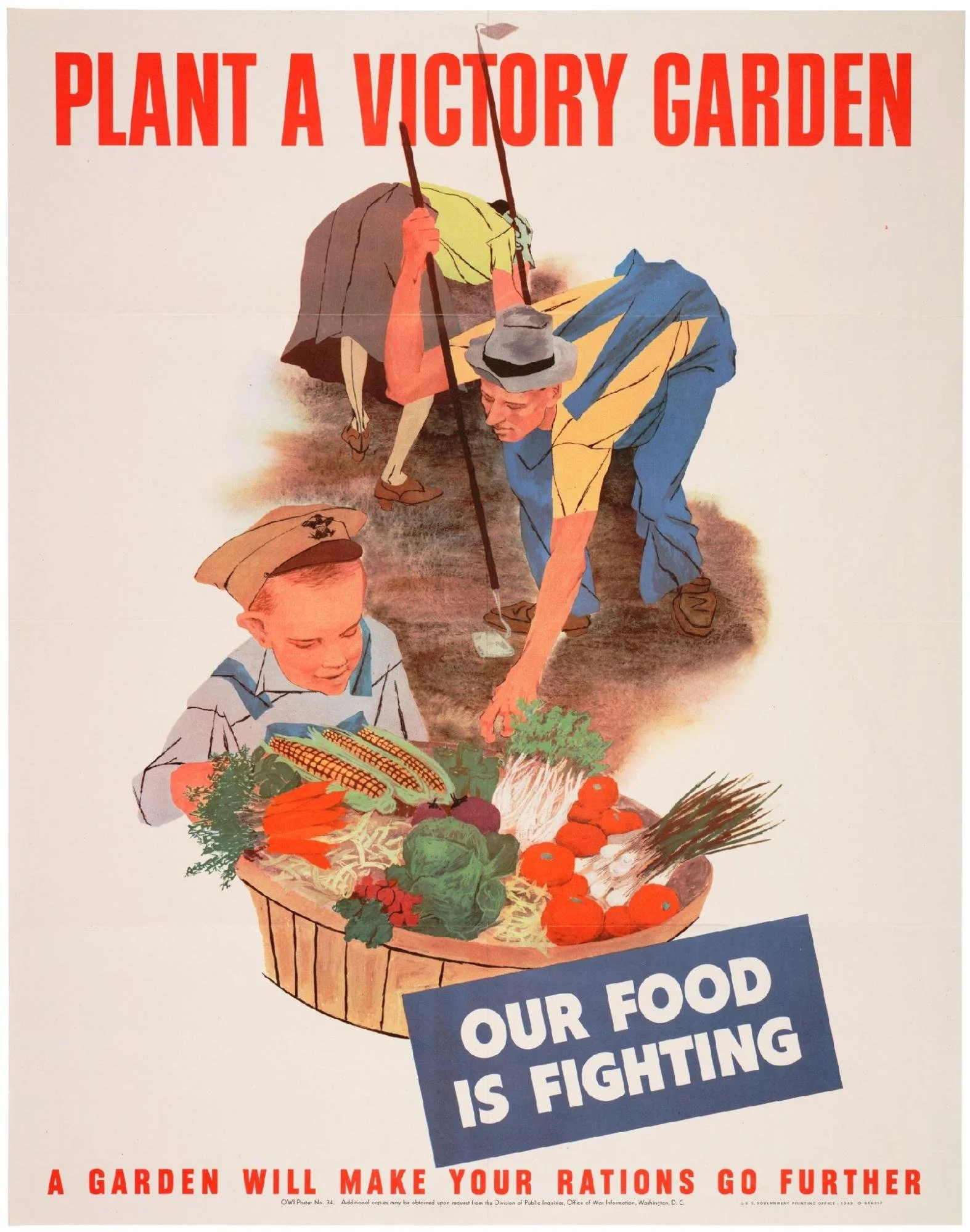
Plant a Victory Garden: Our Food Is Fighting. Office of War Information poster no. 34; 1943 printing imprint. Credit: National Archives, NAID 513818, 44-PA-368. Unrestricted use. Image source
Keep the second war and the second action distinct
Now examine Plant a Victory Garden: Our Food Is Fighting, National Archives item 513818. Its printed footer identifies an Office of War Information poster and a 1943 Government Printing Office imprint. A man and woman work behind a child and a basket of vegetables. The bottom line promises that a garden will stretch rations.
Ask pairs to replace only the first caption’s action: this poster asks viewers to grow food, not merely waste less. Both connect food to war, but they are not interchangeable evidence. Students should retain each war, issuing organization and date instead of filing both under a generic “war poster” heading.
Then look at the idealized scene. The full basket presents a successful harvest; the child’s cap and the phrase about food fighting connect gardening with military effort. These are observations and interpretations of the design. They do not establish that every household had land, time, tools or equal access to food. Ask which practical requirements the image leaves outside its frame.
Give students two verbs to choose between: “encouraged” and “proved.” The poster encouraged planting; it did not prove universal participation or plentiful harvests. Replacing the second verb is a small revision with a substantial historical payoff.
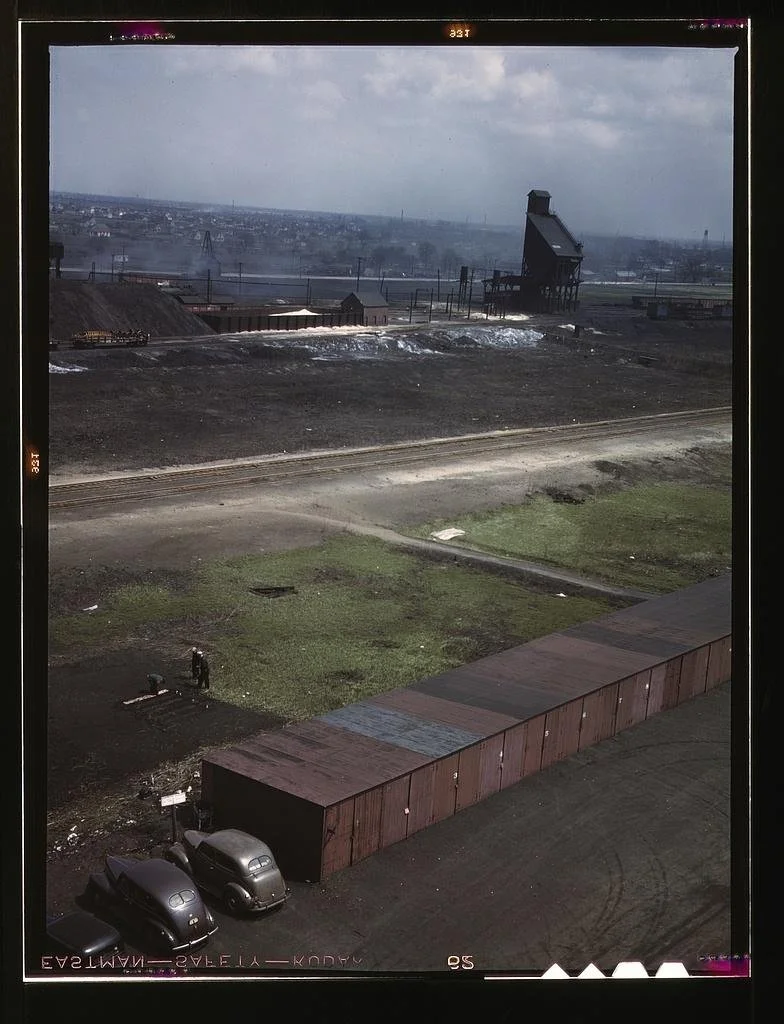
Railroad workers cultivating a small Victory garden at Proviso yard, Chicago area, April 1943. Photograph by Jack Delano. Credit: Library of Congress, Prints & Photographs Division, Farm Security Administration/Office of War Information Color Photographs, LC-DIG-fsac-1a34684. Public domain. Image source
Use a photograph to test a narrower claim
Jack Delano’s April 1943 color photograph shows railroad workers cultivating a small Victory garden at Proviso yard in the Chicago area. The Library of Congress record identifies the photographer, date and location; its title comes from an FSA or OWI agency caption. The wide view includes tracks, industrial structures, parked cars and a small worked plot.
Ask students to compare the poster’s abundant basket with what this photograph actually shows. The photograph and caption support a bounded claim about gardening at this place and time. They do not establish the harvest’s size, the workers’ motives or a nationwide participation rate. Nor do they show that these workers saw this particular poster.
The photograph also came through the Office of War Information. It is not an unselected window onto the entire home front. Have students write one additional source request: a garden log for yield, a participant’s account for stated reasons, or carefully defined statistics for broader participation. Match the requested evidence to the question instead of collecting another attractive image.
Run a twenty-minute caption workshop
Spend four minutes identifying the first poster’s issuer and requested action, five modeling the caption, five comparing the second poster and photograph, and six writing and checking an individual caption. Require four elements: issuer and date, requested action, one explained visual or verbal choice, and a limit on what the source establishes.
Offer a word bank—issuer, audience, command, metaphor, response—and a frame: “The source asks ___ to ___. It uses ___ to connect ___. It does not establish ___.” Let students dictate a caption or annotate an enlarged image before writing. For extension, remove the technique labels and ask whether the explanation still makes sense from the evidence.
Use these non-dehumanizing selections deliberately. Do not require students to invent enemy caricatures, repeat racist slogans or recruit classmates to a war cause. The assessment is an explanation of historical persuasion, not the most persuasive new propaganda. End by having students underline the sentence that prevents their caption from becoming an unsupported claim about public response.
Add retrieval without turning the source task into trivia
HistoraEDU’s separate World War I and World War II digital review games can refresh the home-front vocabulary before the caption workshop. Both listings describe student-access links, teacher instructions and editable Canva materials. The exact posters, photograph and analytical-caption routine here are teacher-added source work, not claimed contents of either game.

World War I Review Game | Social Studies | Interactive Test Prep History Trivia
Use selected home-front mobilization and propaganda questions to establish WWI context, then ask students to explain the Food Administration poster’s request and its evidentiary limits.

World War II Review Game | Social Studies | Interactive Test Prep Trivia
Use selected home-front mobilization and war-production questions before the 1943 garden comparison. Pause the game for individual source analysis rather than scoring how persuasively students reproduce the appeal.
View this HistoraEDU resource on TPT
Sources and credits
National Archives World War I food-conservation poster, NAID 512488
National Archives Victory Garden poster, NAID 513818
Library of Congress Jack Delano photograph and rights statement, 2017878069
National Archives on the two poster collections and their unrestricted reuse
Product covers: HistoraEDU, reproduced from the exact linked TPT listings at the owner’s request. Photographs and archival reproductions are credited beside each image. No claim to original U.S. Government works. Source institutions and depicted people do not endorse HistoraEDU or its products.
