
By HistoraEDU
A class can identify a mound and still misunderstand almost everything about the people who built it. Students may assume all earthworks were tombs, all belonged to one society or all were built at the same time. Give them a more useful task: explain what a particular site allows us to know, and identify the evidence still needed. A small comparison of dated places is more manageable than a long list of cultures to memorize.
Begin with one site and three evidence questions
Show a modern photograph of Mound City Group with its caption and source. Ask what students can observe, what the source tells them and what neither establishes. Grass covered earthworks are visible; the date and significance come from the accompanying historical account. Students should not invent an ancient ceremony from the photograph.
Keep these categories visible during the lesson. An observation is not automatically an explanation. A source can support a claim while leaving other questions open, including who made a particular decision or how a practice varied over time.

Modern view of Mound City Group in Ohio. This is a photograph of the protected landscape today, not an image of its ancient use. Credit: NPS / Tom Engberg. No endorsement implied.
Replace a single timeline box with located comparisons
Use three entries with a place, an approximate period and a source. Separate an Adena example, a Hopewell earthwork and a Mississippian site. Treat the archaeological labels as tools for describing patterns, not as proof of one government or one timeless identity. The National Park Service explicitly explains that Hopewell is not the name of a known tribal nation.
Ask students to write what would be lost by replacing all three entries with “Mound Builders.” A good response identifies a particular difference in date, form or evidence. Avoid requiring a simple progression from primitive to advanced; a later date alone does not establish superiority.
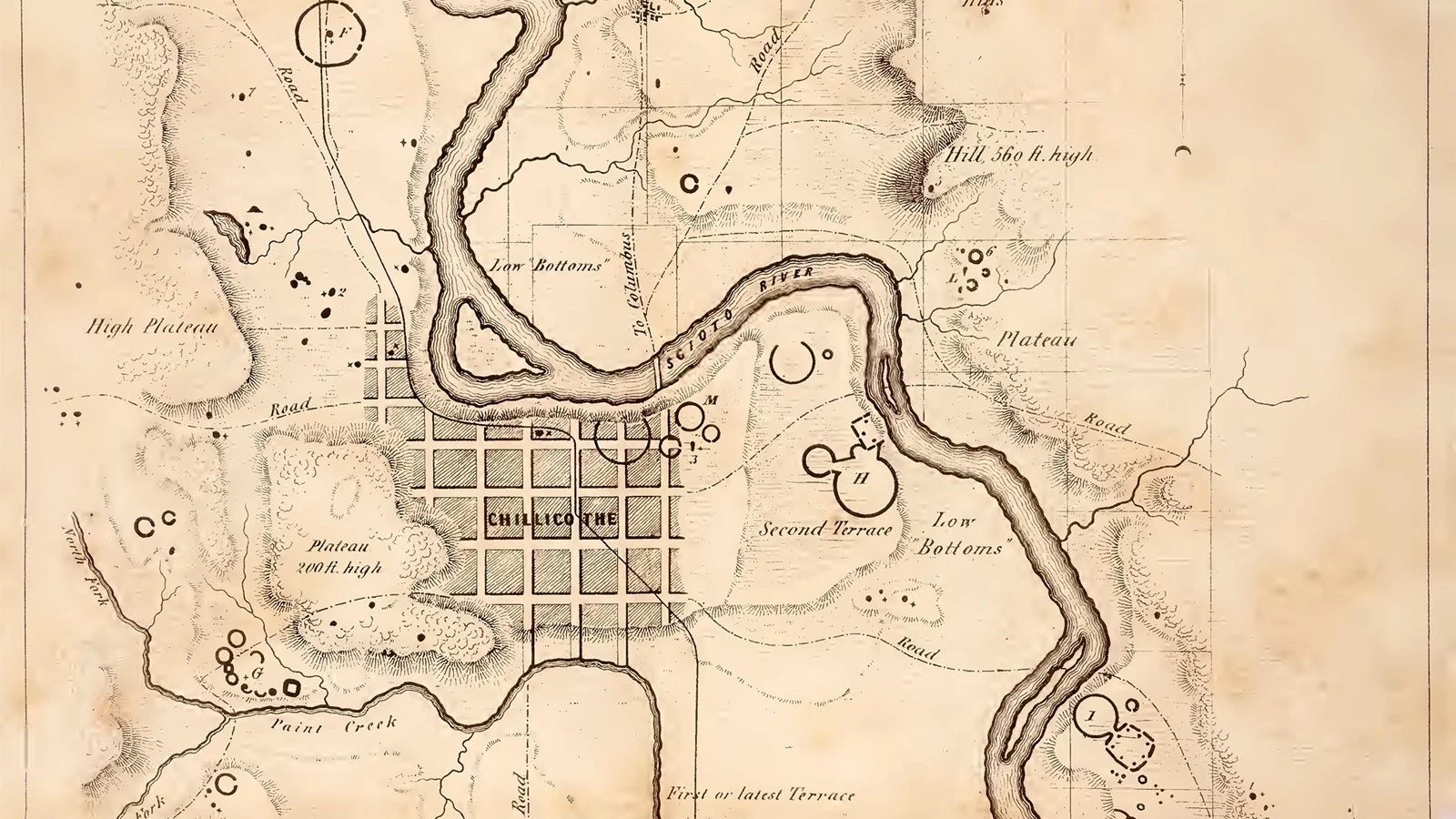
E G Squier’s 1847 map records geometric earthworks. It is a nineteenth century representation of earlier sites, not a map made by their builders. Credit: Lithograph by E G Squier, 1847, via NPS; public domain by age. No endorsement implied.
Read the map as a source with its own history
Students can trace shapes and spatial relationships on the map. They should also ask who recorded them and when. The NPS account explains that early archaeological investigations took place after forced removal had excluded Indigenous communities from their Ohio homelands. That context matters when considering whose knowledge appears in the record.
Use a scale or an official site description to check a size claim. The Great Circle at Newark is approximately 1,200 feet in diameter according to its official site account. Do not substitute the size of the wider complex for the diameter of one enclosure. This is a useful example of why precise nouns matter in historical writing.
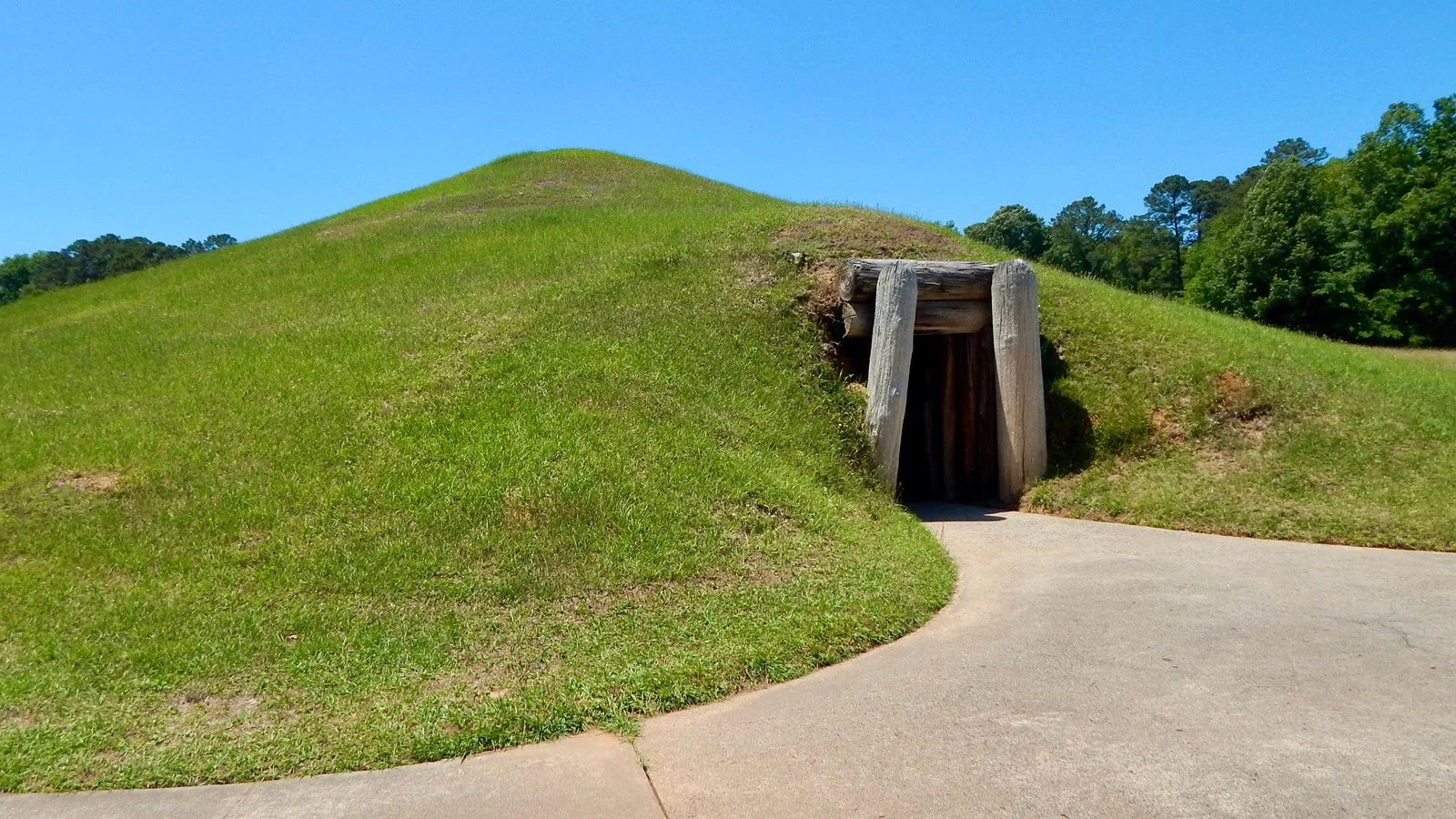
Modern exterior of the reconstructed Earth Lodge at Ocmulgee. The walls and ceiling were reconstructed in the late 1930s; the interior retains an earlier clay floor. The pictured building is a council chamber, not a generic house or burial mound. Credit: NPS/Martinson. No endorsement implied.
Distinguish surviving evidence from reconstruction
The Ocmulgee example makes a productive comparison with Mound City. Its reconstructed council chamber helps students ask about use, materials and interpretation without treating every visible feature as ancient. Have them annotate the caption: which part refers to the modern reconstruction and which part refers to surviving evidence?
Then use Cahokia as a separate case, not a label for all Mississippian communities. The Illinois Department of Natural Resources identifies it as Cahokia Mounds State Historic Site. Students can investigate a bounded question about urban planning or exchange while acknowledging that one center does not describe every community.
Assess a claim rather than a memorized label
For an exit response, offer “All mounds were built for the same purpose by the same people.” Ask students to reject or qualify it using two located examples and one source limitation. Assess the connection between evidence and claim, rather than the number of facts copied.
A useful follow-on task is a caption revision. Give students a vague caption such as “An ancient Native building.” Ask them to name the site, identify the modern photograph or reconstruction and state what the image can support. This is a transferable historical reading skill, not merely an earthworks activity.
Choose the reading that answers the class question
The five readings offer a broad introduction and more focused cultural or site entries. Choose only the passage needed for the class question, and supply the chronology, measurement and site-name clarifications below before assigning it. These selected-use suggestions do not certify every statement or answer in the resources.
Mound Builders Reading Comprehension | Native American History
View this HistoraEDU resource on TPT
Use selected named-site passages for the comparison, with a dated source beside each. Before assigning the opening chronology, explain that 1000 BCE is not a starting date for all North American mound building: NPS dates the creation and use of Poverty Point to about 1700–1100 BCE. Keep that earlier example separate from the later Adena, Hopewell and Mississippian entries; do not copy one start date into every timeline box.
Adena Culture Reading Comprehension | Mound Builders Worksheet
View this HistoraEDU resource on TPT
A focused Adena entry for a dated comparison rather than an all-purpose mound-builder label. Preview the selected passage; this description is not a full worksheet and answer-key certification.
Hopewell Culture Reading Comprehension | Mound Builders Worksheet
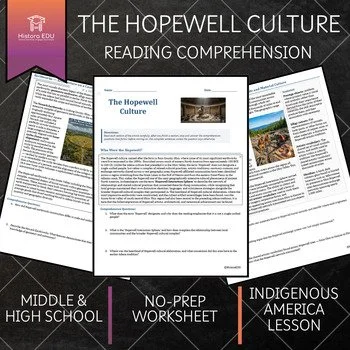
View this HistoraEDU resource on TPT
Use a selected earthwork passage to practice matching a feature to its source. Supply the official site measurement before using the Newark example: the Great Circle is approximately 1,200 feet in diameter, not nearly a mile. Revise any response prompt relying on the larger measurement, and distinguish this enclosure from the entire Newark complex.
Mississippian Culture Reading Comprehension | Mound Builders History
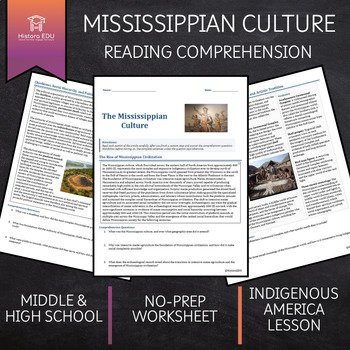
View this HistoraEDU resource on TPT
A Mississippian entry for comparing settlement, agriculture and political organization. Use a specific example and avoid treating a broad archaeological tradition as one uniform state.
Cahokia Reading Comprehension | Mississippian Culture Worksheet
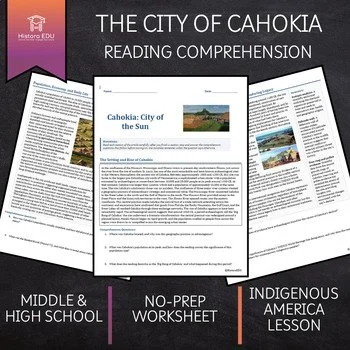
View this HistoraEDU resource on TPT
Use selected descriptions of settlement or earthwork form as a starting point for checking the Illinois site account. Identify the place as Cahokia Mounds State Historic Site, not Cahokia Culture National Historical Park. Use the official account for any numbers included in the comparison, and leave claims about a particular ceremony or meaning unresolved unless a cited source supports them. This one site does not represent every Mississippian community.
Sources and image credits
Hopewell label and historical map context
Newark Great Circle site measurements
Ocmulgee reconstruction and original floor
Illinois official Cahokia site
Image record ocmulgee-earth-lodge
Product thumbnails: HistoraEDU, reproduced from the exact current TPT listings at the owner’s request. Archival sources do not endorse HistoraEDU or its products. No claim to original U.S. Government works.
