
By HistoraEDU
A regional unit can leave students with a list of salmon, cedar and carved poles but no clear sense of whose histories they studied. More facts do not necessarily solve that problem. Give students a comparison that requires them to name the community, identify the source and explain one relationship in context. Chinook and Tlingit histories offer opportunities to practice that precision without treating a regional pattern as a universal rule.
Use a regional overview as an entry point
Locate the lower Columbia River and Southeast Alaska separately. Ask students what distance and location alone cannot tell them about language, government or identity. The regional overview can suggest questions about waterways and resources; it cannot replace a source about a particular people.
Create two source folders or columns with the exact community name, source creator and date. Use a third space for regional observations. Students must decide where a claim belongs rather than copying every statement into both columns.
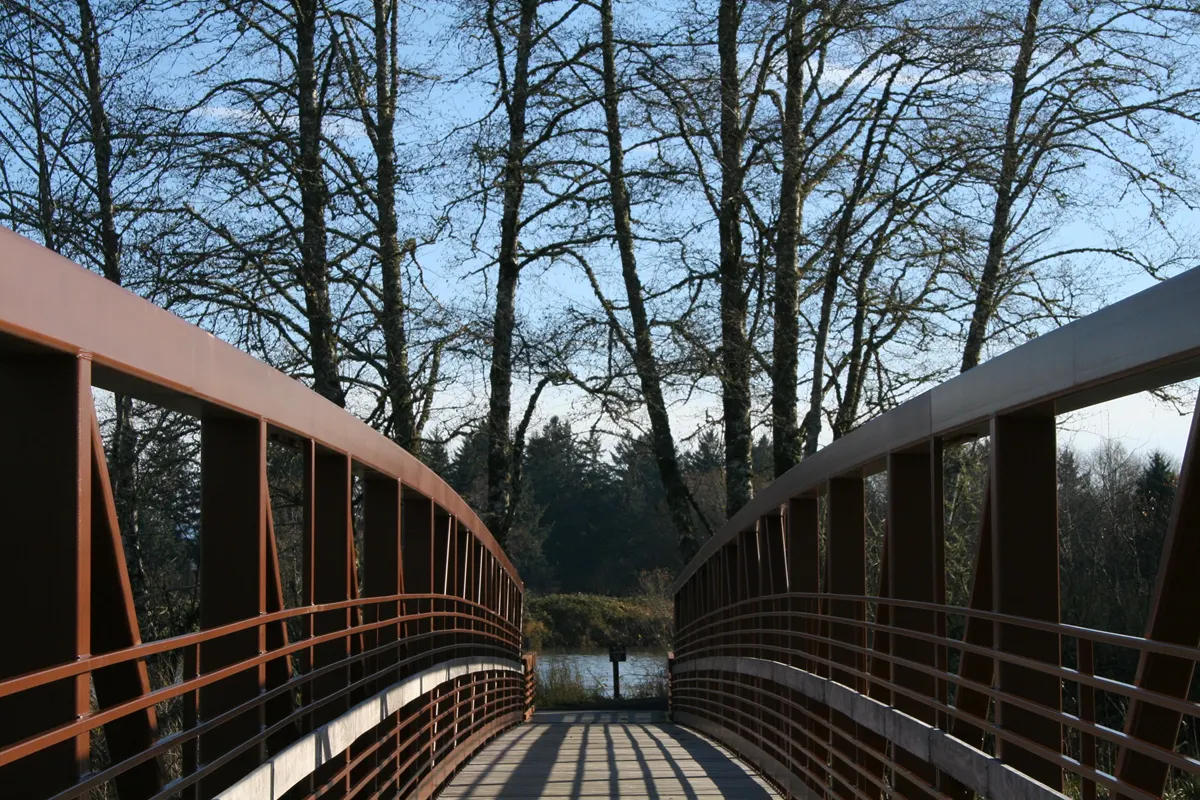
Modern bridge on the Netul River Trail at Lewis and Clark National Historical Park, Oregon. NPS Photo by B. Kasper, public domain. This is a present-day landscape feature, not a historical Chinook structure.
Let community sources establish continuing presence
The Chinook Indian Nation’s Culture Committee describes work to study, teach and revitalize traditions and to respond to questions about Chinook history and language. Ask students what that source shows about who is producing knowledge now. Avoid turning public descriptions of gatherings into instructions to reenact them.
For the Tlingit comparison, use a public source from the Central Council of the Tlingit and Haida Indian Tribes of Alaska. Distinguish the governmental institution from individual clans and communities. Students should be able to explain who is speaking in a source without assuming one organizational page represents every person’s experience.
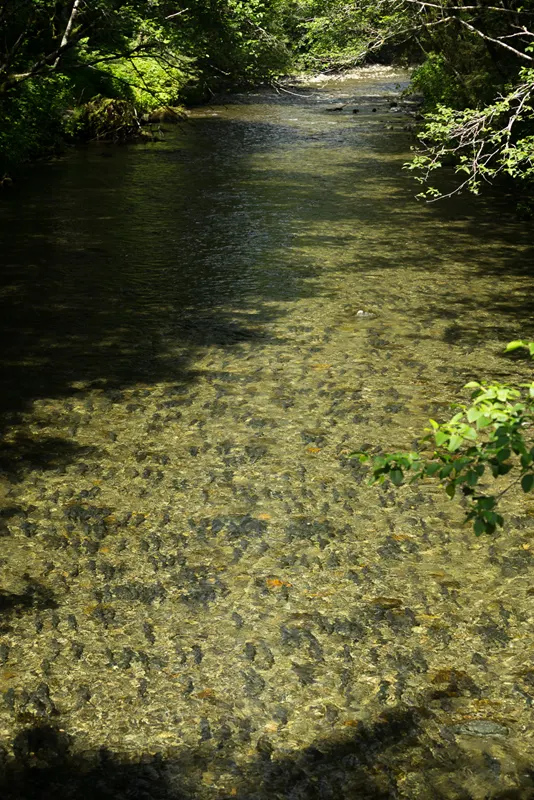
Salmon in the Indian River at Sitka National Historical Park. NPS Photo by Weston Kessler, public domain. The NPS identifies a seasonal run; the photograph does not document a particular community’s fishing rights or methods.
Compare one question rather than every cultural feature
Ask how a waterway can connect places and what additional evidence is needed to explain a community’s relationship with it. A landscape photograph helps students locate a question, but an account of trade, harvesting or governance must supply the historical explanation. Have students underline the exact detail that supports their claim.
Keep a comparison from becoming a ranking. Instead of “Which society was more advanced?” ask “What does each source help us understand, and what would we need to investigate next?” Require a meaningful difference as well as a similarity; both should refer to specific evidence.
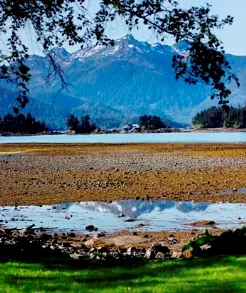
Tidal pools and forested mountains surrounding Sitka National Historical Park. NPS Photo by Katy Kildee, public domain. Modern landscape evidence illustrates one place in Southeast Alaska rather than every Northwest Coast environment.
Respect the ownership of cultural designs
Do not ask students to invent a personal clan crest or copy designs merely because a photograph is online. Sealaska Heritage Institute’s Indigenous Intellectual Properties materials explain why clan-owned intellectual and cultural property requires care. Public visibility is not a blanket invitation to reproduce or reinterpret it.
An appropriate alternative is a source annotation: identify creator, community, stated purpose and any restrictions, then explain what information may responsibly be used in a classroom comparison. Students can learn about cultural ownership without producing imitation cultural objects.
Check whether the explanation still names the people
Ask students to reread their final paragraph and circle every vague phrase such as “they” or “the Native Americans.” Where the reference is unclear, replace it with the specific people or source. This small revision is an assessable habit, not a demand for a longer essay.
The readings below provide a regional entry and two focused accounts. Use selected sections alongside community-authored material, and preview broad regional claims rather than assuming they apply equally to Chinook and Tlingit histories.
Pacific Northwest Native Americans Reading Passage and Questions
View this HistoraEDU resource on TPT
Use the overview to introduce regional questions about environment, trade and colonial disruption, then qualify regional generalizations with nation-specific sources. It should not be the only authority for cultural or artistic practices.
Chinook People Reading Comprehension | Native American History
View this HistoraEDU resource on TPT
A focused lower Columbia River account can support the Chinook side of the comparison. Pair it with current Chinook Indian Nation material so the lesson does not end with historical contact.
Tlingit People Reading Comprehension | Native American History
View this HistoraEDU resource on TPT
Use a selected passage for a Tlingit-specific comparison and keep clan ownership distinct from general regional imagery. The blog does not authorize copying crests or ceremonial designs.
Sources and image credits
Chinook Indian Nation Culture Committee
Central Council Tlingit and Haida questions and answers
Sealaska Heritage Institute Indigenous Intellectual Properties
Product thumbnails: HistoraEDU, reproduced from the exact current TPT listings at the owner’s request. Archival sources do not endorse HistoraEDU or its products. No claim to original U.S. Government works.
