
By HistoraEDU
A student uses Algonquian, Haudenosaunee and Eastern Woodlands as if they were three names for the same kind of group. The vocabulary may be familiar while the categories remain confused. Teach the distinction through a political question: who could make a particular decision, and at what level? A few carefully bounded sources can do more than a large chart of supposedly interchangeable cultures.
Sort the kind of label before memorizing it
Write region, language family, nation and confederacy on the board. Explain that these labels answer different questions. A shared language-family relationship does not establish one government; a regional grouping does not erase distinct nations. Ask students which question each label helps them answer.
Use examples only after introducing the categories. Algonquian is a language-family label, while the Haudenosaunee Confederacy is a political alliance of nations. Keep the individual nation names visible. Do not imply that every Algonquian-speaking community shared the same institutions.
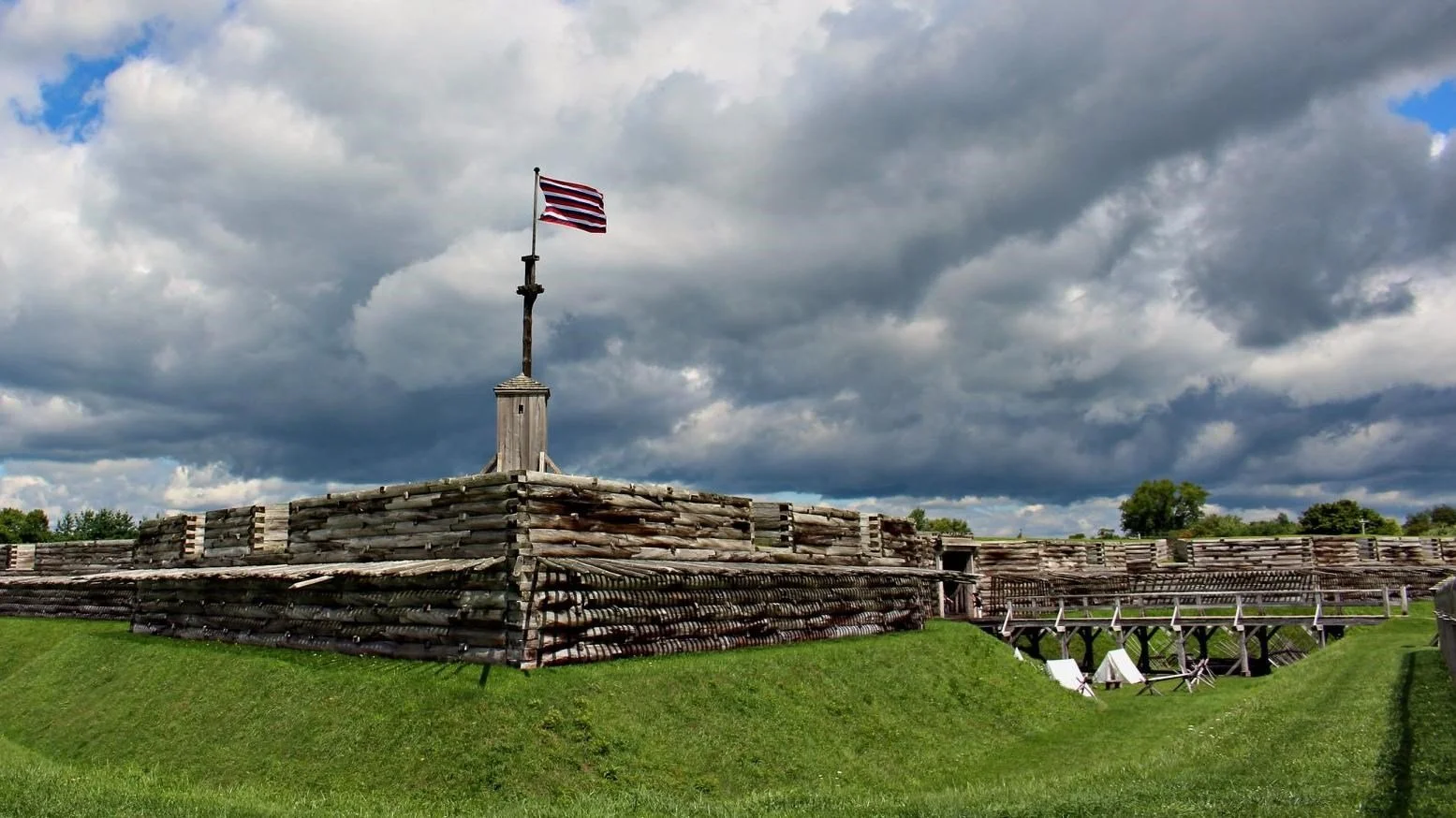
Modern reconstruction of Fort Stanwix, opened in 1976, at the Oneida Carry. Not an Indigenous dwelling or an eighteenth-century photograph. Credit: National Park Service / M. Colangelo. Public domain; no endorsement implied.
Keep the landscape of diplomacy specific
Locate the Oneida Carry and explain why a connection between waterways mattered to travel and competing powers. The photograph shows the modern Fort Stanwix reconstruction, opened in 1976. It is neither an Indigenous home nor direct visual evidence of an eighteenth-century meeting.
Ask students to write two questions: one about the location that the photograph helps them investigate, and one about political authority that requires another source. This prevents a fort image from silently replacing the people and governments whose homeland surrounded it.
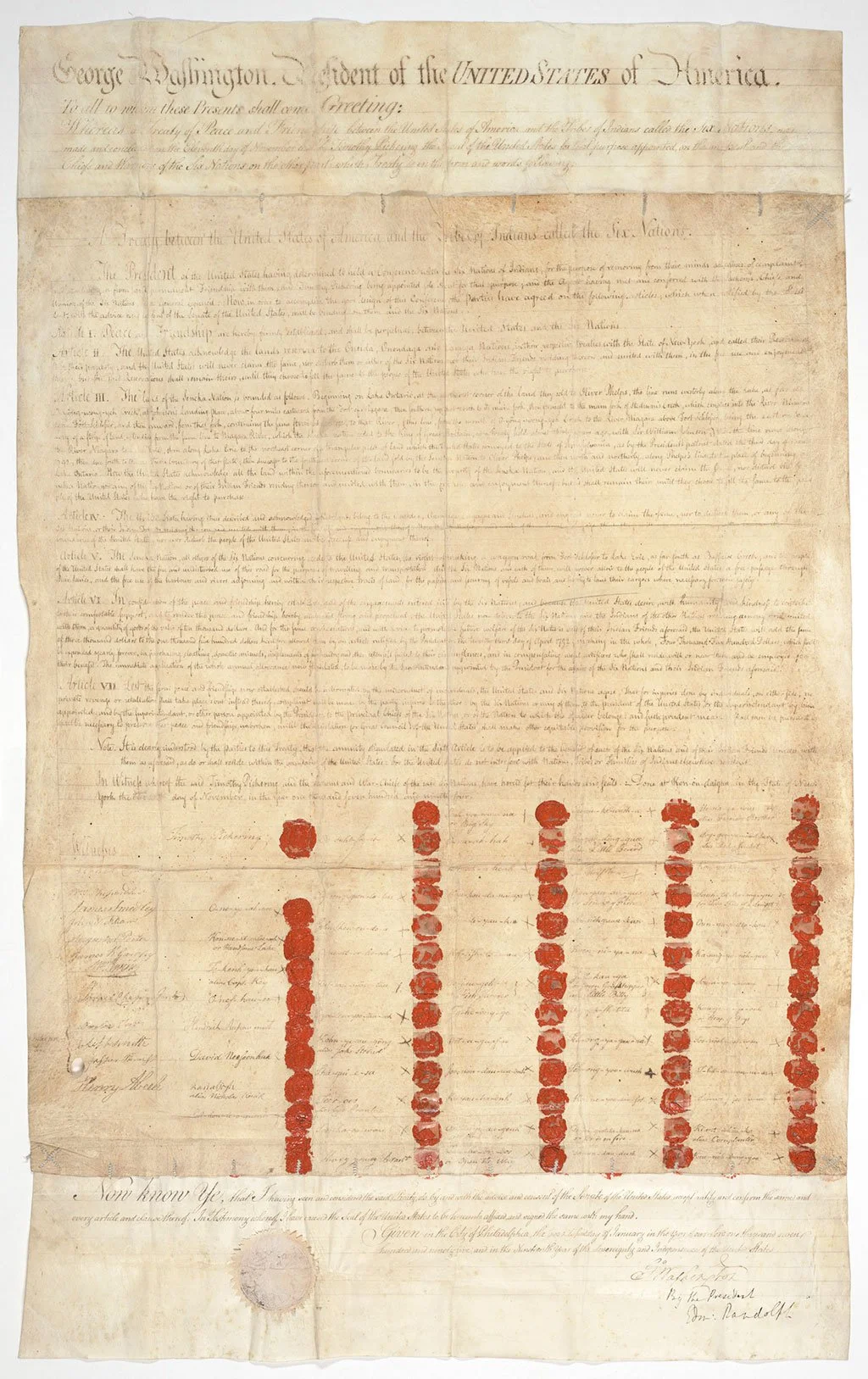
Scan of the 1794 treaty with the Six Nations at Konondaigua (Canandaigua); documentary evidence of diplomacy, not a photograph of negotiations. Credit: National Archives, General Records of the U.S. Government. Public domain; no endorsement implied.
Read a treaty for parties and responsibilities
Introduce the 1794 treaty with the Six Nations at Canandaigua as a specific diplomatic document. Students first record its date, named parties and purpose. Then they select one short provision and identify the actor and commitment rather than paraphrasing the whole page.
Pair the document with the Confederacy’s own explanation of government. Its public account distinguishes each nation’s internal council from the Grand Council’s collective role. Ask students which level of authority their question concerns. Do not pretend the treaty alone explains the entire system or every nation’s experience.
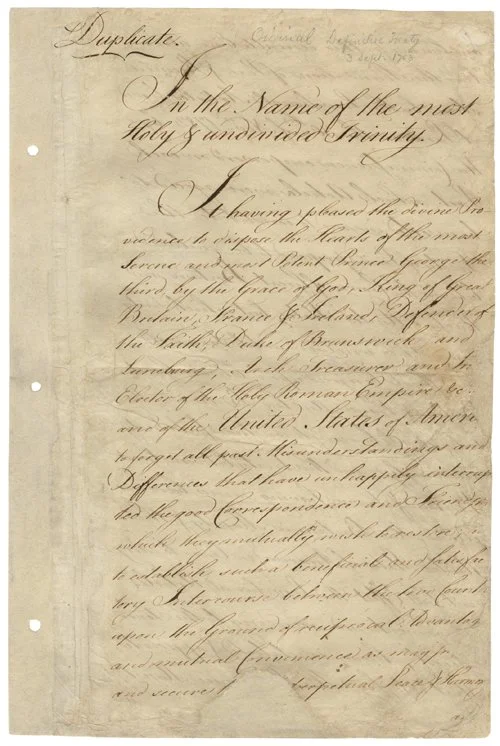
Scan of the 1783 Treaty of Paris. Use its date and named parties to distinguish it from later treaties with Indigenous nations. Credit: National Archives, Record Group 11. Public domain; no endorsement implied.
Compare documents without merging their events
The Treaty of Paris was signed in 1783 by representatives of Great Britain and the United States. It is a different document from the 1794 treaty with the Six Nations. Put the dates and named parties side by side before discussing consequences. A familiar treaty name should not become a shortcut that hides whose voices appear.
Have students identify a question the Paris text cannot answer by itself: how did a particular Haudenosaunee community understand or respond to its consequences? That requires another source. Comparing documents means attending to their limits, not assuming that a boundary on paper settled every claim.
Assess the level of authority in an explanation
Give students a claim that confuses language and government: “All people who spoke related languages had one council.” Ask them to explain what evidence would be needed to support it and why the category alone is insufficient. They should use one specific counterexample or source-based distinction.
A useful extension is to examine how a contemporary nation or confederacy explains its own institutions. Use its current public account rather than asking students to invent ceremonies or role-play sacred offices. The aim is to understand evidence about governance, not imitate it.
Choose a reading and supply its teaching qualifications
The four resources provide regional, linguistic and political entries. They should not become four versions of the same worksheet assignment. Select the reading that matches the misconception, and use it teacher-led with the precise vocabulary, date and grouping qualifications below. These additions support the selected lesson; they do not certify every claim in the full readings.
Eastern Woodlands Native Americans Reading Comprehension Worksheet
View this HistoraEDU resource on TPT
Use a selected regional passage to distinguish a language family from a political alliance. Supply a complete teacher note in place of the unfinished Matrilineal entry: matrilineal means tracing descent through the mother’s line. In the Onondaga Nation’s own account, children belong to their mother’s clan; its Clan Mothers account separately explains their role in choosing and, after warnings, removing a representative. Do not treat clan descent and every political office as the same kind of inheritance, or generalize this account to all Eastern Woodlands peoples.
Algonquian Peoples Reading Comprehension | Eastern Woodlands History
View this HistoraEDU resource on TPT
Language-family entry useful for distinguishing related languages from a single shared government. Assign a focused passage, not a universal cultural template. Full question/key accuracy remains untested.
Haudenosaunee Confederacy Reading Comprehension Worksheet
View this HistoraEDU resource on TPT
Use a selected passage alongside the Confederacy’s own government account to distinguish a nation’s council from the Grand Council. Before using the Treaty of Paris passage or vocabulary, supply the correct event dates: the treaty was signed on September 3, 1783; the United States Congress ratified it on January 14, 1784. Label signing and ratification separately in any timeline or answer. These are different events, and neither should be merged with the 1794 Canandaigua treaty.
Native American Government Reading Comprehension Worksheet
View this HistoraEDU resource on TPT
Use selected governance examples as claims to compare with the named nation’s public account, not as a universal model of Native government. For the Plains example, clarify that Oceti Sakowin is the broader Seven Council Fires alliance, not simply another name for the seven Lakota bands. The Smithsonian’s nation-specific account provides the wider grouping. Keep that correction beside the reading if the confederacies paragraph is used, and evaluate each other example within its own historical setting.
Sources and image credits
Haudenosaunee Confederacy account of government
National Archives treaty catalog
Treaty of Paris primary document
Native Knowledge 360 essential understandings
Image record canandaigua-treaty
Product thumbnails: HistoraEDU, reproduced from the exact current TPT listings at the owner’s request. Archival sources do not endorse HistoraEDU or its products. No claim to original U.S. Government works.
