
By HistoraEDU
A student can memorize three names and still write that Tenochtitlan was a people or that every community under imperial rule had the same identity. Before assigning a longer account of the Aztec Empire, give the class a short naming lesson. Students will revise three deliberately mistaken sentences, explain what each name refers to in their source and check whether an image supports that scale of claim. The useful outcome is clearer historical writing, not a contest to replace every occurrence of one word.
Give each term a job within this lesson
Begin with a working guide rather than three supposedly timeless dictionary definitions. Tenochtitlan names a city. Mexica identifies the people associated with that city in the sources used here. Aztec appears as a broader historical label in museum writing and in the familiar phrase Aztec Empire. Ask students to check the particular author’s usage instead of treating every use as identical.
The Met’s Macuilcoatl record uses Mexica for people in the imperial capital, while its city essay calls Tenochtitlan the Aztec capital. The Guggenheim exhibition account describes the empire’s origins in a coalition involving Tenochtitlan, Texcoco and Tlacopan. These sources let the class distinguish a city, a named people and wider political relationships without claiming that all terminology is uncontested.
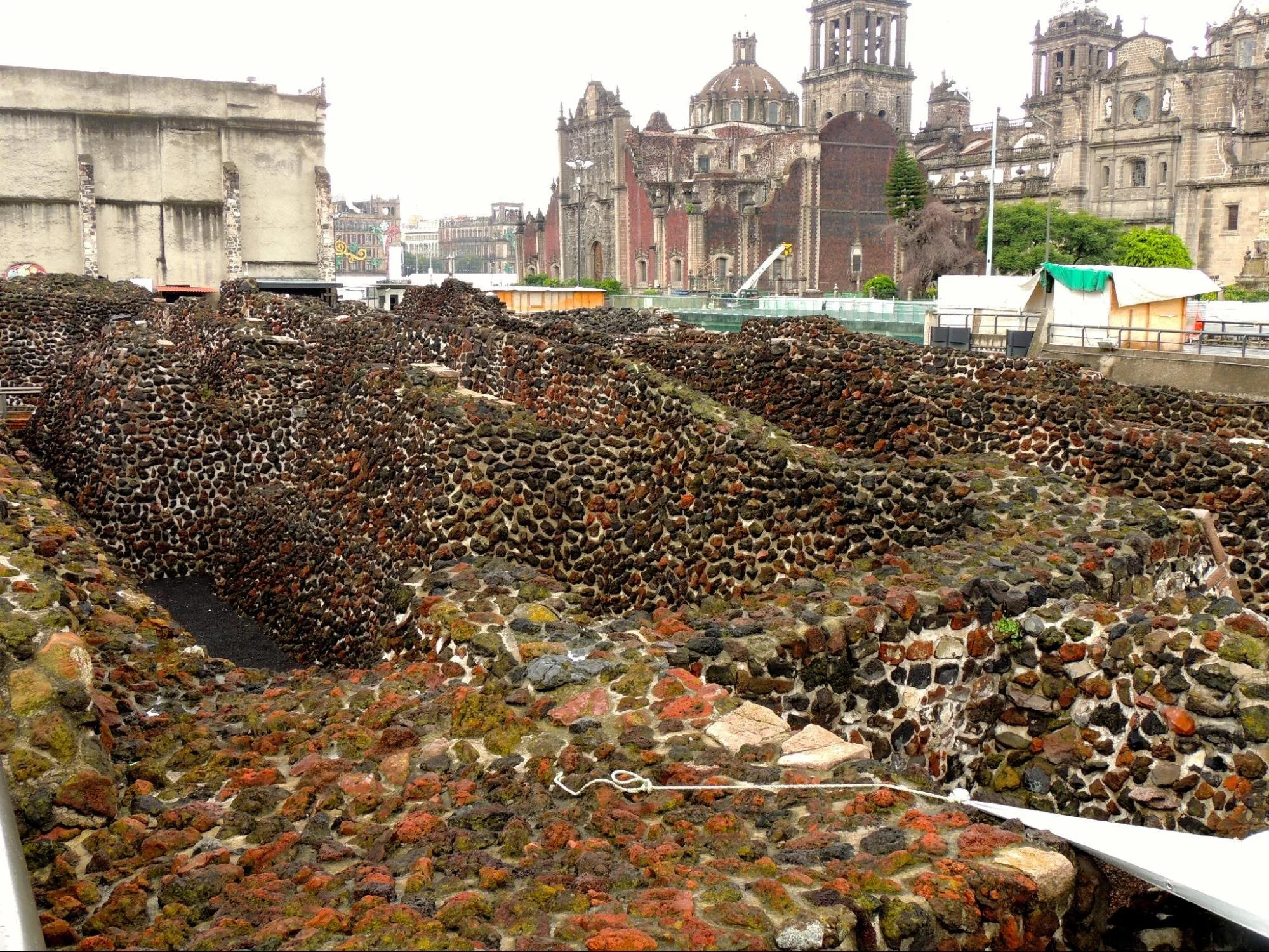
Templo Mayor archaeological remains in Mexico City, photographed by Öskr Rck on September 22, 2013. This is a modern site photograph, not a view of the city in 1519. CC BY-SA 3.0, unchanged; no endorsement implied.
Revise a city name being used for a people
Original practice sentence one: “The Tenochtitlan were a people who built the Mexica.” Ask students to underline both names and write the category intended for each. The problem is not spelling. The sentence has exchanged a place and a people.
A workable revision is: “The Mexica established Tenochtitlan as their city.” Students should connect the revision to the source rather than infer it from the photograph alone. The modern remains show a place that can be investigated; they do not independently establish who built every structure or when.
Use the Met’s Templo Mayor essay to locate the temple within the city’s central sacred precinct. A temple is not the whole city, and the city is not the whole empire. Have students say those relationships aloud before they write a new sentence.
Replace an identity claim with a political relationship
Original practice sentence two: “Every community in the Aztec Empire was Mexica.” The word every turns a broad political label into a claim about the identity of all its inhabitants. Ask which part of the sentence would require evidence that the reading does not supply.
A stronger revision is: “The Aztec Empire involved Tenochtitlan and other communities linked by alliance, conquest and tribute; they should not all be called Mexica.” For a more specific answer, students can name Texcoco and Tlacopan as partners in the Triple Alliance using the Guggenheim account. Explain that partnership and subjection are different relationships; do not draw an alliance arrow and a tribute arrow as though they mean the same thing.
The class need not resolve every historical label today. It does need to stop using membership in a political system as proof that people shared one identity. Keep the named partners visible when later readings focus mainly on the capital.
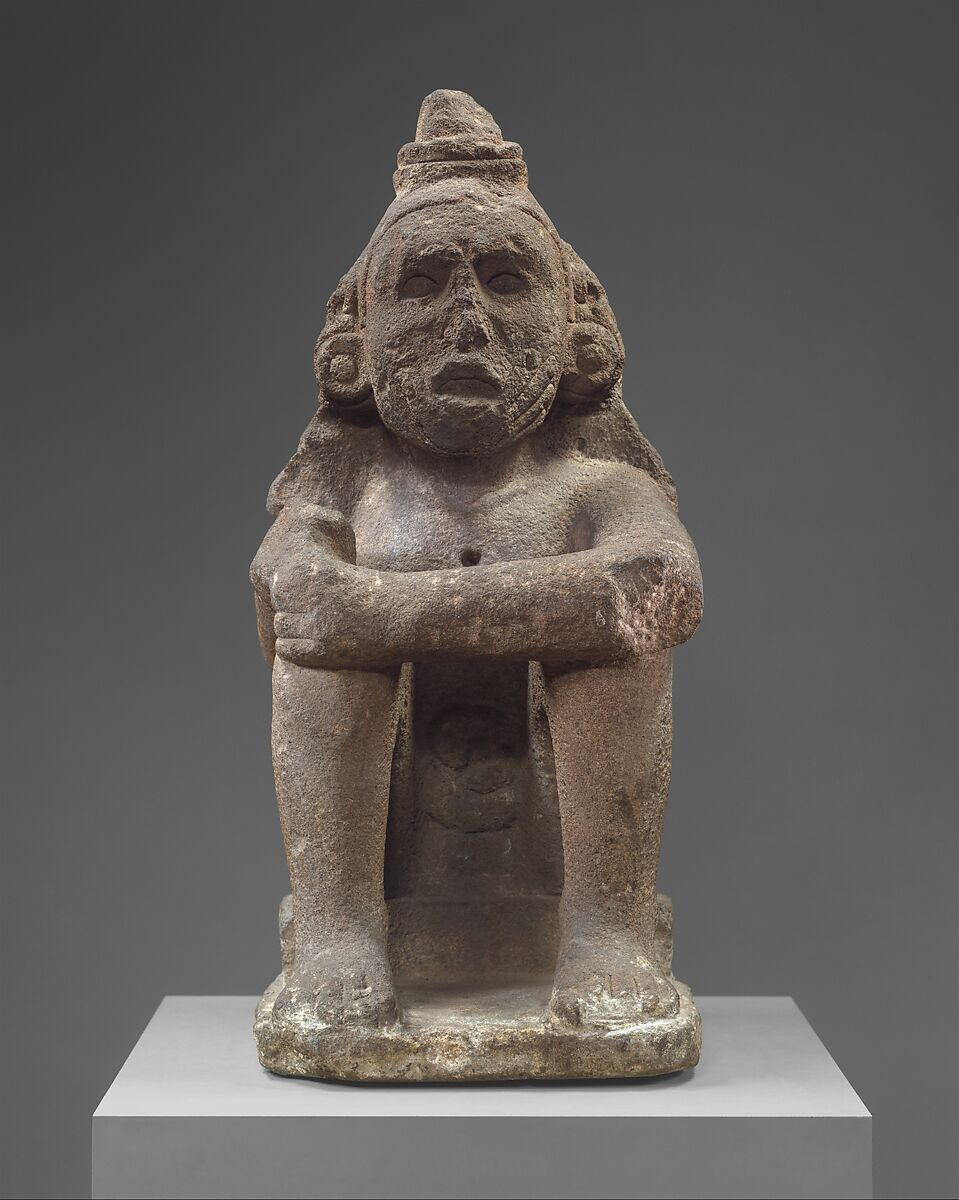
Macuilcoatl, 1450–1521 CE, attributed by The Metropolitan Museum of Art to Mexica artists. The museum interprets this deity figure as a standard bearer, not a portrait of a named resident. Museum Purchase, 1900, 00.5.8. Public-domain photograph; no endorsement implied.
Use an object label without making it speak for everyone
Read the maker or culture field of the Macuilcoatl record beside the photograph. Ask students to write one accurate sentence attributing the museum’s identification. “The Met identifies this sculpture as Mexica” is different from “Everyone in the empire made this kind of sculpture.” The first reports a particular catalog attribution; the second needs much wider evidence.
Let students notice the seated posture and carved hand motif, then separate those observations from the museum’s interpretation of the figure. Do not ask them to assign an ethnic identity from appearance alone. A carefully credited object can make the naming lesson concrete without becoming a universal image of a population.
Read a historical map as a representation with a viewpoint
Original practice sentence three: “The Aztec was a city shown exactly as it looked in this 1524 map.” Revise it to: “This 1524 printed map represents Tenochtitlan and its surroundings through a particular historical viewpoint.” The change fixes the place name and removes an unsupported claim of photographic accuracy.
The map was printed in Nuremberg in association with Cortés’s account. UNAM’s discussion explains the European visual conventions and the possible Indigenous contribution to its graphic organization. The image is therefore evidence of representation as well as a source about place. Its publication date is not automatically the date of every feature it depicts.
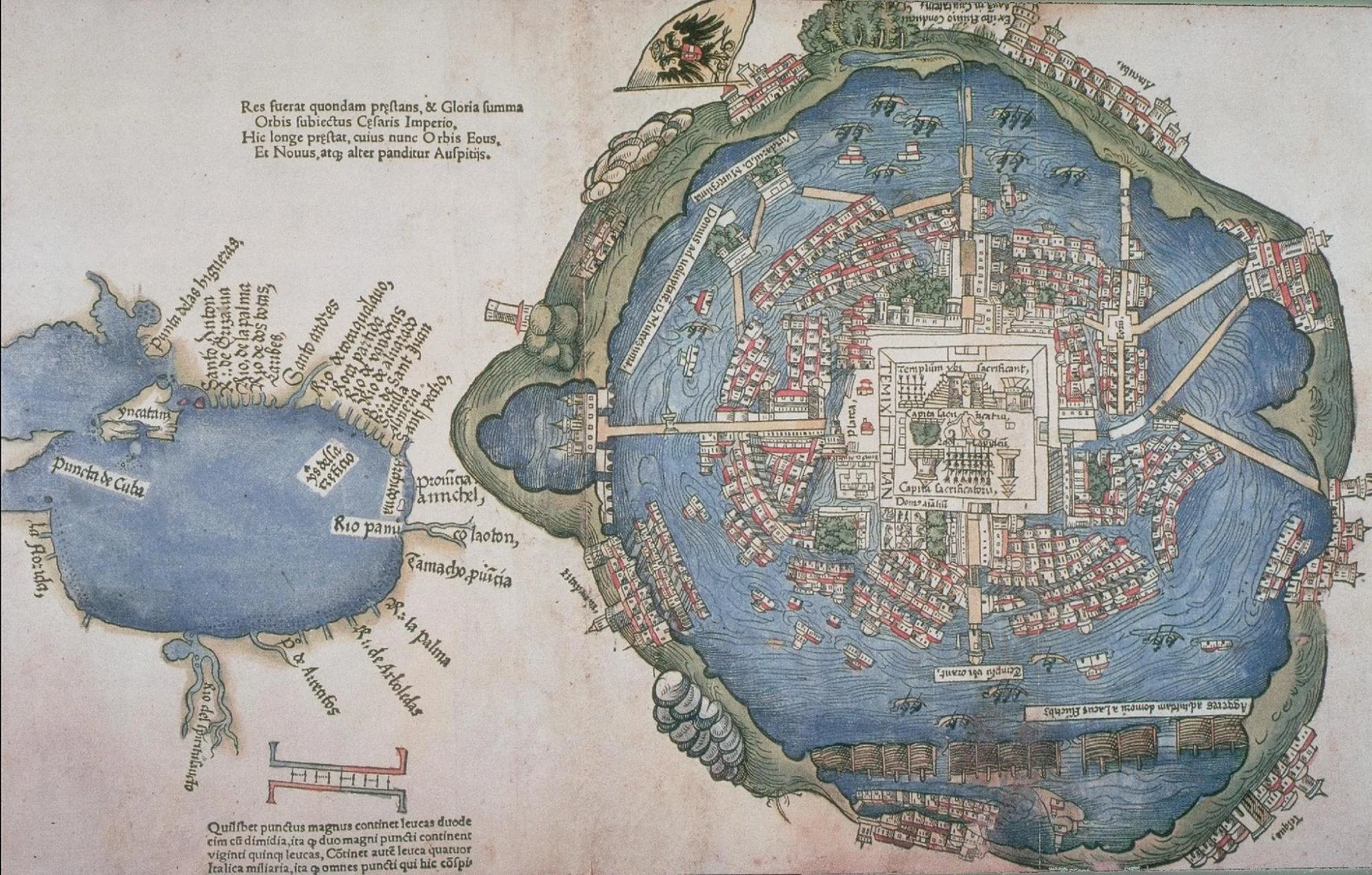
Map of Tenochtitlan and the Gulf of Mexico, printed in Nuremberg in 1524 by Friedrich Peypus; the underlying drawing’s authorship is not established here. Public-domain reproduction of a historical colorized woodcut, via Wikimedia Commons, identifying the original at the Newberry Library. Not a modern reconstruction or a neutral aerial survey.
Build a naming guide that acknowledges the map limits
On a separate sheet, have students identify the represented capital and nearby lake settlements, using the supplied source commentary to check names rather than guessing from tiny print. Add a note naming Texcoco and Tlacopan as alliance partners. Label that note “political relationship from the written source,” not “an imperial boundary visible on this map.”
Finish with three short lines: the place being discussed, the people named by the source, and the wider relationship being described. Underneath, add the map’s publication date and one caution about its viewpoint. Do not use the lake outline as an empire border or ask students to locate a whole people at a single dot.
For support, give students the three categories and let them explain a revision orally before writing. For the exit response, ask for one corrected sentence and the evidence that made the correction necessary. A student who can explain why city, people and empire are not interchangeable is better prepared for the longer reading.
Choose the reading that matches the next question
The two resources below offer different scales of background. Use the broader reading for political relationships and the city reading for place-specific context. The naming guide and three deliberately mistaken practice sentences are additions in this article, not advertised included worksheets.
Aztec Empire Reading Comprehension | Ancient Civilizations Worksheet
View this HistoraEDU resource on TPT
The listing describes an editable Google Doc with reading and comprehension questions on Mexica origins, the Triple Alliance and imperial relationships. Use a selected introductory or political-context passage with the naming guide. For a conquest lesson, supply a separate verified account rather than relying on the current section headed conquest, which repeats preceding religious material.
Tenochtitlan Reading Comprehension | Aztec Empire Worksheet
View this HistoraEDU resource on TPT
The listing describes an editable Google Doc and comprehension questions about the city’s setting, urban planning and social organization. Use a city-focused passage to check place names and locate the Templo Mayor in context. The short naming routine here comes before a detailed infrastructure inquiry; it does not require population rankings or a claim that every resident had the same experience.
Sources and image credits
Met Templo Mayor within the city
Guggenheim exhibition account of the Triple Alliance
UNAM discussion of the 1524 map and its viewpoint
Templo Mayor photograph license CC BY SA 3.0
Product thumbnail reproduced from the exact HistoraEDU listing at the owner’s request. Historical photographs are separate evidence, not product endorsements. Actual HistoraEDU product thumbnails are reproduced at the owner’s request. Öskr Rck’s site photograph is reproduced unchanged under CC BY-SA 3.0 with attribution and a license link; adaptations of that photograph must retain the applicable share-alike terms. The museum photograph and historical map reproduction are public domain. The map is not copied from UNAM’s modern article photographs. None of these creators or institutions endorses the products.


