
By HistoraEDU
Students often bring a sensible classroom rule into a history lesson: a compromise means each side gives something up and everyone gets a fairer result. That rule can hide the people excluded from a political bargain. Instead of asking whether the Compromise of 1850 was a good deal for the North or South, examine one provision and identify who gained power, who faced a new burden and whose voice the process excluded. Students can evaluate consequences without role-playing enslavers or debating whether slavery was acceptable.
Start with the people affected
Draw a four-column table headed provision, affected people, power or burden, and evidence. Leave room for more than one group in a row. “The North” and “the South” are too broad to show what happened to a person accused of escaping enslavement, a claimant seeking that person’s return or someone assisting a freedom seeker.
Tell students that the table is not a scorecard balancing human freedom against an enslaver’s financial interest. It is a tool for explaining how a law distributed power. A settlement between legislators does not establish the consent of everyone whose life it affected.
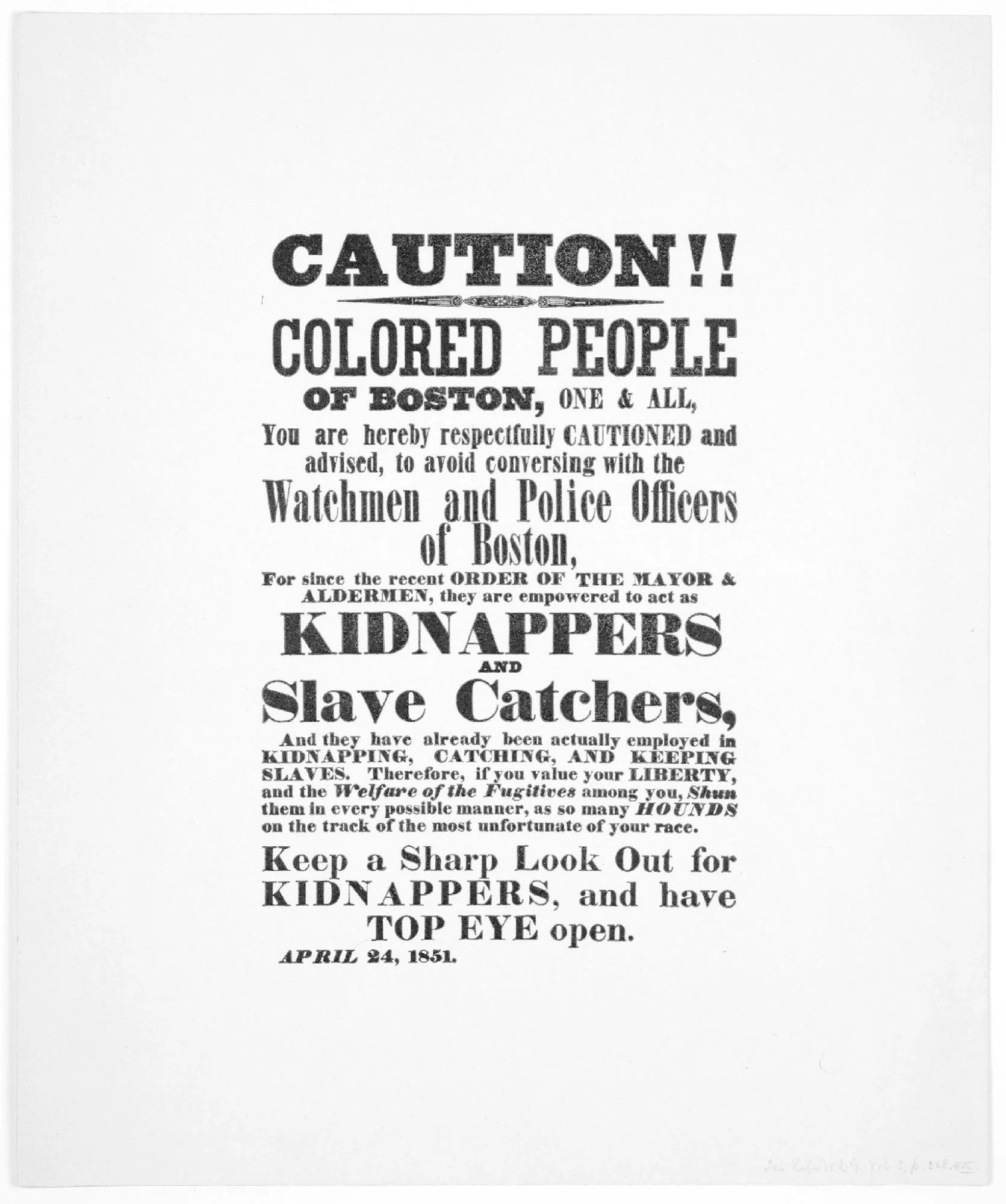
Boston warning broadside dated April 24, 1851. Its historical heading uses language for Black people that is not the article’s preferred present-day terminology. The printed warning is evidence of a public message, not a count of arrests or proof that every reader responded alike. Library of Congress, Rare Book and Special Collections Division, Printed Ephemera Collection, Portfolio 60, Folder 22. Public domain historical print.
Work through one provision carefully
Use section 6 of the enacted Fugitive Slave Act of September 18, 1850, transcribed by the National Archives. It barred the testimony of the person alleged to be a fugitive in hearings under that act. Ask students to identify whose testimony was excluded before they discuss how the provision affected the process. The person’s allegation-based legal label must not be treated as proof that the claim was true.
Model two rows. For the person accused of escape, record exclusion of their testimony as a burden. For the claimant, record a procedure for seeking removal that denied the opposing person that opportunity to testify. Both rows should point to section 6 rather than an invented account of someone’s thoughts.
Then examine section 7 for the penalties imposed on people who knowingly obstructed capture or aided escape. Students can distinguish the people directly targeted from those whose assistance was criminalized. Keep the excerpt short enough to read closely, and explain unfamiliar legal vocabulary before asking for an inference.
Let a public warning complicate the table
Return to the Boston broadside. Ask students whom it addresses, what behavior it urges and what danger it describes. Its audience includes Black residents generally, not only a named person accused in a particular proceeding. That choice helps students see why legal categories and lived vulnerability cannot be reduced to two congressional negotiating teams.
Treat the broadside’s allegations as the message of this source. Students should not infer a numerical arrest rate or the conduct of every officer from it. A useful follow-up question is what court records, personal accounts or local records would allow them to investigate a specific event. Keep the activity an analysis of documents, not a simulation of capture or escape.
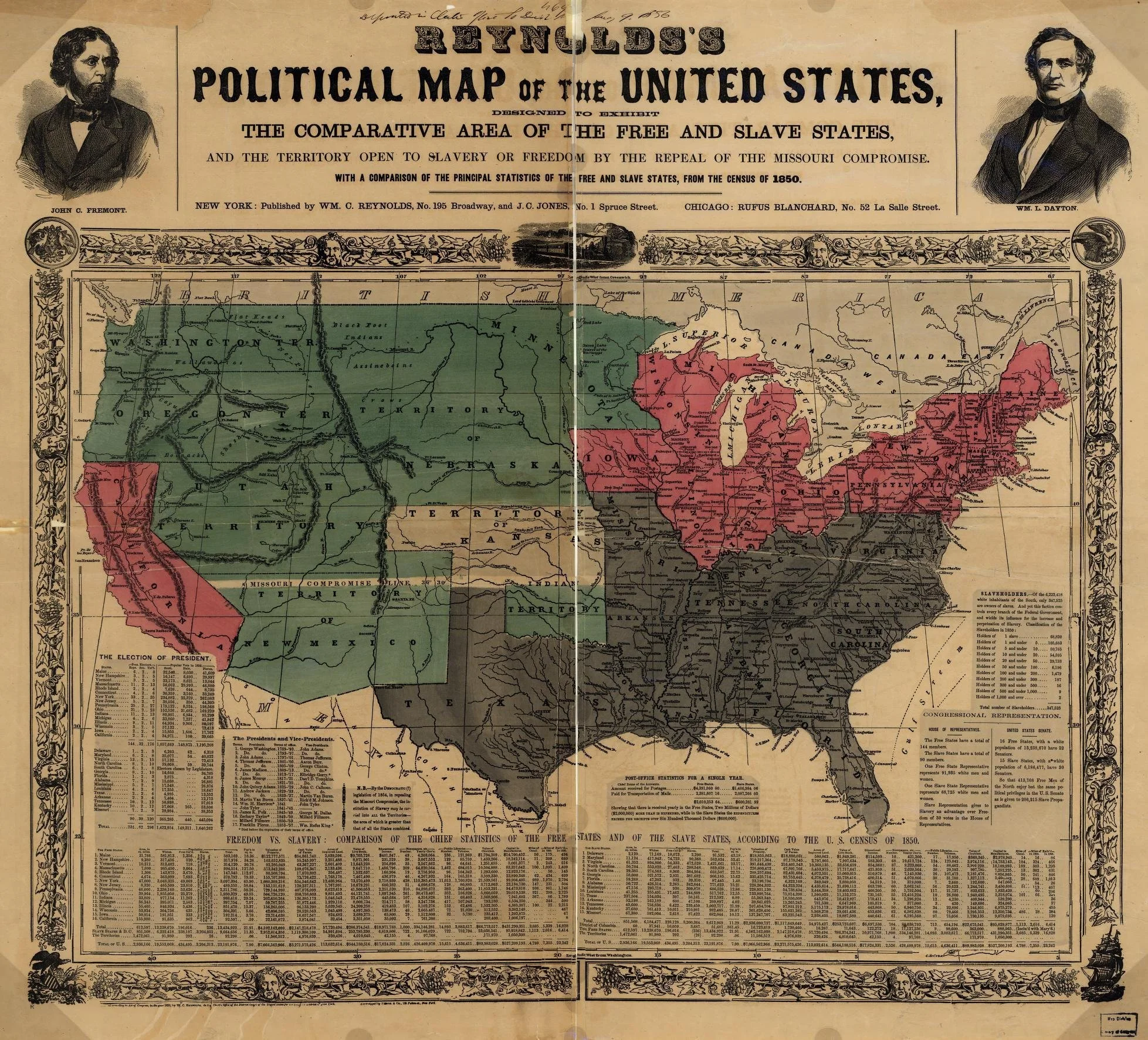
Reynolds’s political map, published by William C. Reynolds and J. C. Jones in 1856, with statistics from the 1850 census. It is not a map made in 1850. Library of Congress, Geography and Map Division, G3701.E9 1856 .R4; free to use and reuse under the item’s rights statement. Consult the linked enlarged image for small labels.
Compare a boundary rule with an excluded voice
Use the Missouri Compromise as a shorter comparison. Its restriction applied north of 36 degrees 30 minutes in the specified Louisiana territory, with Missouri excepted. Ask students which question this rule addressed and which people remained subject to enslavement. A geographical limit on expansion is not the same as universal freedom or equal participation in government.
The 1856 Reynolds map provides a dated representation to investigate, not a timeless picture of two unanimous regions. Have students read its title and date before using the colors. Ask what its categories reveal about territorial conflict and what they cannot show about individual beliefs, resistance or legal vulnerability. Do not let a color stand for every resident’s consent.
Ask who counted in popular sovereignty
The Kansas Nebraska Act of 1854 repealed the earlier Missouri restriction and made slavery in the new territories a contested political question. Its initial voter qualifications specified free white male inhabitants aged twenty-one or older, with further citizenship or declaration requirements. Ask students to identify people affected by slavery who did not have an equal vote in that process.
This makes a useful revision task. Replace “everyone decided for themselves” with a sentence that identifies the permitted electorate and the people excluded. The later violence known as Bleeding Kansas should not be presented as evidence that a fair, inclusive bargain had simply failed to please everyone.
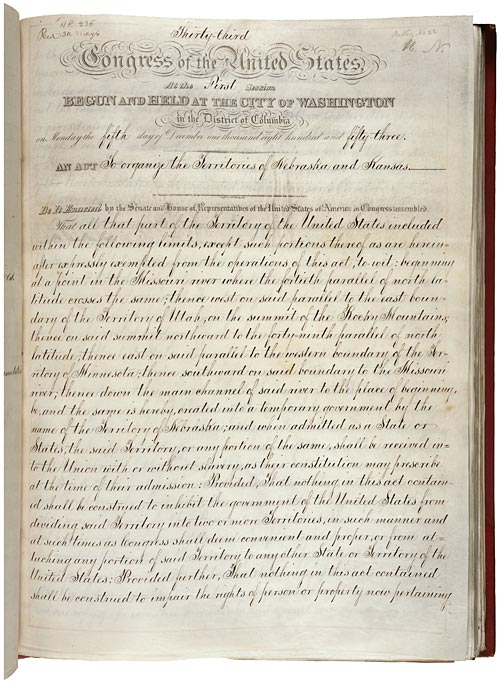
First page of the Kansas Nebraska Act, 1854. It is a different law from the Fugitive Slave Act of 1850. Read the linked transcript for its specific territorial and voter provisions. National Archives, General Records of the United States Government, Record Group 11; public domain federal historical document.
Keep the tariff comparison in its own context
If the Nullification Crisis is already in the unit, use it to practice naming the subject of a claimed power: the immediate dispute concerned tariffs and federal authority. Do not replace the slavery question in the later laws with an unexplained phrase about states’ rights. Students should name the policy, the authority being claimed and the people affected in each case.
End with a brief evidence-based judgment: “This measure settled ___ for ___, while imposing ___ on ___.” Require one specific provision and a source reference. The response need not summarize every law. It should demonstrate that political agreement and fairness to affected people are separate questions.
Choose only the background reading students need
The table and worked example above are teacher-created extensions. The following listings describe non-editable PDF reading-and-question resources. Choose a focused reading rather than assigning all six automatically, and keep the original statutes available for checking scope and wording.
Expansion of Slavery Reading Comprehension Worksheet Causes of the Civil War
View this HistoraEDU resource on TPT
Use the expansion-of-slavery reading to establish the territorial issue before students identify who was affected. The article’s affected-people table is supplied here as a separate teaching routine.
Missouri Compromise Reading Comprehension Worksheet Sectionalism
View this HistoraEDU resource on TPT
Use the Missouri reading for event context, then check the exact geographical restriction and Missouri exception against the primary text. A line drawn across the entire country would misstate that scope.
Compromise of 1850 Reading Comprehension Worksheet Sectionalism
IMAGE i
View this HistoraEDU resource on TPT
Use the 1850 reading to orient students to the package of measures. For the worked example, provide the enacted Fugitive Slave Act section separately and distinguish it from Clay’s earlier proposals.
Kansas Nebraska Act Reading Comprehension Worksheet Popular Sovereignty Civil
View this HistoraEDU resource on TPT
Use selected sections to introduce the new territorial policy. Keep the earlier Missouri restriction tied to the specified Louisiana territory, with Missouri excepted, rather than a rule governing the entire country. Pair the reading with the actual voter qualifications.
The Bleeding Kansas Reading Comprehension Worksheet
View this HistoraEDU resource on TPT
Use this reading after the statute comparison to introduce conflict in Kansas. Ask students to distinguish a description of violence from evidence that all affected people had equal political power.
Nullification Crisis Reading Comprehension Worksheet States Rights
View this HistoraEDU resource on TPT
Use the tariff crisis reading only as a clearly labeled comparison of federal and state authority. It is not a substitute for explaining slavery in the other five readings.
Sources and image credits
Missouri Compromise primary text
Clay proposal and enacted 1850 statutes
Kansas Nebraska Act primary text
Boston warning broadside item and rights record
Reynolds 1856 political map item and rights record
South Carolina Ordinance of Nullification primary text
Product thumbnail reproduced from the exact HistoraEDU listing at the owner’s request. Historical photographs are separate evidence, not product endorsements. The archival visuals are authentic document and map reproductions, not photographs of the events described or generated scenes. They are used as evidence with their dates and credits.
