
Save the reason for a lesson change alongside the changed lesson. A useful reuse note tells your future self what to preserve, what to check and what would justify another revision. It should help you make a decision without reconstructing the entire lesson from a folder of nearly identical files.
“Final revised new final” is a filename, not a memory system. The missing information is usually why a prompt changed, which learners the adaptation served, or whether a problem came from the material rather than the teaching conditions. A short note can preserve those distinctions while they are still clear.
Record a decision rather than a diary
A reuse note is not a full lesson evaluation. It should capture information that could change how someone uses the lesson next time. The core fields are the intended learning, the significant change, the evidence behind it, the parts to keep, and a trigger for review.
The 2025 RAND report on instructional materials draws on American Instructional Resources Survey data from 2019 through 2024 and documents widespread teacher modification of materials. These are reported patterns, not evidence that a particular note-taking system saves time. The template here is a practical proposal for making adaptations interpretable, without promising a measured reduction in workload.
Write the note after a meaningful change, not after every lesson. If you only corrected a typo, version history may be enough. If you changed the sequence because learners interpreted a source incorrectly, record the reasoning. That decision is unlikely to be obvious from the final slide deck.
Use a small example with enough context
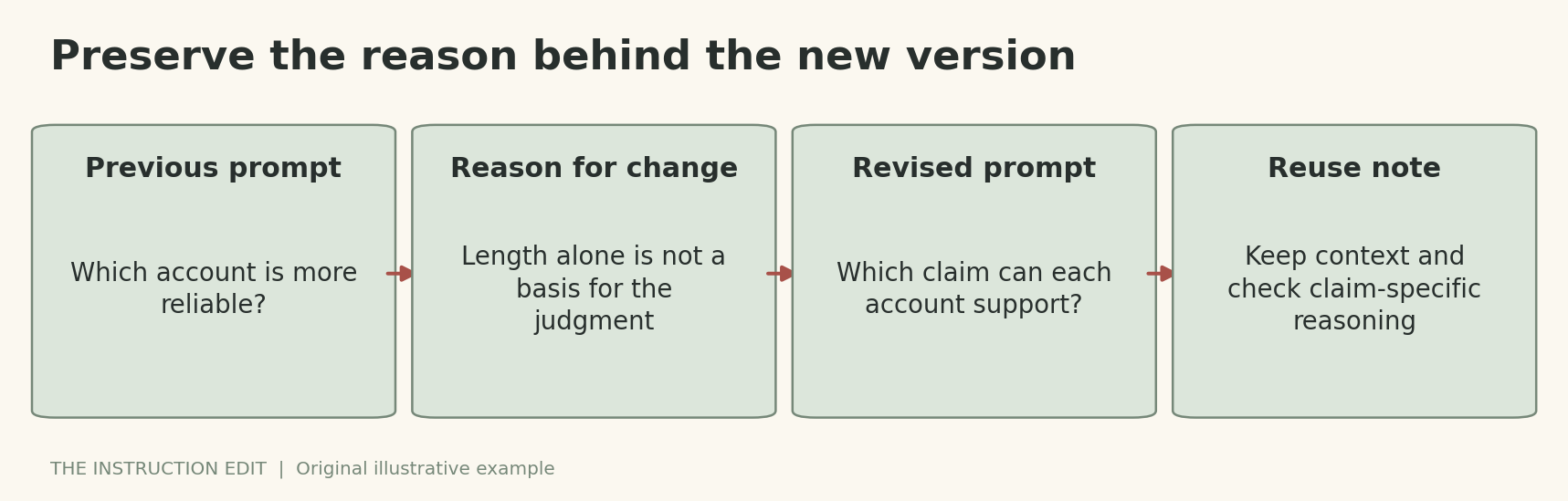
Imagine a fictional grade-seven history lesson about evaluating two accounts of the same event. The original question asked, “Which account is more reliable?” Learners often selected the longer account without explaining why its author’s position, purpose or evidence mattered.
The teacher changed the prompt to ask which claim each account could reasonably support and what additional evidence would help. That is a consequential revision. Next year’s teacher needs to know why the question became more specific, not just that a question moved from slide six to slide seven.
Illustrative reuse note. This example is invented, not a report of an observed class.
Field: Learning to preserve
Example note: Use authorship, purpose and evidence to judge what a historical account can support
Field: Material and version
Example note: Local lesson “Two accounts,” version dated 24 October; source excerpts kept with the lesson
Field: Change made
Example note: Replaced a general reliability ranking with a claim-specific comparison and a request for missing evidence
Field: Reason and evidence
Example note: Fictional responses in this example favored length; the new question is intended to expose the basis of a judgment
Field: Keep
Example note: Both source perspectives, the author context and the opportunity to explain a judgment
Field: Check before reuse
Example note: Source links, reading accessibility, prior knowledge of the event and the accuracy of the contextual notes
Field: Review trigger
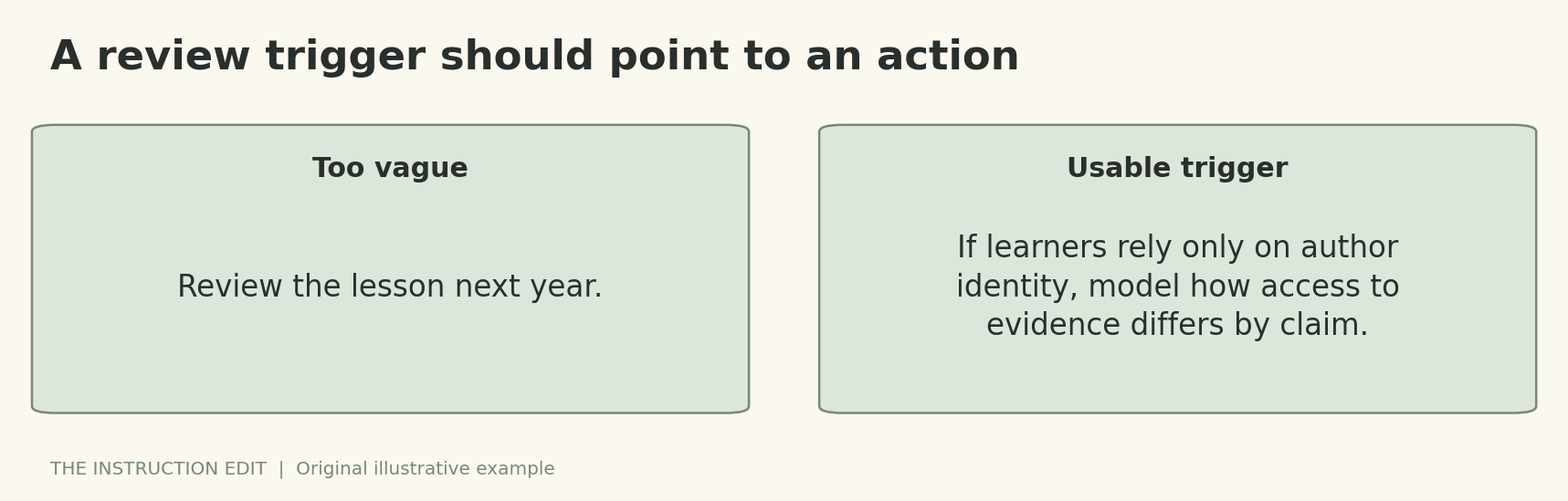
Example note: If learners still choose an account without connecting evidence to a claim, model one claim-specific comparison
The note makes the limitation explicit: the revised prompt has a purpose, but the example does not establish that it worked. In a real note, replace the fictional evidence with a brief, anonymized description of what you actually saw.
Separate what happened from what you think it means
Use two sentences when needed. “Eight responses chose account B because it was longer” describes an observation, assuming you counted it. “The task may have encouraged a superficial ranking” is an interpretation. Combining them into “students could not evaluate sources” makes a larger claim than the evidence supports.
Record conditions that might explain the result. Had learners already studied the event? Was one excerpt much harder to read? Did the class lose ten minutes to an interruption? You do not need a minute-by-minute record, but the most plausible competing explanation belongs in the note.
Avoid storing identifiable student work in a broadly shared lesson folder. Use an anonymized response pattern or a fabricated example clearly labeled as such. If actual work is needed for professional review, follow school policy for access and retention. The note should not become an accidental second student record system.
Make the review trigger actionable
“Review next year” does not say what to look for. A better trigger names a condition and a response: “If the first comparison relies only on author identity, model how an author can be well placed to observe one detail but poorly placed to know another.”
Other triggers might concern the materials themselves. A broken source link requires a replacement or an archived lawful copy. A changed curriculum goal requires checking the task’s fit. A new class with less background knowledge may need a short context-building step. These triggers prevent the note from treating every future problem as a reason to redesign the whole lesson.
Do not freeze a lesson because the note says “keep.” Preserve the purpose of a successful element, not necessarily its exact wording. “Keep competing perspectives” gives a future teacher room to improve accessibility while retaining the intellectual work.
Put the note where reuse begins
Store the note at the top of the lesson document or in a clearly named companion file in the same folder. Link to the canonical version rather than attaching several copies. A colleague should be able to tell which file is current and which source materials belong with it.
Use a simple convention such as lesson name, version date and note owner. If a team already has a versioning practice, follow it. Do not introduce an elaborate naming scheme that nobody will maintain. For collaborative materials, distinguish an agreed change from a personal adaptation and leave the shared original intact unless you have authority to revise it.
A note also needs retirement rules. When a source is unavailable or a task no longer matches the goal, mark it as needing review. If the lesson is replaced, point to the replacement. An obsolete note that looks current can be more troublesome than no note at all.
Keep the next note short enough to use
Begin with one recently revised lesson. Write five sentences: what learners should do, what changed, what evidence prompted it, what should stay, and what you will check next time. Add a link to the current material and a review trigger.
If the note becomes a second lesson plan, remove details that would not affect a future decision. The aim is a compact explanation that lets another teacher, including your future self, reuse the lesson intelligently. A saved file preserves the materials. A good note preserves the judgment behind them.
