
A lively activity can be valuable. Movement, conversation and a little competitive energy can give a lesson momentum. But visible activity does not tell you, by itself, whether learners are making sense of the intended idea.
The useful design question is what the activity makes learners think about, and what evidence of that thinking you can reasonably inspect. That question leaves room for enjoyable lessons. It also leaves room for learners who participate quietly, need time to formulate an answer or use a different response method.
Start with the concern without overstating the evidence
In Pew Research Center's April 2024 report, 47% of surveyed U.S. public K–12 teachers described students showing little or no interest in learning as a major classroom problem. The underlying survey included 2,531 teachers and ran in October and November 2023. These are teachers' reported perceptions, not direct measurements of every student's engagement and not evidence that a particular activity solves the problem. Classroom findings and methodology.
It is reasonable to take the concern seriously without turning it into a demand for constant visible enthusiasm. A learner can enjoy a task without learning the target idea. A learner can also find a task demanding or frustrating while doing important thinking. Enjoyment, participation, effort and learning may relate, but they should not be treated as interchangeable observations.
For practical planning, separate the invitation to participate from the evidence you need. A game might provide the invitation. An explanation, comparison or revision might provide evidence of the intended reasoning. The same activity can contain both if the design makes room for them.
Name the thinking before choosing the format
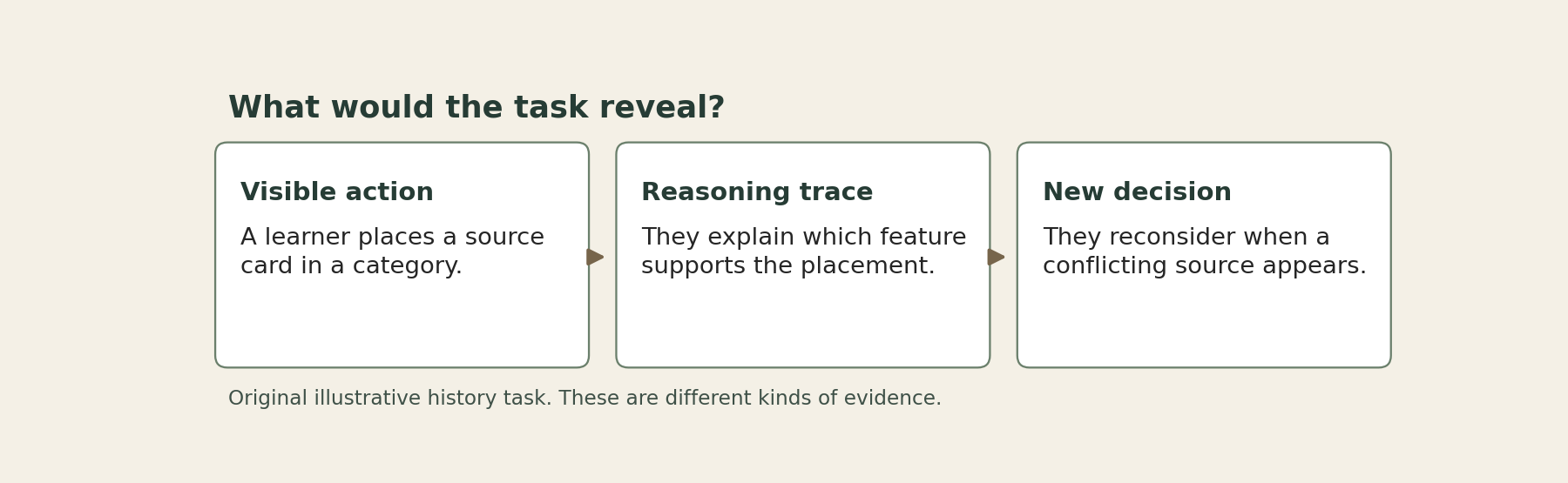
Imagine an illustrative history lesson in which learners evaluate two accounts of the same event. The goal is to explain why accounts can differ and support an interpretation with evidence. The teacher plans a card sort using short source extracts. Nothing about a card sort guarantees that the goal will be met.
Learners could sort by length, familiar vocabulary or the position of a card on the desk. They could follow the most confident group member. They could also make a careful judgment about perspective and evidence. From across the room, those actions may look remarkably similar.
Write the intended thinking in a sentence: “Learners will justify a source grouping using the author's position, the information available and a relevant detail from the account.” Now the task has something to reveal beyond completed piles of cards.
You may decide that identifying the author's position is too much to add before learners understand the event. In that case, teach the necessary context first or narrow the task. An activity cannot compensate for missing information simply by becoming more energetic.
Redesign one task without replacing the activity
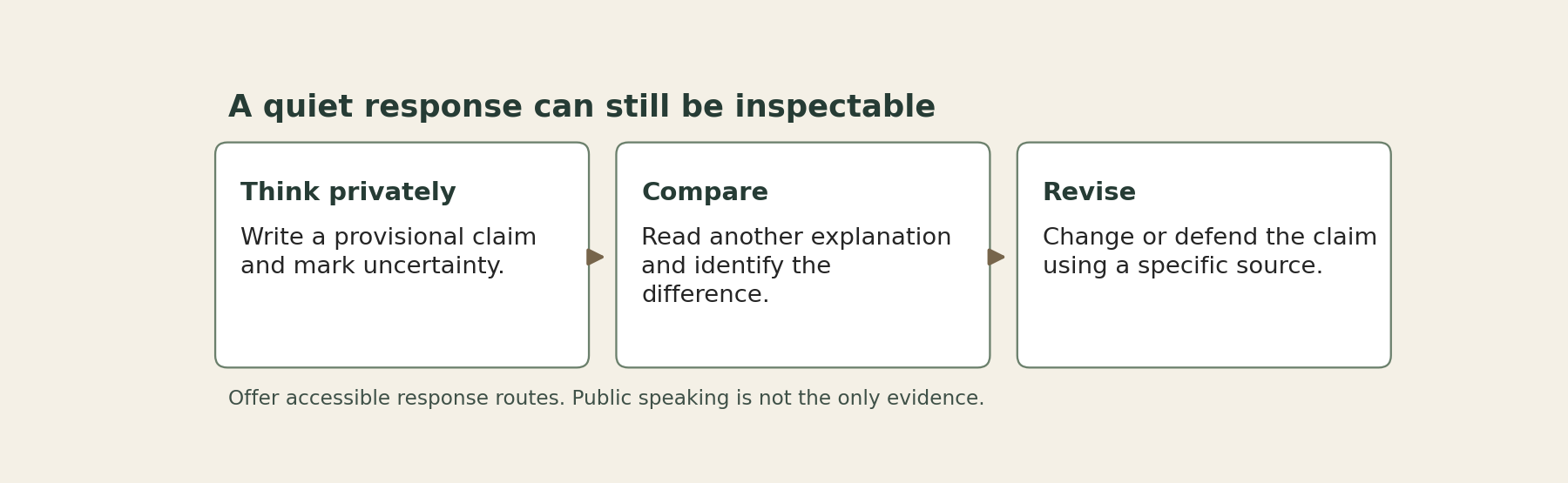
Keep the card sort. Change the requirement attached to one placement. Each learner first chooses a card and writes a provisional explanation. The group compares explanations, then records one disagreement it needs to resolve. After discussion, each learner revises or defends the original choice using a source detail.
This is an original design example, not a tested intervention. Its purpose is to show where individual reasoning becomes inspectable. It also gives the teacher a way to distinguish a misconception from a group simply running out of time.
What you can see: All cards are sorted
What it might indicate: The group completed the procedure
What to inspect next: Ask for the reason behind one placement
What you can see: Learners are talking
What it might indicate: Ideas may be circulating
What to inspect next: Listen for evidence and the question being discussed
What you can see: One learner is quiet
What it might indicate: Thinking, uncertainty or an access barrier may be present
What to inspect next: Offer a private written or supported response
What you can see: A learner changes an answer
What it might indicate: Revision may reflect reasoning or copying
What to inspect next: Ask what evidence changed the decision
What you can see: The group finishes quickly
What it might indicate: The task may be easy or rushed
What to inspect next: Introduce a conflicting source and inspect the response
The point is not to convert every moment into assessment. Choose a small number of responses that tell you something you can use. A teacher cannot read thirty full essays during a ten-minute activity. A short explanation attached to one consequential decision is more manageable.
Avoid making performance of enthusiasm the target
If participation marks reward frequent speaking, speed or visible excitement, learners may learn what kind of behavior receives attention without showing more understanding. Before judging an individual, consider whether the task gives them a usable route to contribute.
For the source task, a written response can precede group talk. A learner might use a response frame that names the source and the evidence. A partner can read an idea aloud with permission. The method should preserve the intended reasoning while reducing avoidable barriers.
Do not read a single behavior as a diagnosis. Looking away, moving or taking time to answer does not establish what a learner understands. Equally, a polished explanation does not settle whether understanding will persist or transfer. A later task may reveal something different.
Classroom observation still matters. If several groups are searching for the same missing instruction, that is useful design information. If the discussion repeatedly returns to an irrelevant surface feature, the prompt may need revision. Observe the relationship between the task and the response, rather than collecting impressions about who looks engaged.
Decide what you will do with the evidence
Before the activity begins, choose a likely next action. If explanations rely only on who wrote the longest account, model a comparison using relevance instead. If learners identify perspective but cannot connect it to a source detail, work through one example. If they reason well, introduce an account that complicates the initial interpretation.
These branches make the evidence worth collecting. Otherwise, the extra response can become another piece of paper that proves the activity happened.
After the lesson, keep one question for revision: did the task require the thinking the goal named? If not, change the decision learners must make or the explanation they must provide before replacing the entire format.
An engaging lesson need not look one particular way. What matters for instructional judgment is whether learners have a meaningful opportunity to think, whether they can participate and whether the resulting evidence helps you choose the next step.
Sources
Pew Research Center (2024), Challenges in the classroom. Teacher-reported classroom challenges.
Pew Research Center, Teacher survey methodology. Survey of 2,531 U.S. public K–12 teachers, October 17 to November 14, 2023.
